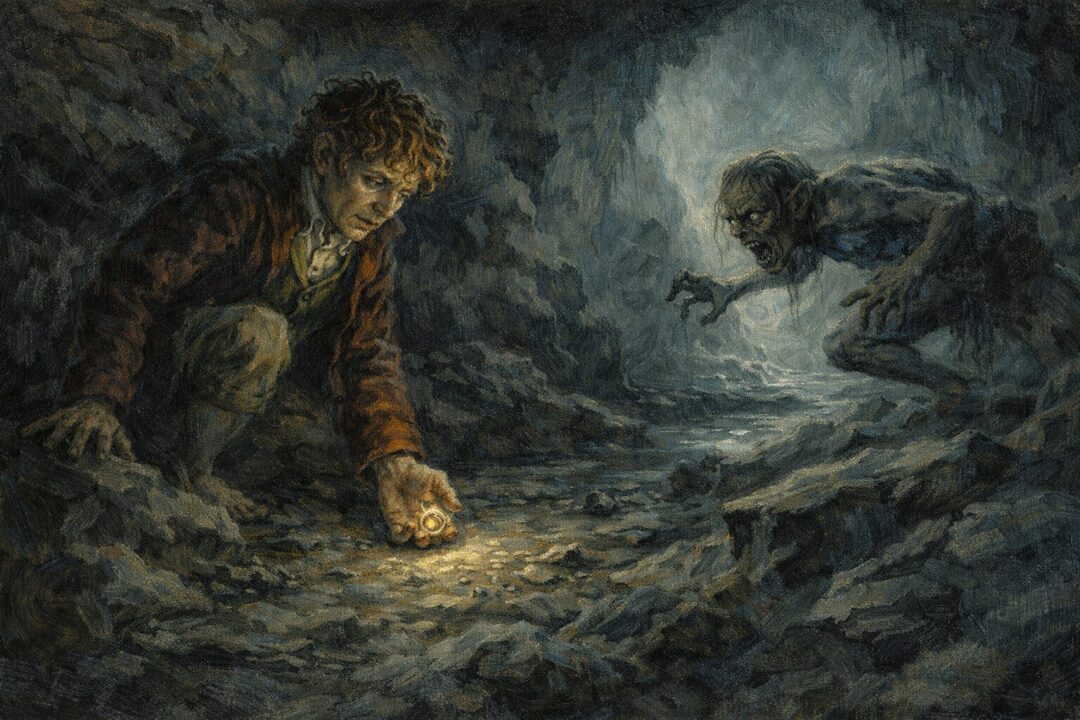
The corruption of Sméagol is one of the most disturbing arcs in The Lord of the Rings. Unlike kings who fall or warriors who are seduced by visions of glory, Sméagol is small, petty, and deeply ordinary. His fall begins not with ambition, but with desire—raw, immediate, and unexamined.
He does not seek power.
He does not imagine conquest.
He wants something beautiful, and he wants it now.
And that moment—when he murders Déagol beside the river—defines everything that follows.
Yet when we look closely at Sméagol’s long possession of the One Ring, something unexpected emerges. Something quietly unsettling.
Sméagol does not behave like other Ring-bearers.
From the moment he kills for it, the Ring owns him completely—but he does not seem to wield it.
The Language Tolkien Uses Matters
In The Hobbit, we are told that Gollum used the Ring to become invisible while hunting goblins and slipping through the tunnels beneath the Misty Mountains. This detail has shaped decades of assumptions. Most readers naturally imagine Sméagol wearing the Ring constantly, vanishing at will, living unseen.
But when the story continues into The Lord of the Rings, Tolkien’s language changes—subtly, but deliberately.
Gollum does not wear the Ring.
He keeps it.
He guards it.
He hides it.
On his island beneath the mountains, the Ring is not described as resting on his finger. It is concealed, hidden away in a secret place known only to him. When Bilbo Baggins encounters Gollum, the Ring is not in use. It is missing.
And that detail is crucial.
Gollum does not realize the Ring is gone because he suddenly becomes visible. He realizes it because he goes to check on it—and finds the hiding place empty.
If Sméagol wore the Ring habitually, its absence would be immediately obvious. Instead, he treats it like a treasure that must be periodically reassured of its presence. Something to be touched, counted, spoken to.
Not something to be used.

Possession Without Use
Sméagol’s relationship with the Ring is fundamentally different from that of later bearers.
Bilbo uses the Ring sparingly, reluctantly, and often with guilt. He puts it on when cornered, when frightened, when there seems to be no other way forward. Even then, the Ring never fully dominates his will.
Frodo Baggins, by contrast, wears the Ring only in moments of extreme danger—and each time, the cost is immediate and severe. His connection to the unseen world intensifies. The Eye grows nearer. His sense of self weakens.
Sméagol appears to have learned something earlier than either of them.
Wearing the Ring hurts.
It sharpens awareness in the unseen world.
It draws attention from powers far greater than its bearer.
It amplifies domination—and with it, pain, terror, and exposure.
For a creature already stretched thin by centuries of corruption, wearing the Ring may have been unbearable. Sméagol survives not by embracing the Ring’s power, but by retreating from it.
Instead of wielding it, he clings to it.
Instead of using it, he orbits it.

A Corruption of Proximity
This explains something that often puzzles readers: why Sméagol gains nothing from the Ring except misery.
He does not become a warlord.
He does not command others.
He does not inspire fear or loyalty.
He becomes smaller.
Meaner.
More suspicious.
More fractured.
The Ring does not elevate Sméagol—it erodes him.
Unlike Frodo, who bears the Ring openly and consciously resists it, Sméagol allows it to hollow him out in secrecy. There is no balance, no restraint, no moral framework left to resist with.
His mind splits because he has no distance from the Ring at all.
It is always near him.
Always spoken to.
Always loved.
The Ring becomes his entire inner world.
Why Sméagol Is Different From Other Bearers
Bilbo gives up the Ring, painfully but willingly. Frodo tries to destroy it, even knowing the cost may be his own life.
Sméagol cannot even imagine letting it go.
But this is not because he uses the Ring more than they do.
It is because he loves it more.
By not wearing the Ring, Sméagol avoids moments of confrontation—moments when the Ring would demand action, risk, or domination. Instead, he sinks into passive obsession. He does not act for the Ring.
He exists for it.
This is why his corruption feels so complete. It is not driven by ambition or purpose, but by dependency. Sméagol does not want to change the world.
He wants the world to shrink until it contains only himself and the Ring.
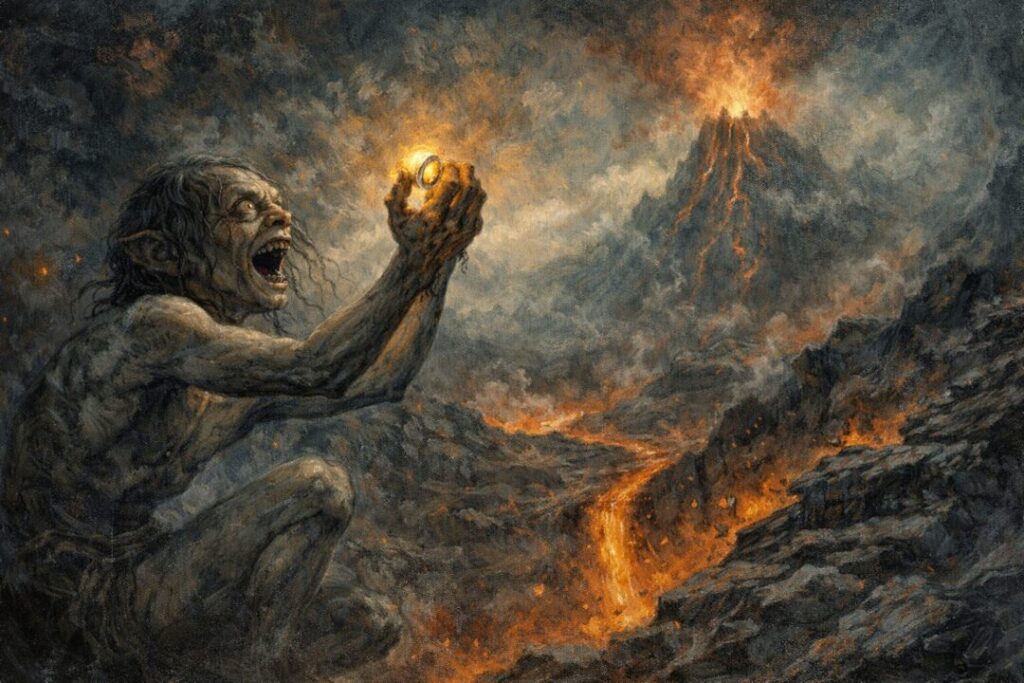
The Tragedy of Mount Doom
This is why Sméagol’s end at Mount Doom is so devastating.
When he finally touches the Ring again, it is not an act of power or conquest. It is not strategy or rebellion.
It is reunion.
For the first time in centuries, the Ring is not merely near him—it is his again. And that moment of ecstasy destroys him.
Sméagol does not fall because he claims the Ring. He falls because he cannot imagine a self without it.
The Ring does not kill him by force.
It lets him destroy himself.
What This Reveals About the Ring
The One Ring does not require use to corrupt.
It requires attachment.
Sméagol’s fate shows the most frightening truth about evil in Middle-earth: that it can destroy you quietly, patiently, without ever asking you to act.
You do not need to wield it.
You do not need to serve it openly.
You only need to hold it close—and refuse to let go.
Sméagol never needed to wear the Ring often.
Loving it was enough.
And in the end, that love consumed him completely.