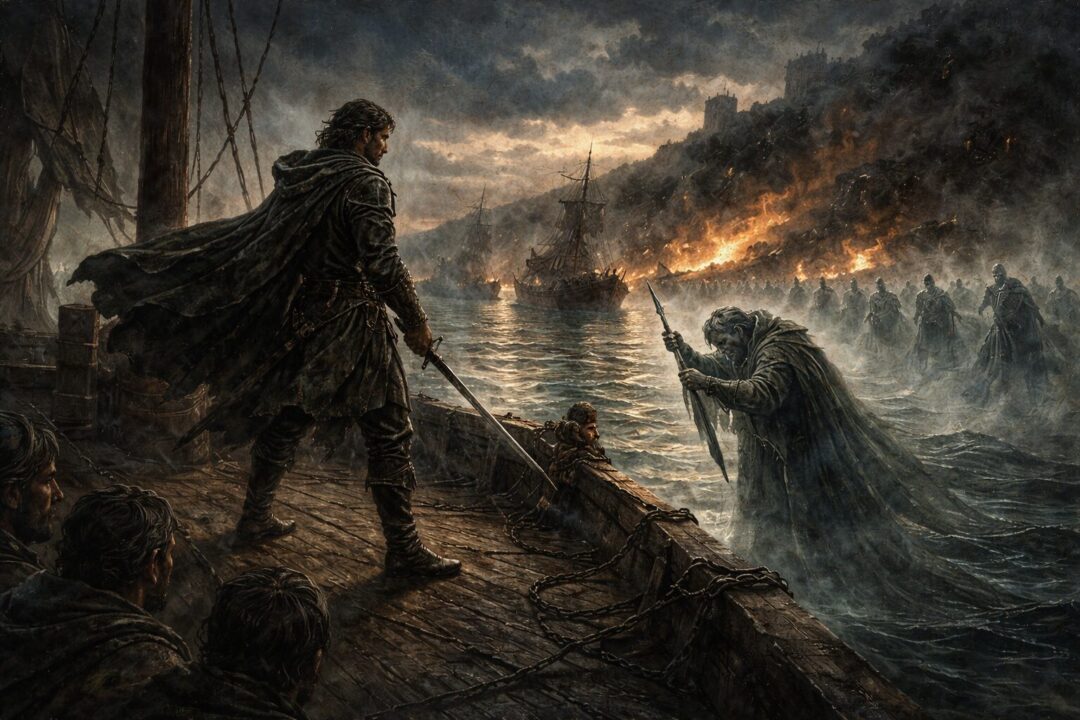
There is a version of the Pelennor that feels clean.
The horns of Rohan sound. The Witch-king falls. The City holds. And then a final power arrives—beyond steel, beyond courage—washing the remaining enemy away as if the battle’s outcome was always guaranteed.
It is satisfying.
It is also not the story the book tells.
In The Return of the King, the Dead do not fight on the Pelennor Fields.
They never set foot there.
And once you notice that, the entire moral shape of the battle changes.
Because Tolkien’s Dead are not written as a victory button.
They are written as a debt.
What the Dead are—and what they are not
The Dead that Aragorn summons are oathbreakers: men who once swore allegiance to Isildur and did not keep it. They remain trapped, unable to find rest, until their oath is finally answered.
The important point is not their power, but their bind.
They are not an ally gained through persuasion. They are not troops rallied by hope. They are a consequence that has endured for generations.
That is why their presence feels wrong—why even brave companions dread the road that leads to them.
And it is why Tolkien is careful with how they are used.
The Dead are terrifying, but their terror has a narrow purpose: to compel a fulfillment that should have happened long ago.
Where the book places their “battle”
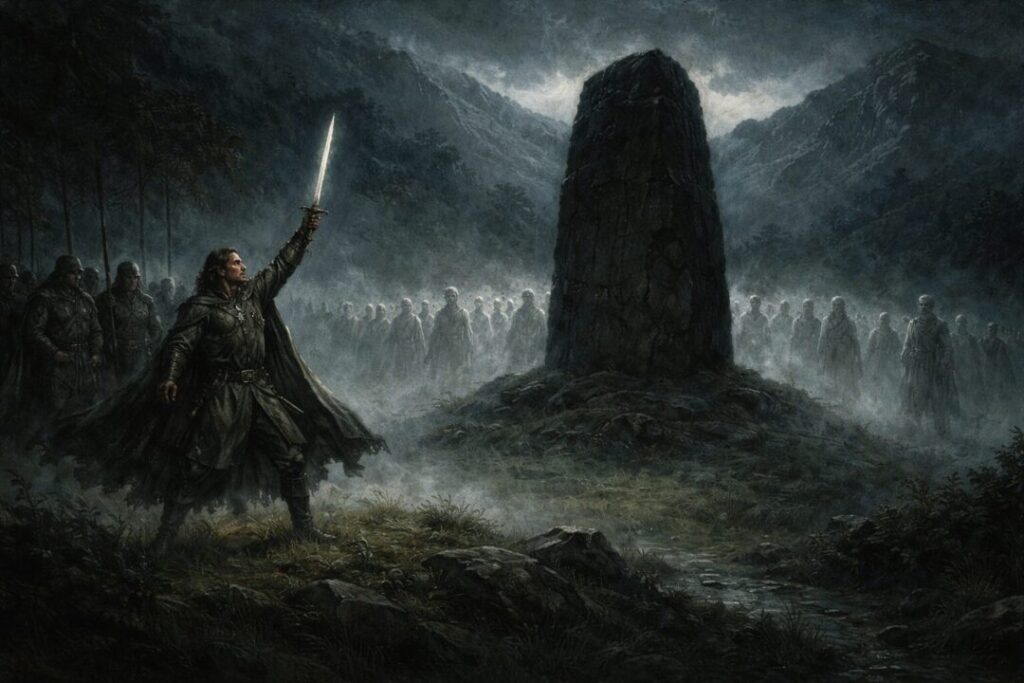
When Gimli finally describes the Paths of the Dead, the narrative doesn’t rush to Minas Tirith.
It runs south.
Out of the haunted mountains, to the Stone of Erech, and then in a relentless ride “to Pelargir on Anduin.”
This is where the oath becomes practical.
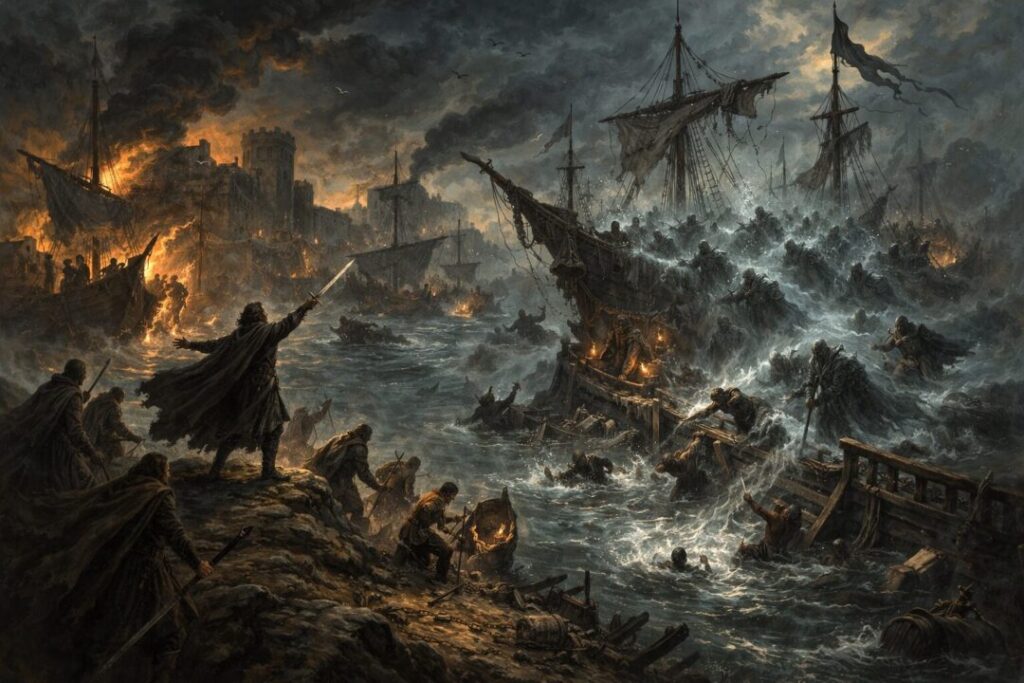
Pelargir matters because it is the river-gate. It is the place where the Corsairs of Umbar gather their fleet—ships meant to move upriver and tighten the noose around Minas Tirith.
If those ships sail unopposed, Gondor’s defense is not merely pressured.
It is strangled.
So Tolkien puts the Dead where they can sever that threat at the root.
At Pelargir, Aragorn calls them openly: “Now come! By the Black Stone I call you!”
And the Shadow Host surges “like a grey tide,” breaking the Corsairs without needing to prove whether ghostly blades can bite.
That line matters: “the Dead needed no longer any weapon but fear.”
Fear is their instrument.
Not conquest.
Not slaughter.
They are a pressure applied to a single hinge in the war.
The moment most people miss: Aragorn releases them
After the fleet is taken, the story could easily do what many expect.
Aragorn could keep them.
He could carry that unstoppable dread north to the Pelennor and end the battle with less cost, less grief, less blood.
Tolkien does not let him.
Instead Aragorn stands on the captured ships, and he speaks—not as a desperate captain clinging to any advantage, but as the Heir of Isildur settling an old account:
“Your oath is fulfilled. Go back and trouble not the valleys ever again! Depart and be at rest!”
Then the King of the Dead breaks his spear, bows, and the host vanishes “like a mist.”
This is the key to the whole question.
If you want the book’s answer to “Did the Dead fight at Pelennor?” it is here:
They are gone before the ships ever reach the battle.
Who, then, arrives at Pelennor?
Living men.
That is the quiet reversal Tolkien builds.
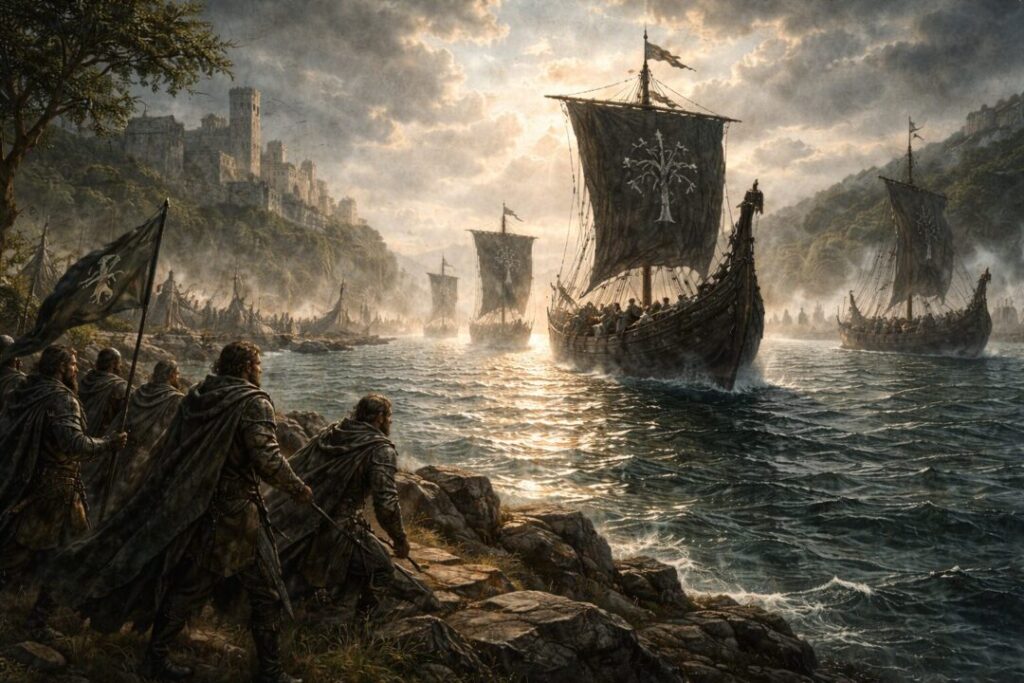
After the Dead withdraw, the text turns immediately to what comes next: captives freed, slaves released, and then “a great gathering of men” from the southern fiefs—now unafraid, now able to act.
They prepare the ships. They man the oars. They sail upriver.
And when the fleet finally appears at the Harlond, the victory shock is not caused by the Dead pouring onto the fields.
It is caused by a standard—Aragorn’s standard—unfurled in daylight as the ships arrive in the “third hour of the morning with a fair wind and the Sun unveiled.”
In other words:
The fleet is not a ghost-weapon.
It is a human reinforcement—won by fear, yes, but carried by living hands.
Why Tolkien does it this way
If the Dead could have ended Pelennor, why remove them?
The book never gives a single sentence that reads, “Here is the author’s reason.”
But the structure of the narrative gives you something stronger than a commentary: it shows you what kind of victory Tolkien is willing to portray as meaningful.
1) Pelennor is meant to cost something
The Pelennor is not a battle Tolkien writes as a spectacle only.
It is a calamity endured.
The Rohirrim’s ride matters because it is not safe. The fall of Théoden matters because it is not prevented. The terror of the Nazgûl matters because it is not erased by an easy counterforce.
If the Dead sweep the field, the battle becomes a demonstration.
If living soldiers win it—at terrible price—it becomes a choice.
And choice is where Tolkien puts moral weight.
2) The Dead are about oaths, not domination
At Pelargir, the Dead fulfill the exact thing they failed to do in life: answer the call of Isildur’s heir.
Once that is done, keeping them would twist the story’s meaning.
Aragorn does not “use” the Dead as a permanent tool.
He ends the curse.
He closes the account.
And he does it with words that deliberately limit their future presence: “trouble not the valleys ever again.”
That is kingship as restraint.
Not kingship as limitless power.
3) The turning point becomes human—and therefore fragile
When the black ships appear, they break the morale of Mordor’s forces and the despair inside Minas Tirith.
But the ships are not full of the Dead.
They are full of men who could have been absent.
Men who only arrive because the southern coast is cleared, because prisoners are freed, because the river is taken.
It is a chain of contingent events, not a guaranteed miracle.
That fragility is part of what makes the “turn” feel real.
It is hope born at the edge of failure, not certainty dropped from above.
Why it matters for how you read Aragorn
This difference also changes the feel of Aragorn’s arrival.
If he comes with an invincible host, he looks like a conqueror.
If he comes having released the only unstoppable force he had, he looks like something else: a man choosing limits when he could choose ease.
The text even lets us see, through Legolas, what Aragorn could become if he pursued power: “how great and terrible a Lord he might have become… had he taken the Ring to himself.”
Tolkien places that reflection right beside the Pelargir victory.
It is not accidental.
Aragorn wins with fear, and then refuses to rule by fear.
He uses the Dead to break a specific threat—and then he ends their haunting.
That is why the Dead not fighting at Pelennor matters.
It keeps the Pelennor as a battle decided by courage, endurance, sacrifice, and timely reinforcements—not by an unanswerable force.
And it makes Aragorn’s kingship look less like a right to command everything…
…and more like the ability to stop, even when victory tempts you to keep going.
If you’ve only ever pictured the Dead on the Pelennor, the book’s version can feel smaller.
But it is not smaller.
It is sharper.
Because Tolkien’s story does not ask, “What if you had an army that cannot be killed?”
It asks something harder:
What kind of person would you be if you did—and chose to let it go?