The Bridge of Khazad-dûm is often remembered as a moment of spectacle.
A narrow bridge.
A shadow and flame.
An old wizard standing alone.
A cry that seems to stop the darkness itself.
But beneath the drama of that scene is a quieter and stranger question:
Did the Balrog know who Gandalf really was?
Not just that Gandalf was dangerous. Not just that he was a wizard. But that behind the grey cloak and bent body stood a being far older than Men, Dwarves, or Hobbits.
Did Durin’s Bane recognize him?
The safest answer is also the most interesting one: the texts never say directly.
But they give us enough to see that the Balrog almost certainly knew Gandalf was not merely an old man.
What it knew beyond that is where the mystery begins.
Gandalf Was Not Simply a Wizard
To understand the encounter, we have to begin with what Gandalf actually was.
In Middle-earth, “wizard” does not mean a mortal magician who learned spells from books. The Wizards, or Istari, were beings sent into Middle-earth in the Third Age to oppose Sauron. Gandalf’s name in the West was Olórin, and he belonged to the order of the Maiar.
That matters because the Maiar were not ordinary creatures. They were spiritual beings of great age and power, though the Istari came to Middle-earth in the form of old men and were limited by that form.
Gandalf’s grey body was real. His weariness was real. His fear, patience, anger, and pity were real.
But he was not only what he appeared to be.
This is why the Bridge of Khazad-dûm feels different from any ordinary fight. Gandalf is not simply a brave companion buying time for the Fellowship. He is a hidden power stepping forward at the one moment when no one else can.
The Balrog is not meeting a traveller.
It is meeting something veiled.
The Balrog Was Ancient Too
Durin’s Bane was not merely a large monster lurking under the mountains.
It was a Balrog of Morgoth.
That places it in a very old category of evil. Balrogs belonged to the terrors of the First Age, servants of the first Dark Lord, Morgoth. They were associated with fire, shadow, and ruin long before Sauron became the chief enemy of the age.
Durin’s Bane had hidden beneath the Misty Mountains. The Dwarves of Khazad-dûm awakened it when they delved too deeply, and it slew Durin VI. The Dwarves later remembered it by the name Durin’s Bane, because they did not know its older name—if it had one that survived in memory.
This means the being that came to the bridge was no servant newly bred in Mordor.
It was a survivor of an older darkness.
And that makes its meeting with Gandalf more than a clash between good and evil in the Third Age. It is a sudden reappearance of the ancient war beneath the surface of the War of the Ring.
Moria becomes, for a moment, a place where the old world breaks through.
The First Recognition Comes Before the Bridge
Before the Fellowship sees the Balrog clearly, Gandalf has already felt something terrible.
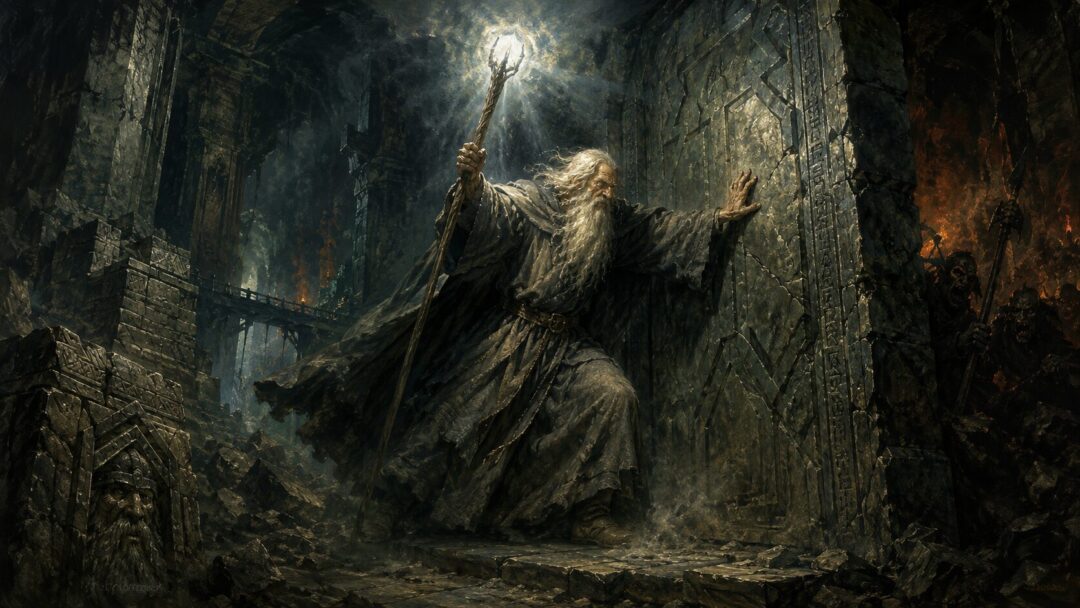
At the Chamber of Mazarbul, Gandalf tries to hold a door against the enemies outside. Something comes to the other side and contests him. He later says that he was nearly broken by the strain.
This is important because the first contact between Gandalf and the Balrog is not physical.
It is a contest of power.
Gandalf does not yet say, with certainty, “This is a Balrog.” But he knows he has encountered something far beyond Orcs or Trolls. The force opposing him is intelligent enough, or at least powerful enough, to perceive his spell and challenge it.
That moment suggests recognition on both sides, though not necessarily full identification.
Gandalf feels the presence of something dreadful.
The Balrog perceives Gandalf’s resistance.
Neither is simply guessing anymore.
By the time they reach the bridge, the Balrog has already met the hidden strength behind the old man.
Gandalf’s Words Are a Declaration
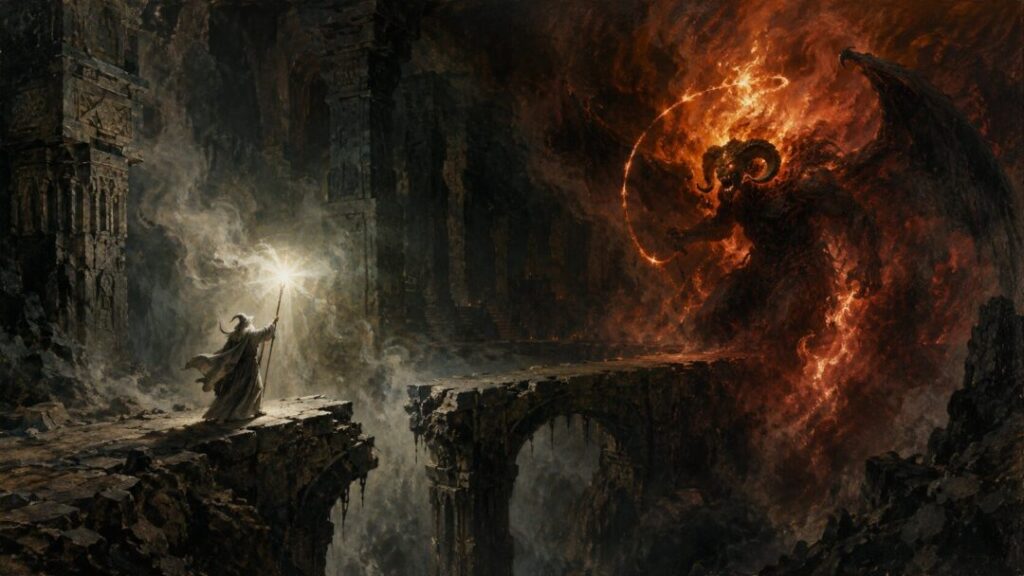
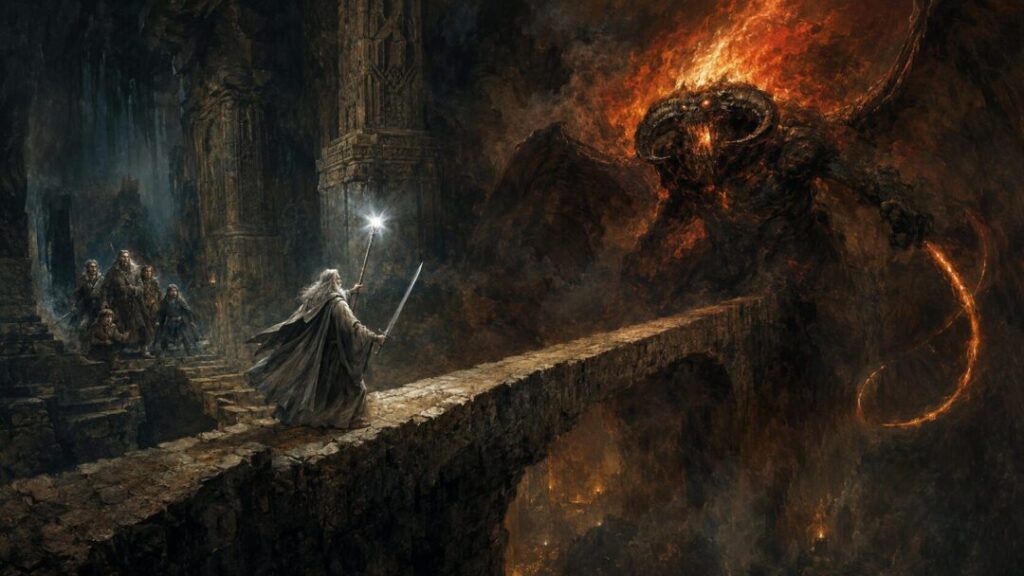
When Gandalf stands on the bridge, he does something very deliberate.
He names himself.
Not as “Gandalf the Grey.”
Not as “Mithrandir.”
Not as a member of the Fellowship.
He says:
“I am a servant of the Secret Fire, wielder of the flame of Anor.”
Then he names the Balrog:
“The dark fire will not avail you, flame of Udûn.”
This is not casual speech.
Gandalf is drawing a line between two kinds of fire.
The Balrog’s fire is linked with Udûn, a name associated with the ancient stronghold of Morgoth. Gandalf’s authority is linked with the Secret Fire and the flame of Anor. The exact meaning of “flame of Anor” is not explained in the scene, and readers have interpreted it in more than one way. But within the passage, its purpose is clear enough: Gandalf is opposing the Balrog’s dark fire with a higher allegiance.
He is not boasting.
He is revealing enough of himself for the Balrog to understand that this is no ordinary enemy.
The bridge becomes a place of identification.
Gandalf says, in effect: I know what you are, and I stand against you by a power you cannot claim.
Did the Balrog Know the Name Olórin?
This is where the answer must become careful.
The texts do not tell us that the Balrog knew Gandalf’s true name. They do not say it recognized him as Olórin. They do not show any exchange of hidden names. They do not tell us what the Balrog thought.
In fact, the Balrog does not speak.
That silence prevents us from claiming too much.
It is possible, as interpretation, that the Balrog recognized Gandalf as a Maia or at least as a being of similar spiritual order. Both Gandalf and Balrogs belong to the deep, ancient side of the world’s history. The Balrog had already perceived Gandalf’s power at the door. Gandalf’s declaration on the bridge would only make the matter clearer.
But “possible” is not the same as proven.
We cannot say with certainty that Durin’s Bane thought, “This is Olórin of the Maiar, sent by the Valar.”
That would go beyond the text.
What we can say is more restrained and more powerful:
The Balrog knew it was facing a power that could challenge it.
And after Gandalf spoke, it had reason to understand that this power stood in direct opposition to the darkness from which the Balrog came.
Why the Balrog Still Advanced
If the Balrog recognized Gandalf as something more than a man, why did it keep coming?
The answer may be simple: recognition does not mean fear.
The Balrog was itself a terror of the ancient world. It had destroyed the power of Khazad-dûm. It had survived hidden beneath the mountains. It was not a beast startled by a bright light. It was a being of ruin, shadow, and flame.
It may have understood that Gandalf was dangerous and still believed it could overcome him.
That confidence is not unreasonable.
Gandalf the Grey was embodied, limited, and weary. He had spent himself guiding the Fellowship through Moria. He had already been strained by the contest at the door. The Balrog had the advantage of terror, force, and the deep places of its own domain.
And even Gandalf’s victory was not easy.
He did not simply destroy the Balrog on the bridge. He broke the bridge beneath it. The Balrog fell, but its whip caught him and dragged him down. Their battle continued through abyss, stair, and mountain peak, ending only after a terrible struggle in which both Gandalf the Grey and Durin’s Bane died.
That matters.
The Balrog was wrong to think it could pass.
But it was not facing an easy defeat.
The Battle Reveals What the Bridge Conceals
The bridge scene shows Gandalf unveiling authority.
The later battle shows the cost of that authority.
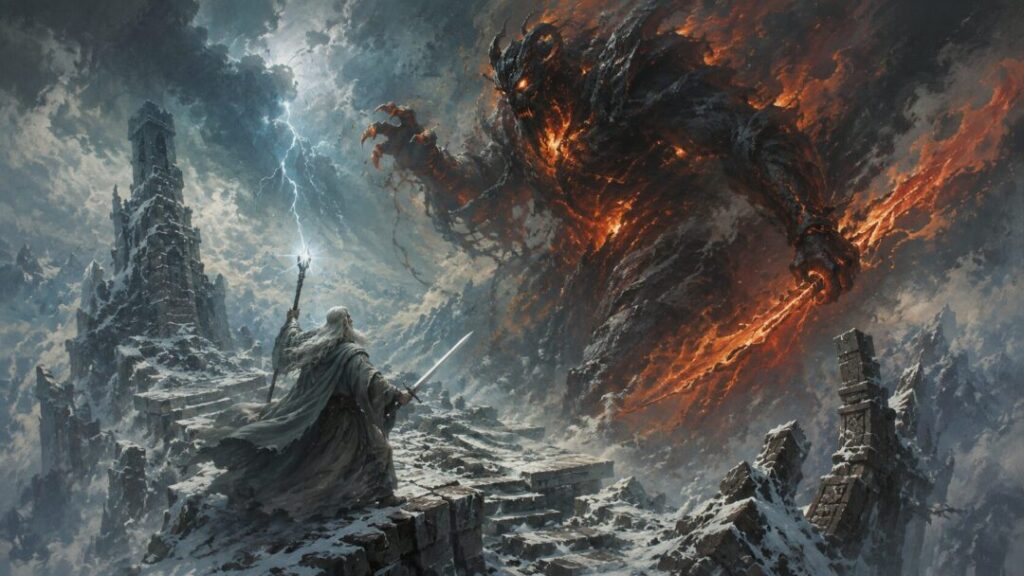
After the fall, Gandalf pursues and fights the Balrog from the depths beneath Moria up the Endless Stair to the peak of Zirakzigil. There, on the mountain, the struggle becomes so great that those far away see storm, lightning, and fire upon the heights.
This is the answer the bridge only begins to suggest.
Gandalf was not pretending.
When he stood before the Balrog, he truly was the one member of the Fellowship who could meet that enemy. Aragorn, Boromir, Legolas, Gimli, and the Hobbits all had courage. But courage alone could not hold that bridge.
Gandalf could.
Not because he was physically stronger than all the others, but because his nature and authority belonged to a deeper order.
The Balrog may not have known every hidden detail of Gandalf’s identity.
But by the end, it knew what it had met.
The Silence Is the Point
The most striking thing about the Balrog is not what it says.
It is that it says nothing.
There is no taunt.
No exchange of ancient names.
No villain’s confession.
No explanation of what it understands.
This silence keeps the scene from becoming a simple duel of exposition. The Balrog remains terrible because it is not fully opened to us. We see its shadow, its fire, its sword, its whip, and its will to pass. But we are not invited into its mind.
That restraint makes Gandalf’s words stand out even more.
Only Gandalf speaks.
Only Gandalf defines the confrontation.
The Balrog answers by advancing.
And in that wordless response, the mystery remains intact. It may know much. It may know only enough. But either way, it chooses to test the old man on the bridge.
That is its fatal mistake.
So, Did It Know?
The most lore-accurate answer is this:
The Balrog almost certainly knew Gandalf was no ordinary old man. It had already encountered his power, and Gandalf’s words on the bridge openly declared an authority opposed to the Balrog’s darkness.
It may have recognized him as a being of the same ancient order.
It may have understood that behind the grey form stood something veiled, powerful, and dangerous.
But the texts never confirm that it knew Gandalf’s true name, history as Olórin, or full mission as one of the Istari.
So the answer is not a simple yes or no.
The Balrog knew enough to be warned.
It did not know enough to turn back.
And perhaps that is the real tragedy of the scene for Durin’s Bane. It saw an old man, felt a hidden power, heard a declaration of fire and authority, and still believed the bridge could be crossed.
But Gandalf had not stepped there merely as a wizard.
He stood there as a servant of a higher fire.
And the Balrog learned the difference only when the stone broke beneath its feet.
Sources & Notes
- J.R.R. Tolkien, The Lord of the Rings, Book II, Chapter 5, “The Bridge of Khazad-dûm” — Gandalf’s contest at the door, his words on the bridge, and the Balrog’s fire, shadow, sword, and whip.
- J.R.R. Tolkien, The Lord of the Rings, Book III, Chapter 5, “The White Rider” — Gandalf’s account of the pursuit and battle with the Balrog from Moria’s depths to Zirakzigil.
- J.R.R. Tolkien, The Silmarillion, “Valaquenta” — identifies Olórin among the Maiar and describes the Balrogs as spirits of fire who followed Morgoth.
- J.R.R. Tolkien, Unfinished Tales, “The Istari” — explains the Wizards as emissaries sent in embodied form to Middle-earth, clarifying Gandalf’s veiled nature.
- J.R.R. Tolkien, The Lord of the Rings, Appendix A, “Durin’s Folk” — gives the Third Age history of Durin’s Bane and the fall of Khazad-dûm after the Dwarves delved too deep.