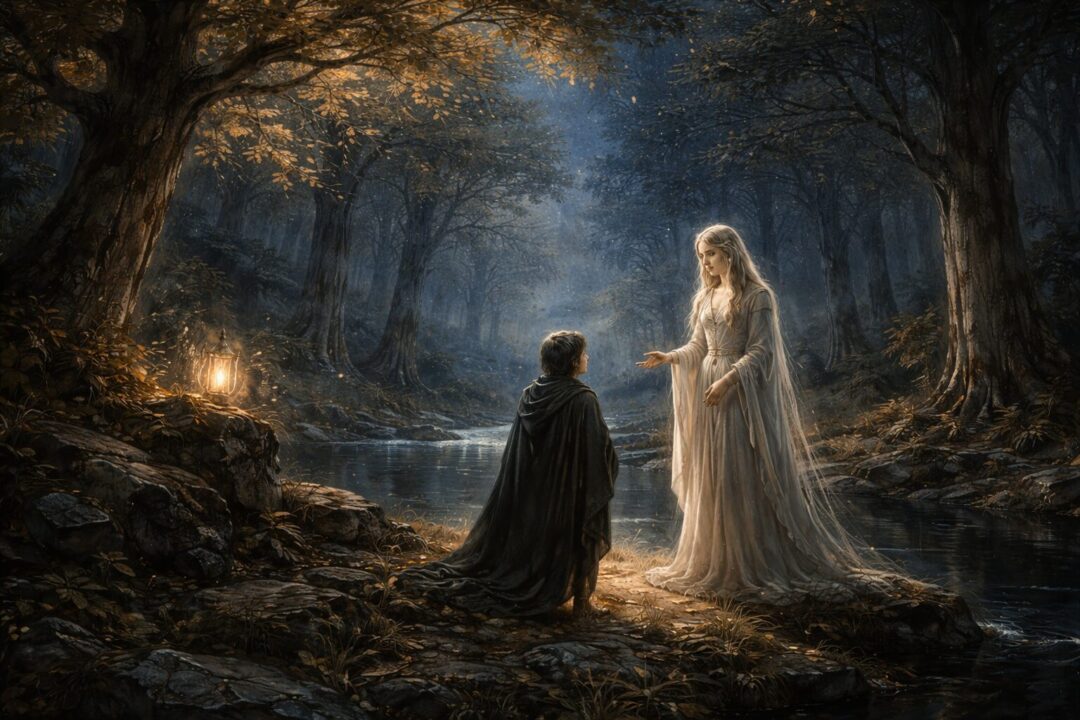
The Three Elven Rings are easy to misunderstand because they sit so close to the edge of contradiction.
They are the purest of the Rings of Power, and yet they are not free.
They were made by Celebrimbor, not by Sauron’s hand. They are never treated like the Nine, which enslave, or the Seven, which inflame desire. They are associated instead with preservation, healing, endurance, memory, resistance to decay.
And because of that, many readers come away with an assumption that feels natural enough: when the One Ring was destroyed, perhaps the Three could go on.
After all, if Sauron never touched them, why should they perish with his master-ring?
But the texts are more exact than that.
They do not present the Three as independent artifacts accidentally resembling the others. They present them as Rings still bound to the same system of power. Sauron did not forge them, and his corruption was not directly upon them, but they were still made according to the craft he had taught. That is why, when he first put on the One, the Elves at once perceived his purpose and removed their Rings.
So the Three were unsullied.
But they were not autonomous.
That distinction is the whole question.
If you want the clearest statement of what was at stake, you do not begin at Mount Doom.
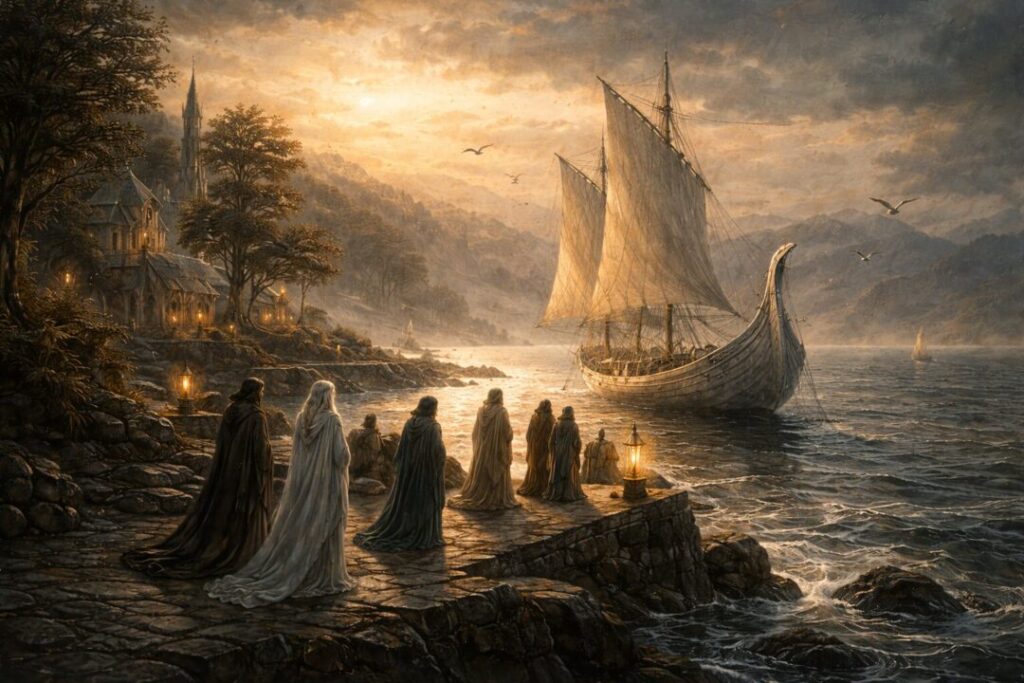
You begin in Lórien.
There Galadriel says something that quietly answers more than readers often notice. She tells Frodo that if he fails, the Elves are laid bare to the Enemy. Yet if he succeeds, “our power is diminished, and Lothlórien will fade, and the tides of Time will sweep it away.”
That line matters because it rules out one comforting reading at once.
The destruction of the One would not leave the Three untouched in practical effect. Victory itself means diminishment. Lórien does not continue indefinitely as it was. Its preserved quality—its suspension against ordinary wearing time—cannot survive the fall of the Ruling Ring.
Already the shape of the answer is visible.
The Three still “work” only within a world in which the One exists, even if lost.
That sounds backwards at first. But it fits the history of the Rings exactly. The Elves could use the Three only because Sauron had lost the One. So long as he held it openly, they could not safely wield their own. Yet the Three remained linked to that greater structure. Once the One was unmade altogether, the underlying order that sustained them also came to an end.
This is why the Three are tragic objects, not merely blessed ones.
They preserve beauty in a marred world, but not permanently. Their preservation was always conditional.
And the texts never hide that from us for long.
The next step is where readers often press harder: yes, their power was doomed—but did it end instantly?
Here the answer becomes more careful.
The texts do not give a stopwatch.
They do not say: the One was destroyed at this hour, and the Three ceased entirely at that same instant in a measurable mechanical sense. There is no passage that lays out a timed interval for their remaining active power. No canon text says they continued fully for weeks, nor that they vanished as nothing in the same heartbeat.

What the texts do give is a pattern of language: diminished, fading, passing, ending.
That pattern is important. It suggests not continued strength, but the withdrawal of a sustaining power from the world. In other words, Tolkien does not frame this like a lamp switched off in a room. He frames it like the ending of an enchantment that had long been holding back change.
That is exactly how Lórien and Rivendell should be thought of.
Their beauty is not said to collapse into ruin overnight. But neither are we invited to imagine that their Rings remained fully operative for some extended second life after the One was gone. The safer reading is that the power of preservation was broken with the destruction of the One, and what followed was the beginning of ordinary time reclaiming what had long been sheltered from it.
That difference matters.
Because “the Three still worked for a while” is stronger than the texts say.
“The realms they had preserved did not physically alter in a single instant” is much safer.
Those are not the same claim.
You can see the same restraint in the ending of the book.
The Keepers do not sail immediately on the day Sauron falls. The last riding of the Ring-bearers comes later. There is a stretch of time between the destruction of the One in March 3019 and the departure from the Grey Havens in September 3021.
That gap tempts some readers into imagining that the Three must have remained effective all through it.
But the texts do not actually require that conclusion.
A delayed departure is not proof of unchanged Ring-power. It proves only that the Keepers remained in Middle-earth for a time before leaving it. The emotional meaning of that interval may be farewell, ordering, transition, the slow acceptance of loss. Appendix B does not present it as a period in which the old Elven preservative power simply continued as before. On the contrary, the appendix marks the end of the age in relation to the ending of the Three.
So the gap is real.
But it should not be overread.
This is one of those places where the lore becomes clearer when phrased negatively. Tolkien never explicitly confirms a post-Mount-Doom season in which the Three continued to function with their former virtue. What he does confirm is that their age is ending, their preserving power is bound up with the fate of the One, and the departure of the Keepers belongs to that same unwinding.
That is why Galadriel’s earlier words matter so much. They interpret the event before it happens.

Success will save Middle-earth from Sauron.
It will also end the Elves’ ability to hold back the weariness of time in the way they had done.
And that helps explain a larger sadness in the ending of The Lord of the Rings that can be missed when readers focus only on victory.
The destruction of the One is not simply liberation.
It is renunciation.
The Elves do not merely defeat a Dark Lord and keep their fairest works. They consent, in effect, to the loss of the conditions that allowed their hidden realms to remain what they were. The defeat of evil and the fading of the Elder Days arrive together.
This is why the Three are never just magical tools in the ordinary fantasy sense.
They are bound up with memory itself. With conservation. With resistance against loss. With the wish to keep unstained things unstained. And in Middle-earth, even the noblest version of that power cannot endure forever within history.
So did the Three still work after the One was destroyed?
The most careful answer is: not in any full continuing sense that the texts clearly affirm.
Their power is presented as ended in principle with the unmaking of the One, and the realms sustained by them begin to pass into fading rather than preserved continuance. If there is any brief residual after-effect, Tolkien does not define it as an extended period of ongoing Ring-rule. The texts support diminishment and ending far more strongly than they support continued operation.
And for how long?
Canon gives no exact duration.
That is not a gap to be filled with certainty. It is part of the tone of the ending. We are meant to feel that the old world does not explode or collapse in spectacle. It recedes. The power goes out of it. The keepers remain for a while, but the age is already over in essence.
That is why the last mention of the Three carries so much weight.
They do not fall in battle. They do not shatter in some visible catastrophe. They pass out of the history of Middle-earth with their bearers, and with them goes the last great effort to preserve an older beauty against the mortal flow of time.
If you ask whether the Three survived the One, the truest answer is only barely—and not as powers that could still hold the world unchanged.
They survived long enough for us to understand what was being lost.
And then they ended with it.