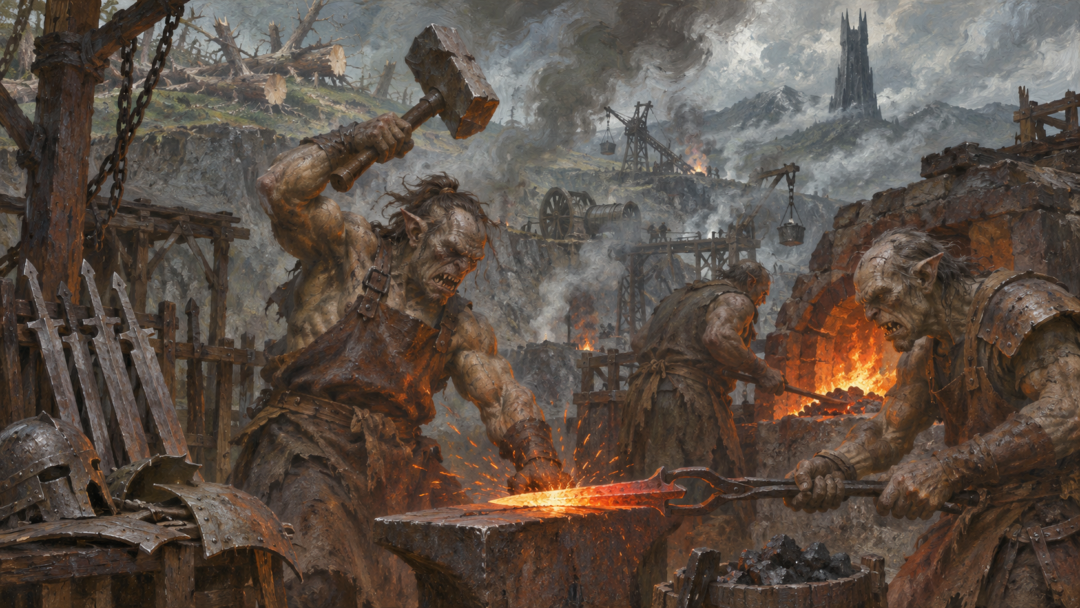
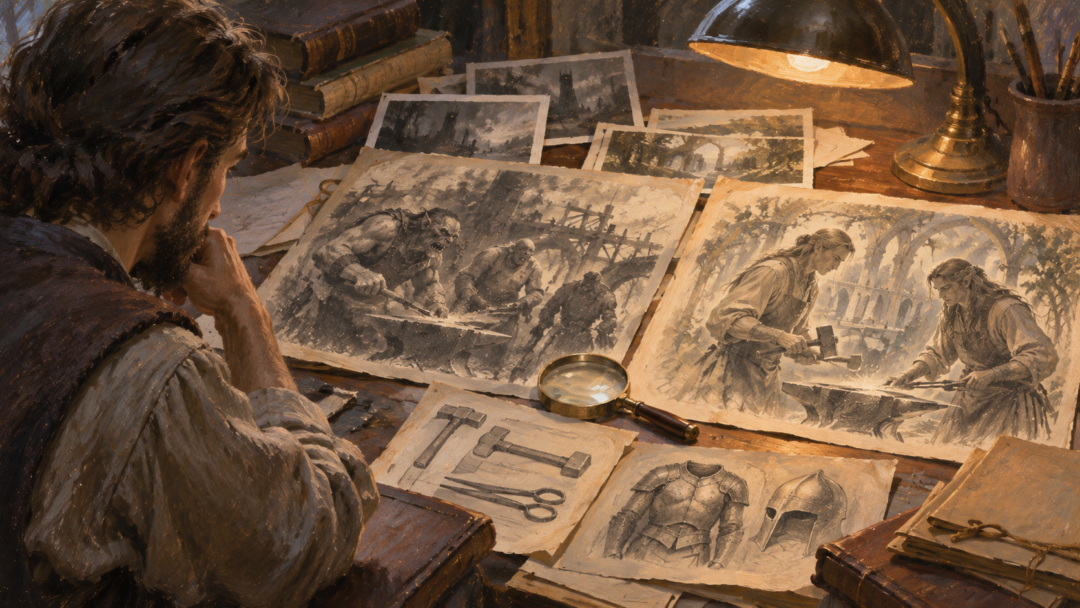
Beneath Orthanc, Saruman’s war machine comes to life in fire and smoke. Trees disappear, furnaces blaze, and Orcs hammer metal in Isengard. The workers look at home with their tools. There is a reason that might be so: the people identified as those Orc blacksmiths were also credited for real metalwork at Weta Workshop.
This is more than a nice-sounding behind-the-scenes rumour. A cast listing supplies three names, and production-era records independently identify all three as Weta craftspeople. That combination gives the story unusually strong support for a small, uncredited appearance. There is still a distinction worth keeping: the records establish who the named craftspeople were, but they do not provide a firsthand account of how each Isengard shot was cast or filmed.
Three names in the smoke
In The Fellowship of the Ring, Saruman’s transformation is told through the landscape as well as dialogue. His retreat becomes a vast industrial excavation. Where trees stood, smoke and flames rise. The underground workings show an army being equipped, not merely summoned. Hammering and forging give it a frightening sense of organisation.
The Orc smiths work in the background, creating the impression that Isengard can turn raw materials into instruments of conquest. Easy to overlook, their casting is surprisingly interesting. Behind the creature makeup are people rarely discussed in accounts of the trilogy.
Tolkien Gateway’s cast listing for The Fellowship of the Ring identifies Warren Green, Stu Johnson and Peter Lyon as “Isengard Orc Blacksmiths.” The page includes a warning that parts of the entry need stronger sourcing, so that attribution should not be treated as an original casting sheet. Nevertheless, it gives us something concrete to test: three specific names, attached to a specific kind of background performance.
A cast listing alone could not establish that these men actually worked as blacksmiths. “Blacksmith” might simply be a character description, just as “soldier” does not mean the performer served in an army. But in this case, another part of the production record supplies exactly the occupational connection that the casting entry cannot establish on its own.
The production notes provide the missing link
The decisive corroboration appears in New Line Cinema’s The Return of the King production notes, published by TheOneRing.net in November 2003. In a discussion of Weta Workshop’s armour and weapons operation, the notes name Stu Johnson and Warren Green as the workshop’s two full-time armour smiths. Their job was to make armour by hand from steel, with the original pieces subsequently serving as the basis for reproductions.
The same account identifies Peter Lyon as Weta’s master swordsmith. It connects him directly to Andúril, Aragorn’s reforged sword, describing a blade made from plate-spring steel and finished with brass inlay and acid etching. These are not fictional roles. They are descriptions of actual work undertaken to build the physical world of the films.
These are precisely the three names given for the Isengard Orc blacksmiths. Instead of an assumption that background Orcs were played by craftspeople, we have a named cast attribution supported by contemporary documentation of the same individuals’ metalworking jobs.
There is further corroboration in TheOneRing.net’s archived crew listing for The Fellowship of the Ring. It lists Lyon under “Sword Smith,” Johnson under “Armoursmiths” and Green under “Chain Maille.” That last category differs from the broader armour-smith description in New Line’s notes, but it does not undermine his place in Weta’s metalworking operation. It adds a useful reminder that workshop credits can describe specific tasks differently across documents.
The sources are doing different jobs. The cast listing tells us which performers have been associated with the Isengard roles. The studio notes and crew credits show that Green, Johnson and Lyon were genuinely part of the workforce making Middle-earth’s weapons and armour. The American Film Institute’s catalogue and available Fellowship filmmaker commentary offer wider production context but do not identify people in particular forge shots. Put together, the name matches strongly support the claim that actual Weta metalworkers appeared as Orc smiths. The remaining qualification concerns scene identification: the cast entry is not a primary, shot-by-shot record.
What they were making off camera
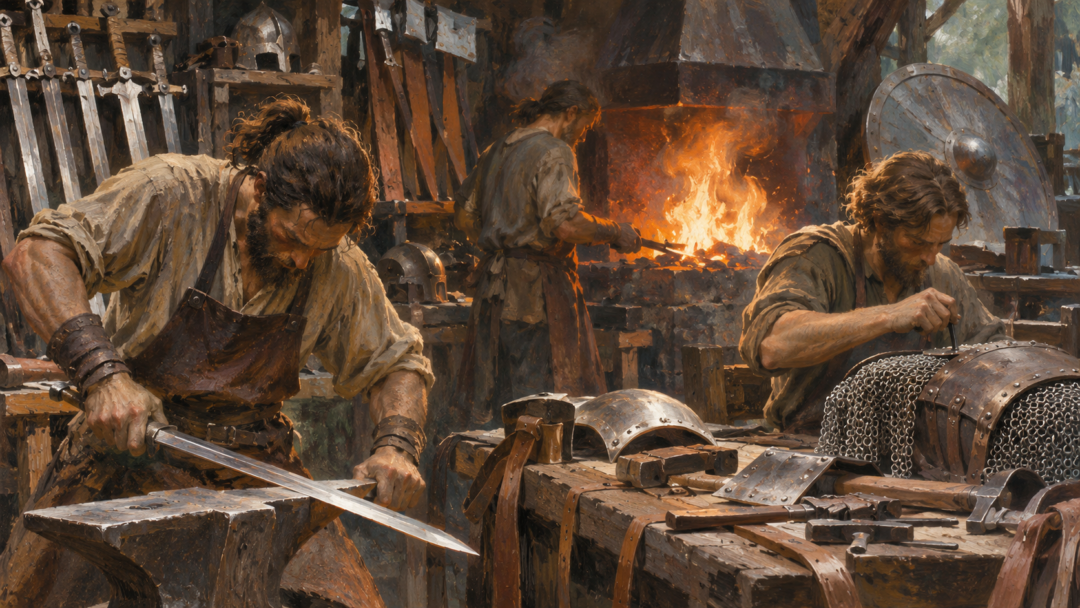
The real workshop was far larger and more specialised than three smiths. New Line’s notes describe departments covering creatures, makeup and prosthetics, armour and weapons, and miniatures. Weta Digital was a separate operation handling digital visual effects.
Metalworkers had a distinctive task. Armour had to suggest the culture that made it, withstand filming and read clearly on screen. A sword had to convince in close shots, while other versions might serve different needs in action scenes. The result depended on designers, technicians, costume teams and performers as well as smiths.
Johnson and Green’s documented role in producing original armour pieces is especially relevant to Isengard. The movie’s Orc and Uruk-hai war gear is part of a larger visual language in which armour immediately tells the audience what sort of fighting force is approaching. The production notes say Weta made original steel armour and used moulds to create further pieces for the different peoples of Middle-earth. That account gives substance to the idea of craftsmen moving between the real production workshop and the fictional industry shown on screen.
Lyon’s work on Andúril represents the other extreme of the trilogy’s metalwork: a single sword laden with history, rather than mass production beneath Orthanc. Both belong to the same filmmaking enterprise, but communicate very different things.
None of this proves that the Orc actors were striking heated steel during a particular take. The metal shown on camera might be a prepared prop, and editing, lighting and sound do much to create the force of a forge. The stronger, demonstrable point is that the named performers possessed the kinds of skills the scene depicts.
The other blacksmith cameo belongs to Rivendell
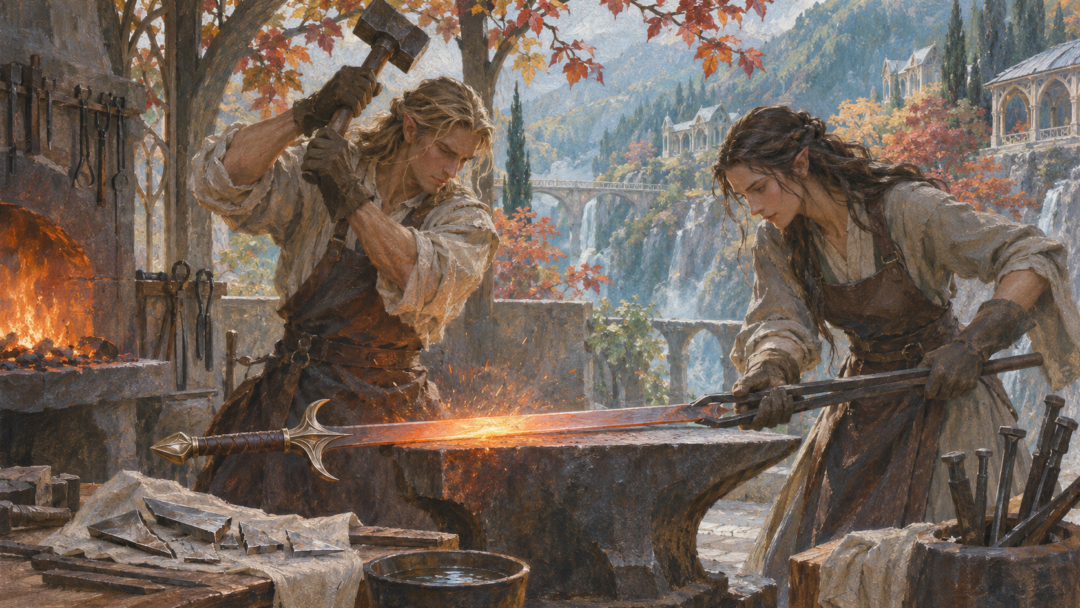
There is a second story about Weta smiths appearing in the trilogy, and it is important not to merge the two. FantasiaDomain’s fan-maintained guide to cameos describes two Elves in Rivendell reforging Narsil into Andúril. According to that guide, the performers were real blacksmiths who helped make the films’ weapons and armour. The writer candidly says, “I don't know their names, unfortunately.”
That report is intriguing, but it neither names Green, Johnson and Lyon nor identifies the Elven smiths through a production credit. There are two performers in the Rivendell claim and three in the Isengard attribution. The guide does not say they are the same people. Even with the solid evidence for the Isengard workers’ real trades, we cannot simply transfer those names to the Elven scene.
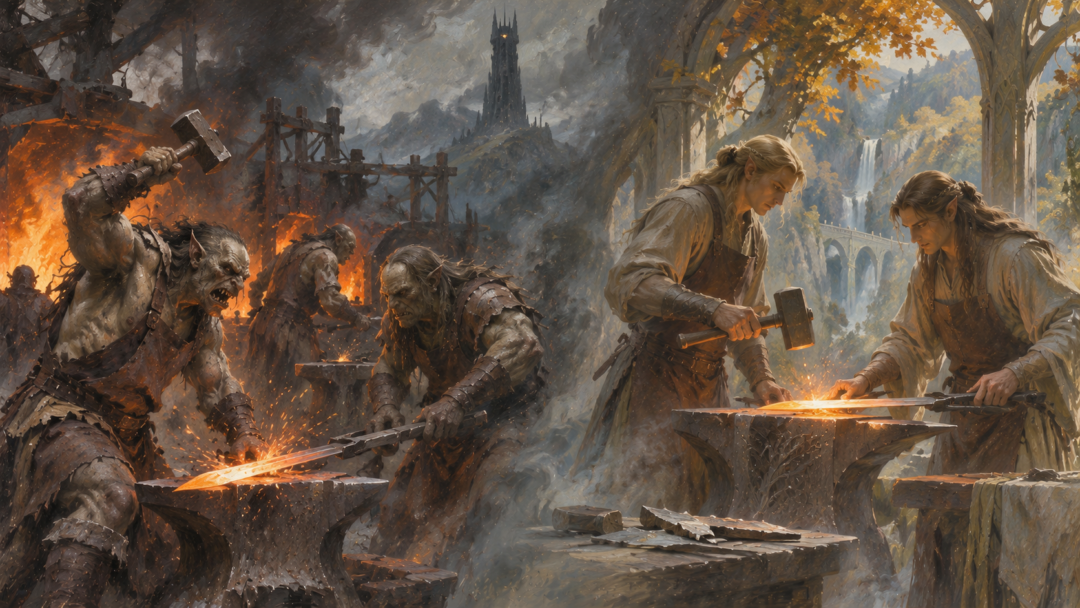
The scenes also belong to different films. Isengard’s industrial imagery appears in The Fellowship of the Ring, whereas the forging of Andúril at Rivendell is presented in The Return of the King. Their contrast is memorable: the pits under Saruman’s tower evoke the machinery of domination; the Elven forge prepares an heirloom associated with Aragorn’s restored kingship.
Tolkien’s book tells the sword’s story on a different schedule. In “The Ring Goes South,” in The Fellowship of the Ring, the broken Narsil is reforged before the Company leaves Rivendell. Aragorn gives the restored blade the name Andúril, Flame of the West. Jackson’s films delay the sword’s return, making it a major turning point later in Aragorn’s journey. That adaptation choice helps explain why the Elven smithing sequence has such a different dramatic weight from the Orc furnaces.
The Rivendell cameo remains a separate, less firmly identified claim. It is not needed to establish the point about the Isengard performers.
Why real tradespeople fit this world
There is an appealing symmetry in the idea that the craftspeople supplying Middle-earth’s armies could also portray workers supplying those armies inside the story. An armour smith understands how heavy material sits in the hands, how a tool is held and how repetitive workshop movements look. Such experience could plausibly make an onscreen task feel less rehearsed.
That is an interpretation, however, not a documented explanation of the casting. Neither the production notes nor the named cast listing records Peter Jackson deciding to recruit the smiths because their experience would look more authentic. It would be equally possible for skilled screen performers to learn suitable movements, with carefully staged props doing much of the work. We should not invent a director’s reasoning merely because it would make a good anecdote.
The achievement is visible regardless. In Isengard, the labour is not decorative: it makes Saruman’s plans physical. The land has been stripped, the forges lit, and workers are turning material into an army. Images of tools and fire tell the audience enough.
Knowing that Johnson, Green and Lyon worked on real armour and swords deepens those images. It suggests a remarkable overlap between the production’s practical skills and the world those skills helped portray. It also reminds us that fantasy filmmaking is not opposed to craftsmanship. Its convincing impossible places are often built out of profoundly ordinary knowledge: how to shape steel, make a costume hold together, or produce an object that will withstand repeated handling.
A good story, with a precise answer
So, were the Orc blacksmiths at Isengard played by actual Weta blacksmiths? The available records strongly indicate yes. Tolkien Gateway attributes the roles to Warren Green, Stu Johnson and Peter Lyon; New Line’s production notes identify Green and Johnson as armour smiths and Lyon as a master swordsmith; and the archived crew listing places all three in the workshop’s metalworking departments.
It is still fair to say that the public material considered here stops short of a primary casting sheet or an eyewitness account assigning each person to a particular shot. Nor does it tell us why they were selected, whether they performed live forging on set, or whether any of them also appeared among Rivendell’s Elves.
Those limits do not erase the striking coincidence of three exact names across the performance listing and the craft credits. The men identified with Saruman’s Orc forges were, by the production’s own documentation, working metalworkers in the real operation that helped equip Middle-earth. In a trilogy celebrated for making imaginary worlds tangible, that is a small but unusually fitting piece of filmmaking history.
Sources & Notes
This article is based on close reading and interpretation of Tolkien's published works and related source material where relevant.