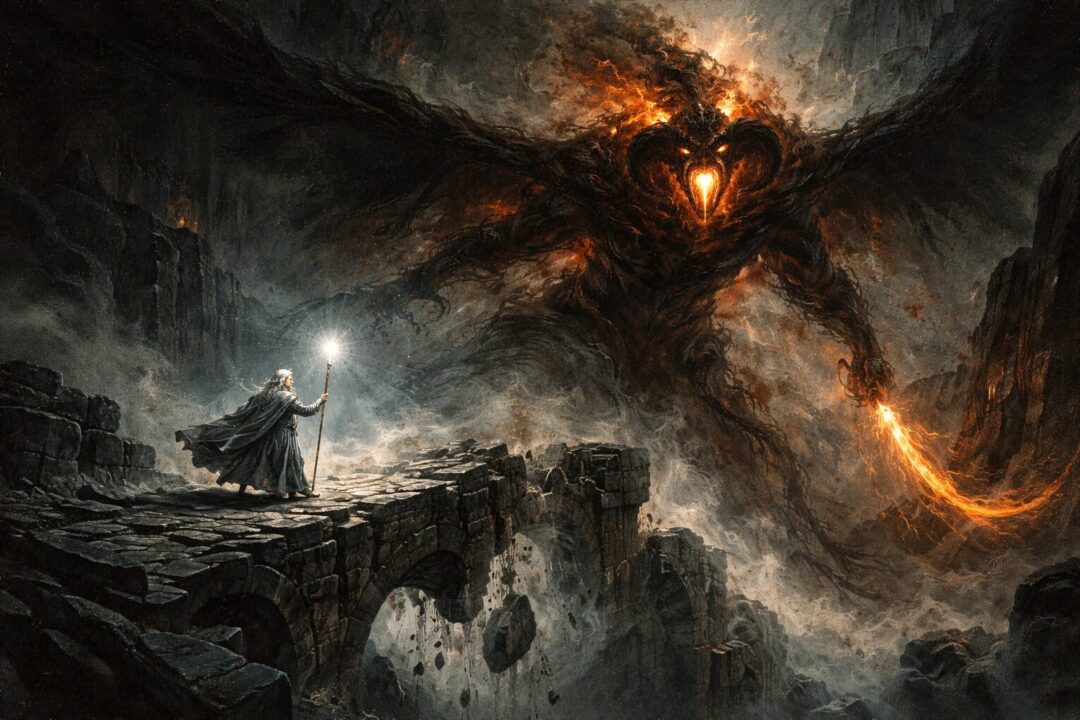
Few questions in Middle-earth provoke as much passionate debate as this one.
Do Balrogs have wings?
For many readers, the answer feels obvious. In The Fellowship of the Ring, the Balrog that confronts Gandalf in Khazad-dûm is described with imagery so vivid that it seems decisive: fire, shadow, terror—and wings stretching from wall to wall.
The image is unforgettable. A vast hall swallowed by darkness. Flame coiling around a towering shape. Shadow spreading outward until escape feels impossible.
And yet, Tolkien’s legendarium is not built on literalism alone.
His language is mythic, symbolic, and deliberately layered. He rarely describes creatures the way a naturalist would. Instead, he evokes how they feel to encounter—especially when fear, awe, and ancient power distort perception.
To understand the Balrog, we must look not only at what is described—but how and why it is described that way.
What Balrogs Actually Are
Balrogs are not animals.
They are not demons in the modern fantasy sense, nor are they simply monsters made of fire. In Tolkien’s world, that distinction matters.
Balrogs are corrupted Maiar—the same order of beings as Gandalf and Sauron. They are spirits that entered the world at its beginning, before the shaping of Elves or Men. In the Elder Days, they were drawn into Morgoth’s service and became his most feared champions.
This is crucial.
Maiar do not possess fixed physical bodies by necessity. When they take form, it is an act of will. Their appearance is shaped by purpose, power, and identity—not by biology.
A Maia’s body is not anatomy.
It is expression.
When Gandalf appears as an old man, that is a chosen limitation. When Sauron appears as a towering Dark Lord, that is a projection of domination. When a Balrog manifests as fire and shadow, it is doing the same—embodying terror, wrath, and destructive force.
A Balrog’s shape is not what it is.
It is how it chooses to be seen.
The Famous “Wings” Line
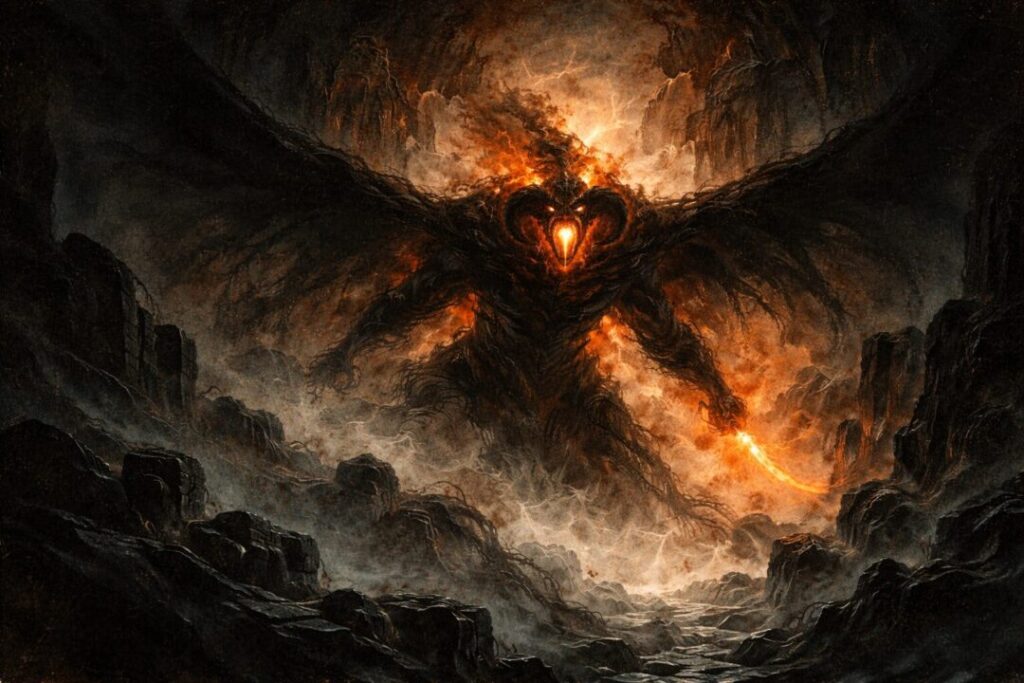
The entire debate hinges on a single line during the confrontation on the Bridge of Khazad-dûm, when the Balrog reveals itself fully:
“Its wings were spread from wall to wall…”
This is the only explicit reference to wings in the entire legendarium.
There are no earlier descriptions.
No later confirmations.
No elaboration.
And most importantly:
- Not once do Balrogs fly
- Not once do they take to the air
- Not once are wings used as functional limbs
Even during the great battles of the First Age—where Balrogs fight atop cliffs, pursue fleeing enemies, and clash with dragons—flight is never attributed to them.
This absence is striking.
Tolkien was perfectly capable of describing flight when he wanted to. Eagles soar. Dragons take wing. Even spirits can move swiftly through the air when the narrative calls for it.
The fact that Balrogs never do is not an oversight.
It is a choice.
Shadow as Substance in Middle-earth
To understand the “wings,” we must first understand how Tolkien treats shadow.
In Middle-earth, darkness is not merely the absence of light. Shadow can cling. It can press. It can spread. It can carry weight, fear, and moral corruption.
The Nazgûl radiate terror that Frodo experiences physically.
The Ring grows heavier the closer it comes to its master.
Sauron’s will stretches outward like a pressure across the world.
Shadow, in Tolkien’s writing, behaves almost like a force.
When the Balrog appears, it is described as:
- A man-shaped shadow
- Surrounded by flame
- Wrapped in darkness that expands outward
The “wings” appear in this exact moment—when darkness fills the hall from side to side, blotting out light, enclosing the Fellowship in dread.
Nothing in the text suggests feathers.
Nothing suggests bones or joints.
Nothing suggests motion through air.
What spreads is shadow.
The wings are not used. They are revealed.
Why Tolkien Likely Chose This Language
Tolkien’s prose draws heavily from ancient and biblical imagery, where wings often symbolize something very different from flight.
In myth and scripture, wings frequently represent:
- Overwhelming authority
- Encroaching doom
- The covering of darkness
- Power extending beyond physical boundaries
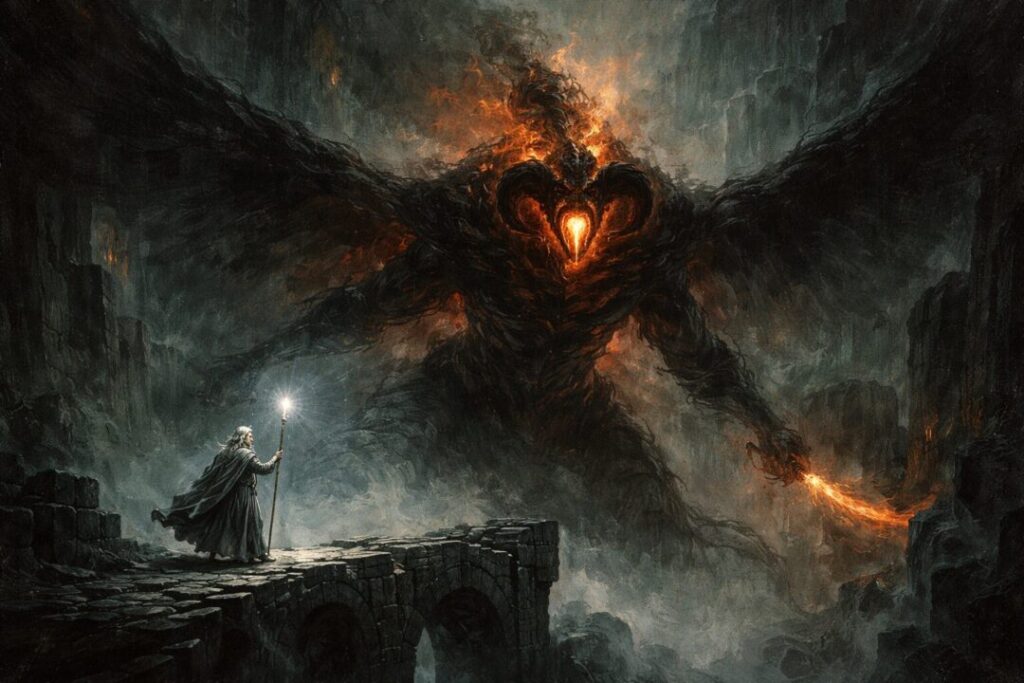
Wings can signify domination—something that overshadows, envelops, and traps.
The Balrog’s wings function exactly this way.
They transform the space.
They erase distance.
They make retreat feel futile.
The vast hall of Moria becomes a suffocating chamber, sealed by fear rather than stone.
This is not physical anatomy.
It is psychological warfare made visible.
Why This Matters for Tolkien’s View of Evil
If Balrogs were simply winged fire-demons, they would fit neatly into modern fantasy categories.
But Tolkien consistently resists that kind of simplification.
Evil in Middle-earth is rarely bestial. It is spiritual, corruptive, and parasitic. The most dangerous beings are not terrifying because of what they do, but because of what they are.
The Balrog is terrifying not because it can fly.
It is terrifying because it is a fallen being of divine origin—an immortal spirit that chose ruin, now wrapped in fire and shadow.
Giving it literal wings would reduce it to a creature.
Allowing shadow itself to behave like wings elevates it into something mythic and uncanny—something that does not obey the expectations of flesh and bone.
So… Do Balrogs Have Wings?
Textually?
They are described as having wings once, using language that is poetic and symbolic.
Functionally?
They never fly.
They never use wings.
They are never treated as winged beings.
Lore-wise?
Balrogs are spirits whose forms are not fixed—and whose terror often manifests in ways meant to overwhelm perception rather than define anatomy.
The most faithful reading is this:
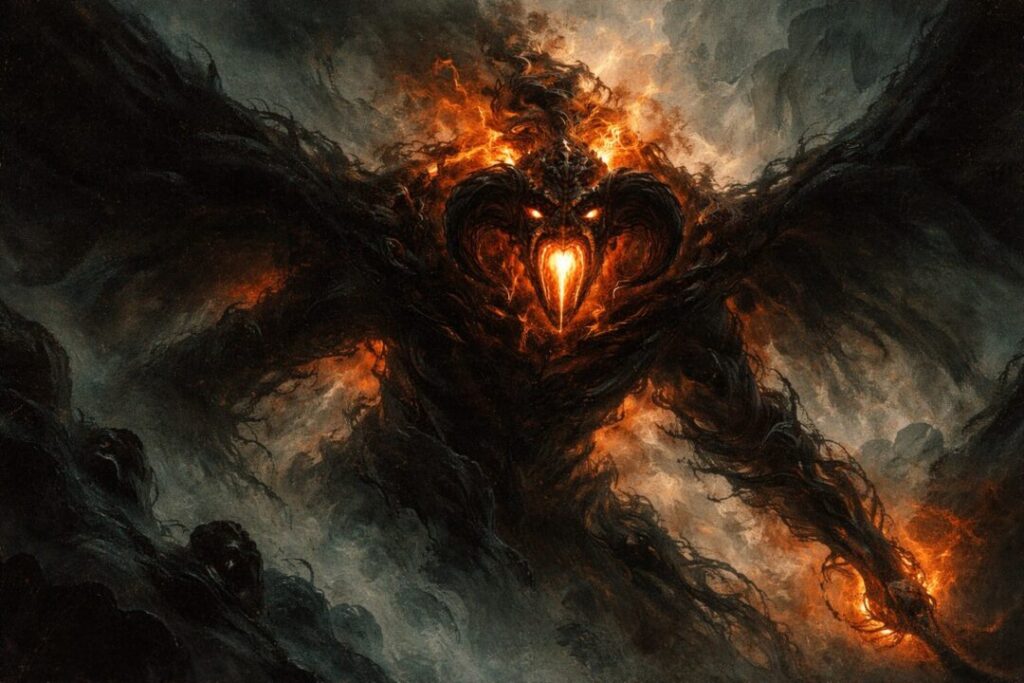
Balrogs do not have physical wings.
They have shadows that behave like them.
And in Tolkien’s world, that distinction matters more than a diagram ever could.
Why the Debate Never Truly Ends
Tolkien rarely explains everything outright. He leaves space for interpretation, for mythic ambiguity, and for readers to wrestle with language and meaning.
The Balrog’s wings exist in that liminal space—between vision and terror, symbol and substance.
And perhaps that is exactly where they belong.
Because the Balrog was never meant to be catalogued.
It was meant to be feared.