The Silmarils are among the most revered objects in all of Middle-earth’s history, but they are also among the most misunderstood.
Because they sit at the center of so much tragedy, readers often start treating them as if they were all-purpose magical artifacts: jewels that heal, empower, bless rightful owners, or radiate victory simply because they are holy. The texts are much more precise than that.
A Silmaril is extraordinary, but not vague. Its powers and limits matter. And once those limits are understood, the long catastrophe surrounding the jewels becomes even more compelling.
What a Silmaril is
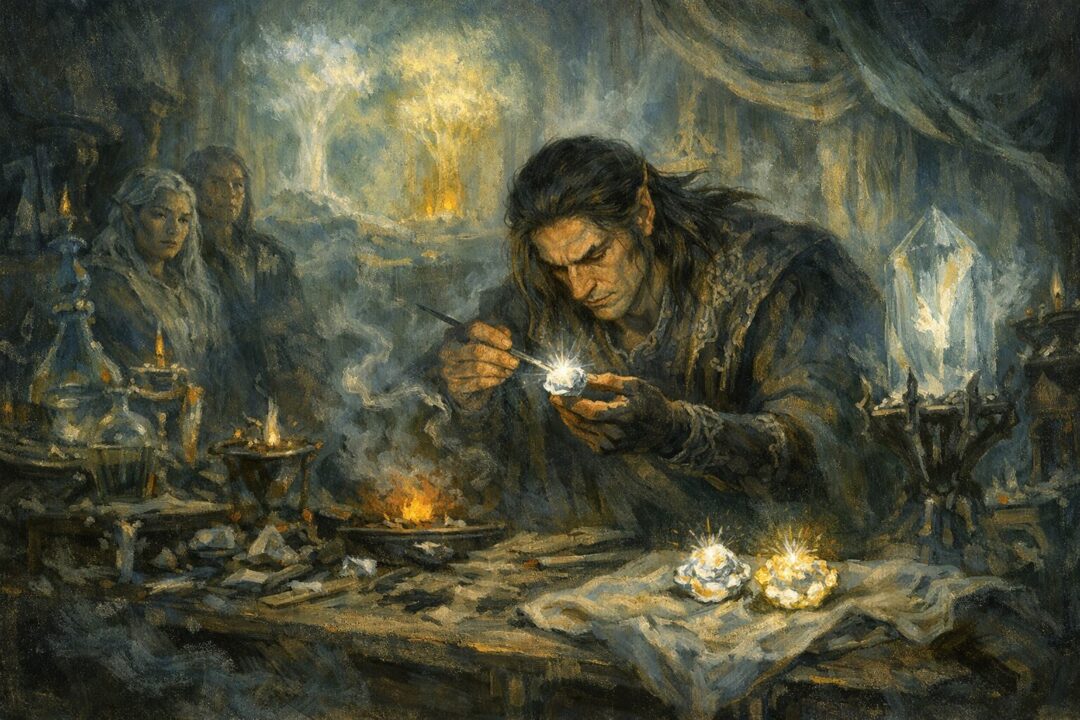
A Silmaril is one of the three jewels made by Fëanor in Aman. In them he enclosed the light of the Two Trees of Valinor before their destruction. That point matters more than almost anything else: the Silmarils are precious not merely because they are beautiful, but because they preserve a light the world cannot simply replace. After the Trees were poisoned, that unsullied light remained above all in the Silmarils.
That is why the jewels carry such weight in the First Age. They are not interchangeable treasure. They contain something lost.
The texts also stress their uniqueness in another way. Fëanor alone knew the full secret of their making, and no one else reproduced their like. In other words, the Silmarils are not just rare because nobody bothered to imitate them. They are singular because their making itself is beyond repetition within the surviving tradition.
What a Silmaril can do: preserve and radiate holy light
The most basic answer is also the most important: a Silmaril holds and gives forth the light of the Two Trees.
That sounds simple, but it explains nearly everything else. A Silmaril is not valuable only as a jewel of craft; it is luminous with the memory of blessed light from before the Darkening. That is why its presence is so overwhelming, why the Valar ask for the jewels after the Trees are wounded, and why the loss of the Silmarils becomes bound up with the loss of an entire age.
This light is not presented as a decorative glow. It has sanctity. It carries the moral and spiritual charge of the Blessed Realm, and that leads directly to the next point.

What a Silmaril can do: burn the unclean
Varda hallows the Silmarils so that mortal or evil hands cannot touch them without being burned and withered. This is one of the clearest and most explicit rules attached to the jewels.
That rule is not abstract. The story repeatedly enforces it.
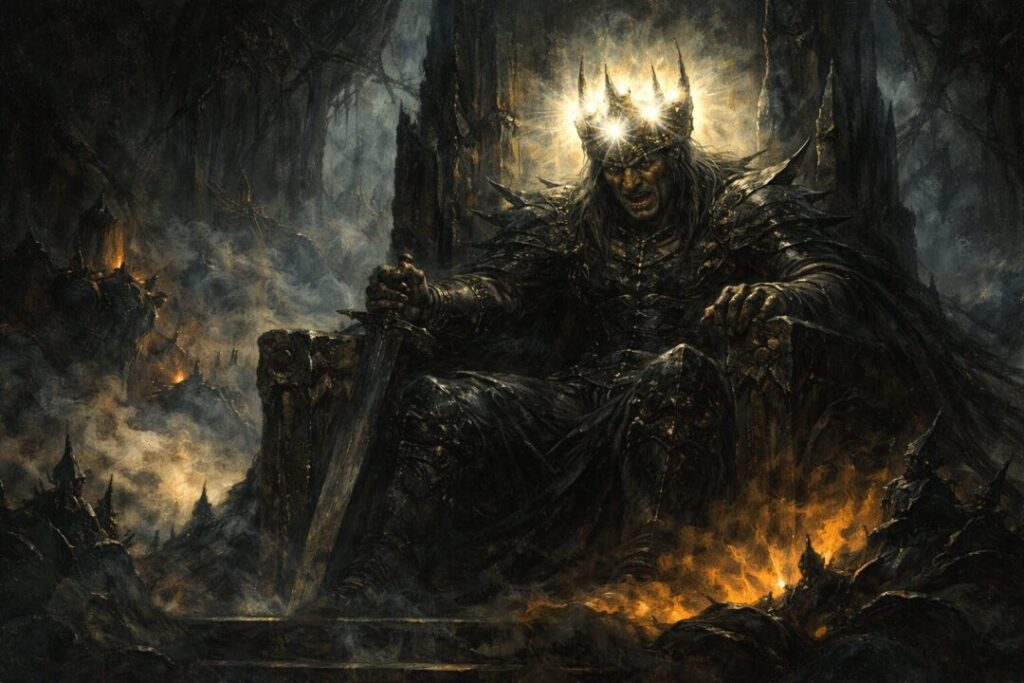
Morgoth takes the Silmarils and sets them in his Iron Crown, but their touch torments him. Carcharoth bites off Beren’s hand with a Silmaril in it and swallows the jewel, only to be driven mad by its burning power. At the end of the First Age, Maedhros and Maglor finally seize the last two Silmarils, yet they cannot keep them: their own deeds have made them unworthy, and the jewels burn them as well. Maedhros casts himself into a fiery chasm with his Silmaril, while Maglor throws his into the sea.
This is one of the central truths of the legend. A Silmaril is not simply an object to be possessed. The jewel itself judges touch in a way ordinary treasure does not.
What a Silmaril can do: become a sign of hope
The most transformative example comes with Eärendil.
When the Silmaril borne out of Morgoth’s crown eventually reaches Eärendil and Elwing, it does not become a battlefield superweapon. Instead, it becomes part of a different kind of meaning. Eärendil sails with the Silmaril bound upon his brow, and its light is seen from Middle-earth as Gil-Estel, the Star of High Hope.
That is crucial. The Silmaril can serve as a visible sign across distance, and in that capacity it becomes associated with guidance, endurance, and hope. Much later, the light of Eärendil’s star is remembered in Galadriel’s phial, but that does not mean the phial contains a Silmaril itself. The tradition points instead to reflected or derived light, not the jewel in person.
So yes, a Silmaril can function as a beacon. But even here, the jewel’s role is not “grant power to its owner.” It is bound up with a particular fate, a particular bearer, and a particular act of witness.

What a Silmaril cannot do: act like the One Ring
One of the easiest mistakes is to read every major artifact in Middle-earth through the logic of the Rings of Power.
A Silmaril does not work that way.
The One Ring concentrates domination, possession, and the extension of Sauron’s will. The Silmarils do not offer that kind of agency in the text. They inspire desire, certainly. Men and Elves commit terrible deeds because of them. Oaths, pride, and covetousness cluster around them. But that is not the same as the jewel exerting Ring-like mastery over minds. The safer reading is that the Silmarils become the focus of possessiveness already present in fallen hearts.
That distinction matters. The evil around the Silmarils often comes from what people do for them, not from an explicit mechanism by which the jewels dominate thought.
What a Silmaril cannot do: heal anyone just because it is holy
Readers often assume that because a Silmaril contains blessed light, it must also function as a healing object.
The texts do not support that as a general rule.
Beren handles a Silmaril, but the healing associated with his story comes through Lúthien, not through the jewel itself. Carcharoth is not purified by swallowing a Silmaril; he is tormented. Morgoth is not made better by proximity to the hallowed light; he is burned by it. Maedhros and Maglor do not find absolution once they finally reclaim the jewels; they find unbearable judgment.
So a Silmaril is holy, but holiness here does not mean “practical healing device.” In these tales, sanctity often exposes rather than repairs.
What a Silmaril cannot do: guarantee rightful ownership
Another false assumption is that the Silmarils reward whoever has the strongest claim.
Again, the story is harsher than that.
Fëanor made them, yet his possessiveness helps bring ruin on his house. The sons of Fëanor swear to recover them, but their oath destroys kingdoms and finally leaves them unable to endure the jewels they sought. Morgoth steals them, but cannot possess them in peace. Beren wins one from the Iron Crown, but does not build a worldly dominion on it. Elwing bears one, yet that jewel also draws violence to her people.
The lesson is not that the Silmarils cleanly identify the best owner. The lesson is almost the opposite: they reveal how broken the possessive instinct has become in a fallen world.
Could a Silmaril restore the Two Trees?
This is where careful phrasing matters most.
When the Trees are dying, the Valar ask Fëanor to surrender the Silmarils because Yavanna might heal the Trees if their light were released. The wording is not a flat mechanical guarantee in the way modern fantasy readers sometimes imagine a magical procedure. It is a plea made in extremity, before the history of the jewels unfolds further.
There is also a later prophetic tradition in which, at the world’s end, the Silmarils are recovered and Fëanor breaks them so the Trees may be rekindled. But that belongs to eschatological prophecy and late tradition, not to the ordinary present capabilities of a Silmaril during the First Age. It should be treated as prophecy, not as evidence that anyone in the story could simply use a Silmaril like a restoration tool on command.
So the cautious answer is this: the tradition strongly links the Silmarils to the possibility of restoring the lost light of the Trees, but the texts do not present that as a routine or currently available function.
The real tragedy of the Silmarils
In the end, the Silmarils are not powerful because they do everything.
They are powerful because they do a few things with terrible clarity.
They preserve the most blessed light left from a vanished age. They reject unclean possession. They can become signs of hope when borne in the right fate. And they expose the ruin in anyone who treats holy light as private property.
That is why the story of the Silmarils is not merely about jewels. It is about desire meeting sanctity and discovering that sanctity cannot be owned without cost.
The jewels never become ordinary treasure, and they never become convenient magic tools. They remain what they were from the beginning: a preserved light too pure to be grasped safely by corrupted hands.
And that is precisely why nearly everyone who reaches for them is broken by the attempt.