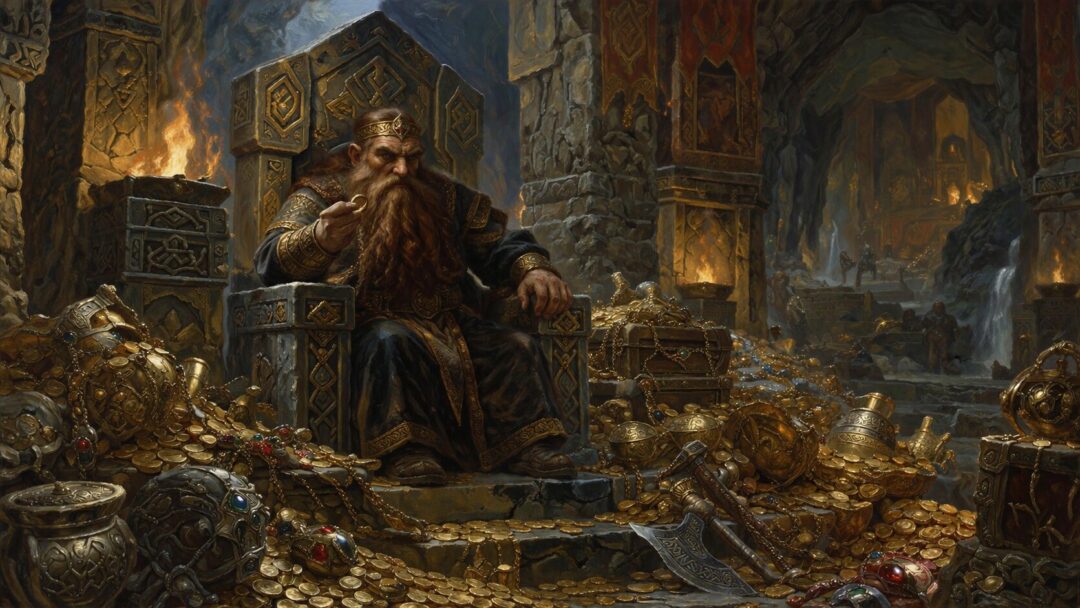
At first glance, it seems like Dwarves should have produced their own version of the Nazgûl.
They were mortal.
They received Rings of Power.
Those Rings were ultimately tied to Sauron’s larger design.
And yet Middle-earth gives us Ringwraiths only among Men.
No Dwarven kings vanish into the unseen.
No shadow-servants of Sauron emerge from the great houses of the Dwarves.
No Dwarven Nazgûl ever appear in the history of the Third Age.
That absence is easy to treat as a gap in the story.
It is not.
The texts answer it directly, and the answer reveals something important not only about Dwarves, but about how corruption works in Middle-earth.
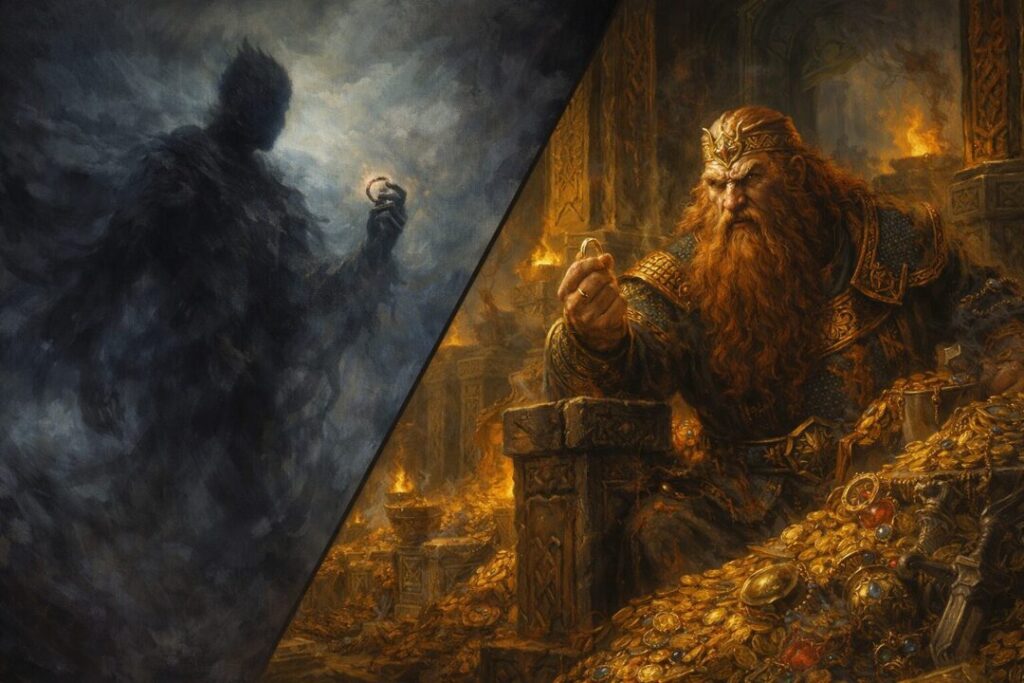
The Nine and the Seven Were Not the Same in Effect
A common mistake is to assume that all the Great Rings worked in basically the same way, and that different peoples simply resisted them with different levels of success.
That is too simple.
The Nine given to Men had a very specific result. Their bearers became mighty in their day. They gained glory and wealth. Their lives seemed to stretch beyond normal limits. But this apparent gift became unbearable. In time they faded, entered the realm of shadows, and fell completely under Sauron’s domination.
That is the pattern that produces the Nazgûl.
But the Seven do not follow that pattern with Dwarves.
The texts do not say Dwarves became wraiths more slowly.
They do not say some almost did.
They say something much firmer than that.
Dwarves could not be turned into shadows.
That line is crucial, because it removes the entire question from the realm of speculation. The Rings did not merely fail to finish the process. They could not produce that result in Dwarves at all.
The Text Gives the Reason in Plain Form
The explanation is not hidden in an obscure note.
It is built directly into the tradition of the Rings.
Dwarves are described as tough and hard to tame. They do not endure domination well. Their inner thoughts are hard to fathom. And most importantly, they are said to be incapable of being turned to shadows.
Later, the point is stated even more sharply: though they could be slain or broken, they could not be reduced to shadows enslaved to another will. Their lives were not lengthened or shortened by the Rings in the way Men’s lives were affected.
This matters for two reasons.
First, it explains why there are no Dwarven wraiths.
Second, it shows that Sauron’s power over different peoples was never mechanically identical.
The Rings were instruments of domination, but domination in Middle-earth always meets the nature of the one being dominated. Men, Dwarves, and Elves are not simply interchangeable mortals with different levels of willpower. They are distinct peoples with distinct places in the world.
And the Rings act accordingly.
Dwarves Were Corrupted, But Not Hollowed Out
To say Dwarves did not become wraiths is not to say they were unaffected.
This is where many summaries go wrong.
The Seven absolutely did harm.
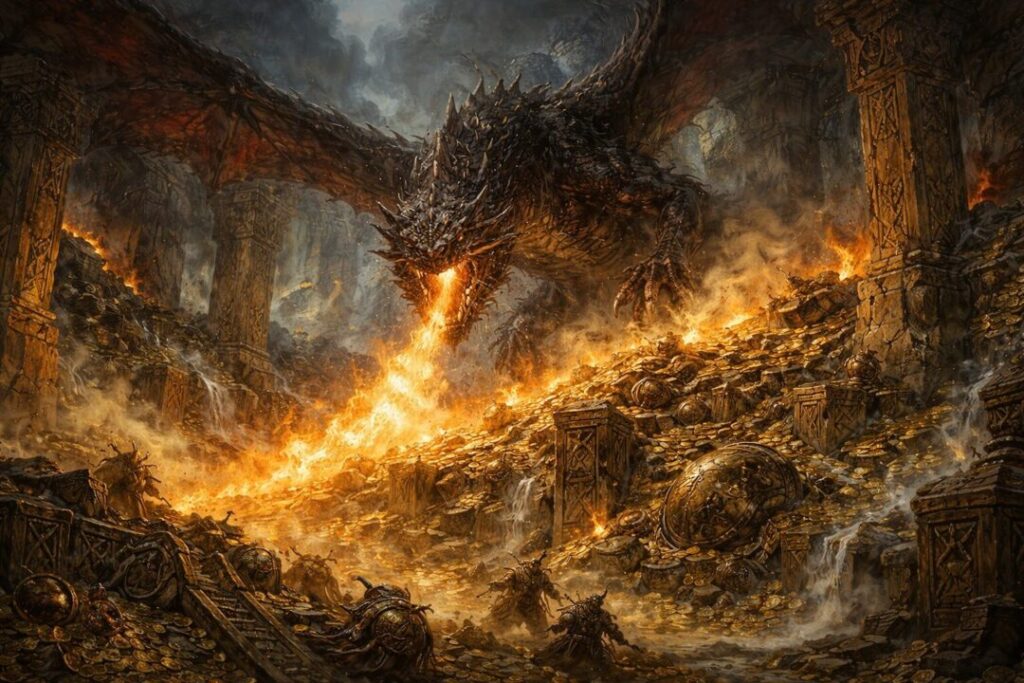
The Rings worked upon Dwarves by intensifying greed and wrath. They were used for the getting of wealth. Great treasure-hoards grew around their bearers. But with that came an overmastering desire for gold and a furious possessiveness that led to conflict, vengeance, and ruin.
So the Dwarves were not immune.
They were corrupted differently.
Men under the Nine move toward fading, submission, and enslavement.
Dwarves under the Seven move toward accumulation, obsession, and destructive possessiveness.
That difference is morally important.
Sauron could not erase the Dwarves into obedient shadows. He could, however, worsen traits that would still spread misery through Middle-earth. Their hoards drew envy. Their wealth attracted dragons. Their wrath deepened feuds. Kingdoms could be imperiled without a single Dwarf becoming a servant in the Nazgûl sense.
In other words, the Seven did not give Sauron the form of victory he wanted most.
But they still gave him profit.
Why Their Resistance Should Not Be Mistaken for Purity
There is a temptation to turn this into a flattering myth about Dwarven incorruptibility.
The legendarium does not support that.
Dwarves are not presented as morally invulnerable. They are stubborn, enduring, and difficult to dominate, but that is not the same thing as spiritual immunity.
The texts are careful here.
The Seven do not make Dwarves invisible wraiths.
They do inflame greed.
They do help create conditions for disaster.
They do distort the lives of their bearers, even if not through the same fading that overtakes Men.
So the right contrast is not corrupted versus uncorrupted.
It is enslaved versus resistant.
Wraith-like submission versus hardened possessiveness.
Direct domination versus indirect ruin.
That distinction preserves the dignity of the Dwarves without romanticizing them.
Why Sauron Hated This Failure
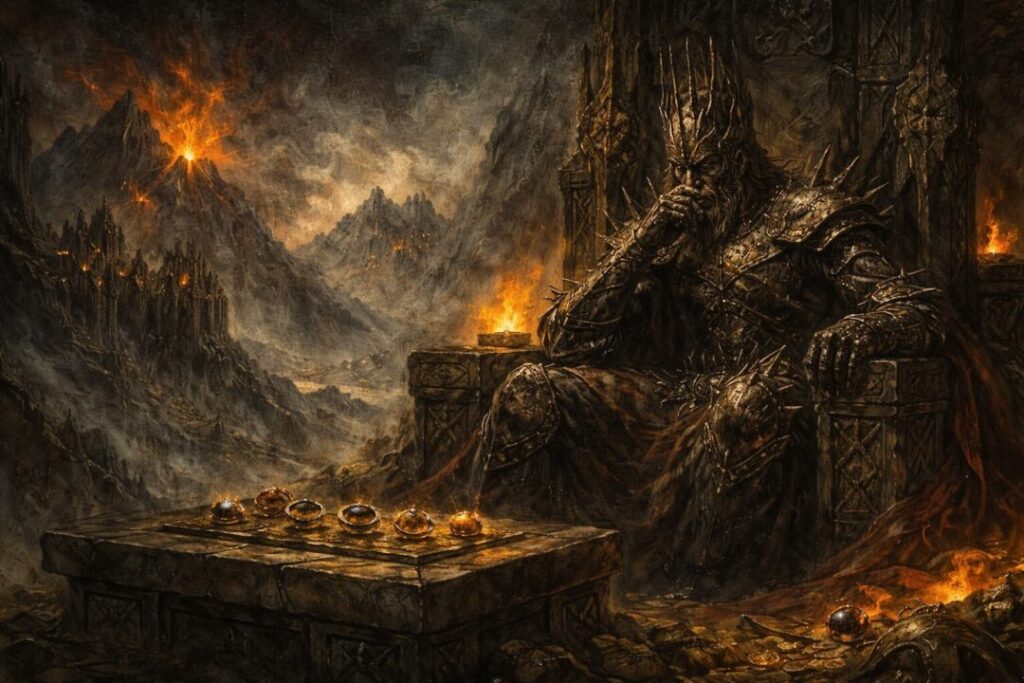
One of the most revealing details is that Sauron hated the possessors of the Dwarven Rings and desired to dispossess them.
That tells us something about his frustration.
If the Seven had produced Dwarven equivalents of the Nazgûl, the Rings would have been perfect tools. Instead, the Dwarves remained too resistant to become shadow-slaves. Sauron could profit from the chaos their greed produced, but he could not fully master them through the same method he used on Men.
So the Dwarven bearers remained partly outside his grasp.
That is a limited victory for the Dwarves, but it is still a real one.
The Seven are therefore a story of resistance mixed with damage. Sauron cannot get all he wants. The Dwarves do not become his wraiths. Yet neither do they escape unscathed.
This half-failure fits Middle-earth very well.
Evil in these texts often fails to achieve its highest ambition, but still leaves terrible scars behind.
The Seven Still Brought Ruin
The history of the Dwarven Rings makes that plain.
The Seven helped found great hoards. Those hoards in turn drew dragons. Of the Seven, four were consumed by dragon-fire, while Sauron recovered the others in time. That pattern alone tells its own story.
The Rings did not elevate the Dwarves into lasting greatness.
They fed desires that made their realms more vulnerable.
This does not mean every Dwarven disaster can be blamed on a Ring. The texts never reduce Dwarven history to a single cause. But they do make clear that the Rings intensified greed and contributed to evils that ultimately favored Sauron.
So even without wraiths, the Seven remained dangerous instruments.
That is why “Dwarves don’t become wraiths” should never be read as “the Seven didn’t work.”
They worked badly for Sauron’s original purpose.
They worked well enough to poison what they touched.
Is the Reason Ever Fully Explained?
Only up to a point.
The texts explicitly state the fact: Dwarves could not be turned to shadows and were made to resist domination.
What they do not do is give a long metaphysical lecture explaining every mechanism behind that resistance.
So here we need to be careful.
It is fair to say the legendarium ties Dwarven resistance to their created nature as a people marked by unusual hardiness and an exceptional resistance to domination.
It is not as safe to claim more than that.
The deeper “why” is only partly unfolded.
The fact itself is certain.
The full inner mechanism is not laid out in systematic detail.
That restraint matters. Middle-earth often explains enough to establish the truth of something without reducing it to a technical formula.
Why the Difference Matters So Much
The deeper point is not just about Dwarves.
It is about how power behaves.
The Rings do not erase the nature of every bearer in the same way. They exploit what is there. Men are lured by promises of power and longevity and are slowly drawn into fading servitude. Dwarves resist that surrender of will, but the same instruments still catch hold of appetite, treasure, and wrath.
So the legendarium does not offer a single model of corruption.
It offers several.
That is why the Dwarven case is so revealing. It shows that resistance to domination is not the same as freedom from damage. A being may refuse enslavement and still be spiritually harmed. A people may avoid becoming wraiths and yet suffer ruin through the very thing that could not wholly master them.
That is a darker and more interesting answer than the simpler one.
Dwarves Do Not Become Wraiths Because the Text Says They Cannot
In the end, the answer is not mysterious.
Dwarves do not become wraiths because Middle-earth explicitly says they cannot be turned into shadows or reduced into that kind of enslavement.
But that is not a story about immunity.
It is a story about limits.
Sauron’s power has limits.
The Rings have limits.
Even evil does not conquer every nature in the same way.
The Dwarves frustrate Sauron’s plan at its deepest point.
He cannot hollow them into Nazgûl.
So he settles for something else.
Greed.
Wrath.
Treasure that becomes a snare.
Kingdoms made vulnerable not by spectral slavery, but by the slow corruption of desire.
And that may be the more unsettling truth.
Because the Seven did not fail by doing nothing.
They failed by doing enough.