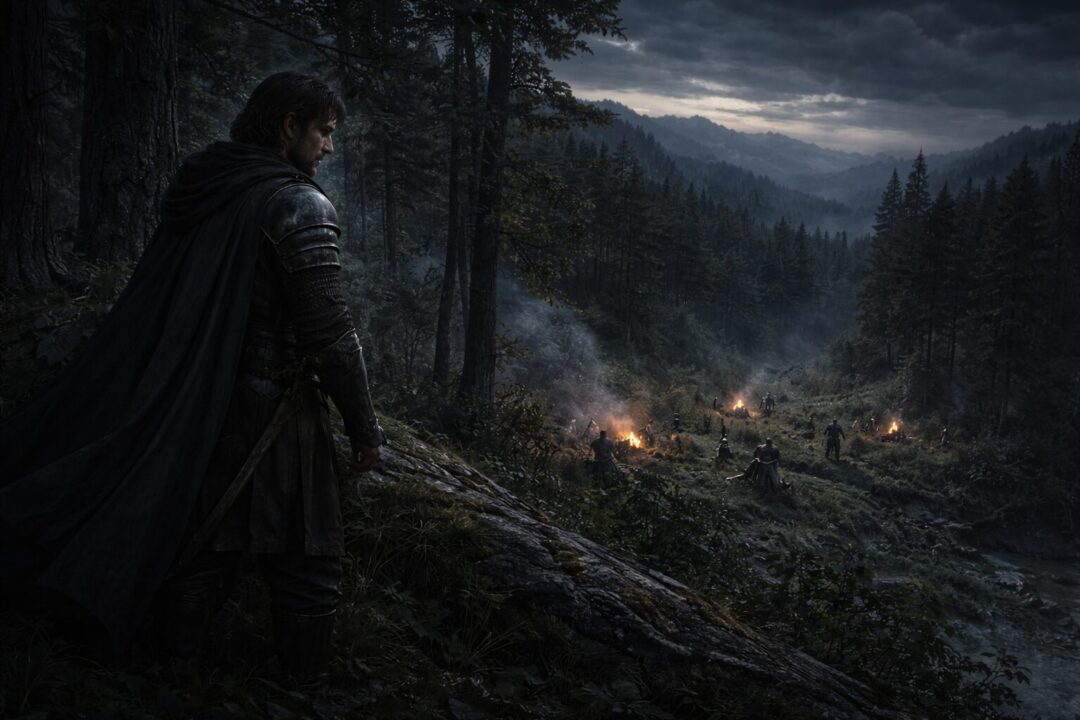
Faramir’s test does not arrive with thunder or fire.
It arrives in silence.
There is no crack in the sky. No sudden surge of power. No voice promising him glory or dominion. There is only a stretch of damp green land in Ithilien, the slow movement of men who are tired but disciplined, and a war that has already decided to grind forward whether anyone is ready or not.
In Ithilien, far from Minas Tirith, Faramir is entrusted with command — but not authority.
That distinction matters.
He is expected to hold ground without hope of reinforcement.
To follow orders without explanation.
To risk men without being allowed to change the terms of the fight.
He is responsible for outcomes he is not allowed to shape.
This is not a test of strength.
It is a test of restraint.
And restraint, when practiced long enough, begins to feel like erasure.
Command Without Control
Faramir’s position is one of the cruelest Tolkien ever gives a “good” character.
He is not naïve.
He is not protected.
And he is not blind to the reality unfolding around him.
Faramir sees Gondor clearly.
He sees the thinning lines, the exhausted soldiers, the way victories are no longer measured in ground gained but in days survived. He understands that Minas Tirith is not a bastion of hope — it is a dam holding back inevitability.
And yet, he is asked to behave as though obedience alone might change that.
That is where the real pressure begins.
Because obedience, when detached from agency, slowly hollows the person practicing it.
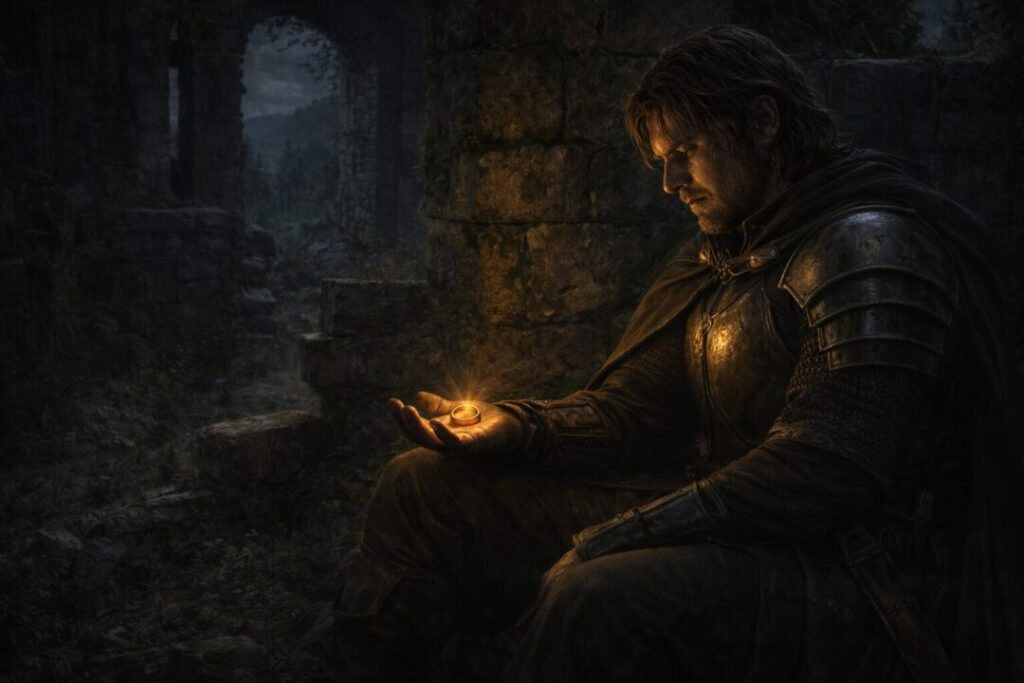
The Difference Between Faramir and Boromir Is Timing
Boromir is tested when hope still exists.
Even if it is fragile.
Even if it is desperate.
There is still a belief — however strained — that Gondor might be saved by decisive action.
Faramir is tested when hope is already rationed.
By the time Frodo and Sam stumble into his path, Faramir has already accepted something his brother never had to face:
Gondor may fall regardless of who he is or how well he serves.
That knowledge does not explode inside him.
It corrodes.
Slowly. Quietly. Persistently.
Boromir is crushed by responsibility all at once.
Faramir is worn down by it.
And erosion is harder to notice than collapse.
What the Ring Shows Faramir
The Ring does not whisper conquest to Faramir.
It does not show him banners unfurled or enemies kneeling.
It whispers clarity.
A world where decisions are final.
Where hesitation ends.
Where complexity collapses into certainty.
Where his father finally listens.
That last one matters more than Faramir would ever admit.
Denethor does not ignore Faramir because he is weak.
He ignores him because Faramir represents a kind of strength Denethor no longer believes in.
Patience. Mercy. Discernment.
The Ring offers Faramir something subtle and devastating:
Permission to stop being overlooked.
Tolkien is explicit that Faramir feels the pull — not as desire, but as relief.
Relief is more dangerous than hunger.
Hunger can be resisted.
Relief feels earned.
Why Relief Is the Ring’s Sharpest Weapon
The Ring succeeds most often not by offering excess — but by offering rest.
Rest from uncertainty.
Rest from moral friction.
Rest from waiting.
For someone like Faramir, who has lived inside contradiction for years — loyal son to an unloving father, righteous man in an unjust war — the Ring’s promise is not power.
It is simplicity.
And simplicity is intoxicating when your life has been nothing but careful judgment.
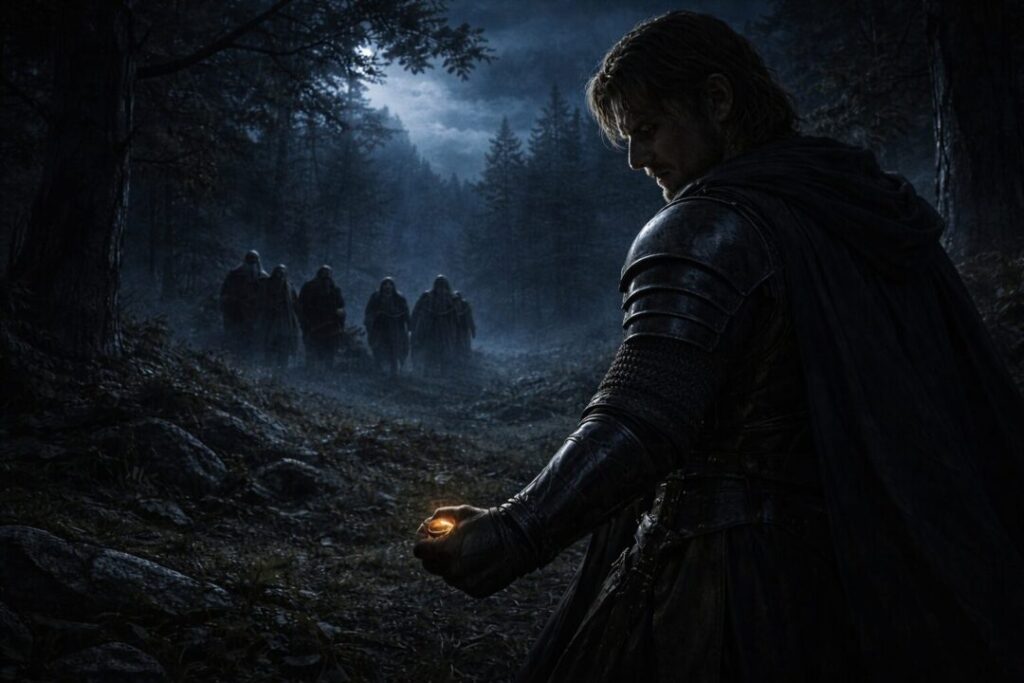
The Moment Tolkien Barely Emphasizes
There is a moment — brief, devastating — where Faramir realizes three things at once:
- He has the Ring within reach
- No authority stands above him in Ithilien
- Taking it would finally make his life simple
No council would stop him.
No command would override him.
No father would dismiss him.
And Tolkien moves on.
No speech.
No drama.
No thunder.
Because the danger is not in the act.
It is in the understanding.
Faramir understands exactly how easy it would be.
And exactly how justified it would feel.
That is the moment where many people would break — not loudly, but cleanly. Convinced they are doing what circumstances demand.
Why Faramir’s Victory Is Smaller — And Greater
Faramir doesn’t destroy the Ring.
He doesn’t save the quest.
He does something quieter.
He refuses to let resentment become justification.
That choice does not change the course of the war.
It does not spare Gondor its suffering.
It simply preserves something inside him.
And that matters more than Tolkien lets on at first glance.
Because in Middle-earth, corruption is not always about falling into darkness.
Sometimes it is about convincing yourself that bitterness is wisdom.
Faramir refuses that transformation.
The Cost of Refusal
Refusal is not free.
By letting Frodo go, Faramir does not gain clarity.
He gains uncertainty.
He returns to Minas Tirith empty-handed — knowing exactly how that will be received.
He chooses to face his father without proof, without victory, without the one thing that might have finally earned approval.
That is not moral grandstanding.
That is endurance.

Denethor’s Greatest Failure
Denethor believes strength must look like domination.
Control. Certainty. Force.
Faramir proves that strength can also look like refusal.
The refusal to become what the world rewards.
That is why Denethor cannot see him.
And that is why Tolkien lets Faramir live.
Not as a consolation prize — but as a counterargument.
Boromir shows us what happens when goodness is crushed by expectation.
Faramir shows us what happens when goodness survives it.
Why This Story Matters More Than Ever
Faramir’s story is not about temptation.
It is about what happens when good people are trapped inside systems that reward hardness and punish reflection.
It is about how often restraint is mistaken for weakness.
And how easily endurance is mistaken for irrelevance.
The Ring didn’t fail to corrupt Faramir.
It simply ran out of time.
And Middle-earth is better — quieter, humbler, but better — because of it.