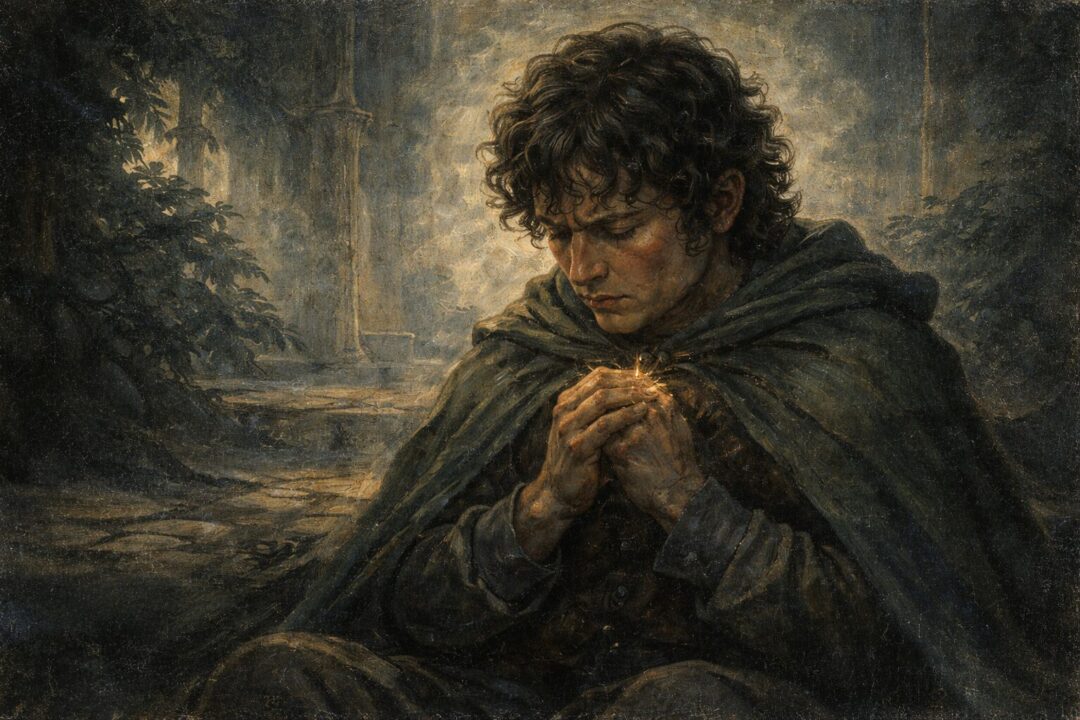
When Frodo Baggins arrives in Rivendell, it feels—at first glance—like the safest place in Middle-earth. Water runs clear through stone channels. Songs drift softly beneath the arches. Ancient wisdom lives in every pillar, every leaf, every quiet pause between words. After the terror of the road, the wounds of Weathertop, and the constant fear of pursuit, Rivendell looks like sanctuary.
But Frodo does not arrive empty-handed.
Unlike most who dwell in Rivendell, Frodo is not there to study history, to recover from battle, or to observe the world from a distance. He is there because something has been placed upon him that cannot be set down. The Ring does not rest in libraries or locked vaults. It does not sit safely in the hands of the wise. It rests on Frodo—quiet, constant, and demanding.
Elves speak of evil as memory. Frodo feels it as presence.
This single difference defines his entire experience in Rivendell.
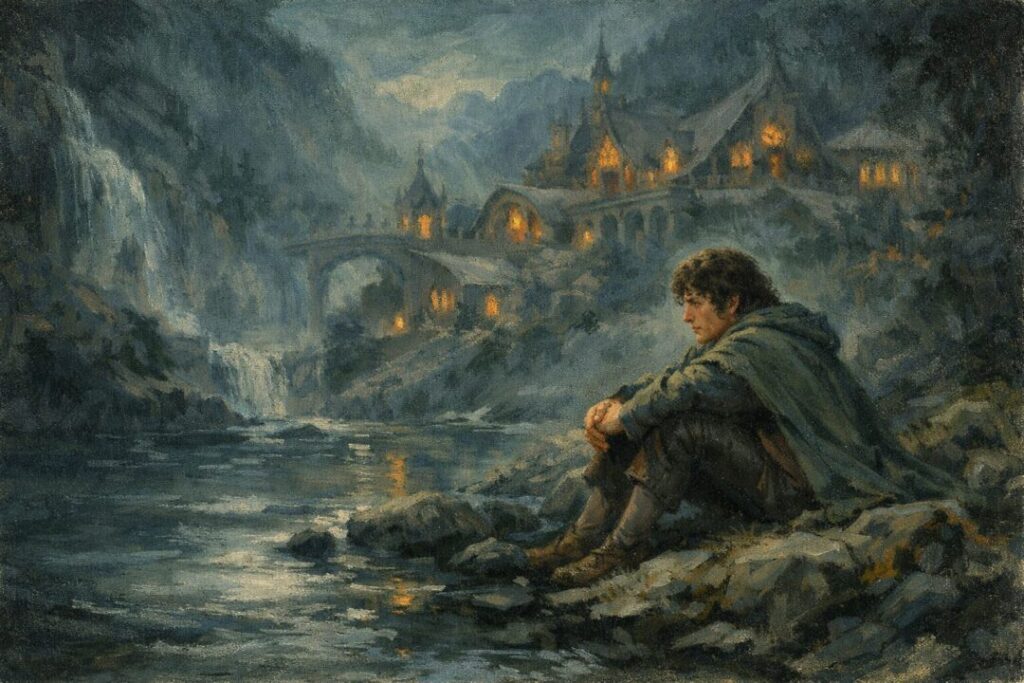
Many of the Elves who walk its halls have lived through wars older than the Shire itself. They have seen kingdoms fall, alliances shatter, and darkness rise and retreat again. But their pain belongs to the past. It has been remembered, processed, and woven into song and story. Frodo’s pain is not memory. It is current. Ongoing. He cannot step away from it.
When the Wise speak of the nature of the Ring, Frodo is the only one whose body reacts. His chest tightens. His thoughts scatter. Fear rises without warning or clear cause. Others debate corruption in careful words; Frodo feels its pull like a low hum beneath every moment of silence. The Ring is not an idea to him. It is weight.
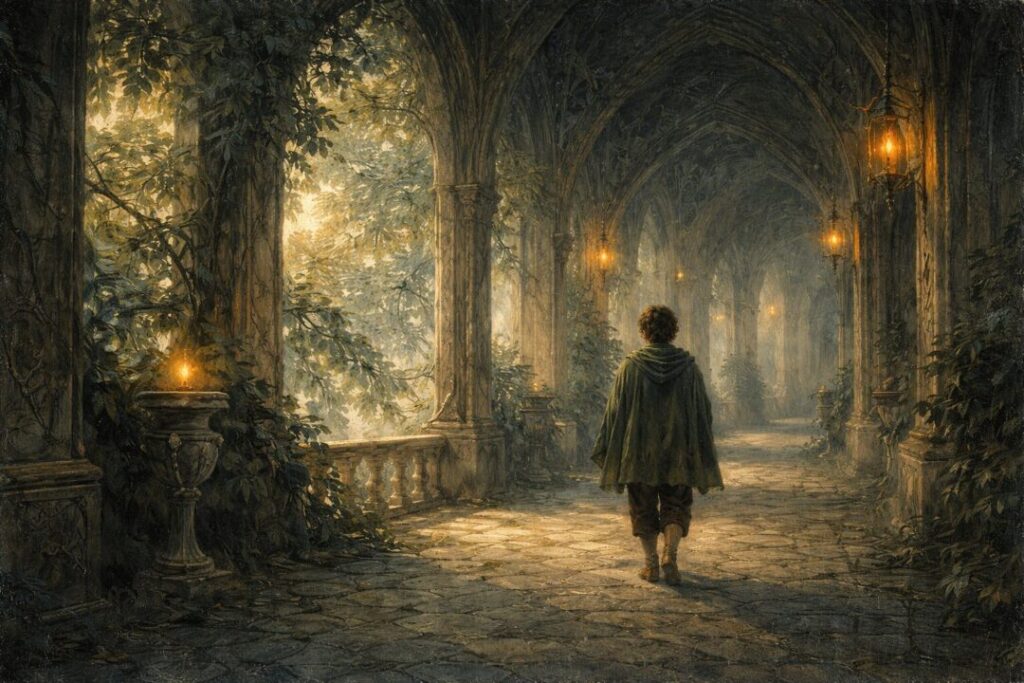
He is not trained for this life.
Hobbits are not raised for prophecy. They are raised for meals shared at regular hours, for gardens tended patiently, for evenings that end in song or stories by the fire. Frodo’s childhood in the Shire taught him kindness, loyalty, and a quiet resilience—but not how to carry the fate of the world in his pocket. He knows how to endure discomfort, not obsession. Loss, not temptation.
So when the Elves speak to him of patience and endurance, Frodo listens politely. He nods. He thanks them. And somewhere inside, he wonders how anyone could expect him to endure this forever. Elves measure time in centuries. Frodo measures it in heartbeats and sleepless nights.
Rivendell itself only deepens the distance he feels.
The valley is beautiful, but restrained. Calm. Orderly. Everything has its place. For someone who grew up with laughter spilling from open doors and the comforting chaos of Hobbit gatherings, that stillness can feel heavy. There is little noise here, little shared struggle. Even sorrow is carried with dignity and control.
Everyone belongs.
Everyone, except him.
Frodo is not truly a student of Elven lore, though he listens. He is not a guest in the ordinary sense, though he is welcomed. He is not a warrior, though danger follows him everywhere. He exists in a strange in-between space: honored, protected, and quietly observed. People speak gently around him. They avoid pressing questions. They offer comfort without intrusion.
That kindness, though well-intended, sharpens his sense of being different.
He becomes aware of the way conversations pause when he enters a room, of the careful looks that pass between Elves who know more than they say. He feels watched, not with suspicion, but with concern—and concern can be just as isolating. It reminds him that he is fragile. That he is temporary. That he carries something far older and stronger than himself.
And then there is the Council.
At the Council of Elrond, the fate of the Ring is debated openly—but the burden is not. Strategies are discussed. Risks are weighed. History is cited in long, measured speeches. The room is filled with voices that have shaped the world.
And at the center of it all sits Frodo, small and silent, slowly realizing that no one else in that room will have to live with the decision they are making.
Others may fight. Others may guide. Others may advise.
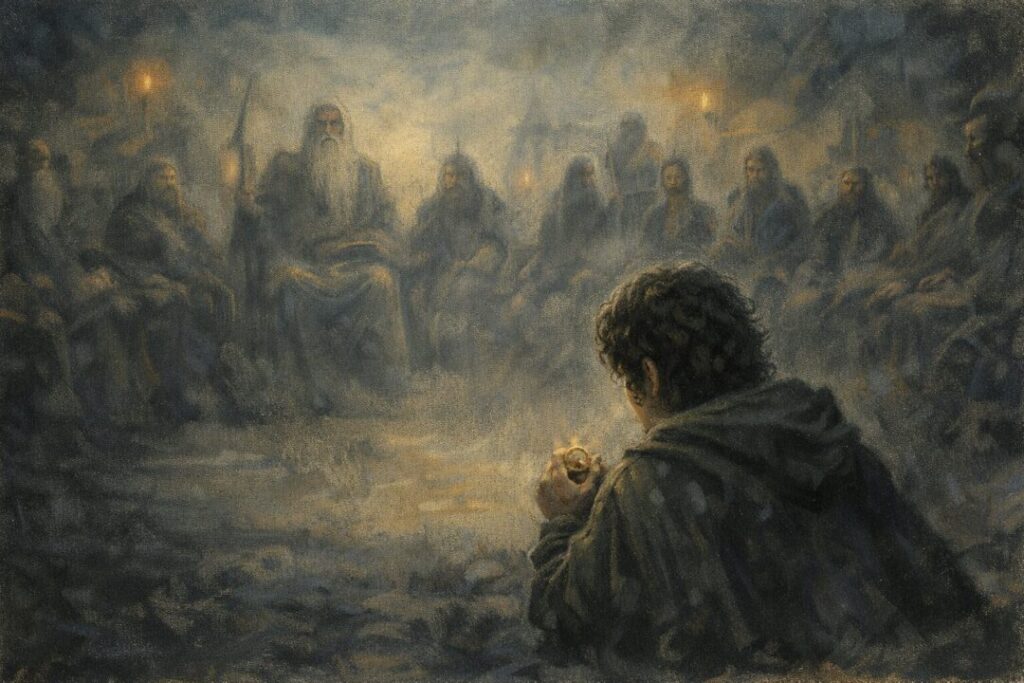
But only he will carry it.
The Ring does not challenge Frodo in ways that can be trained away. There is no lesson that prepares him for temptation. No discipline that dulls fear. Like a wound that never quite heals, the Ring presses inward. Looking inside himself does not bring clarity or peace. It brings noise. Whispers. Pressure. A sense that something within him is growing louder the longer he tries to ignore it.
In Rivendell, reflection is encouraged. Frodo learns quickly that reflection is dangerous.
The more stillness he finds, the clearer the Ring becomes. Silence does not soothe it—it amplifies it. So Frodo begins to withdraw, not out of pride or resentment, but out of self-preservation. He walks alone. He keeps his thoughts to himself. He learns how to appear calm while carrying something that never rests.
Not because he wants to be alone—but because he does not know how to explain what he feels without sounding ungrateful, or afraid, or weak. He has been saved. Protected. Honored. And yet he feels heavier than he ever did on the road.
That is the quiet tragedy of Frodo’s time in Rivendell.
It is not that he suffers. Suffering is expected in stories of great deeds.
It is that he suffers quietly, surrounded by wisdom, without anyone who truly shares his experience. The Ring sets him apart in ways that kindness cannot bridge. No amount of beauty can ease the knowledge that his path leads only forward—and almost certainly toward loss.
Rivendell prepares Frodo for the journey ahead. It heals his body. It sharpens his understanding. It gives him time to rest.
But it also teaches him something far more important: that this burden cannot be passed on. That choice, once made, belongs to him alone.
And so, in the calm of that hidden valley, Frodo becomes what he will need to be—not because he is ready, not because he is fearless, but because no one else can do it.
That is the true weight he carries out of Rivendell.