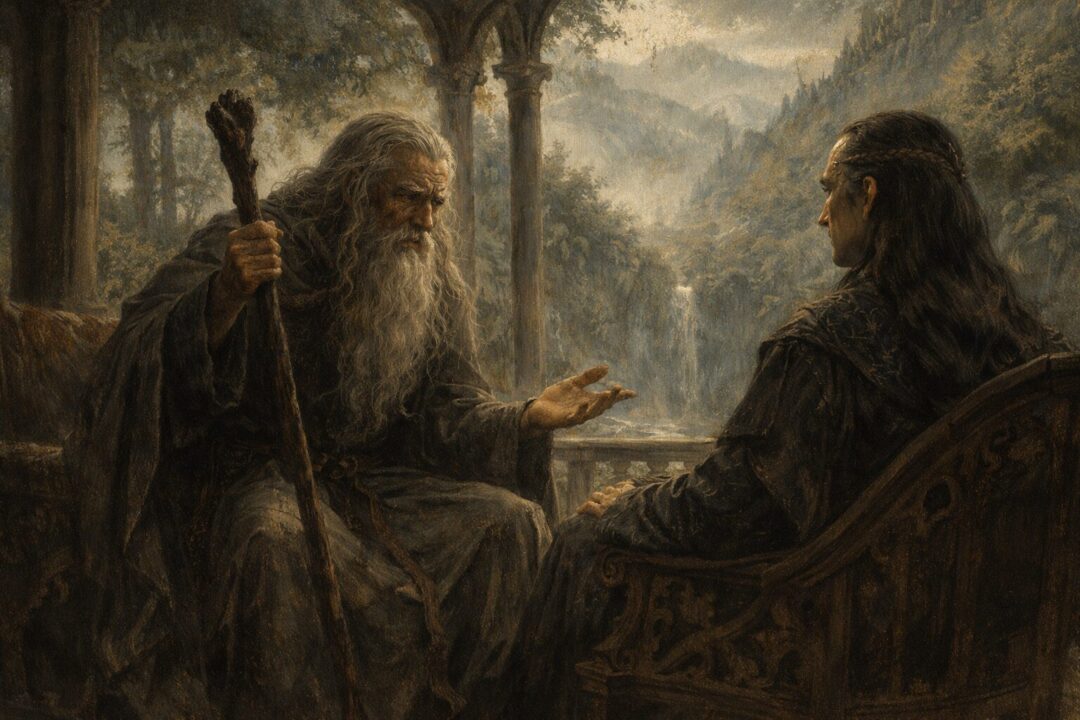
In the film adaptations of The Lord of the Rings, Gandalf can feel almost contradictory.
At times, he appears genuinely old: climbing stairs slowly, pausing to catch his breath, leaning heavily on his staff. His voice carries the weight of centuries, and his posture suggests someone who has walked too far and carried too much for too long.
Then, without warning, that same figure stands unyielding before creatures of shadow and flame. He shatters stone with a spoken word, holds back enemies that scatter armies, and commands battlefields with calm authority.
It’s easy to assume this contrast is merely cinematic shorthand — an old wizard who pretends to be frail until the moment demands spectacle.
But Middle-earth does not operate on illusion in that way.
In Tolkien’s world, age, limitation, and restraint are not costumes that power wears for convenience. They are rules. And Gandalf is bound by them more tightly than most.
The Istari Were Meant to Feel Old
Gandalf was not simply a powerful being hiding behind the appearance of an elderly man.
As one of the Istari, he was deliberately placed into a body that could weaken, tire, hunger, and ultimately fail.
This was not a punishment. It was a design choice.
The Istari were sent to Middle-earth with a very specific mission: to oppose Sauron not through domination, but through guidance. They were forbidden from matching raw power with raw power. They were meant to advise, encourage, warn, and inspire — not to rule.
To ensure this, they were clothed in mortal forms.
These forms were not illusions. They were not masks that could be discarded at will. They were real bodies, subject to pain, fatigue, and fear. Gandalf’s stiffness, slowness, and visible age were not theatrics. They were the cost of incarnation.
Unlike many fantasy mentors who remain physically unchanged while centuries pass, Gandalf was meant to feel time. To know weariness. To understand mortality from the inside.
Only by sharing the limitations of those he guided could he truly serve them.
Power in Middle-earth Is Always Conditional
One of the most misunderstood aspects of Middle-earth is how power actually works.
In many fictional worlds, power is a resource — something a character can access freely as long as they are skilled or strong enough. Exhaustion is temporary. Consequences are cosmetic.
Middle-earth rejects that idea entirely.
Here, power always leaves a mark.
When Gandalf drives off the wolves in The Hobbit, he collapses afterward. When he holds off the Nazgûl at Weathertop, he does not pursue them — he withdraws. Even his most impressive displays are followed by silence, rest, or retreat.
Power is not something Gandalf has.
It is something he channels — carefully, deliberately, and sparingly.
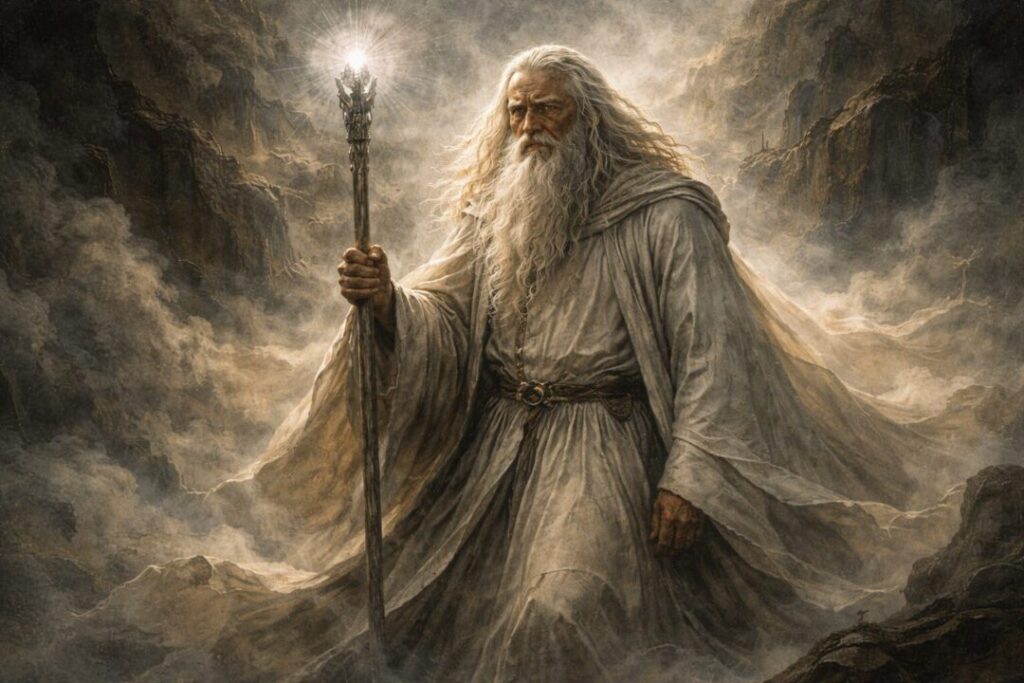
Even after his return as Gandalf the White, his strength is not limitless. It is clearer, more focused, but still restrained. He does not throw lightning across battlefields or tear down fortresses with a gesture. He speaks, commands, and intervenes only when absolutely necessary.
The staff he carries reflects this philosophy.
It is not merely a symbol of office. It is an anchor — a focus through which power is directed, limited, and controlled. When Saruman’s staff is broken, it is not just a humiliation. It is the removal of restraint from someone who has already abused power.
Breaking those limits is dangerous.
The Balrog Was Not a Typical Battle
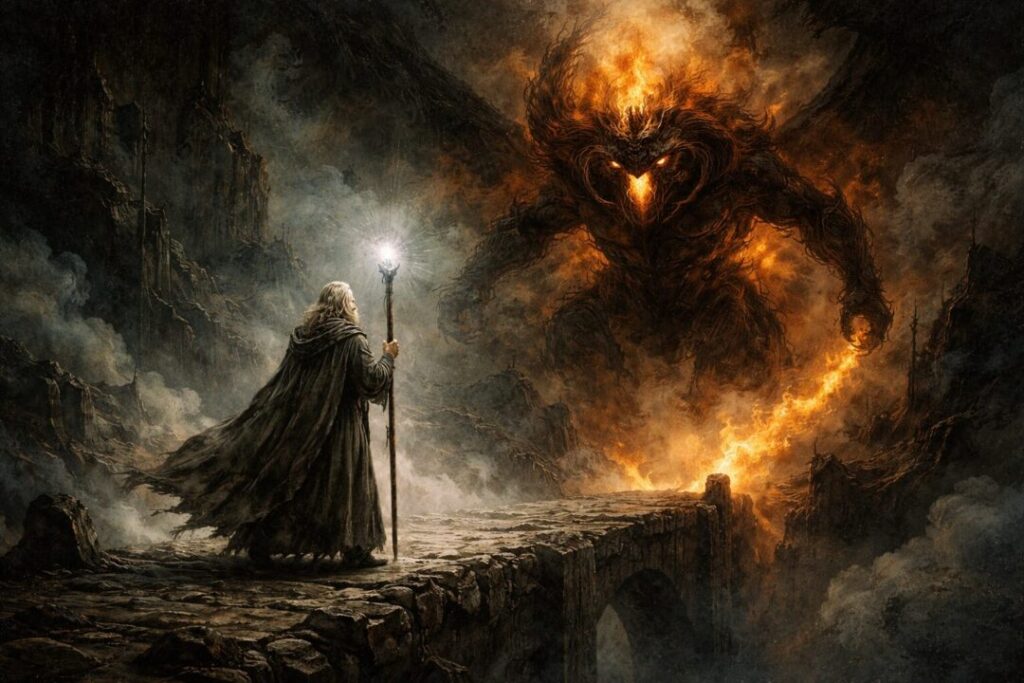
The confrontation in Moria is often remembered as a moment of heroic sacrifice. But it is far more than that.
When Gandalf faces the Balrog, he is not fighting a monster in the conventional sense. He is confronting a being of the same order as himself — a Maia, ancient, corrupted, and unbound by the same restrictions.
This is not a duel meant to be won cleanly.
It is an emergency.
To stop the Balrog, Gandalf must abandon the careful balance he has maintained for centuries. He does not simply fight harder. He burns through the restraints placed upon him.
The language he uses changes. His authority becomes absolute. The tone shifts from guidance to command.
And it costs him everything.
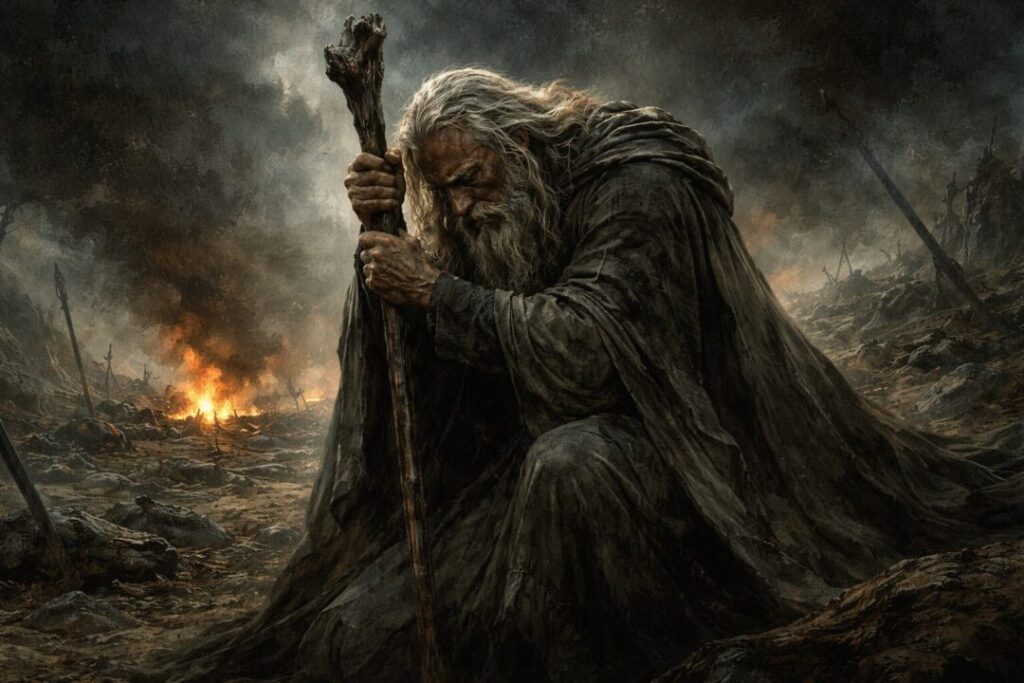
Gandalf’s death is not incidental. It is not bad luck or an unfortunate outcome of a heroic stand. It is the direct result of exceeding what his embodied form was meant to endure.
His body — already aged, already burdened — cannot survive that release of power.
He wins the battle, but the price is death.
Death as Consequence, Not Failure
This is one of the most important points often overlooked.
Gandalf does not die because he is weak.
He dies because he breaks the rules.
Only intervention beyond Middle-earth restores him — and even then, he does not return unchanged. He comes back as Gandalf the White not because he has “leveled up,” but because his task is now narrower and more urgent.
Even then, his role remains the same: guide, not dominate.
Why Gandalf Rarely Shows His Full Strength
After his return, Gandalf is more commanding, more decisive, and less patient with foolishness. But he is not reckless.
He does not duel Saruman again. He does not confront Sauron directly. He does not seize control of armies or crowns.
Instead, he places responsibility where it belongs — on the Free Peoples of Middle-earth.
He prepares Aragorn to claim his throne.
He pushes Théoden to act rather than despair.
He trusts Hobbits with the fate of the world.
Because Middle-earth does not survive through displays of overwhelming power.
It survives through restraint, courage, and choice.
Gandalf understands that better than anyone.
Age Was the Price, Not the Weakness
It is tempting to see Gandalf’s age as a contradiction — an old body housing an ageless spirit.
But that tension is the point.
His age grounds him. It limits him. It reminds him — and everyone around him — that power unchecked is not salvation.
His slowness, his weariness, his reluctance to act are not flaws.
They are safeguards.
Gandalf’s greatness lies not in how much power he possesses, but in how little he uses.
His age was not weakness.
It was the price of being allowed to walk among mortals at all.
And perhaps the reason Middle-earth survives is because he was willing to pay it.