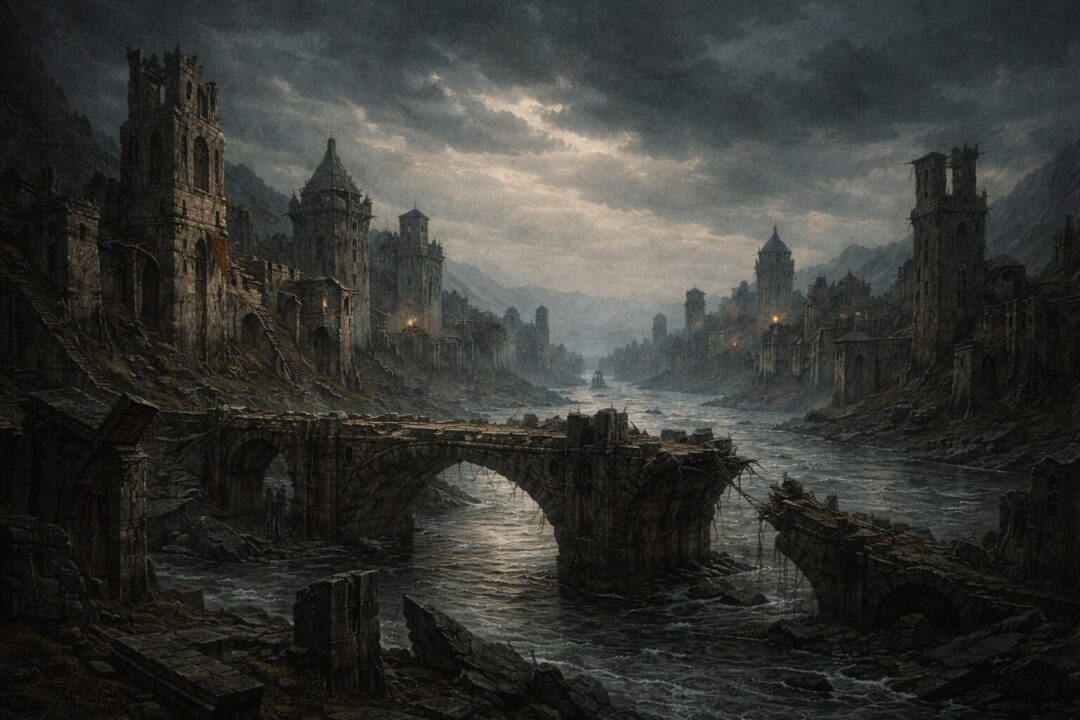
When readers think of Gondor’s fall, the image that most often comes to mind is dramatic and immediate: the white walls of Minas Tirith under siege, fires burning in the Pelennor Fields, the kingdom pressed to the edge of annihilation in a single, terrible hour.
It feels sudden. Violent. Apocalyptic.
But this framing is misleading.
The War of the Ring does not mark the beginning of Gondor’s decline. It marks the moment when that decline can no longer be hidden. By the time Sauron openly returns to power, Gondor is already a realm in long decay—politically diminished, territorially reduced, and sustained more by memory, discipline, and endurance than by strength.
Understanding this changes how nearly every major event involving Gondor should be read. The siege of Minas Tirith is not the collapse of a healthy kingdom. It is the final strain placed on one that has been holding together for centuries.
The Loss of the Kings
Gondor’s decline does not begin with invasion or defeat.
It begins with absence.
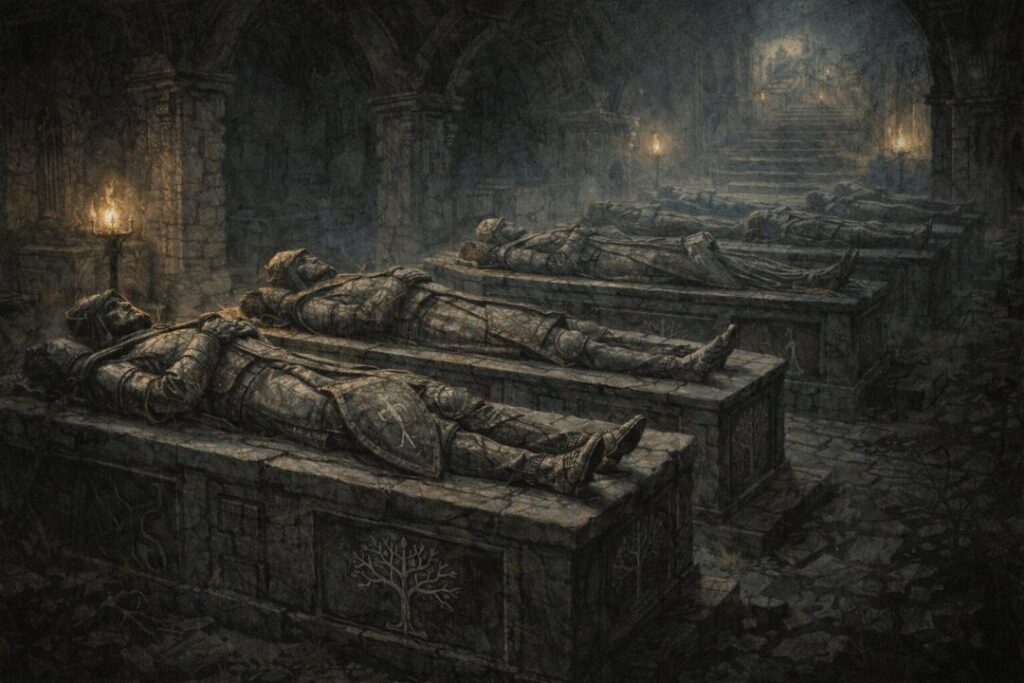
After the death of King Eärnur in the year 2050 of the Third Age, the royal line fails. Eärnur rides to meet the Witch-king and never returns, leaving no heir. From that moment onward, no king claims the throne of Gondor again.
Instead, the realm passes into the hands of the Stewards, who rule “until the King returns.”
This arrangement is lawful, accepted, and necessary. The texts are clear on this point. The Stewards are not usurpers. They govern with care, discipline, and deep loyalty to Gondor’s traditions. Several are explicitly described as wise and capable rulers.
But the system is not permanent by design.
The Steward rules in trust, not by inherent right. Authority continues, but legitimacy becomes conditional—tied to a future restoration that never arrives. Over time, this creates a subtle but accumulating instability. Gondor becomes a kingdom waiting for something that does not come, shaped by stewardship rather than sovereignty.
Nothing collapses overnight. But something essential is missing.
Shrinking Borders and Lost Cities
At its height, Gondor was vast. Its power extended far beyond the Anduin, supported by great cities, strong borders, and active governance across its territories.
By the late Third Age, this is no longer true.
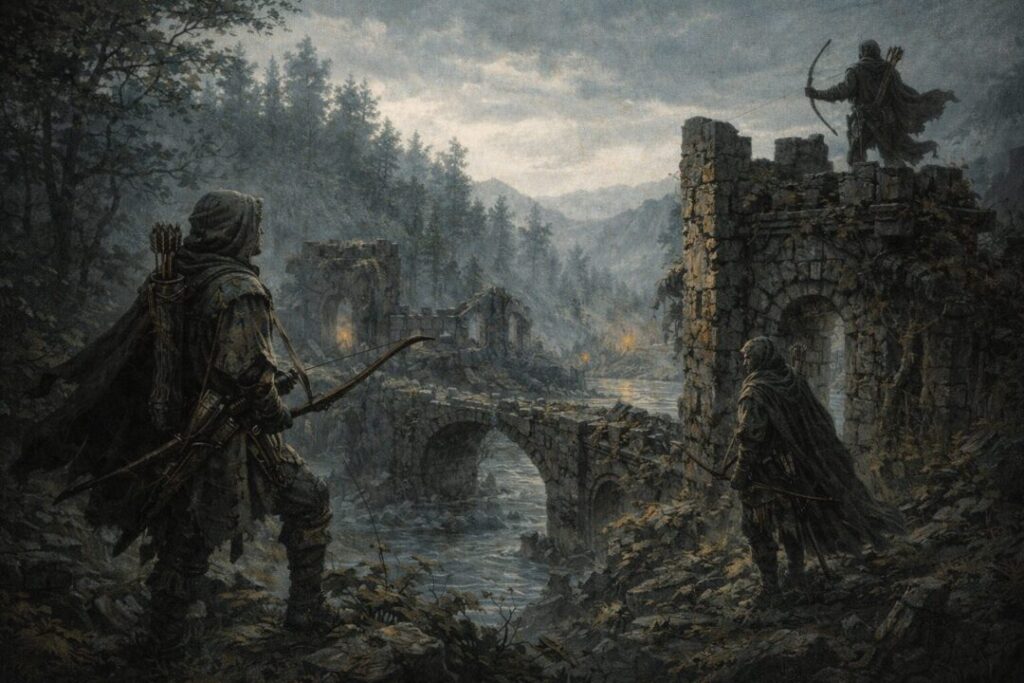
Osgiliath, once the capital and chief city of the realm, lies in ruin—abandoned, contested, and finally reduced to a shell of its former importance. Ithilien, once a flourishing eastern province, becomes a dangerous borderland, patrolled by rangers rather than governed as a settled land.
Gondor’s eastern defenses no longer project confidence or control. They delay loss.
These changes are not sudden. They are not caused by Sauron’s open return. They are the result of long attrition—of borders that cannot be fully held, cities that cannot be rebuilt, and territories that slip from active rule into memory.
The realm does not shatter.
It contracts.
Plague, Kin-strife, and Accumulated Loss
Gondor’s weakening cannot be traced to a single disaster. It is the result of accumulation.
The Great Plague devastates its population, leaving cities emptied and strength diminished for generations. The Kin-strife—a civil war born of disputed succession—damages internal unity and permanently weakens the realm’s political cohesion. Continuous pressure from the South and East drains men, attention, and resources.
None of these events ends Gondor.
Together, they ensure it never fully recovers.
By the time the War of the Ring begins, Gondor is not a rising power preparing to meet a great enemy. It is a realm that has already endured too much, surviving through resilience rather than renewal.
Denethor’s Gondor: Order Without Renewal
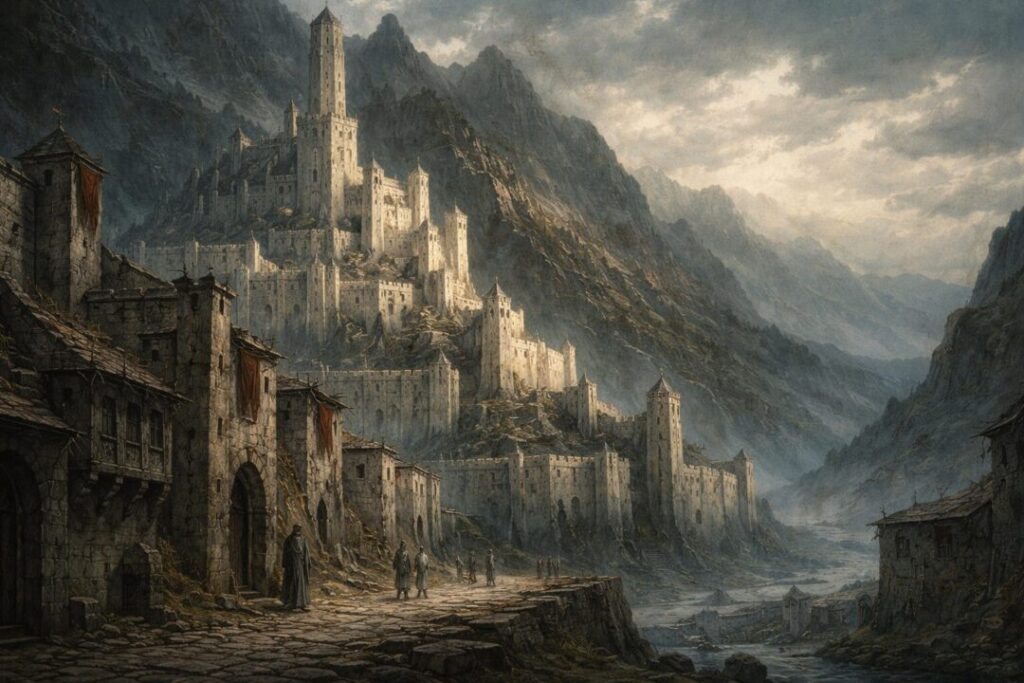
Under Denethor II, Gondor is disciplined, vigilant, and proud.
It is also brittle.
Its armies fight defensively. Its victories are delaying actions. Its strategy is focused on preservation rather than expansion or restoration. This is not cowardice, and it is not incompetence. It is realism born of long experience.
Denethor governs a kingdom that no longer has reserves to spend.
His despair—often misunderstood—is rooted not only in fear of Sauron, but in the knowledge that Gondor has been spending its strength for generations. Every loss matters. Every failure carries weight. There is no surplus left to absorb catastrophe.
The War of the Ring does not arrive when Gondor is strong.
It arrives when Gondor is tired.
Sauron as the Revealer, Not the Cause
One of the most important points the texts imply—though never state outright—is that Sauron does not create Gondor’s weakness.
He exploits it.
His strategy succeeds because Gondor is already strained: its manpower limited, its leadership isolated, its alliances fragile. The pressure he applies works precisely because the realm has been holding its ground for centuries without renewal.
A fully restored Gondor, united and at its ancient strength, would be a different problem entirely.
What Sauron faces instead is a kingdom still standing—but standing at the edge of its endurance.
Why Gondor’s Survival Requires Change
Gondor does not endure because it holds the line.
It endures because it is transformed.
The return of the King does not restore Gondor to its ancient imperial height. The texts never suggest such a return to dominance. Instead, it restores legitimacy, healing, and continuity—things the realm has lacked for generations.
Gondor survives by becoming something new, not by reclaiming everything it once was.
That is the quiet tragedy at the heart of its story.
The kingdom that resisted darkness for centuries cannot remain unchanged. It can only pass into a new age—or fade entirely.
And in that sense, Gondor’s story mirrors the larger movement of Middle-earth itself: not a tale of endless restoration, but of necessary endings, painful endurance, and renewal that comes only through loss.