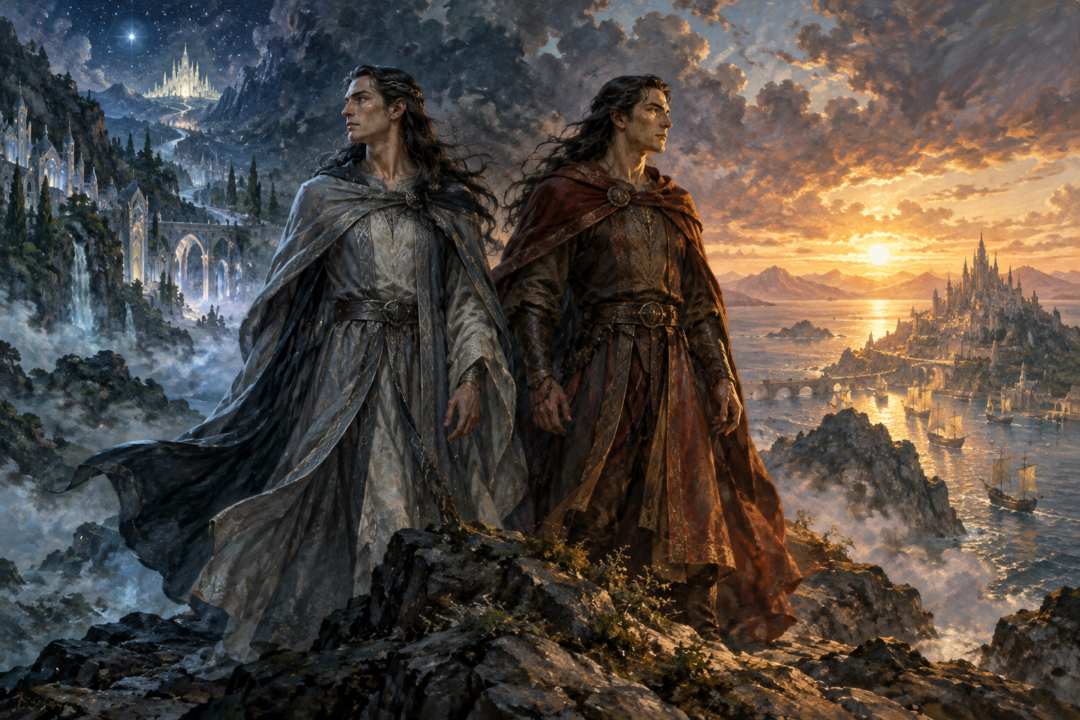
Elrond and Elros were twin brothers. They had the same father, the same mother, and exactly the same ancestry. Yet Elrond became one of the great Elven lords of Middle-earth, while Elros became a mortal Man, founded the royal house of Númenor, grew old, and died.
That alone should warn us that “Half-elven” does not work like a modern ancestry percentage.
The family of the Peredhil—the Half-elven—is certainly built from unions between Elves and Men. Blood and descent matter enormously. But when the texts reach Eärendil, Elwing, Elrond, Elros, and later Elrond’s children, the decisive question is no longer simply how much Elvish or Mannish ancestry someone possesses.
The deeper question is: to which of the Two Kindreds is this person ultimately joined?
That is why “Half-elven” is best understood, in these central cases, as a category bound up with lineage and fate rather than as a literal biological calculation.
The Two Kindreds Do Not Merely Have Different Lifespans
The distinction between Elves and Men goes deeper than one race living longer than another.
Both are Children of Ilúvatar, but their ultimate relationships with the world differ. Elves remain bound to Arda for its duration. Men die and depart from the world to a destiny that the Elves do not share and do not fully understand.
This is why mortality in Middle-earth cannot simply be treated as a medical condition that enough Elvish ancestry might overcome.
The Númenóreans provide the clearest warning against that interpretation. They possessed extraordinary longevity compared with ordinary Men, particularly in the earlier generations, yet they remained mortal. Their tragedy eventually arose partly because many came to resent precisely that distinction.
Long life was not immortality.
The Doom—or Gift—of Men remained theirs.
Against that background, the Half-elven become extraordinary. Their importance lies not merely in having mixed ancestry but, for the line specially granted the Choice, in standing at the boundary between two fundamentally different fates.
Eärendil Forces the Question Into the Open
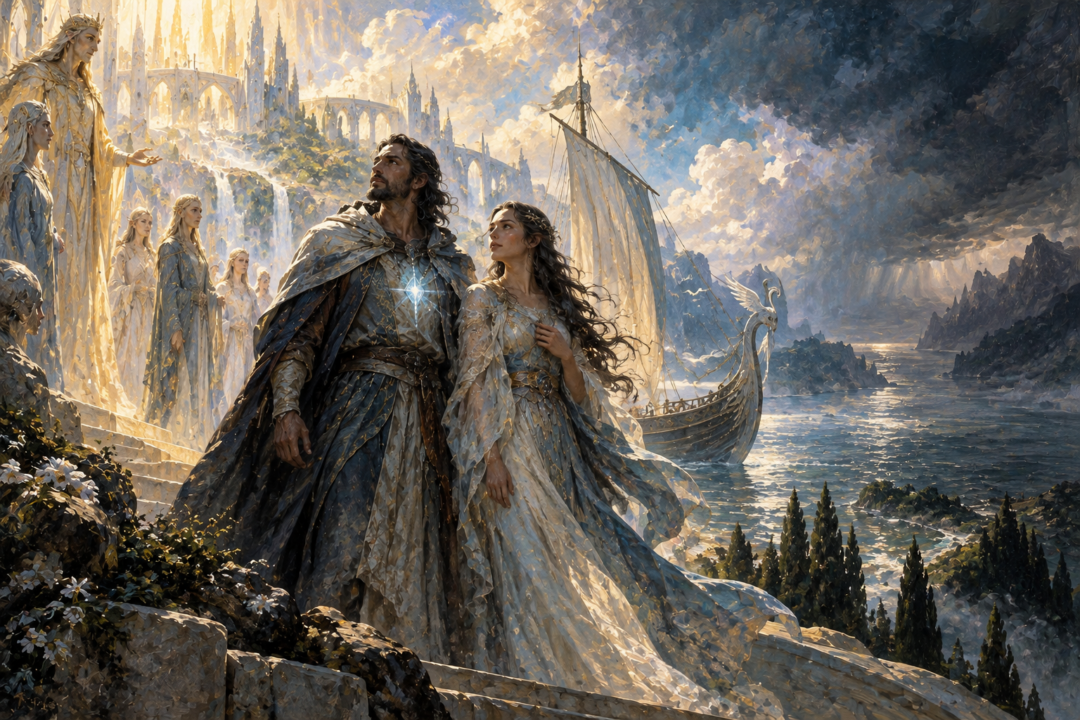
Eärendil is the son of Tuor, a Man, and Idril Celebrindal, an Elf of Gondolin. His wife Elwing also unites the great lines of Elves and Men: she descends from Beren and Lúthien through their son Dior.
When Eärendil finally reaches Aman seeking aid against Morgoth, his presence creates a problem that cannot be answered by drawing a family tree and calculating fractions.
In The Silmarillion, the debate surrounding him explicitly asks whether he is to be understood through Tuor, his mortal father, or Idril, his Elven mother.
Manwë’s judgment resolves the matter by granting Eärendil, Elwing, and their sons freedom to choose to which kindred their fates will be joined and under which they will be judged.
That language is crucial.
The decree concerns kindred, fate, and judgment.
It does not say that their Elvish and Mannish components will be measured against each other until one side exceeds fifty percent.
Indeed, earlier textual versions of this material make the principle even more explicit: possession of mortal blood, however small, normally brings mortality unless another doom is specially granted. That sentence was not retained in the published Silmarillion, so it should not simply be treated as though it appears there. But it helps illuminate how the problem was conceived during the development of the legendarium.
The Choice is exceptional.
Elwing Is Already Proof That the Mathematics Do Not Work
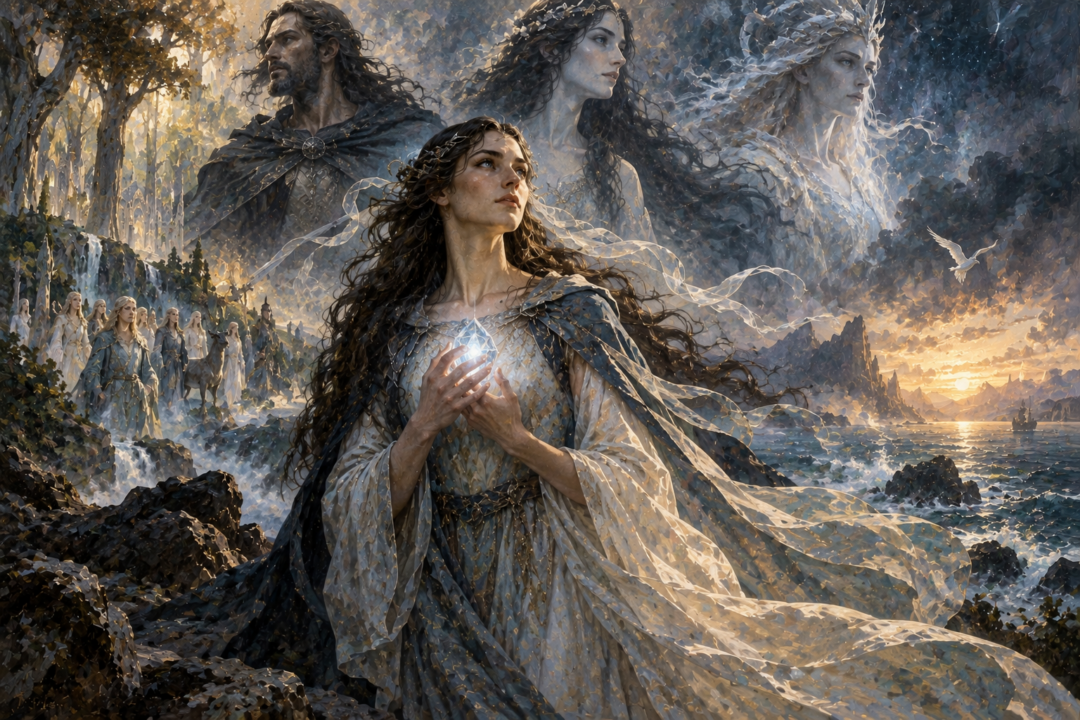
Consider Elwing.
Her father Dior is the son of Beren and Lúthien. But Lúthien herself is not simply an Elf in genealogical terms: her mother is Melian, one of the Maiar.
Elwing’s mother, Nimloth, is an Elf.
So Elwing’s ancestry cannot sensibly be described by the everyday meaning of “half Elf, half Man.” She carries descent from Men, Elves, and through Melian even the Ainur.
Nevertheless, she belongs to the Half-elven story.
That immediately reveals the weakness of treating “Half-elven” as a precise fraction.
The term identifies a lineage in which the fates of Elves and Men have met. In the case of Eärendil, Elwing, and their descendants who receive the Choice, that meeting becomes a question requiring an actual judgment about destiny.
Elwing chooses to be counted among the Firstborn. Eärendil chooses likewise for her sake, although the published Silmarillion says that his heart was more with the people of his mortal father.
Their ancestry does not change.
Their doom does.
Elrond and Elros Destroy the Percentage Theory Completely
Their sons make the point unmistakable.
Elrond and Elros are twins.
No genealogical calculation can distinguish them. Whatever fraction of their ancestry comes from Elves, Men, or Melian is identical.
Yet their final destinies diverge.
Elrond chooses to be numbered with the Elves. He remains in Middle-earth through the Second and Third Ages, eventually becoming master of Rivendell and bearer of Vilya.
Elros chooses the fate of Men.
He becomes Tar-Minyatur, first King of Númenor, and receives an extraordinarily long life. According to the chronology preserved in the Appendices, he dies at five hundred years of age.
But five hundred years is still a mortal life.
Elros does not become “less Half-elven” genetically than Elrond. Elrond does not suddenly acquire more Elvish ancestors.
The brothers possess the same ancestry and receive different dooms.
That is perhaps the clearest possible demonstration that the central meaning of their Half-elven condition cannot be reduced to blood percentage.
Elros Makes the Choice—and His Descendants Are Men
The next generation makes the distinction even sharper.
Elros has children.
They do not continue choosing between Elvish immortality and the Doom of Men generation after generation. They belong to the mortal line.
This point is explicitly clarified in Tolkien’s Letter 153: Elros chose mortality, and his descendants are mortal.
That matters because the descendants of Elros include the Kings of Númenor, the Lords of Andúnië, Elendil, Isildur, the Dúnedain of Arnor, and eventually Aragorn.
Aragorn therefore possesses extraordinarily distinguished Elvish ancestry. Through Elros he descends from Eärendil and Elwing, Tuor and Idril, Beren and Lúthien, and ultimately Melian.
Yet Aragorn is a Man.
He does not receive Elrond’s choice simply because Elrond is his distant kinsman or because Elvish blood remains in his lineage.
His mortality is not determined by calculating how diluted that ancestry has become.
The line of Elros has already entered the fate of Men.
Elrond’s Children Show the Other Side of the Rule
Elrond chooses differently, and something remarkable happens with his children.
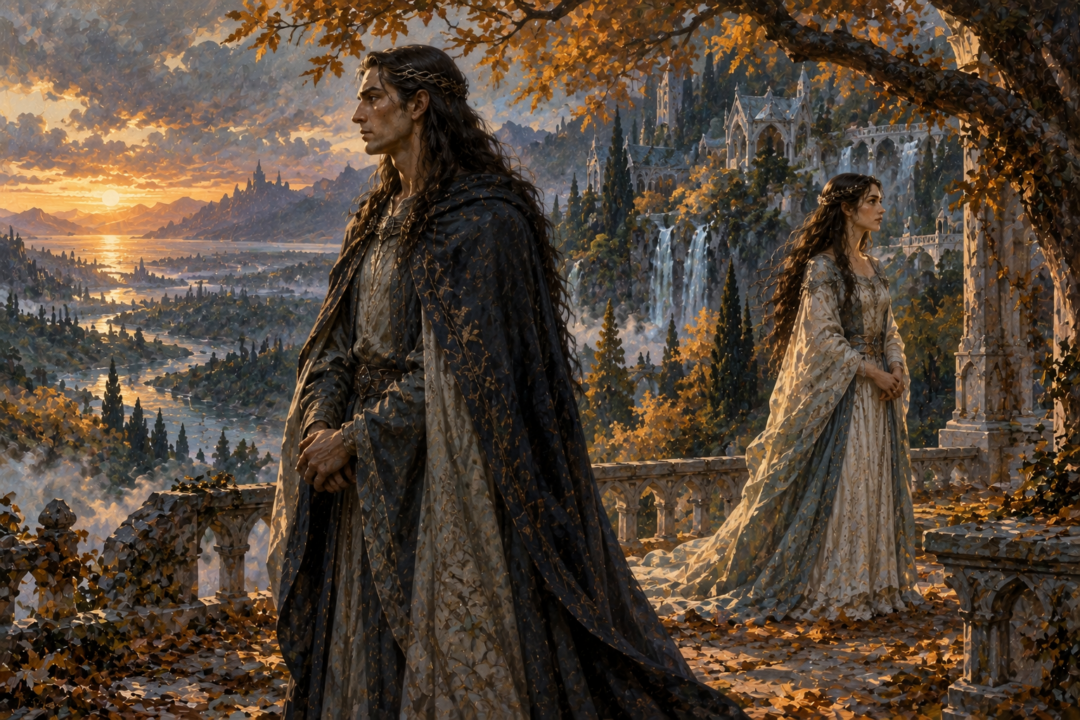
Arwen, Elladan, and Elrohir inherit the unresolved Choice associated with Elrond’s line.
Appendix A of The Lord of the Rings, in “The Tale of Aragorn and Arwen,” makes the approaching decision central to Elrond’s sorrow. Aragorn understands that Elrond’s children must eventually face a parting: with their father, or with Middle-earth.
Arwen chooses mortality through her union with Aragorn.
Again, nothing changes in her ancestry at the moment of that decision.
She remains the daughter of Elrond and Celebrían, granddaughter of Galadriel and Celeborn, and descendant of the ancient houses of both Elves and Men.
But her fate changes decisively.
After Elrond departs Middle-earth, Arwen is described as having become mortal. When Aragorn eventually dies, she acknowledges that the Doom of Men is now hers.
The choice is no metaphor.
It determines the ultimate destiny she shares.
The final choices of Elladan and Elrohir, however, are not explicitly recorded. They remain in Middle-earth for a time after Elrond’s departure, but the surviving narrative does not give us a definitive statement of their ultimate fate. Claims that they certainly chose mortality or certainly sailed West therefore go beyond what the texts establish.
Not Everyone With Mixed Ancestry Receives the Choice
This is where an important distinction must be made.
It is tempting to formulate a universal rule: whenever an Elf and a Man have a child, that child automatically gets to choose between mortality and immortality.
The texts do not support so broad a rule.
The famous Choice is specifically granted in connection with Eärendil, Elwing, their sons, and subsequently Elrond’s children. It is a special doom associated with this extraordinary lineage.
Dior is a useful complication. He is the son of Beren and Lúthien and therefore unquestionably belongs to the mixed lineage from which Elwing descends. Yet the published narratives never give us a scene in which Dior is offered the same formal Choice later granted to Eärendil and Elwing.
Nor should the traditions concerning the Princes of Dol Amroth be used to manufacture a universal mechanism. The house of Dol Amroth was said to possess Elvish ancestry through Mithrellas, and Legolas recognizes Elvish blood in Prince Imrahil’s line. But Imrahil is plainly a Man, not someone awaiting a decision between the two dooms.
Mixed descent and the Choice of the Peredhil are therefore related ideas, but they are not automatically identical.
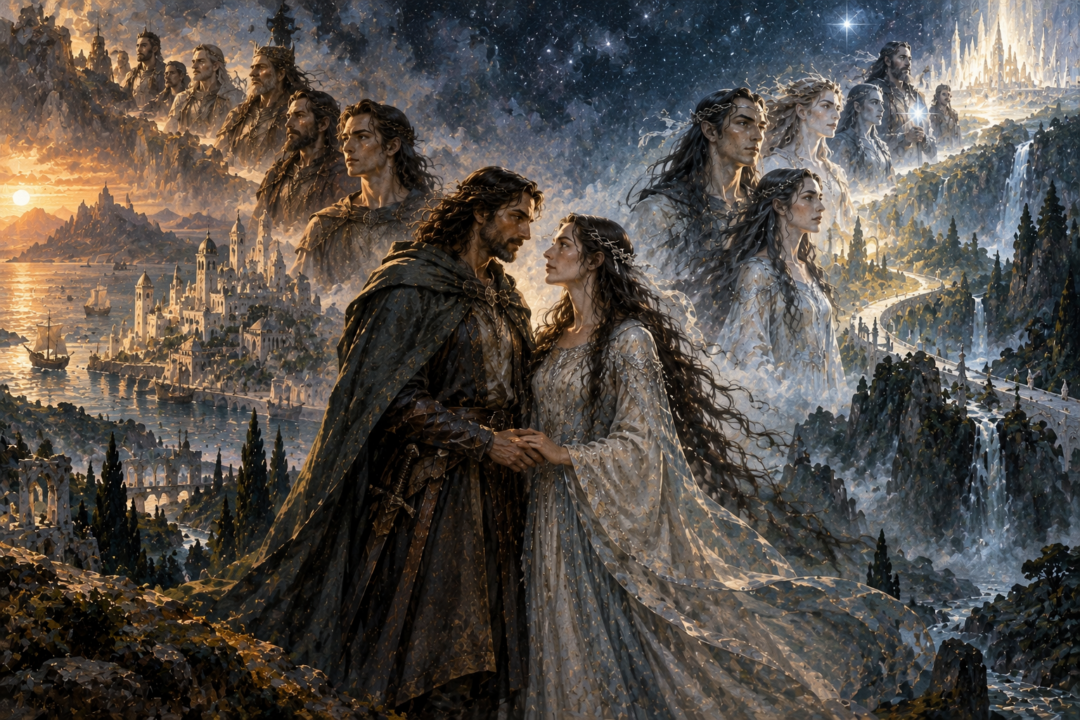
“Half-elven” Describes a Boundary in the World
The most useful way to understand the title is not as arithmetic but as a sign that two great destinies have crossed.
The Half-elven stand where some of the oldest divisions in Middle-earth become personal.
Eärendil stands between his father’s people and his mother’s.
Elwing carries the inheritance of Beren and Lúthien.
Elrond and Elros begin with identical blood and choose opposite fates.
Arwen later reverses the direction of her father’s choice, accepting mortality and joining herself to Aragorn, the distant descendant of Elros.
The symmetry is extraordinary.
The sons of Eärendil divide the family into immortal and mortal branches. Thousands of years later, those branches meet again when Aragorn and Arwen marry.
Yet they do not erase the difference between Elves and Men.
Arwen must surrender one fate to share the other.
That is the hidden weight behind the word “Half-elven.” It does not mean that someone is walking around Middle-earth as precisely fifty percent Elf. Genealogy explains how the boundary was reached, but ancestry alone does not determine what happens once that boundary becomes a matter of doom.
For the central line of the Peredhil, “Half-elven” is ultimately about something far more consequential than percentages.
It is about which destiny will claim you when the two kindreds in your blood lead beyond the circles of the world in different directions.
Sources & Notes
- Half-elven — the Choice of Eärendil's line: https://tolkiengateway.net/wiki/Half-elven
- Elros — twin of Elrond who chose mortality and founded Númenor: https://tolkiengateway.net/wiki/Elros
- Arwen — Elrond's daughter and her mortal choice: https://tolkiengateway.net/wiki/Arwen
Sources checked for relevance and availability.