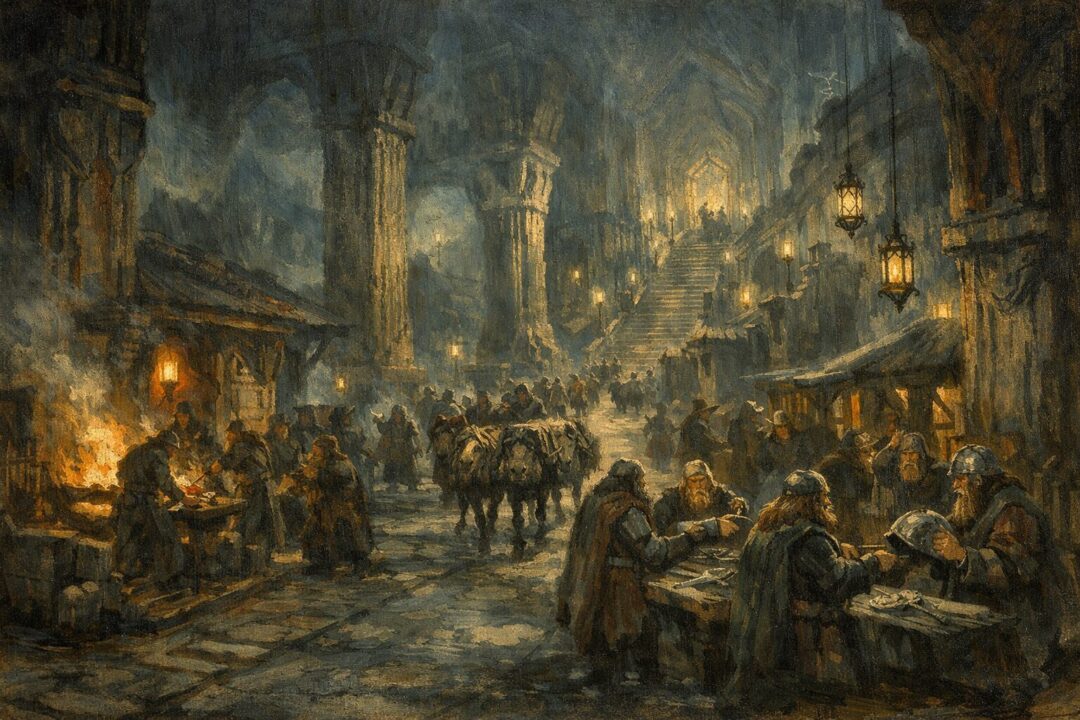
When readers picture a Dwarf realm in Middle-earth, they often imagine a contradiction.
A people living underground.
A kingdom built on ore and stone.
Generations of delving beneath a mountain.
And yet somehow the kingdom does not collapse after a few decades of exhaustion.
At first glance, that can sound implausible. A mine should run out. A treasure hoard should be spent. A mountain should eventually become empty.
But the texts quietly suggest that this is the wrong model from the beginning.
The great Dwarf kingdoms are not presented as single-purpose mines. They are presented as civilizations of stone: fortified, interconnected, technically skilled, and supported by trade as much as by extraction. That difference matters.
Because once you stop imagining Khazad-dûm or Erebor as one giant hole in a mountain, their endurance starts to make much more sense.
Khazad-dûm Was Never Just a Mine
The clearest starting point is Moria before its fall.
Readers often remember Khazad-dûm through its ending: darkness, Orcs, the Balrog, the silence of abandoned halls.
But that is not how its greatness is described.
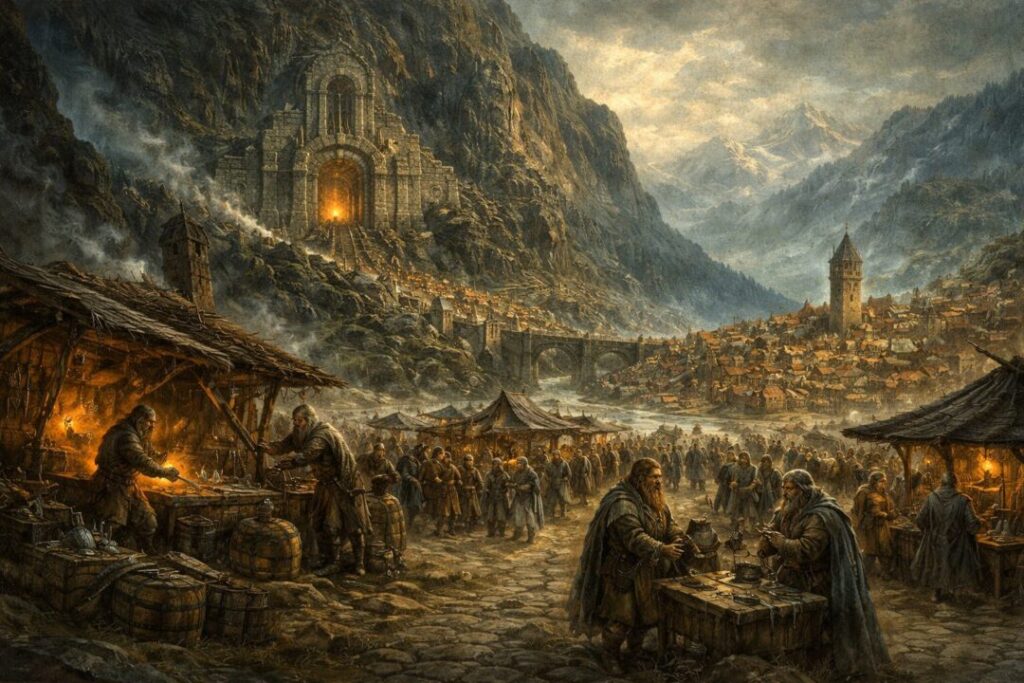
When Gandalf speaks of its former wealth, he makes an important distinction. Moria’s wealth was not mainly in gold and jewels. It was founded on mithril. He also says that the Dwarves did not need to delve for many ordinary things, because they could obtain what they desired in traffic. That line changes the whole picture.
Khazad-dûm, then, was not a sealed vault cut off from the world.
It had roads.
It had exchange.
It had the capacity to import what it did not need to mine itself.
That is exactly what a long-lived mountain kingdom would require.
If food, timber, livestock, cloth, and other everyday needs can come through trade, then the mountain does not have to provide everything. The mine becomes one pillar of the kingdom, not the whole structure.
Roads and Outlying Settlements Kept the Kingdom Alive
The Dwarves also do not seem to depend on one isolated chamber system alone.
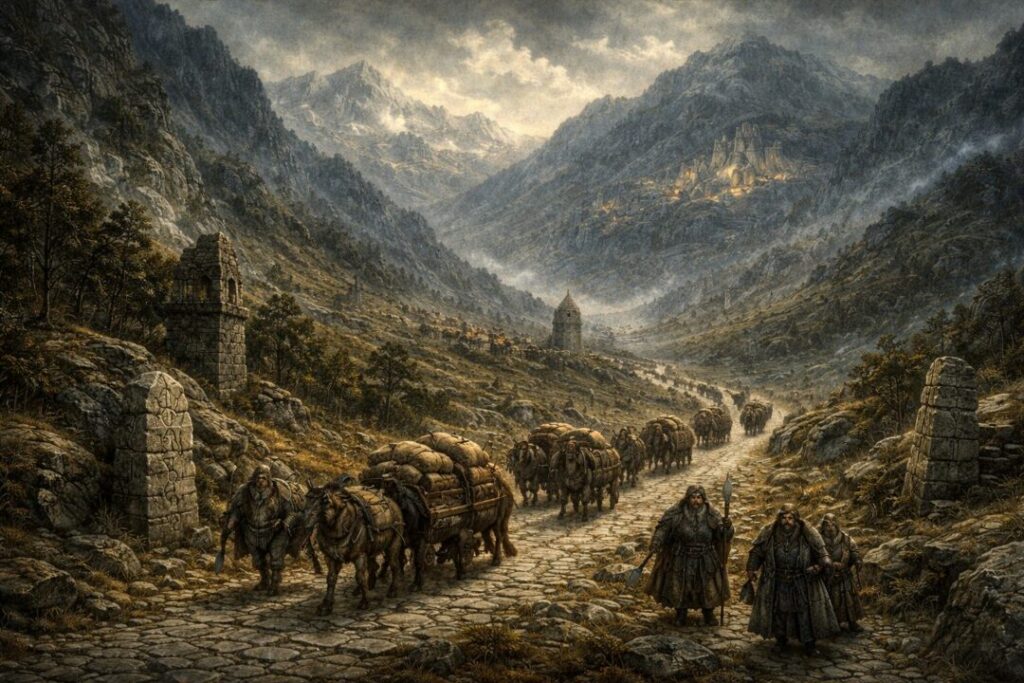
Durin’s Folk are explicitly linked to the Iron Hills, which became a primary source of iron ore, and the Dwarf-road connected those regions for traders and merchants. That matters because it shows dispersion of resources. One realm could draw wealth from more than one place, and one people could operate across several strongholds.
This pattern appears again and again in their history.
After Khazad-dûm is lost, Durin’s Folk do not vanish. They regroup. Some move to Erebor. Others gather in the Grey Mountains. Later, after dragons trouble the north, many shift again toward the Iron Hills and eventually back to Erebor under Thrór. In other words, their survival is not tied forever to one site. The people endure by moving their center of gravity when needed.
That is one of the quietest answers to the puzzle.
A Dwarf kingdom can survive centuries of mining because “the kingdom” is often larger than one mine. It is a network of halls, roads, craft traditions, royal authority, and kindred settlements.
The mountain is important.
But the people are more portable than the mountain.
Erebor Shows What Dwarven Wealth Really Looks Like
The Hobbit gives another useful clue.
When Thorin looks back on the days before Smaug, he does not describe Erebor simply as a place where metal was pulled out of the ground. He describes halls filled with armour, jewels, carvings, and cups. He also links Erebor’s prosperity with Dale, whose toy market became the wonder of the North. That is not the language of raw extraction. It is the language of finished goods, artistry, and shared regional prosperity.
This suggests a more durable economic model.
The Dwarves mine.
They refine.
They forge.
They carve.
They create objects of enormous value.
And neighboring Men participate in that prosperity through trade.
So even if a specific vein becomes harder to work, the kingdom’s wealth is not measured only by uncut ore still buried in rock. It is also measured by skill, reputation, transport, stored wealth, and manufactured goods.
That is a much more believable basis for centuries of endurance.
A people famous for making rather than merely taking would naturally stretch a mountain’s value far further than a people who only extracted and hoarded.
The Texts Do Not Show Resource Exhaustion as Their Main Problem
This is another important point.
When the great Dwarf centers fall or are abandoned, the reason is usually not that the mountain has finally been emptied.
Khazad-dûm falls because the delving reaches Durin’s Bane.
The Grey Mountains become dangerous because of dragons.
Erebor is broken by Smaug.
Balin’s colony in Moria is destroyed by hostile forces, not by lack of ore.
That does not mean the Dwarves were perfectly cautious. Quite the opposite.
Moria’s history explicitly warns that mithril, which was the foundation of their wealth, was also tied to their destruction. The texts do support the idea that excessive delving became perilous there. But even that famous warning is not really a statement that Dwarf civilization was impossible to sustain. It is a statement that one particular form of overreaching carried catastrophic risk.
So the canon picture is not:
“They mined until nothing was left.”
It is closer to:
“They could flourish for very long periods, but they were vulnerable to greed, monsters, and the dangers sleeping in deep places.”
That is a different claim, and a much narrower one.
Dwarves Do Not Treat Stone as Something to Consume
There is also a cultural clue in the way Dwarves are written.
Again and again, they are associated not just with possession of stone, but with knowledge of it.
They build halls.
They shape gates.
They recognize veins, chambers, and hidden strength.
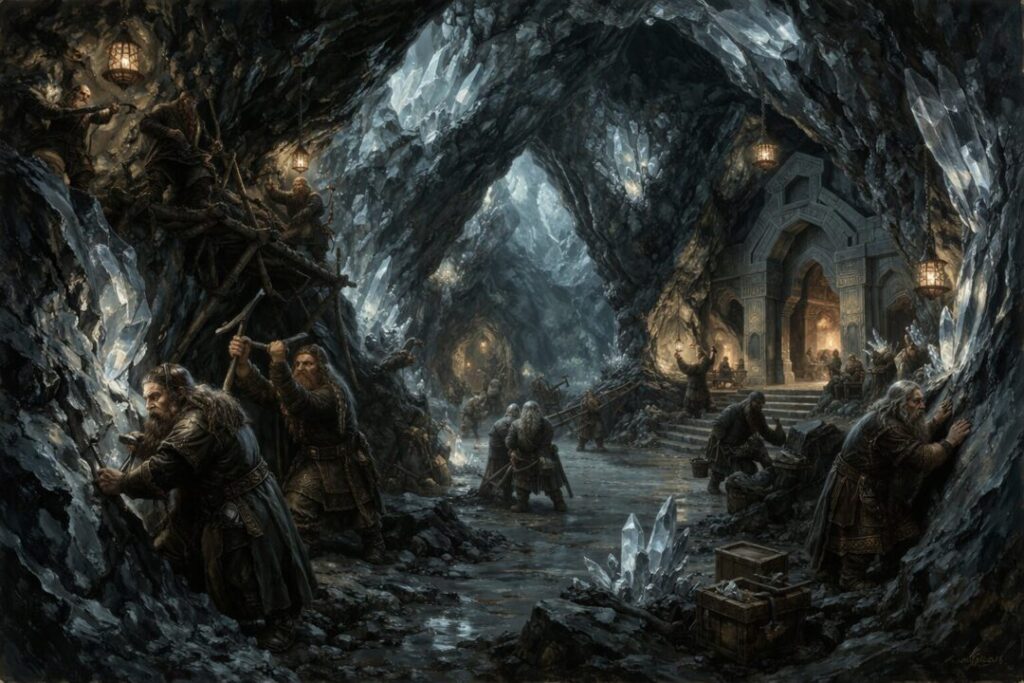
Even the later colony in the Glittering Caves is not described as a frantic rush for ore. Gimli and his people tend the stone walls, open new ways and chambers, and fill the caverns with light. The language there is almost curatorial. They are keepers and enhancers of stone, not merely exploiters of it.
That matters because it suggests restraint of a particular kind.
Not moral perfection.
Not freedom from greed.
The texts do not allow that.
But they do suggest that Dwarven greatness lies in craft, ordering, and endurance. A kingdom built by such a people would naturally be better at making a mountain livable across generations than a simpler image of “miners underground” would imply.
The Hidden Answer Is Diversification
So how could a Dwarf kingdom survive mining for centuries?
Not by relying on one endless seam.
Not by living on treasure alone.
And not by treating the mountain as a thing to be stripped as fast as possible.
It survives by diversification.
Khazad-dûm had trade and external connections.
Durin’s Folk operated across more than one stronghold.
Erebor’s wealth appeared in crafts and finished goods, not just raw ore.
Dale prospered beside it.
The Iron Hills supplied additional resources.
Later, even Aglarond becomes another example of Dwarves turning a mountain realm into something lasting.
That does not make Dwarf realms invulnerable.
Middle-earth never promises that.
But it does make them believable.
The deeper answer is that a Dwarf kingdom is not really a mine at all.
A mine is only one organ inside a larger body.
The real thing that endures is the people: their roads, memory, craft, kingship, alliances, and ability to make stone itself part of civilization.
Once you see that, one old assumption begins to fall away.
The mystery is not how they kept digging for so long.
The mystery is why we ever imagined digging was the whole story.