Some weapons in Middle-earth seem almost too remarkable to fail.
Angrist was one of them.
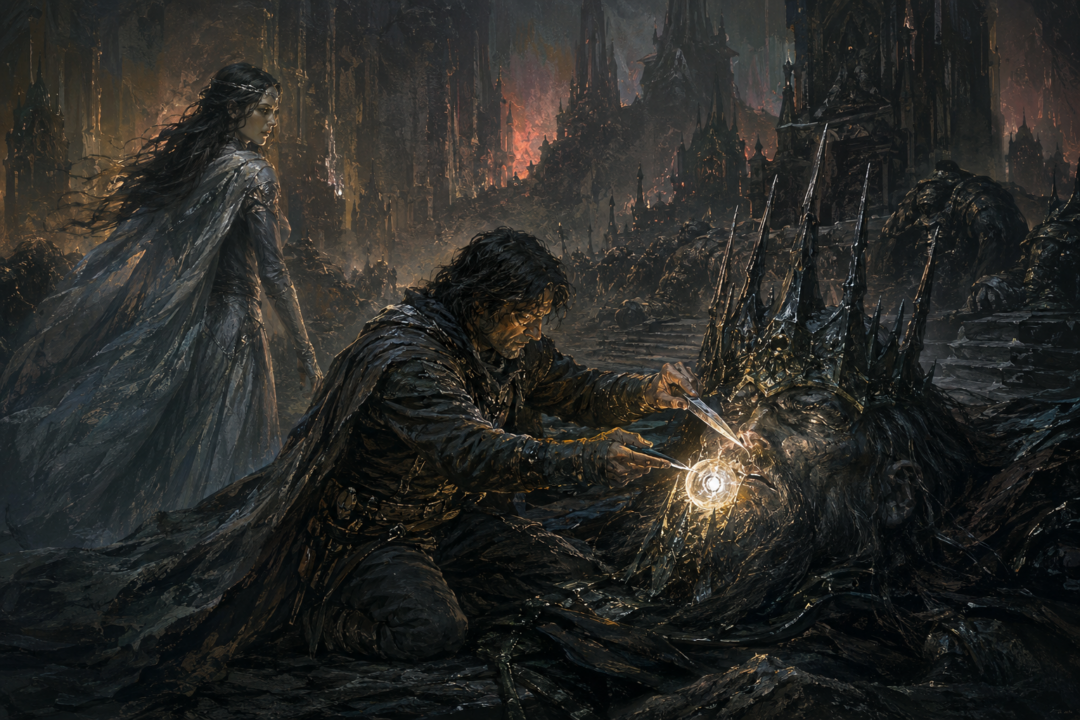
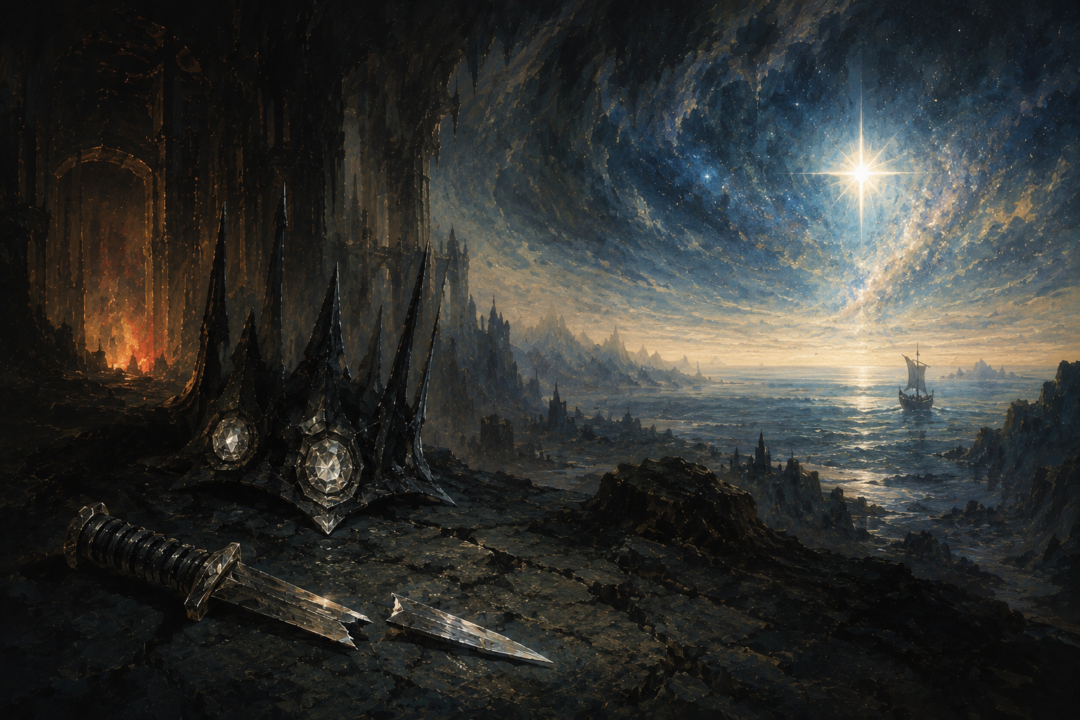
Forged by Telchar of Nogrod, the famed Dwarven smith, the knife was so keen that iron could be cut by it as though it were green wood. It eventually came into Beren’s possession, and deep beneath Thangorodrim he used it for something no ordinary weapon could have accomplished: cutting a Silmaril from Morgoth’s Iron Crown.
Then Beren tried to take another.
Angrist broke.
It is a tiny moment inside one of the greatest tales of the First Age, but it reveals something important about how extraordinary objects function in Middle-earth. Great craftsmanship matters. Ancient weapons matter. Some blades accomplish things that ordinary steel plainly could not.
But exceptional does not mean unlimited.
And Angrist reaches its limit at exactly the moment when Beren reaches beyond the task he originally accepted.
Angrist Was Already an Extraordinary Weapon
Angrist was not simply a convenient knife that happened to survive the journey into Angband.
It had a pedigree worthy of the deed.
The blade was made by Telchar of Nogrod, one of the most renowned Dwarven smiths named in the histories of the Elder Days. Telchar is also associated with other famous works, including Narsil, the sword that would much later be broken beneath Elendil and eventually reforged as Andúril.
Angrist’s own defining quality is given with unusual directness: iron could be cleaved by it as though it were green wood.
That matters because Beren’s task eventually brings him before the Iron Crown itself.
The knife originally belonged to Curufin, son of Fëanor. After Curufin and Celegorm attacked Beren and Lúthien, Beren defeated Curufin and stripped him of his weapons and equipment. Among the things he took was Angrist.
The transfer is rich in irony.
A blade carried by one of the sons of Fëanor ultimately becomes the instrument by which a Silmaril is liberated from Morgoth.
Curufin does not accomplish that deed.
Beren does.
The greatness of an artifact, in other words, does not determine the moral worth of its bearer.
The Knife Succeeds Where Almost Anything Else Might Have Failed
Beren and Lúthien eventually penetrate Angband and reach Morgoth himself.
Lúthien’s power reduces the terrible court of the Dark Lord to sleep, and Morgoth lies helpless. At that point the impossible quest suddenly becomes physically possible.
But there remains a practical problem.
The Silmarils are fixed in Morgoth’s Iron Crown.
Beren needs something capable of removing one.
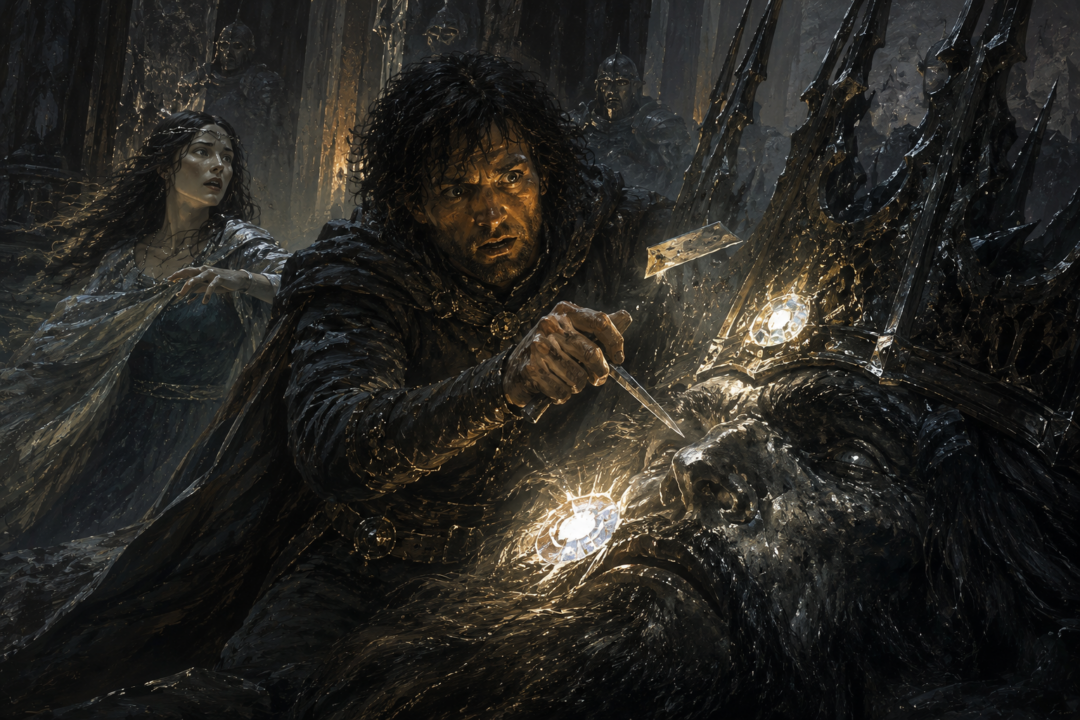
This is where Angrist fulfills the purpose for which its extraordinary craftsmanship is perfectly suited. Beren takes the knife and cuts a Silmaril from the crown.
The blade works.
That distinction is essential.
Angrist does not fail because its reputation was exaggerated. It does not fail at the first encounter with Morgoth’s ironwork. The text establishes its quality and then demonstrates that quality under almost unimaginable circumstances.
One Silmaril comes free.
Thingol had demanded a Silmaril from Morgoth’s crown as the bride-price for Lúthien. However impossible or hostile that demand had seemed, Beren has now actually achieved the object of his quest.
He could leave.
Instead, the sight and possession of the Silmaril changes the moment.
Beren Reaches Beyond His Vow
After taking the first jewel, Beren determines to attempt the other two.
This is the turning point.
It would be too strong to say that the text presents Angrist’s breaking as a simple mechanical punishment for greed. Beren’s motives and the workings of fate in the episode are more complex than such a neat moral equation.
But the narrative unmistakably contrasts the completion of his sworn task with his decision to go further.
He was required to bring one Silmaril.
One has been won.
Then he attempts to take all three.
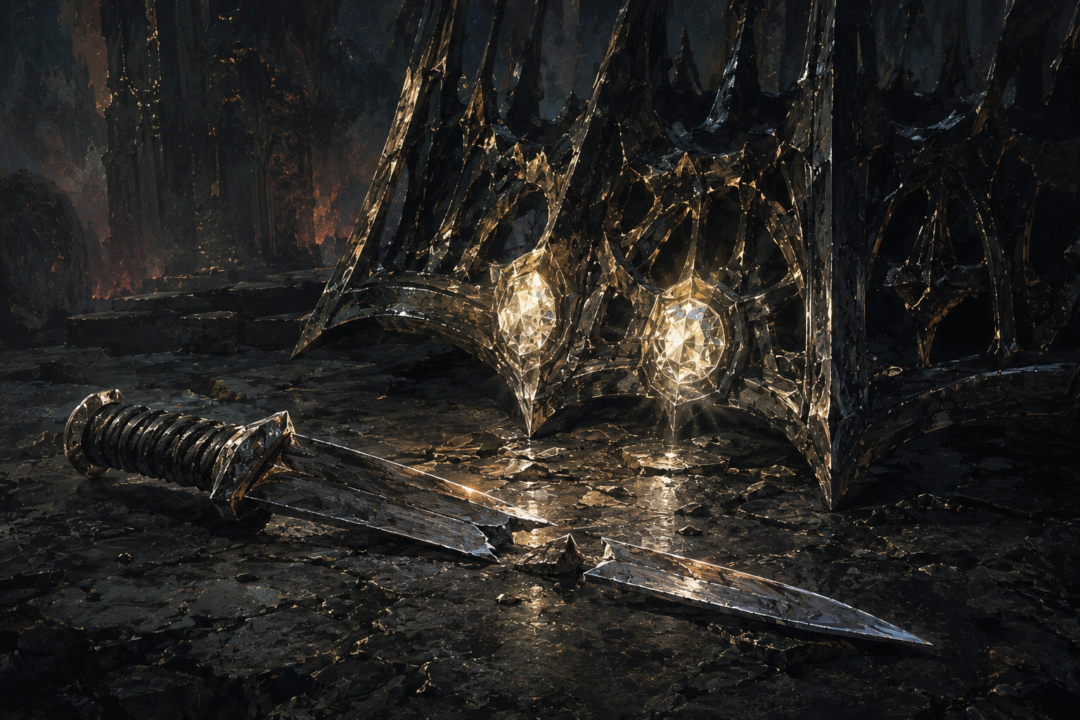
As he works at the second jewel, Angrist snaps. A fragment of the blade strikes Morgoth’s face, and the sleeping Dark Lord begins to stir.
The knife that had made victory possible suddenly becomes part of the danger.
That reversal is characteristic of the deeper logic of Middle-earth: power can accomplish astonishing things without granting mastery over consequences.
Angrist is exceptional.
It is not absolute.
Great Weapons Are Not Indestructible
This is not unique to Angrist.
Middle-earth repeatedly refuses the simple fantasy rule that a legendary weapon must therefore be an indestructible weapon.
Narsil provides the most famous later example. It too was made by Telchar. Yet Narsil breaks beneath Elendil when he falls in the war against Sauron.
Its breaking does not prove that Narsil was a poor sword.
Quite the opposite.
Its history remains extraordinary, and its fragments become central to the inheritance of Isildur’s heirs. Eventually those fragments are reforged into Andúril.
The same distinction helps explain Angrist.
A great blade can possess exceptional properties while remaining a created physical object. Nothing in Angrist’s description requires us to imagine it as immune to every possible stress or circumstance.
Nor does the text provide a technical metallurgical explanation for why it breaks against the crown during the second attempt.
That uncertainty should be preserved.
We know what happens.
We should be cautious about pretending we know precisely why.
Compare Angrist With Sting
Sting provides another useful comparison because it demonstrates how specialized the great blades of Middle-earth can be.
Bilbo’s small Elvish blade shines when Orcs are nearby. Frodo inherits it, and Sam later uses it against Shelob.
Its importance does not come from being universally superior to every other weapon.
It has particular qualities.
So does Angrist.
Angrist’s defining property is its extraordinary ability to cut iron. That makes it almost impossibly well suited to Beren’s situation beneath Angband.
But specialization is not omnipotence.
This helps separate the weapons of Middle-earth from modern ideas of magical equipment arranged in a simple hierarchy. There is rarely a straightforward ladder where one legendary sword is automatically stronger than another legendary sword in every circumstance.
History, maker, material, bearer, purpose, and circumstance all matter.
The weapon participates in the story.
It does not overrule the story.
The Silmaril Is Not Merely Treasure
There is another important distinction.
Angrist is an extraordinary manufactured object.
A Silmaril belongs to a different category.
The three jewels were created by Fëanor, but they contain the blended light of the Two Trees. Varda hallowed them so that mortal flesh, unclean hands, or anything evil would be burned by touching them.
That property repeatedly becomes consequential.
Beren, however, is able to hold the Silmaril he takes.
Later, when Carcharoth bites off Beren’s hand and swallows it together with the jewel, the Silmaril burns within the wolf and drives him into terrible torment.
The contrast is revealing.
Angrist has astonishing physical effectiveness, but the Silmaril carries a sanctity that cannot be reduced to hardness or sharpness.
One can imagine measuring the performance of a blade.
The moral and spiritual significance of a Silmaril belongs to another order entirely.
Middle-earth contains craftsmanship of almost unimaginable greatness, but its deepest powers are not simply technological.
The Broken Blade Actually Makes the Scene More Dangerous
Angrist’s failure is also narratively cruel because the knife does not merely become useless.
Its broken fragment strikes Morgoth.
The attempt to gain more therefore threatens what has already been achieved.
Beren and Lúthien have entered the deepest stronghold of their enemy. Morgoth and his servants have been overcome through Lúthien’s extraordinary power. Beren has removed the jewel demanded by Thingol.
They have succeeded.
Then, in the attempt to increase that success, everything begins to unravel.
The danger is not abstract. Morgoth stirs, and the sleepers around him begin to awaken. Beren and Lúthien must flee.
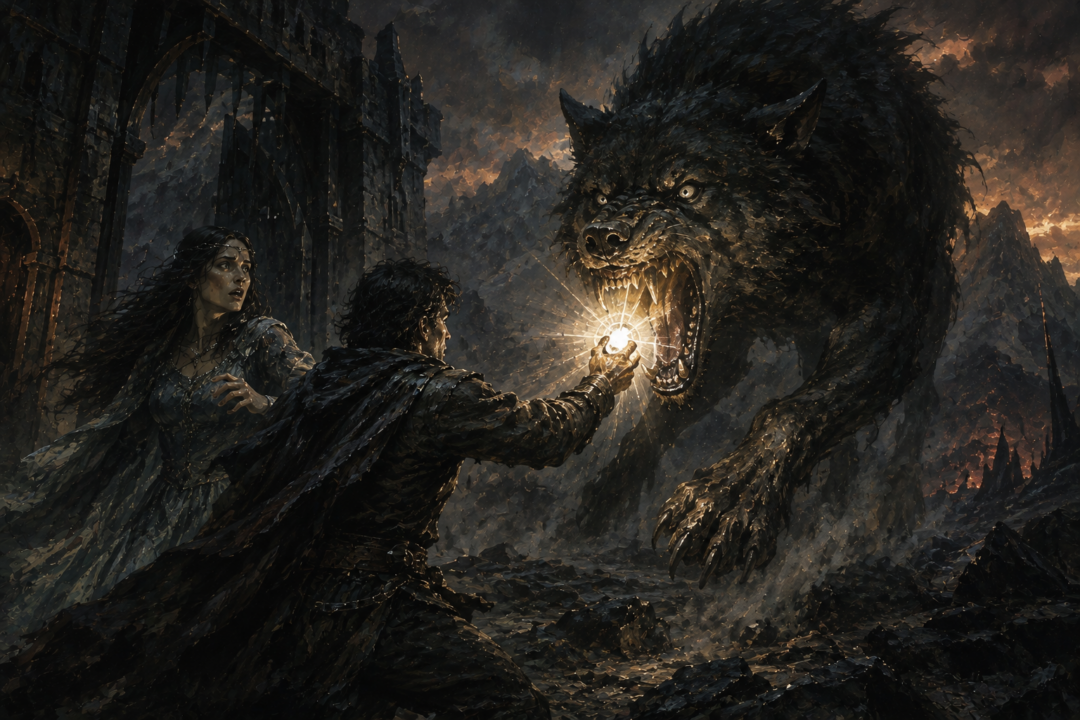
Their escape then leads them to Carcharoth at the gates of Angband, where Beren raises the Silmaril against the wolf.
Carcharoth bites off his hand.
The jewel that seemed safely won disappears inside the greatest wolf of Angband.
Victory becomes catastrophe in only a few moments.
Yet the quest is not ultimately defeated.
That is another reason Angrist’s breaking matters.
The Quest Never Depended on the Knife Alone
Angrist makes the theft of the Silmaril physically possible.
But Angrist does not get Beren into Angband.
It does not overcome Morgoth.
It does not save Beren from Carcharoth.
The success of the quest depends on many different things: Beren’s courage, Lúthien’s power, Huan’s earlier aid, unexpected reversals, mercy, sacrifice, and circumstances no single character completely controls.
This is one of the most persistent limits placed upon power in Middle-earth.
Possessing the right object is never enough.
The sons of Fëanor possess extraordinary weapons, lineage, knowledge, and determination, yet their oath helps drive them toward ruin.
Morgoth possesses enormous military power and dominates much of Beleriand, yet two seemingly hopeless intruders reach his throne.
Beren possesses perhaps the finest possible knife for the task before him, yet even that knife breaks.
No artifact abolishes uncertainty.
Angrist Succeeds Before It Fails
That may be the most important thing to remember about the knife.
Calling Angrist a failed weapon would miss the point.
It accomplished exactly the deed for which Beren desperately needed it.
One Silmaril was cut from the Iron Crown.
That Silmaril would pass through consequences far greater than Beren could have understood while standing over Morgoth. It would eventually come to Eärendil and be borne into the sky, becoming the great star seen in later ages.
Angrist did not need to survive forever to become part of that history.
Its greatness lies partly in the fact that it had a limit.
The knife could cut iron like green wood, but it could not guarantee possession of all three Silmarils. It could open one impossible path without giving its bearer command over everything that followed.
That distinction appears again and again across the history of Middle-earth.
Great swords break.
Great kingdoms fall.
Great fortresses are breached.
Great jewels bring both hope and disaster.
Exceptional things remain exceptional without becoming absolute.
And beneath Angband, with Morgoth sleeping only a few feet away, one of the finest blades ever forged proves that truth in the sharpest possible way.
Angrist cuts the impossible once.
Then it breaks.
Sources & Notes
- https://tolkiengateway.net/wiki/Angrist — Tolkien Gateway: Angrist’s making by Telchar, its ability to cleave iron, and its breaking when Beren attempts a second Silmaril.
- https://tolkiengateway.net/wiki/Quest_for_the_Silmaril — Tolkien Gateway: the full sequence of Beren and Lúthien’s quest and Angrist’s role inside Angband.
- https://tolkiengateway.net/wiki/Iron_Crown — Tolkien Gateway: the iron setting from which Angrist cuts one jewel before failing on the next.
- https://tolkiengateway.net/wiki/Silmarils — Tolkien Gateway: the jewels’ material and narrative context and Beren’s recovery of one from Morgoth.
Sources document Angrist’s exceptional forging, its use on the Iron Crown, and the precise point at which the blade breaks.