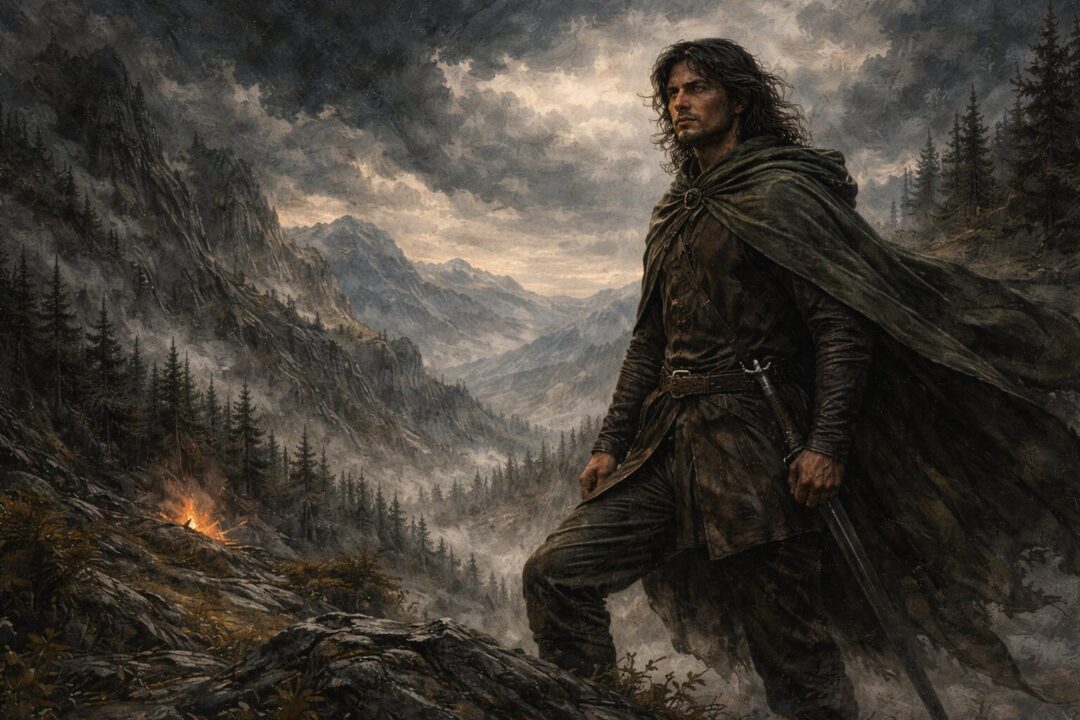
Most people meet Aragorn when his fate already seems sealed.
He appears first in Bree as Strider: weather-beaten, guarded, a man who watches more than he speaks. There is danger in him, but also restraint. Later, at the Council of Elrond, he stands revealed as the Heir of Isildur, bearing the shards of a broken sword and carrying himself with the quiet authority of someone who belongs among ancient names and long memories. By the time he is crowned King of Gondor, it feels inevitable — as though destiny itself has been carrying him forward since birth.
But Aragorn’s life did not begin with certainty or honor.
It began with loss.
A Child Marked by Death
Aragorn was only two years old when his father, Arathorn II, Chieftain of the Dúnedain of the North, was slain by Orcs while riding in the wilds. This was not an isolated tragedy, but part of a long pattern of loss suffered by the heirs of Isildur. The line of kings had already failed once, and enemies still watched for its final extinction.
His mother, Gilraen, understood the danger immediately. With her husband dead and her son now the last known heir, she fled north in secrecy. She did not travel in triumph or ceremony, but in fear — carrying a child who could not yet understand why the world had suddenly become so small and so quiet.
Her destination was Rivendell.
There, Gilraen placed her son into the care of Elrond Half-elven, who had long guarded the remnants of Númenórean history and knew better than most the weight of broken oaths and failed kings. Elrond took the child in, but not as a prince. Aragorn’s true name and lineage were deliberately hidden — not only from the world, but from the boy himself.
Instead, he was raised as Estel, a name meaning Hope.
Growing Up as Estel
To most in Rivendell, Estel was simply a foster child. He was quieter than many, more watchful, already carrying a gravity that set him apart even before he could explain it. He learned alongside the Elves, yet never truly belonged among them.
Rivendell became his home in every sense that mattered. He learned lore, history, poetry, and the long memory of the Elder Days. He learned languages and songs that spoke of a world far older than the one he would inherit. He trained in arms, not as a future king, but as a youth being shaped for survival in a dangerous age.
Yet alongside this education came a subtler lesson — one that no teacher needed to speak aloud.
Time moved differently for him.
The Elves around Estel did not age. Faces remained unchanged as years passed. Friends he trained beside would look the same decades later, while he himself grew taller, stronger, and older. Even as a boy, Aragorn sensed that he was walking a different path — one with an ending, while those around him seemed untouched by such limits.
This awareness planted something deep within him: patience, restraint, and a quiet acceptance of mortality. Unlike many Men who rage against the shortness of life, Aragorn learned early that his time mattered precisely because it was finite.
The Truth Revealed
When Aragorn reached his twentieth year, Elrond judged that the time for secrecy had ended.
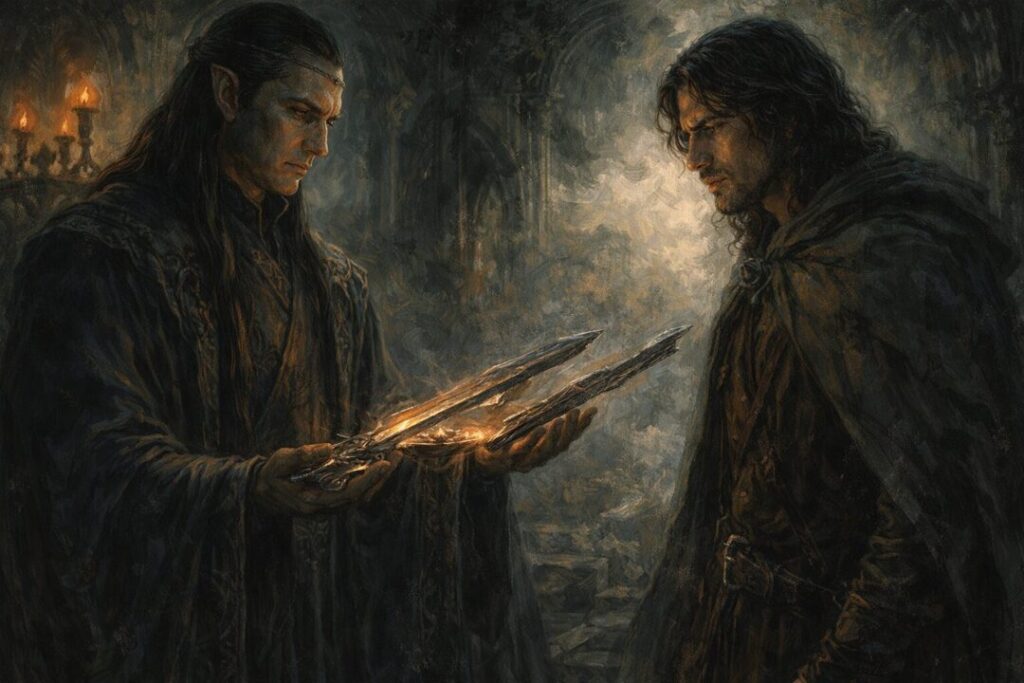
He called Estel before him and revealed the truth that had been hidden since childhood. He spoke of Arathorn, slain in the wilds. He spoke of Isildur, whose failure still cast a shadow across Middle-earth. He spoke of the long defeat of the Númenórean kingdoms, and of a line that had dwindled from kings to wanderers.
Then Elrond showed him the shards of Narsil — the sword that had cut the One Ring from Sauron’s hand, and broken in the same stroke. It was not presented as a symbol of triumph, but as a reminder of unfinished duty.
With that revelation came no command.
Elrond did not name him king. He did not promise him a throne, nor speak of destiny as something guaranteed. Instead, he spoke plainly. The road ahead would be long. It would be marked by suffering, rejection, and years of labor with little reward. Even Aragorn’s love for Arwen would not be granted lightly — it would demand proof beyond words or blood.
In that moment, Aragorn stood at a crossroads.
The Choice of the Ranger
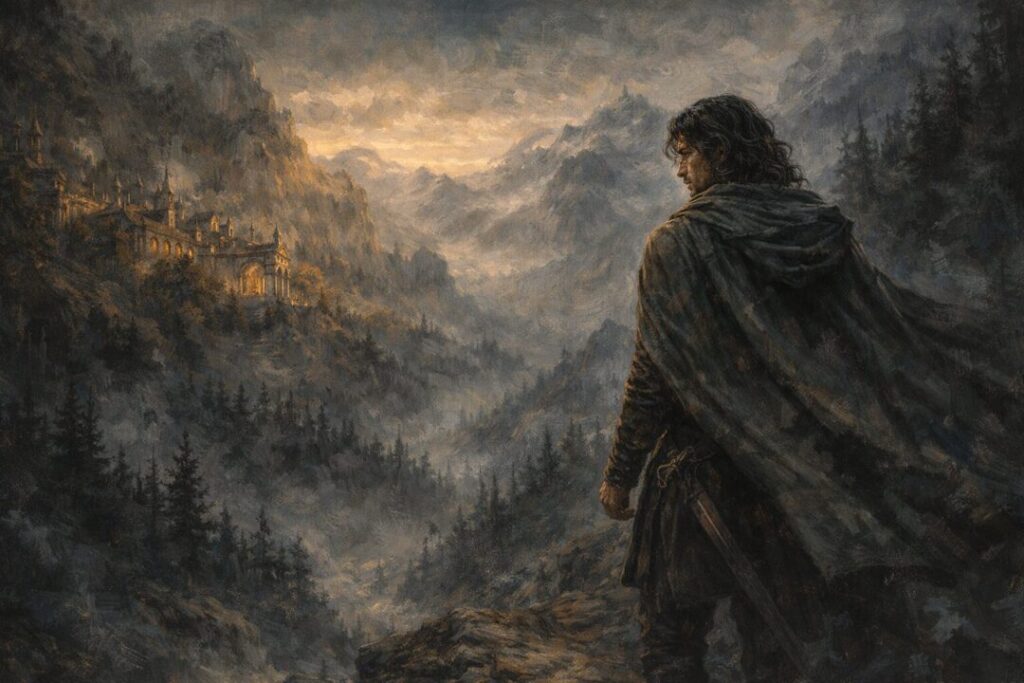
Aragorn could have remained in Rivendell.
He was loved there. He was protected. Elrond would have sheltered him for the rest of his life if he had asked it. Rivendell offered peace, beauty, and wisdom — and freedom from the crushing weight of history.
Many would have chosen that path.
Aragorn did not.
Instead, he chose to leave the only home he had ever truly known. He went out into the wild as a Ranger of the North, living without title or recognition. He guarded lands that would never thank him, protected people who would never know his name, and fought enemies who would never sing of his victories.
For decades, he served in shadows.
He traveled under many names. He walked in distant lands, served in the armies of others, and learned the cost of leadership without ever wearing a crown. He learned how men break under fear, how hope survives in unlikely places, and how authority is earned through action rather than proclamation.
This was not the life of a king in waiting.
It was the life of someone becoming worthy of kingship.
Love, Loss, and Long Years
Aragorn’s path was not sustained by ambition alone. His love for Arwen remained both a strength and a burden. Elrond had made it clear that she would not bind her immortal life to a man unless he proved himself beyond doubt — not merely as heir, but as restorer of what had been lost.
This knowledge sharpened Aragorn’s resolve. He did not chase glory. He did not seek recognition. Instead, he endured.
Years passed. Decades passed. The world slowly moved toward war, and Aragorn moved with it — always present, rarely seen, shaping events from the margins.
A King Forged Before the Crown
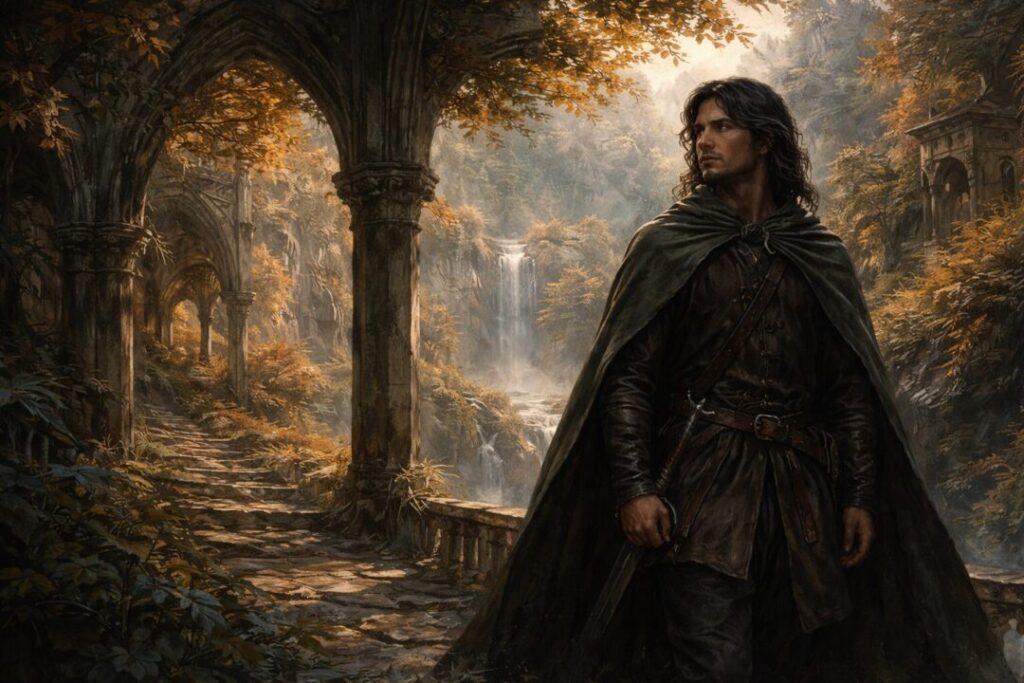
By the time Aragorn re-enters the central story of Middle-earth during the War of the Ring, his kingship has already been decided — not by blood alone, but by a lifetime of sacrifice.
He leads not because he must, but because others trust him to do so. He commands not through fear, but through example. When the crown finally comes, it does not change him. It simply names what he has already become.
The crown does not make Aragorn worthy.
The choice he made at twenty years old does.
Aragorn’s story reminds us that destiny in Middle-earth is never forced. Even those born to greatness must choose it — again and again — often at great personal cost. Blood may open a door, but only character allows one to walk through it.
And that is why, when Aragorn finally takes the throne, it feels earned.
Because the King was forged long before he was crowned.