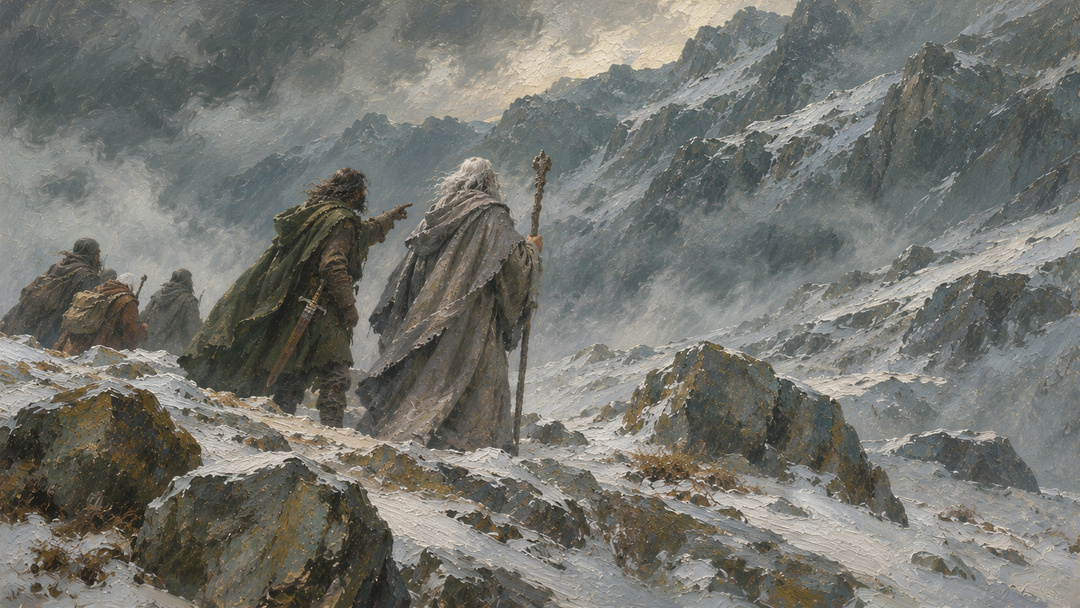
Before the Fellowship enters Moria in The Fellowship of the Ring, Aragorn warns Gandalf that the danger ahead concerns the wizard in particular. Tolkien puts it directly into the discussion about which route the Company should take after their failed attempt to cross the Misty Mountains.
But the question contains an important uncertainty. Aragorn does not say that he knows a Balrog is waiting, or that he has seen Gandalf’s death in a vision. What the book establishes is narrower and more interesting: he has visited Moria before, remembers that experience with dread, and feels a specific foreboding about Gandalf. Whether that feeling amounts to supernatural foresight is a reasonable interpretation, not a fully explained fact.
The warning Tolkien actually wrote
The warning appears in Book Two, Chapter Four, “A Journey in the Dark”. The Fellowship has been driven back from the Redhorn Gate on Caradhras. Going south towards the Gap of Rohan looks dangerous because Saruman controls Isengard, while a long detour would cost time and expose the Ring-bearer to pursuit. Gandalf proposes the underground passage through Moria, a possibility he had considered since planning the journey.
This matters because the book does not present Moria as a casual mistake made by a leader who ignores an obvious safe road. The Company is trying to choose between serious dangers. Aragorn had favoured attempting the mountain pass first, whereas Gandalf already regarded Moria as a possible route. Aragorn had urged him not to raise it until other ways had been tested.
When Moria becomes the leading option, Gandalf explains that he has traversed it before and survived. Aragorn answers that he too once passed the Dimrill Gate, the eastern entrance, but remembers the journey as deeply evil and does not want to repeat it. He then agrees to follow Gandalf, partly because Gandalf had followed his judgement into the snow without reproach. His acceptance is accompanied by a final, unusually personal warning: his concern is not principally for the Ring or the other travellers, but for Gandalf himself.
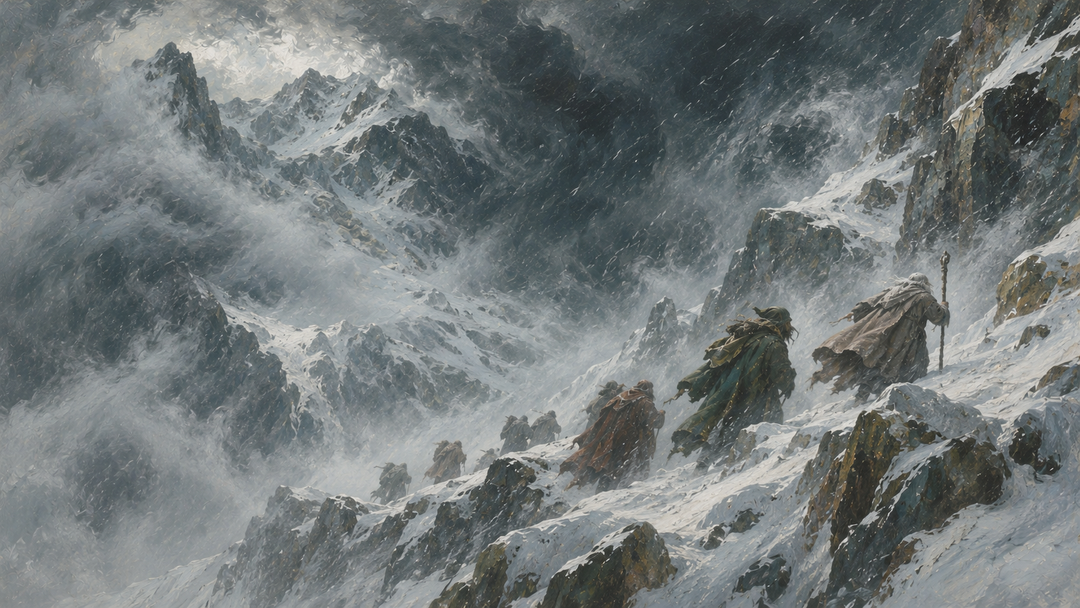
That distinction is the heart of the scene. Anyone familiar with Moria’s reputation might tell the entire party to stay away. Aragorn instead singles out the person best equipped to confront its dangers. He neither identifies an enemy nor explains a chain of reasoning. Tolkien leaves that specificity unexplained.
Nor is the decision treated as Aragorn’s to make. Boromir objects, Gimli is eager to search the ancient halls of his people, and the hobbits are frightened. Frodo asks that they postpone a vote until morning. Later events eliminate the practical alternatives, and the Company approaches the western doors. Aragorn has warned Gandalf, but he has not demonstrated that a safer course is available.
What Aragorn knew about the mines
Aragorn’s strongest concrete reason for caution is his own earlier passage through Moria. The text confirms that journey and his disturbing memory of it. It does not describe when he made the crossing, which entrance he used first, what he encountered, or why the experience affected him so badly. The reference to the Dimrill Gate proves a connection with the eastern side of the mines, not a detailed itinerary.
That gap is important. Claims that Aragorn personally saw Durin’s Bane, narrowly escaped a Balrog, or discovered a secret prophecy during his first visit are fan speculation. They can make imaginative stories, but Tolkien does not supply those events. Even the suggestion that he was captured by Orcs on that journey remains conjecture. His silence is not evidence of a particular encounter.
He nevertheless had plenty of ordinary information on which to base a warning. Khazad-dûm had once been the greatest Dwarven kingdom in the Misty Mountains. In the Third Age, its people were driven out by a terror remembered as Durin’s Bane. Orcs later occupied its halls. By the time of the Fellowship, Balin’s attempt to establish a new Dwarven colony had stopped sending news. The road was dangerous even without identifying the kingdom’s destroyer.
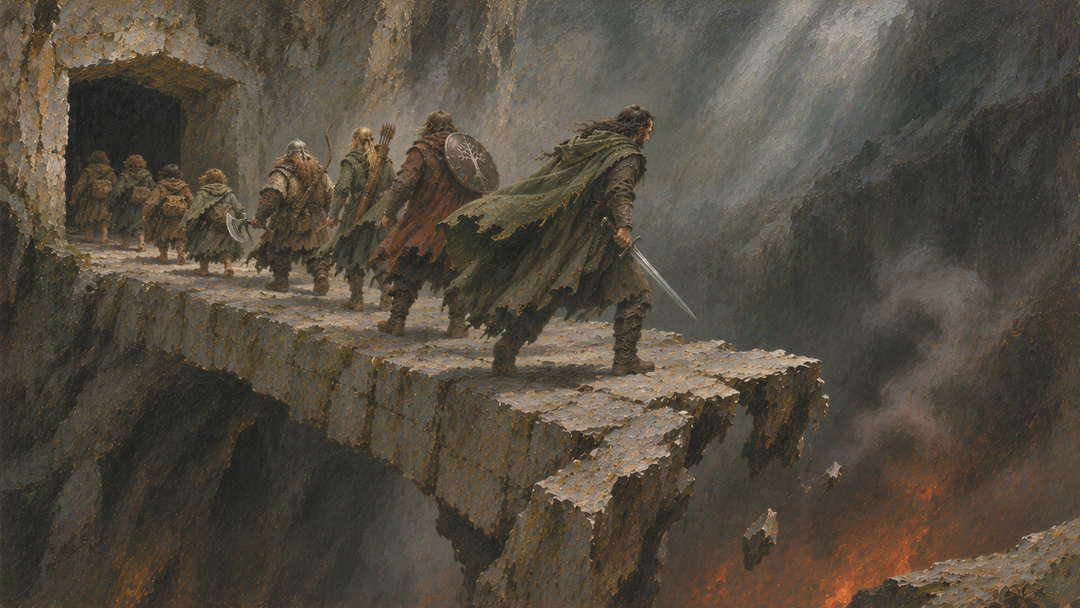
The distinction between knowing that Moria housed a terrible power and knowing that this power was a Balrog is essential. The ancient disaster was part of Dwarven history, but the precise identity of Durin’s Bane was not established for the Fellowship before their encounter. When the creature appears near the bridge, Legolas recognises a Balrog, and Gandalf understands the nature of the opponent facing him. That dramatic recognition loses much of its force if Aragorn is assumed to have known the answer all along.
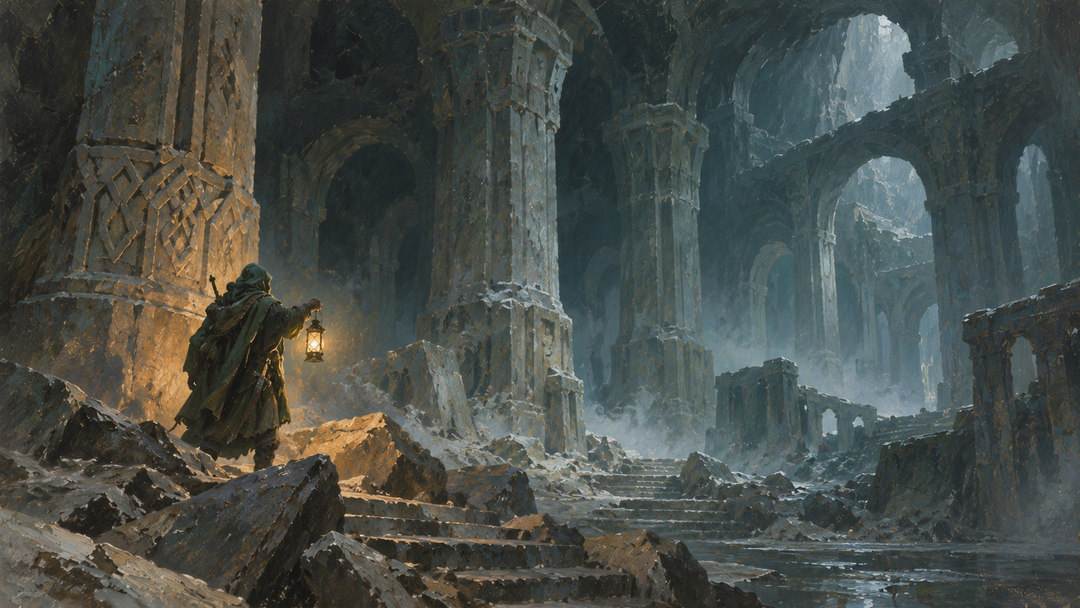
Gandalf’s earlier visit also complicates the idea that Aragorn simply had superior intelligence. The wizard had searched Moria for the missing Dwarf Thráin and emerged alive. He was familiar with its passages and its reputation. Aragorn could warn him without being better informed about its physical layout or enemies. His concern cannot be explained by experience alone.
The discoveries made after the Company enters should not be projected backwards into Aragorn’s mind. The Watcher attacks at the western doors, Balin’s tomb and the records of his colony reveal its destruction, and the Fellowship fights Orcs in the chambers before meeting the Balrog. These events confirm how perilous the route is. They do not prove that Aragorn knew their details beforehand.
Foresight, fear and the limits of certainty
The most persuasive explanation for the personal warning is that Aragorn experiences a form of foresight. Tolkien’s world allows characters to sense an approaching danger without seeing a complete future. Such moments are not presented as a reliable technique with fixed rules. They may emerge as intuition, foreboding, or words whose significance becomes apparent only after the event.
Aragorn belongs to the Dúnedain, whose history includes remarkable longevity, inherited knowledge and occasional prophetic insight. The wider story supplies examples of foresight associated with his people. In the appendices to The Return of the King, Ivorwen, Aragorn’s maternal grandmother, anticipates the importance of the marriage that will lead to his birth. Malbeth the Seer, another figure of the northern Dúnedain, foretells matters connected with the Paths of the Dead. Such examples show that foresight exists in this tradition, not that every Ranger can predict events.
Aragorn himself is consistently more than an exceptionally skilled tracker. His long experience teaches him to read people, roads and threats, but Tolkien also gives him a sensitivity to moments of consequence. Readers can therefore interpret his words to Gandalf as an intuition sharpened by an extraordinary heritage. That reading fits the scene without requiring a hidden dream, a message from Elrond, or advance knowledge of the Balrog.
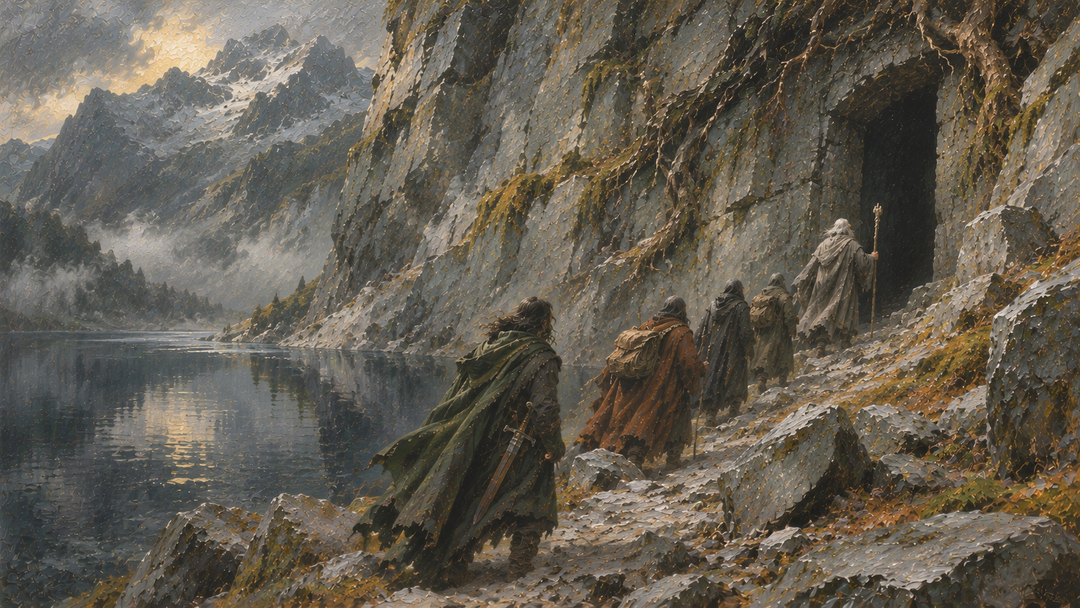
There is supporting foreshadowing elsewhere in the same volume. At the Council of Elrond, Elrond suggests that accompanying the Ring-bearer may bring Gandalf’s labours to an end. This is not a disclosure of the future battle in Moria, but it prepares readers for the possibility that Gandalf’s role will involve a grave personal cost. Aragorn’s warning makes that broad possibility more immediate and places it at a particular doorway.
Tolkien then makes the earlier words matter after the bridge collapses. The Balrog falls, pulls Gandalf down with it, and the remaining companions escape. Outside the eastern gate, Aragorn recalls that he warned Gandalf and grieves that his words proved true. His reaction shows that the warning was serious, not an offhand expression of nervousness retrospectively made significant by readers.
In Lothlórien, Celeborn’s response adds another layer. He says that he and his people had long feared a terror beneath Caradhras, yet the news that the Fellowship encountered that terror in Moria shocks him. The scene distinguishes fearing a danger from identifying it. A warning may be well founded without amounting to a complete explanation.
None of this means that Aragorn saw a fixed vision of Gandalf dying. The book gives no such vision and no account of a prophecy spoken to him. Gandalf’s fall is not even his final end: after defeating the Balrog, he is sent back and returns as Gandalf the White. Aragorn’s foreboding is vindicated by the catastrophe at the bridge, but it does not contain the whole course of Gandalf’s fate.
Why the films suggest a different answer
Peter Jackson’s The Fellowship of the Ring changes the route debate in a way that can easily confuse memories of the novel. The film omits Aragorn’s explicit warning about Gandalf entering Moria. It also shifts the initial enthusiasm for the mines towards Gimli, while Gandalf is conspicuously reluctant to take that road. The book’s central disagreement between Aragorn and Gandalf is therefore substantially rearranged.
On the film’s Caradhras, Saruman is shown working against the Fellowship and speaks of the horror awakened beneath Khazad-dûm. The accompanying images point the audience towards the Balrog well before the Company meets it. Gandalf’s fear becomes prominent, and he asks Frodo to choose the route. Frodo elects to go through the mines. This is film storytelling, not evidence that the book’s Aragorn was secretly informed of the Balrog’s identity.
The contrast also changes responsibility. In Tolkien’s novel, Gandalf regards Moria as a difficult but plausible passage, and Aragorn reluctantly trusts his judgement despite a personal warning. In the film, Gandalf’s reluctance, Saruman’s knowledge and Frodo’s choice create a different pattern of suspense. Both versions lead to the same confrontation, but the characters reach it with different information and different emphases.
Fan speculation sometimes combines these versions into a single explanation: Aragorn knew about the Balrog from a previous visit, Gandalf knew too, and both knowingly marched towards an unavoidable duel. That argument is not established by the novel, and the film does not establish it for Aragorn either. A familiar dramatic outcome is not proof that every character anticipated its cause.
There is also a counterfactual question: should Gandalf have obeyed Aragorn and refused Moria? Knowing what happens, it is natural to imagine that an alternative route would have spared him. But this is a hypothetical argument, not a recorded alternative history. The Gap of Rohan carried the danger of Saruman, the mountain crossing had failed, and a distant detour might have exposed the Ring for much longer. Tolkien does not tell us that any other route would have brought the Fellowship safely to Mordor.
Nor can the later return of Gandalf the White be treated as proof that the Company was supposed to seek out the Balrog. His sacrifice protects the others, and his return becomes decisive in the wider war, but those later results do not turn Aragorn’s warning into a complete prediction or make Gandalf’s fall a plan openly understood by the travellers.
So Aragorn knew enough to fear Moria, and he appears to have sensed something more particular about Gandalf’s danger. His earlier visit explains his hostility to the place; the story’s pattern of foresight explains why his warning can be read as prophetic. What he did not demonstrably know was the identity of Durin’s Bane, the exact encounter on the bridge, or Gandalf’s eventual return. The force of Tolkien’s scene comes from that gap between a warning honestly given and a future no one in the Company can fully see.
Sources & Notes
- Tolkien Gateway — A Journey in the Dark — https://tolkiengateway.net/wiki/A_Journey_in_the_Dark
- Tolkien Gateway — The White Rider — https://tolkiengateway.net/wiki/The_White_Rider
- The Encyclopedia of Arda — Moria — https://www.encyclopedia-of-arda.com/m/moria.php
Primary reading: The Fellowship of the Ring, A Journey in the Dark and The Bridge of Khazad-dûm; The Two Towers, The White Rider. Aragorn's prior journey and personal warning support foreboding, not proven advance knowledge of the Balrog or a complete prophecy.