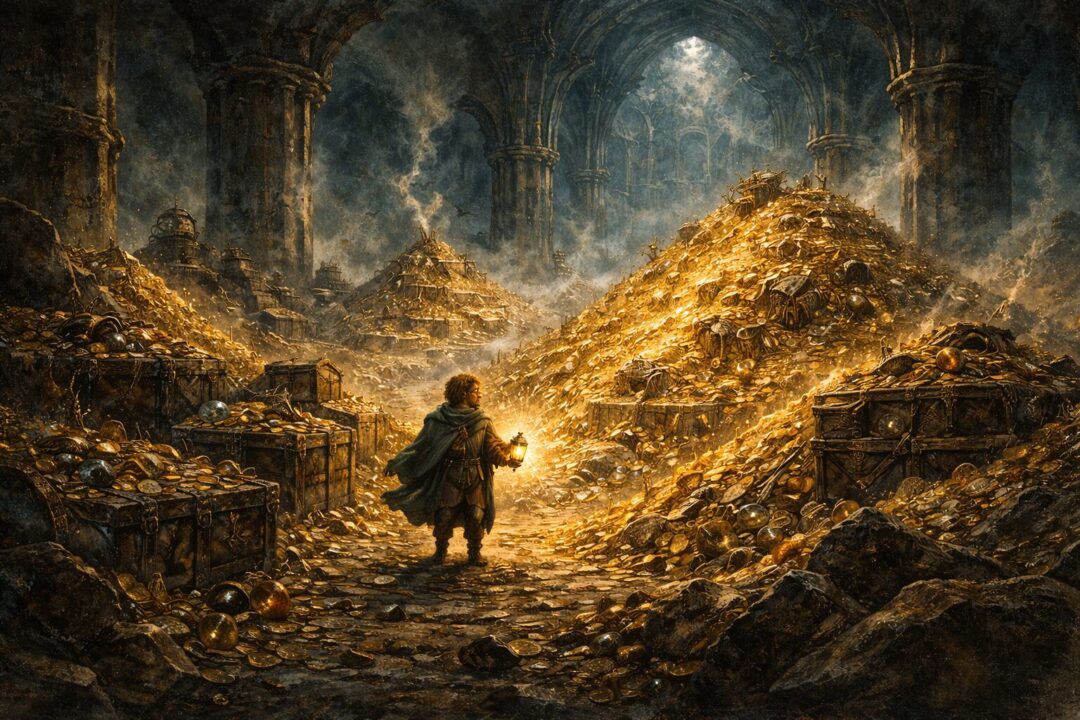
When people talk about wealth in Middle-earth, they almost always look upward—toward crowns, thrones, and ancient halls of stone. The riches of kings, the deep vaults of dwarves, and the timeless abundance of elven realms dominate the conversation. Hobbits rarely appear in these discussions at all, and when they do, it is usually to emphasize how little they care for gold.
That is why Bilbo Baggins is so easy to overlook.
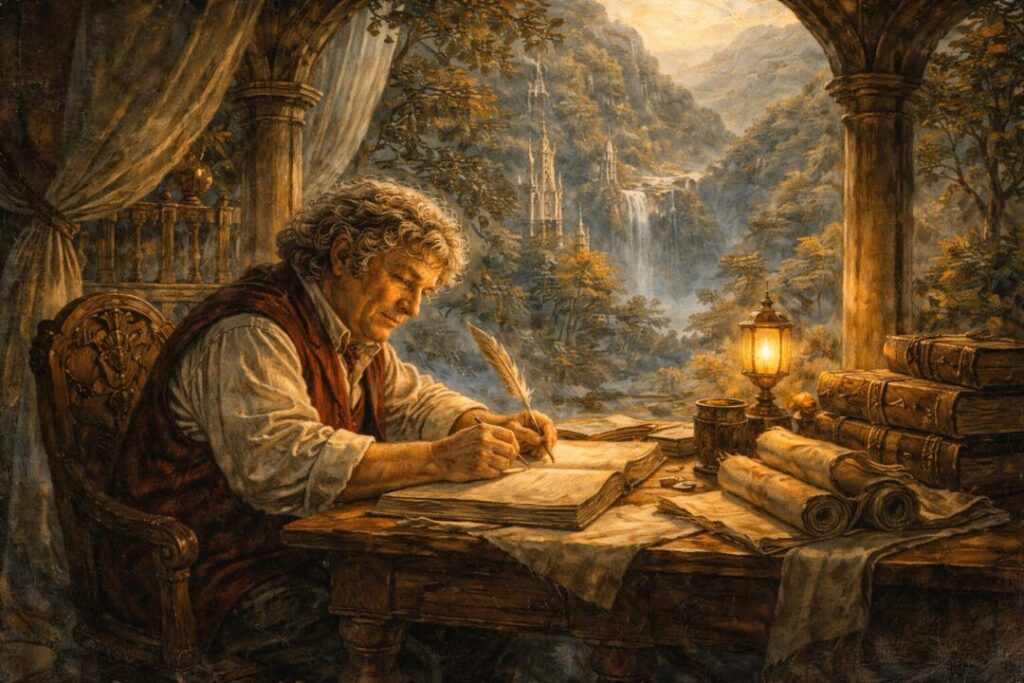
He did not rule a kingdom. He did not command armies. He did not rebuild a fallen realm or mint his own coin. He lived quietly in the same home for most of his life, wrote his memoirs, and hosted an odd but generous birthday party.
And yet, by the end of his life, Bilbo was quietly one of the wealthiest private individuals in the entire Third Age.
Not in appearance. Not in power. But in raw, accumulated, freely controlled wealth—wealth that he barely used and never displayed.
Understanding how that happened requires looking closely at where Bilbo started, what he gained, what he refused, and how radically his attitude toward money differed from nearly everyone around him.
Bilbo’s Starting Point: Comfortable, Not Wealthy
Bilbo was born into what could best be described as upper-comfortable hobbit society.
His father, Bungo Baggins, had the means to have Bag End constructed—no small undertaking. Bag End was one of the finest hobbit-holes in Hobbiton, set into a hill with many rooms, generous pantries, and ample storage. It was clearly the home of someone with resources.
But it is crucial to understand what that meant in the Shire.
This was landed comfort, not liquid wealth. Bilbo inherited property, furnishings, and savings, but nothing resembling vast reserves of coin, precious metals, or trade interests. He did not own mills, shipping ventures, or farmland worked by others. He had no income streams beyond modest rents or returns typical for a well-off hobbit family.
Within the Shire, this placed him among the respectable and prosperous—but not exceptional.
The Economic Nature of the Shire
Hobbit society is intentionally small-scale and inward-looking.
There is:
- No visible aristocracy
- No merchant class with international reach
- No banking system
- No large-scale trade in precious metals
Most wealth exists to support predictability, not expansion. Hobbits value full pantries, good ale, comfortable chairs, and peace of mind far more than accumulation.
In that context, Bilbo was doing exactly what was expected of him: living quietly, hosting the occasional dinner, and writing poetry that few people asked to hear.
Nothing about his early life suggests future financial dominance.
The Shock of Sudden Wealth
That changes the moment Bilbo leaves the Shire.
The Quest of Erebor does not just pull Bilbo into danger—it drags him out of an economy where wealth is measured in comfort and into one where wealth is measured in hoards.
Smaug’s treasure is not a metaphor. It is described repeatedly and explicitly as one of the greatest amassed fortunes in Middle-earth: gold, silver, gems, works of art, armor, heirlooms, and tribute gathered over generations.
This hoard represents:
- The wealth of the Kingdom under the Mountain
- The spoils of conquered lands
- The compounded accumulation of centuries
Bilbo’s agreement with Thorin Oakenshield entitled him to one fourteenth of the entire hoard.
Even stating that number should give pause.
The Fraction Bilbo Refused
One fourteenth of Smaug’s hoard would have made Bilbo unimaginably wealthy even by dwarven standards.
But here is where Bilbo becomes truly unusual.
He does not take it.
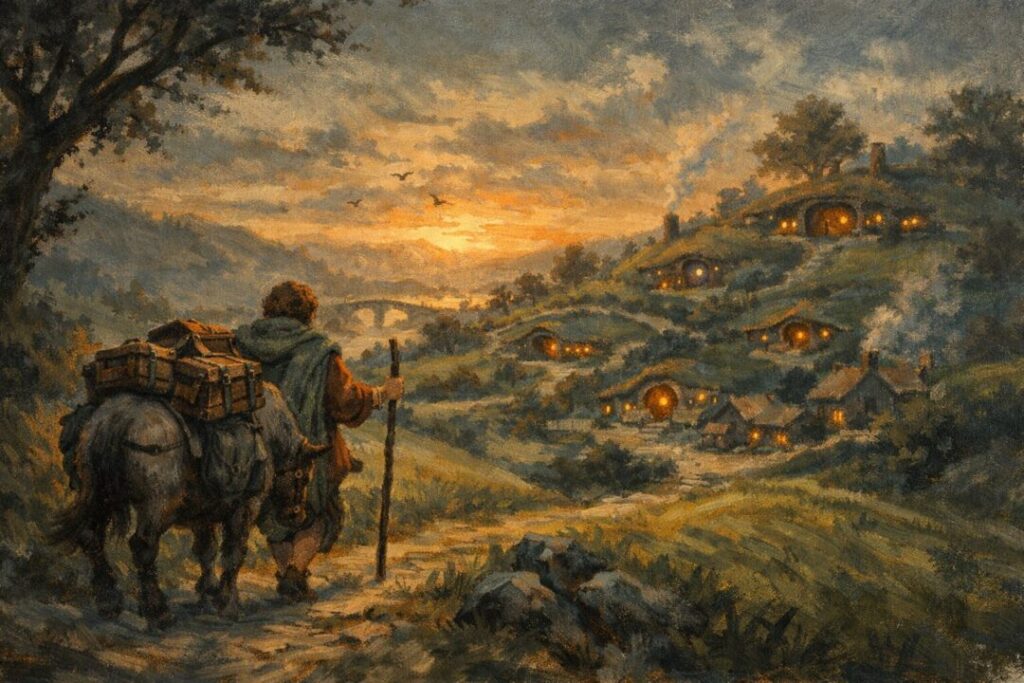
Instead, he fills a few chests with gold and silver—already more wealth than any hobbit could reasonably use in several lifetimes—and leaves the rest behind. This is not forced upon him. It is a choice.
And yet, Tolkien makes something very clear: even that reduced share was enough to astonish the Shire.
People talk.
Rumors spread.
Relatives speculate.
Assumptions are made about madness, recklessness, or hidden trouble.
The amount Bilbo brings back is so disproportionate to hobbit norms that it permanently alters how others see him.
This is the key moment:
Bilbo becomes extremely rich while deliberately refusing the vast majority of his fortune.
Why That Still Made Him One of the Richest Individuals Alive
It is easy to underestimate what “a few chests of gold and silver” means in a world where most people never see gold at all.
In the Shire:
- Currency is rarely mentioned
- Trade is informal
- Barter and local exchange dominate
- Precious metals are almost irrelevant to daily life
Bilbo returns with wealth that exists almost entirely outside the Shire’s economic scale.
To put it another way: Bilbo brings back more wealth than the Shire is designed to absorb.
He does not invest it because there is nothing to invest in.
He does not spend it because he has no need.
He does not hoard it visibly because that would violate every social expectation.
So the wealth simply sits, untouched, compounding in significance if not in interest.
Gifts, Heirlooms, and Silent Accumulation
Bilbo’s wealth does not stop at Erebor.
Over the years, he retains:
- Gold and silver from the hoard
- Valuable items from the journey
- Gifts received from dwarves
- Elvish hospitality that costs him nothing
- A fully paid-off home
- Complete independence from economic pressure
He has:
- No dependents
- No debts
- No required expenses beyond food and upkeep
- No ambition to expand his estate
Every year Bilbo does not spend his wealth, it becomes more significant relative to everyone around him.
By the time of his eleventy-first birthday, Bilbo has quietly achieved what we would now call generational wealth—despite having no generation to pass it to.
The Power of Time
One of the most overlooked aspects of Bilbo’s fortune is duration.
He does not squander his wealth.
He does not speculate.
He does not lose it to war, disaster, or political upheaval.
Decades pass.
The world changes.
Kingdoms rise and fall.
Bilbo’s wealth remains untouched.
In modern terms, this is equivalent to someone acquiring a vast fortune early in life and then living with extreme financial inertia—no risk, no growth, no losses.
That stability alone magnifies the real value of what he holds.
Comparing Bilbo to Modern Billionaires
Direct conversion between Middle-earth economics and modern economies is impossible. There are no stock markets, no fiat currencies, no GDP measurements.
But relative comparisons are possible.
Bilbo controls:
- Massive precious-metal reserves (by Shire standards)
- Fully owned real estate
- Zero debt
- Zero compulsory expenses
- Absolute freedom of use
In modern terms, Bilbo resembles a billionaire who:
- Lives in a modest suburban home
- Drives the same car for 60 years
- Never upgrades, expands, or shows off
- Casually gives away fortunes as “gifts”
- Is considered eccentric rather than powerful
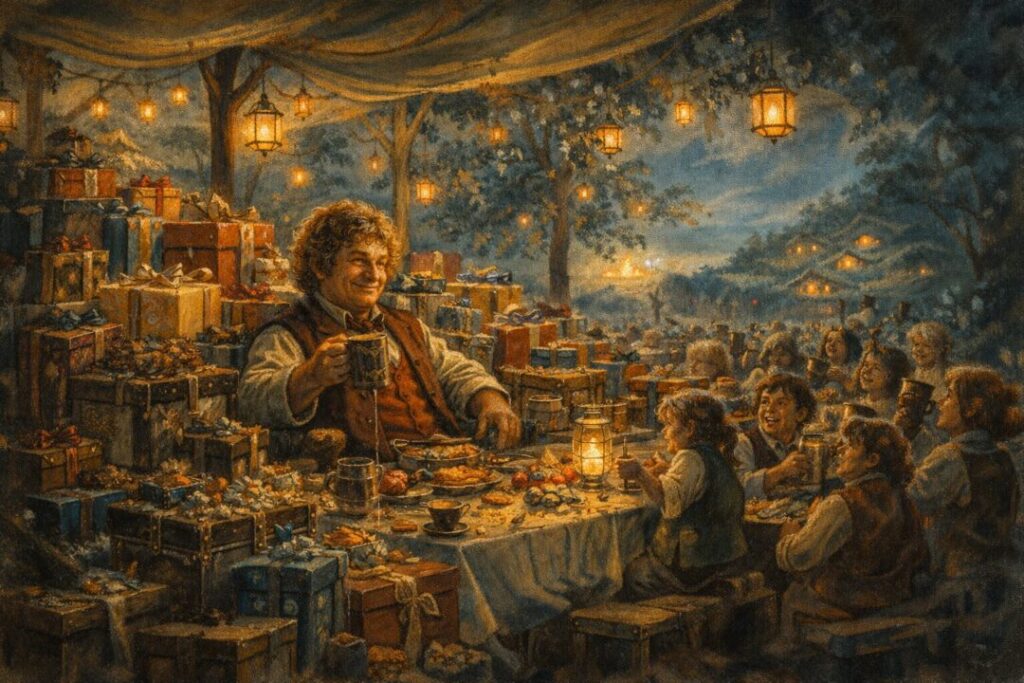
His eleventy-first birthday party alone involves gifts and food on a scale that, translated into modern wealth, would resemble someone giving away millions without hesitation.
And that was done purely for amusement.
Why Bilbo Never Looked Rich
Wealth is not just what you have—it is how you signal it.
Bilbo signals none of it.
He does not:
- Expand Bag End
- Hire staff
- Accumulate land
- Influence local politics
- Establish a family legacy
- Display luxury
In fact, he actively undermines the signs of wealth by:
- Giving things away
- Traveling alone
- Writing instead of building
- Associating with elves and dwarves
- Leaving the Shire entirely
This unsettles people.
To the Shire, wealth is supposed to be invisible, stable, and reinforcing of tradition. Bilbo’s wealth enables disruption—social, cultural, and personal.
So instead of being admired, he becomes suspect.
Wealth Without Power
This is where Bilbo’s story diverges sharply from most wealth narratives.
He never converts wealth into power.
He does not:
- Command loyalty
- Shape policy
- Influence trade
- Establish authority
His wealth buys only freedom:
- Freedom to leave
- Freedom to return
- Freedom to write
- Freedom to give
- Freedom to refuse expectations
In a world obsessed with lineage and legacy, Bilbo opts out.
The Final Irony
Bilbo dies without ever needing his fortune.
He does not use it to survive.
He does not use it to dominate.
He does not use it to reshape the world.
Measured in gold, Bilbo Baggins was extraordinarily rich.
Measured in power, he chose to remain small.
And measured in freedom, he may have been the wealthiest individual in Middle-earth—because he alone understood that the greatest value of gold is the ability not to need it.