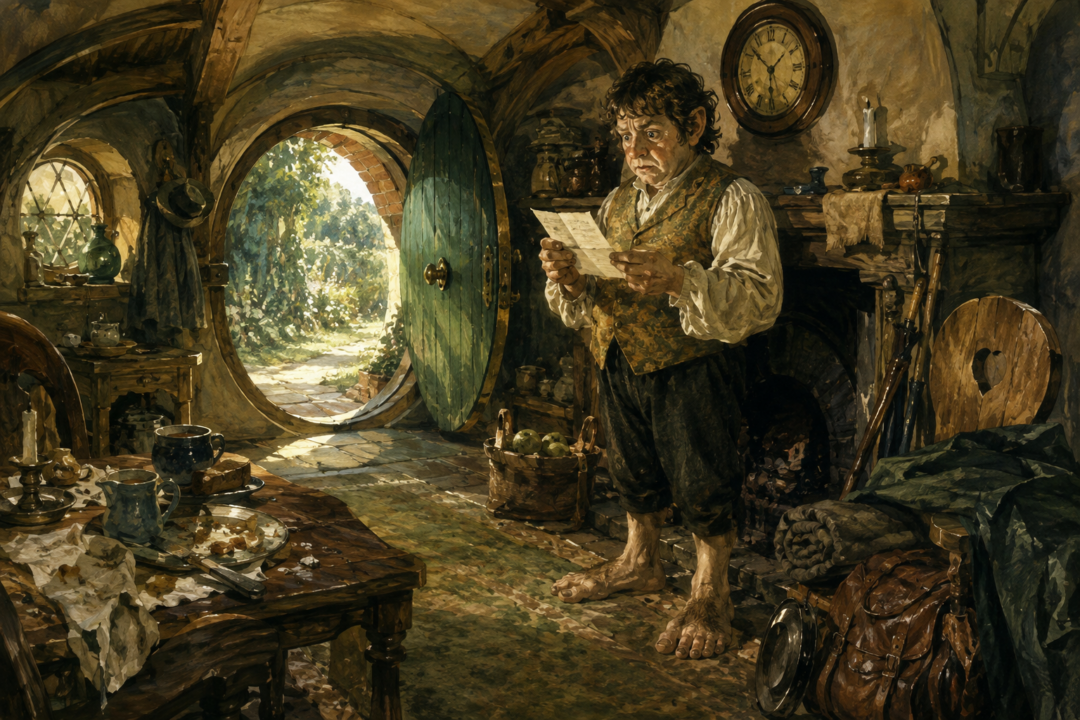
Bilbo Baggins begins The Hobbit worrying about cakes, handkerchiefs, washing-up, and what thirteen unexpected guests are doing to his pantry. By the following morning, those same visitors have transformed him into something much stranger: a professional burglar with a profit share and provision for his funeral.
The document responsible is wonderfully small. In the book, unlike some later adaptations, Bilbo is not handed an enormous contract to sign. Thorin and Company leave a short letter beneath the clock on his mantelpiece. It accepts his supposed offer of professional assistance and lays out the essential terms: payment connected to the expedition’s profits, travelling expenses, and funeral expenses should the worst happen.
It is one of The Hobbit’s best jokes.
It is also remarkably serious.
The letter turns an absurd morning in Bag End into an economic relationship that continues to matter almost until the Battle of Five Armies. What initially sounds like comic business language becomes a framework for questions about ownership, risk, obligation, treasure, and finally the difference between having a legal claim and deciding what that claim is morally worth.
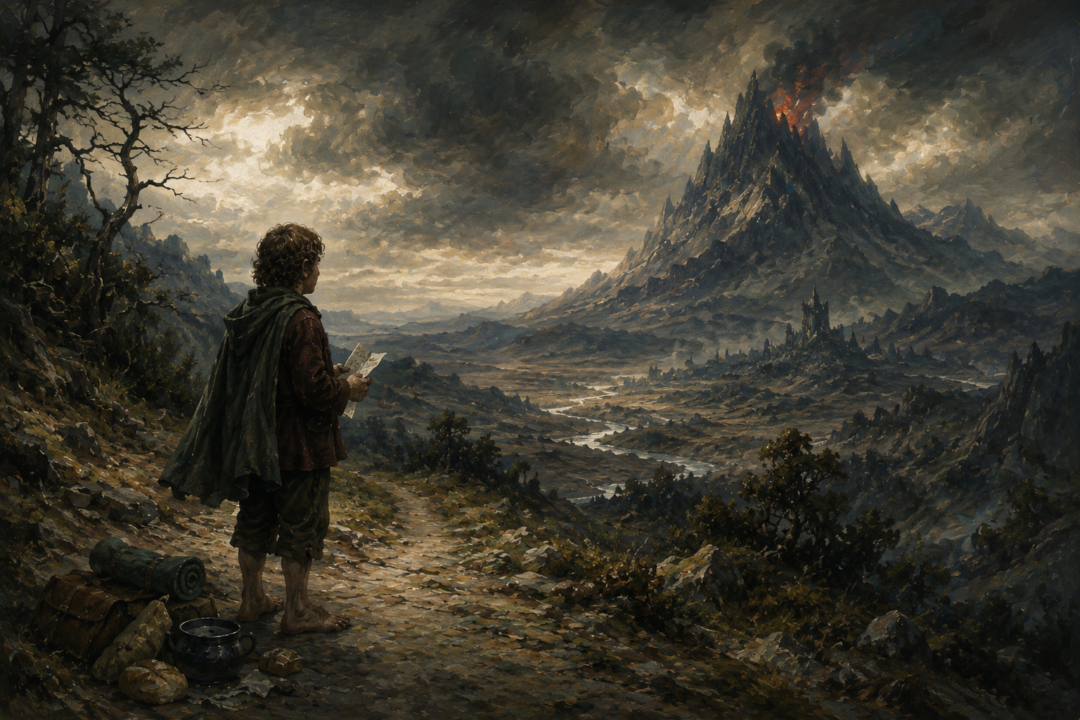
The Joke Begins With Bilbo Being Treated as a Professional
The comedy depends partly on the enormous gap between Bilbo’s actual experience and the language used to describe him.
The dwarves address him as “Burglar Bilbo” and refer to his “professional assistance.” Yet Bilbo has never conducted a burglary. Gandalf has effectively nominated him for a profession before Bilbo has performed a single act belonging to it.
That mismatch is funny because the formal language pretends that everything has already been settled.
The previous evening has been chaotic. Bilbo has protested, become flustered, listened to songs about distant mountains and dragon-fire, and been drawn emotionally toward adventure. By morning, Thorin and Company have translated all of that confusion into something resembling a commercial arrangement.
Their letter makes the impossible sound administrative.
A dragon has occupied a lost Dwarven kingdom and its immense treasure. Thirteen Dwarves intend to travel across dangerous country and recover it. Their chosen specialist is a comfortable hobbit who has barely managed to leave home on time.
And somebody has apparently calculated his expenses.
The narrator lets the contrast do much of the work. Heroic adventure and ordinary business procedure occupy the same sentence.
But the humor does not make the terms meaningless.
One Fourteenth Changes Bilbo’s Position
The crucial economic provision is Bilbo’s potential share: up to one fourteenth of the total profits, if there are any.
That qualification matters.
Bilbo is not simply promised a chest of gold for accompanying the Company. His reward depends upon the success and profitability of the enterprise. The wording therefore connects him economically to the Quest of Erebor.
The fraction also fits his position within the expedition. Thorin travels with twelve other Dwarves, making thirteen Dwarves in all; Bilbo becomes the fourteenth member of the travelling company. His presence also conveniently removes the unlucky number thirteen, something the story explicitly plays with when Bilbo later calls himself the “lucky number” before Smaug.
Yet his one-fourteenth interest should not automatically be treated as a modern legal partnership agreement. The Hobbit never provides enough information to construct a complete legal system around Thorin’s letter. What the text clearly establishes is simpler: Bilbo has been promised an economically defined interest in the success of the expedition.
That distinction becomes extremely important later.
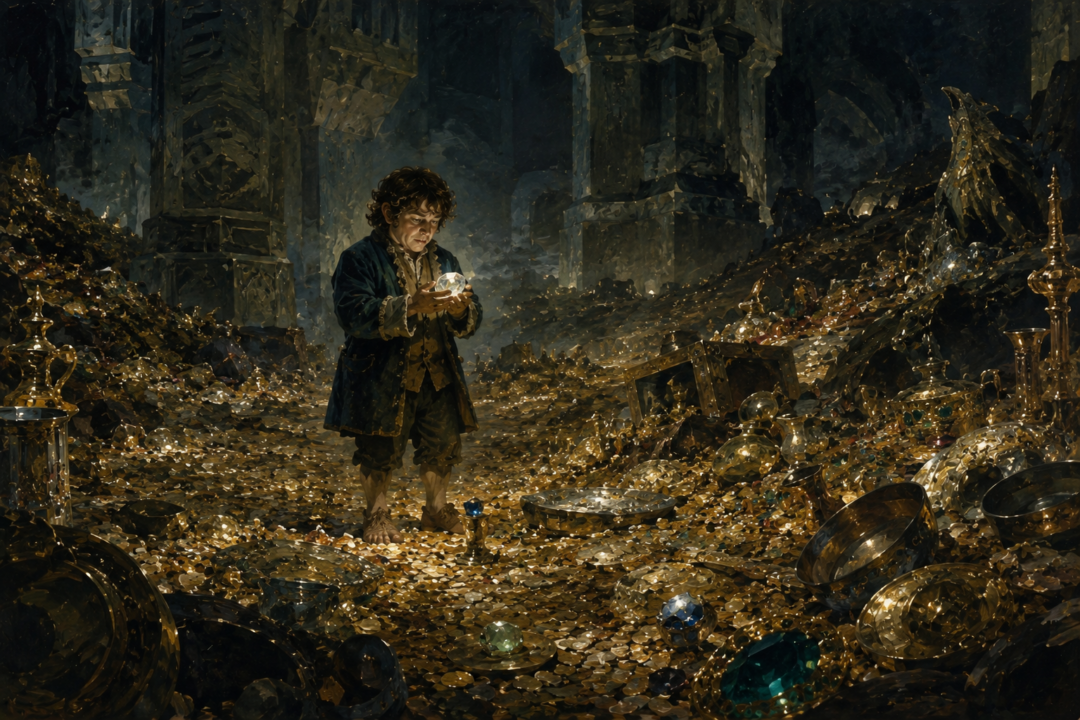
The Funniest Clause Is Also the Darkest
Then comes the funeral provision.
The Company promises that funeral expenses will be covered if necessary and if arrangements have not otherwise been made.
On first reading, it is classic Hobbit comedy. The dwarves discuss the possibility of Bilbo’s death with the same practical tone used for travelling costs.
For Bilbo, however, this is the first morning of the adventure.
Before he has encountered trolls, goblins, wolves, giant spiders, or a dragon, the financial terms quietly acknowledge that he may never return to Bag End.
That is what makes the joke work so well. Nothing about the danger is exaggerated. If anything, the language understates it.
The Quest really can kill him.
Indeed, several members of the Company eventually die because of the conflict surrounding Erebor. Thorin, Fíli, and Kíli do not survive the Battle of Five Armies.
The funeral clause therefore establishes a pattern that The Hobbit repeatedly uses: cheerful or comic language can sit directly beside mortal danger without cancelling it.
The joke is funny because the risk is real.
The Contract Makes Adventure Sound Like Commerce
The dwarves’ vocabulary also tells us something about how the expedition is being presented to Bilbo.
This is simultaneously a quest of inheritance and a treasure-recovery venture.
For Thorin, Erebor is not merely a pile of valuables waiting to be divided. Smaug destroyed his people’s kingdom and seized wealth accumulated under the Kings beneath the Mountain. Thorin’s desire to return therefore has dynastic, historical, and personal dimensions.
Bilbo occupies a different position.
He has no ancestral claim to Erebor.
His initial connection is contractual.
That difference helps explain why the language of “profits” is so useful. Bilbo is being offered compensation for services in an enterprise whose deeper emotional meaning belongs primarily to the Dwarves.
But once the treasure is recovered, those two ways of understanding Erebor collide.
Is the hoard recovered property?
An inheritance?
Royal wealth?
Compensation for the destruction of Dale?
A source from which obligations to allies should be paid?
Or simply treasure possessed by whoever can defend the Mountain?
The book does not reduce these competing claims to one simple economic formula. Instead, the dispute after Smaug’s death shows how inadequate formulas become once ownership, history, vengeance, and pride collide.
Bilbo’s little letter survives directly into that larger crisis.
Bilbo Actually Keeps the Letter
One of the most revealing details appears much later.
During the siege of the Mountain, Bilbo secretly leaves Thorin’s position and meets Bard and the Elvenking. He explains that he has an interest in the dispute: a one-fourteenth share according to the letter he has preserved.
The document from Bag End is still with him, now crumpled and repeatedly folded. PubHTML5
That detail transforms an early joke into something tangible.
Bilbo can produce evidence of his claim.
More importantly, he understands the wording carefully. He distinguishes a share in the profits from an unconditional right to one fourteenth of every object beneath the Mountain. He is willing to hear the claims made by Bard and others and allow legitimate deductions before asserting his own interest.
This is a striking contrast with Thorin’s increasingly possessive attitude toward the hoard.
Bilbo is the supposedly ridiculous amateur burglar, yet at the crucial moment he approaches the economic dispute with considerable restraint.
He has a claim.
He does not therefore assume that every other claim is invalid.
The Arkenstone Tests the Limits of the Agreement
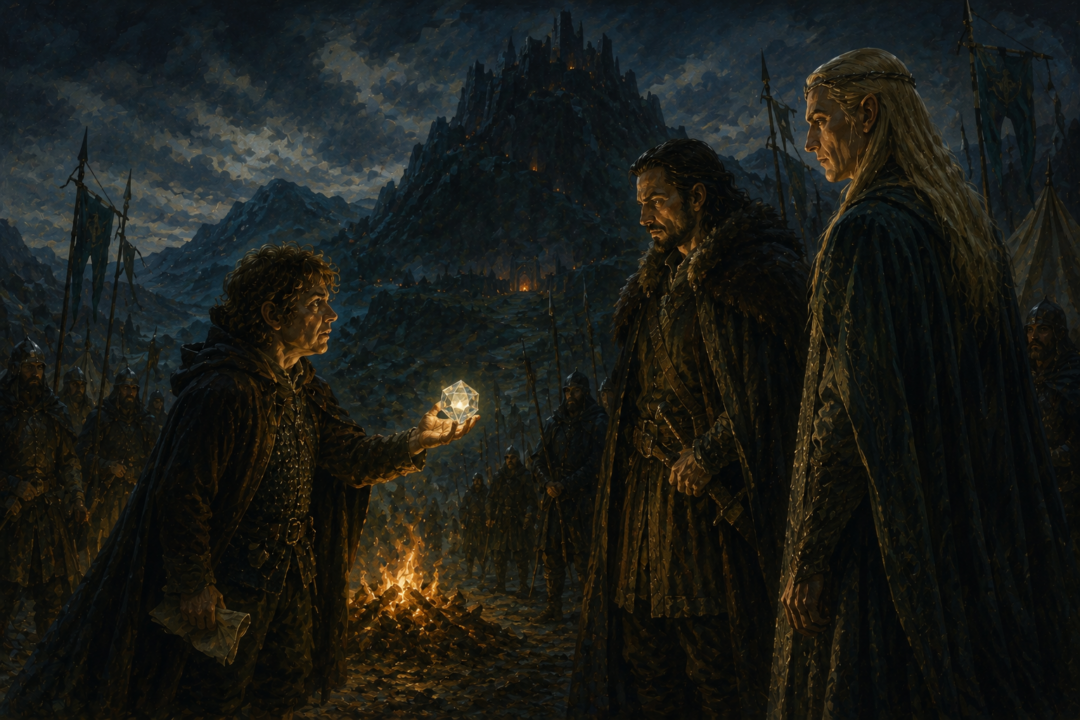
Bilbo’s decision to give the Arkenstone to Bard is where contractual interest and moral judgment collide most sharply.
He has found the jewel and concealed that fact from Thorin. During negotiations outside the Mountain, he gives it to Bard and the Elvenking so they can use it as leverage.
Bilbo does not imagine this is harmless. He knows Thorin values the Arkenstone intensely, and when Thorin discovers what he has done, his anger is terrible.
The text does not present Bilbo’s one-fourteenth share as an explicit legal authorization to dispose of the Arkenstone. That would go beyond what the book establishes. Bilbo instead invokes his share while making a desperate intervention intended to help break the deadlock.
His reasoning is practical and moral rather than a carefully defined statement of property law.
That matters because the entire situation has moved beyond what the original agreement could comfortably govern.
No clause beneath the clock at Bag End explained what should happen if Smaug were killed by someone outside the Company.
Nothing there resolved Bard’s claims on behalf of the people of Lake-town.
Nothing anticipated an armed confrontation between Dwarves, Men, and Wood-elves.
And nothing could account for Thorin’s increasingly destructive fixation upon the treasure.
The contract gives Bilbo an economic stake.
It cannot tell him what he ought to do with that stake.
Bilbo’s Greatest Use of Wealth Is His Willingness to Give It Up
This is where the early comedy reaches its deepest consequence.
Bilbo begins the adventure as someone strongly attached to comfort and possessions. He loves his home, meals, clothes, furniture, and predictable routines. None of that is condemned; much of it remains genuinely good, and his desire to return home never disappears.
But by the crisis at Erebor, Bilbo has learned something more difficult: possessing a legitimate interest does not require maximizing it at every cost.
He is prepared to risk Thorin’s friendship and his own reward in an attempt to prevent bloodshed.
After the battle, Dáin offers to honor the arrangement generously, but Bilbo does not carry home anything remotely resembling a full fourteenth of the enormous wealth of Erebor. He ultimately takes only two small chests, one of silver and one of gold, explaining in effect that this is as much as he can reasonably manage.
The contrast is deliberate and powerful.
At Bag End, the adventure begins with precise-sounding financial terms.
At Erebor, Bilbo discovers that knowing how much one may claim is not the same thing as knowing how much one should take.

Why the Contract Matters
Thorin’s letter works because The Hobbit never forces readers to choose between comedy and consequence.
The businesslike wording is funny. The “professional burglar” is completely inexperienced. The funeral provision is absurdly polite. The payment is contingent on profits from an expedition whose principal obstacle is a dragon.
Yet virtually every part of the joke points toward something real.
Bilbo genuinely risks death.
The treasure genuinely creates competing claims.
His promised share genuinely becomes relevant in negotiations.
And wealth genuinely becomes one of the story’s central moral pressures.
The small letter beneath Bilbo’s clock therefore does more than launch him out of his front door. It gives economic form to one of the book’s deepest tensions.
Bilbo begins by asking, in effect, what he will receive for joining the adventure.
By the end, the more important question is what a person should do when he finally has the right to claim something valuable.
The contract can calculate a fraction.
It cannot calculate wisdom.
Sources & Notes
- https://tolkiengateway.net/wiki/Bilbo%27s_contract — Tolkien Gateway: the written offer’s duties, remuneration, funeral terms, and liability provisions.
- https://tolkiengateway.net/wiki/An_Unexpected_Party — Tolkien Gateway: the comic dinner, Bilbo’s recruitment, and the contract delivered before departure.
- https://tolkiengateway.net/wiki/Thorin_and_Company — Tolkien Gateway: the expedition’s membership, aims, and Bilbo’s formal role as burglar.
- https://tolkiengateway.net/wiki/Quest_of_Erebor — Tolkien Gateway: the economic and dynastic objective of recovering Erebor and its treasure from Smaug.
Sources reproduce the contract’s terms and place them within Thorin’s company and the Quest of Erebor.