
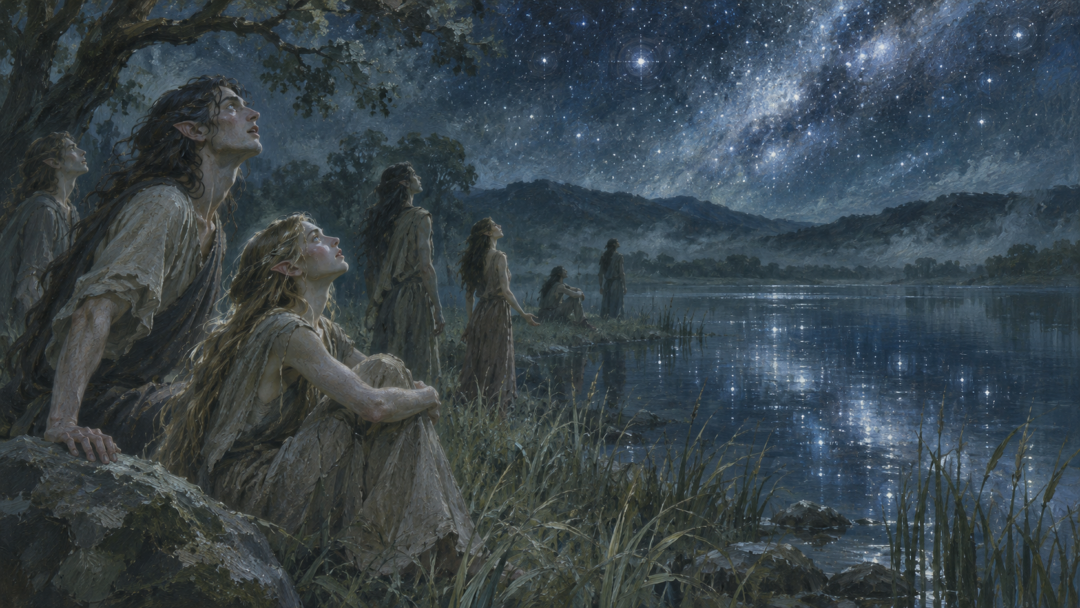
On the shores of Cuiviénen, the first Elves woke beneath the stars and began to name the things around them. Water, darkness, the faces of their companions: the world was already there to be discovered, and speech became part of that discovery. Yet long before the Elves opened their eyes, the Ainur had sung the Music from which the world’s history would unfold. How could they have sung anything meaningful when no Elvish language existed?
The contradiction comes from assuming communication began with Elvish and Mannish languages. In the Ainulindalë, Eru Ilúvatar already speaks to the Ainur and teaches them musical themes before the Great Music. Their song conveys thought, but the story never identifies its words as Quenya or any later tongue. And Fëanor’s famous invention concerns letters, not the beginning of speech.

The story begins with listening
The opening of the Ainulindalë places the Ainur before the making of the world. Born of Ilúvatar’s thought, each understands only part of his mind. They do not begin by inventing vocabulary. An exchange is already taking place: “And he spoke to them, propounding to them themes of music;” The story never pauses to explain a mechanism for it, just as it never suggests that the Ainur must wait for the arrival of Elves to understand one another.
At first the Ainur do not perform as one magnificent choir. They sing alone or in small groups while others listen, because each knows only the part of Ilúvatar’s mind from which that Ainu came. They do not immediately understand one another. Listening deepens their knowledge of one another, and their music grows in harmony. Separate voices move toward shared understanding.
Remembering only the tremendous final song can obscure this beginning. Before the Great Music there is learning, attention, and a developing relationship among beings who are already capable of expression. There is no lesson in inventing grammar. Listening allows different minds to participate in a common work. The possibility of misunderstanding is already present, even before the famous discord.
Only after this preparation does Ilúvatar gather all the Ainur and declare a mighty theme. They are amazed by what he reveals, and he calls upon them to make a Great Music together, each adding thoughts and devices of their own. The scene needs no later Elvish dictionary to supply meaning. The theme has meaning before they elaborate it.
Did the Music have words?
One phrase prevents a neat answer that the Ainur simply hummed without words. Their voices are compared to many kinds of instruments and “like unto countless choirs singing with words”. The description suggests recognizable music with the expressive force of many voices. We cannot erase that reference to words simply to solve the puzzle.
Still, the wording is a comparison, not a surviving lyric. The passage does not give an alphabet, a grammar, a named language, or a verse that readers could translate. It places harps, lutes, pipes, trumpets, and other familiar sounds beside choirs to convey the range of the Music. The Ainur need not be holding those instruments. Nor does it establish a language later spoken by Elves in Middle-earth or Valinor.
Nor does it prove the opposite, that the event was definitely wordless. There is an honest gap between what the text evokes and what it specifies. It allows for meaningful song without supplying the mechanics of primordial speech. Asking exactly which syllables were sung is reasonable curiosity, but the published account does not answer it. Assigning them Elvish lyrics would be invention, not discovery.
What the story does tell us is what their singing expresses. Ilúvatar gives a theme; the Ainur adorn it with their own thoughts; their agreement and their failures of agreement can be heard within the music. When Melkor introduces ideas at odds with the theme, the result is discord, and other voices are affected. This is no ordinary conversation set to a tune. Ideas and wills become audible as music, with consequences that go beyond anything a set of spoken sentences could contain.
A song heard before a world was seen
After the Music, Ilúvatar shows the Ainur a vision of a world in the Void. The narrative explicitly marks a change in how they perceive: what had previously been heard is now made visible. They see a history unfolding beyond their earlier understanding. The singers are not Elves performing within Arda. Arda has yet to be revealed. The Ainur will also see the Children of Ilúvatar, whose coming surprises them: they have helped shape the Music without possessing complete knowledge of everything it contains.
Even the vision is not yet identical to a world that has independent existence. Ilúvatar subsequently brings Eä, the World that Is, into being. Some Ainur enter it and become part of its history. The Music, its vision, and the world’s realization are distinct stages. Its opening cannot be dated by the later history of Elvish speech as if both belonged to the same society.
This is also why familiar words in the narration should be handled carefully. The story is told to readers who know what singing, speaking, instruments, and hearing are. Those descriptions tell us about relationships, not the physical conditions of the Void. The text presents real acts of expression without telling us how a pre-world voice corresponds to a physical voice in Middle-earth.
The first Elves had their own beginning of speech
When the Quendi awaken beside Cuiviénen, their story begins in a different setting. They dwell under the stars, walk in wonder, and begin making speech and giving names to the things they perceive. They call themselves Quendi, the people who speak with voices. This is a vivid account of language developing among the Firstborn as they encounter their world. It does not claim that no being anywhere had communicated before that moment.
The distinction appears in the reason given for their name. The Elves had not yet met other living things that spoke or sang. That describes their experience, not a universal history of language. The Elves had not witnessed the Ainur’s first Music. They knew no other speaking people, but other beings had already communicated. Indeed, the Quendi have names of their own before Oromë encounters them; their speech is not introduced as a gift of writing from an Elven inventor.
Their languages also have a history after Cuiviénen. The Elves do not wake speaking the fully developed Quenya familiar from the lore of the Noldor. As groups travel, separate, and live in different lands, their speech changes. Quenya belongs to that later history of Elvish languages, shaped among the Eldar in Aman. Elven songs of the First Age do not establish the language of the primordial Music.
This gives the two stories different purposes. At Cuiviénen, naming joins the Elves to a newly encountered world: they distinguish what they see and give voice to their experience. In the Ainulindalë, the Ainur receive a theme that will disclose a world not yet made. Both value voice and understanding, but the movement differs. One begins with a world to name; the other begins with a music whose significance will become a world.
Fëanor made letters, not the first language
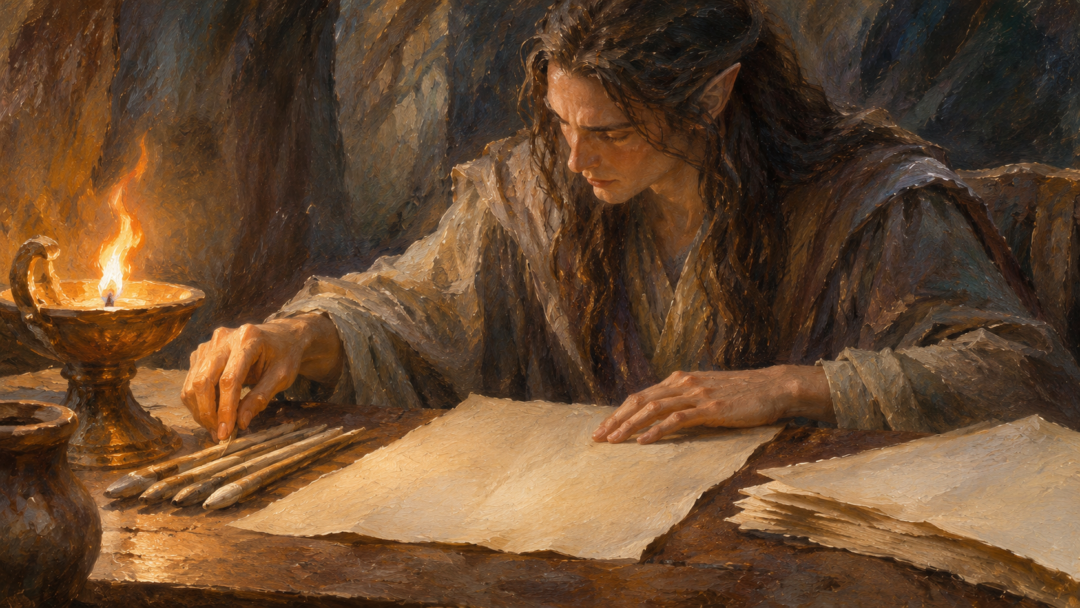
Fëanor enters this history much later, and his achievement is often misstated. He did not invent language for the Elves, let alone for all existence. The Silmarillion describes Rúmil of Tirion as a loremaster who devises suitable signs for recording speech and song. That work already presupposes people speaking and singing. He preserves existing speech in marks rather than teaching silent beings to communicate.
Fëanor improves on Rúmil’s work and devises the letters that bear his own name. Those are the famous tengwar, known to readers through Elvish inscriptions in The Lord of the Rings, including the writing on the West-gate of Moria. An ingenious alphabet is not itself a language. Letters are tools for representing speech; a language is the living system of sounds, meanings, and patterns that speakers use. Fëanor never receives credit for inventing speech.
The distinction becomes especially clear when we imagine a singer who cannot write. That singer can still know a melody, remember its words, and teach it to others. A script allows a community to record and transmit what it already possesses in spoken form. Elvish creativity in language and writing belongs to different stages. Neither is a prerequisite for the Ainur’s earlier Music.
There is even a fitting connection between Rúmil’s work and the ancient Music: the loremasters seek ways to preserve song, while the Ainulindalë itself preserves an account of the first singing. But preserving its story is not transcribing its performance. Elves can record events before their awakening without making those events Elvish. A narrative’s language need not be the language of everything it narrates.
So the mystery is not how the Ainur managed to sing without Fëanor’s letters. The deeper mystery is what their primordial expression was like, and there the text leaves room for wonder. It gives us speaking, listening, words in comparison, and thoughts unfolding into music, but no recoverable first lyric. At Cuiviénen the Elves learned to name the stars reflected in water. Long before their names, the Ainur had sung of a world in which those stars could shine.
Sources & Notes
- Tolkien Gateway, Ainulindalë — guide to The Silmarillion's opening: Ilúvatar's themes, the Ainur's Music, the vision, and the creation of Eä — https://tolkiengateway.net/wiki/Ainulindal%C3%AB
- The Encyclopedia of Arda, Quendi — the Elves' name for themselves as speakers, formed at Cuiviénen before meeting other speaking beings — https://www.encyclopedia-of-arda.com/q/quendi.php
- Arden R. Smith, Writing Systems (The Tolkien Estate) — Rúmil's sarati and Fëanor's tengwar are scripts for recording language, not the invention of speech — https://www.tolkienestate.com/scholarship/arden-smith-writing-systems/
Reading references: The Silmarillion, Ainulindalë, Of the Coming of the Elves, and Of Fëanor and the Unchaining of Melkor; The Lord of the Rings, Appendix E. The links below provide reference guides and specialist commentary on those passages. The exact language or lyrics of the primordial Music are not specified; interpretation is distinguished from textual fact.