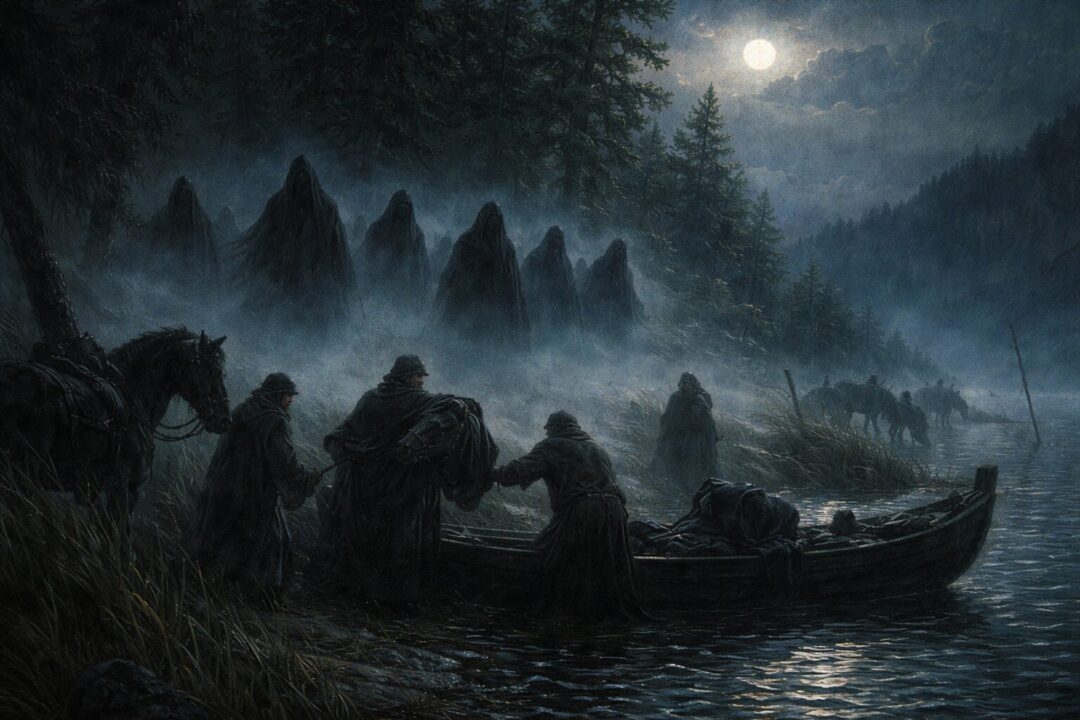
The Nazgûl feel, at first glance, like the wrong kind of beings to run a war.
They are not generals who hold councils in tents. They do not need sleep. They do not write letters, sign orders, or negotiate alliances. Most living creatures can barely stand to be near them.
And yet, Sauron uses them as organizers—not just as hunters.
So the question is fair: how can a force that is “half in the Unseen” coordinate anything as practical as command-and-control?
The answer the texts allow is both simpler and stranger than modern readers expect.
Because Tolkien doesn’t treat the Nazgûl as intangible phantoms. He treats them as embodied agents whose relationship to will—and to fear—changes how coordination works.
“Half in the Unseen” doesn’t mean “half absent”
A common mental picture is that the Nazgûl are constantly slipping out of reality, like a radio signal cutting in and out. But the book-language around the “wraith-world” is not describing unreliable existence so much as a different mode of perception and presence.
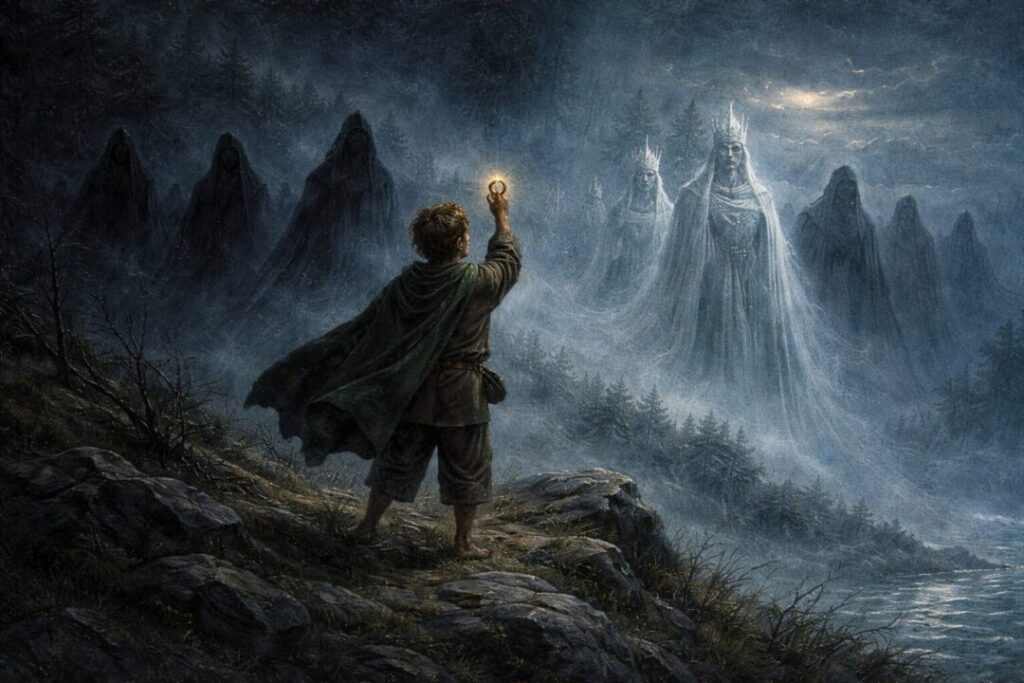
Gandalf’s explanation to Frodo is the key reference point. Frodo’s danger at the Ford was not that he was “weak,” but that he was beginning to fade. The wound was drawing him toward the wraith condition, and the Ring intensified that movement. Gandalf says Frodo was “half in the wraith-world” while wearing it—and that this was why the Riders might have seized him.
Notice what that implies:
- The Nazgûl can interact with the physical world (they ride, hunt, and pursue), but they also operate in a reality that overlaps the Seen.
- “Unseen” here is not “nonexistent.” It is closer to “present on a different side.”
That’s why Frodo can see them differently when he crosses that threshold. The Riders aren’t suddenly invented by the Ring; they are revealed.
So the premise “they’re half in the Unseen” doesn’t block coordination. It reframes the kind of coordination they need.
The Nazgûl run on hierarchy, not deliberation
Command-and-control in a pre-tech world usually depends on delegation: captains receive orders, interpret them, and act.
But the Nazgûl are unusual because their chain-of-command is unusually tight.
In Unfinished Tales, Tolkien states Sauron chose them because they had “no will but his own,” being “utterly subservient” to the Ring that enslaved them (which Sauron held).
This is one of the most important logistical facts about them.
If your chief problem is trust—if you’re a Dark Lord surrounded by traitors, double-agents, and servants with private ambitions—then the best “communications upgrade” is not faster messengers.
It’s perfect obedience.
This doesn’t mean the Nazgûl are mindless puppets in every moment. The same Unfinished Tales material depicts them conducting searches, making movements, and carrying out complex instructions across wide regions.
But it does mean their coordination is less like a council of war and more like a body responding to one brain.
When Sauron decides the search must begin, the Nazgûl begin it. When secrecy matters, secrecy becomes policy. When a rendezvous is required, they keep it.
Tolkien actually shows their logistics
The most revealing thing about “The Hunt for the Ring” is how practical it is.
Sauron does not simply “send the Nine.” He sends them with constraints, locations, and roles.
- They are “commanded to act as secretly as they could.”
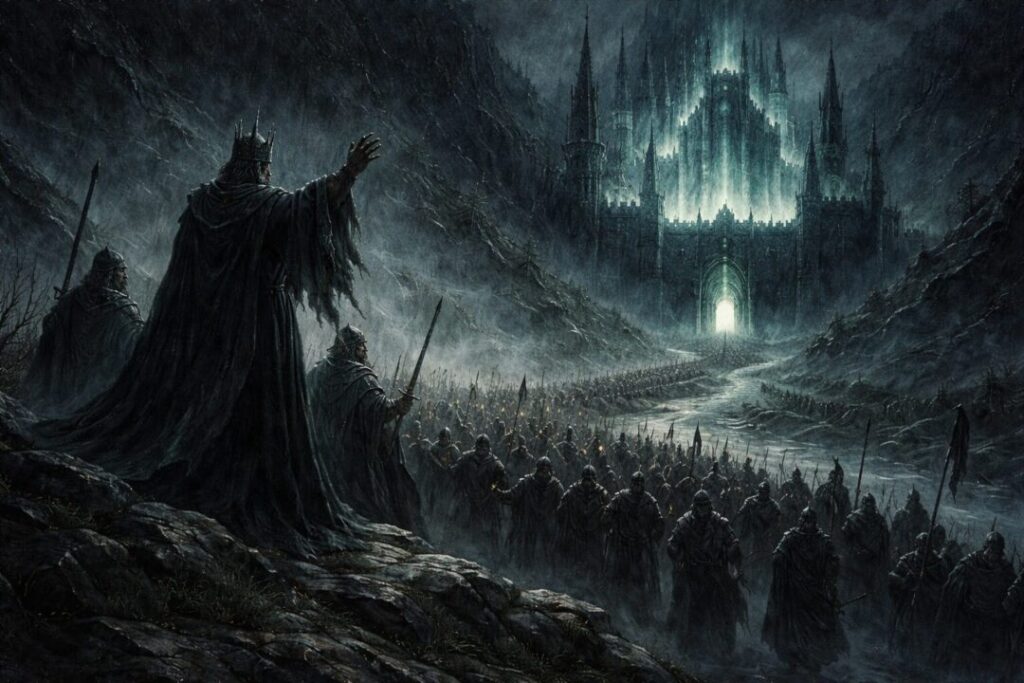
- Their leadership has a base structure: the Chieftain of the Ringwraiths dwells in Minas Morgul with six companions, while Khamûl, second to the chief, abides in Dol Guldur.
That is already a command map: Morgul as a western spearpoint, Dol Guldur as a northern stronghold.
Then Tolkien adds the detail most people skim past:
The Riders reach the west-shores of Anduin “as they had trysted,” and there they receive horses and raiment “secretly ferried over the River.”
A tryst. Secret ferrying. Supplies staged in advance.
That is not ghost-lore. That is military movement.
It tells you exactly what kind of “coordination” Tolkien imagines for them: pre-arranged contact points, prepared assets, and disciplined execution.
In other words, the Nazgûl can coordinate war the way real pre-modern armies did—through planning, staging, and hierarchy—because they are participating in the physical systems of war, even if their nature is spiritually distorted.
Their “communication” advantage is not technology—it’s fear
Even with hierarchy and trysts, armies still need something else: control at scale.
How do you keep pressure on captains spread across fronts? How do you keep troops moving when morale breaks? How do you enforce the will of the center?
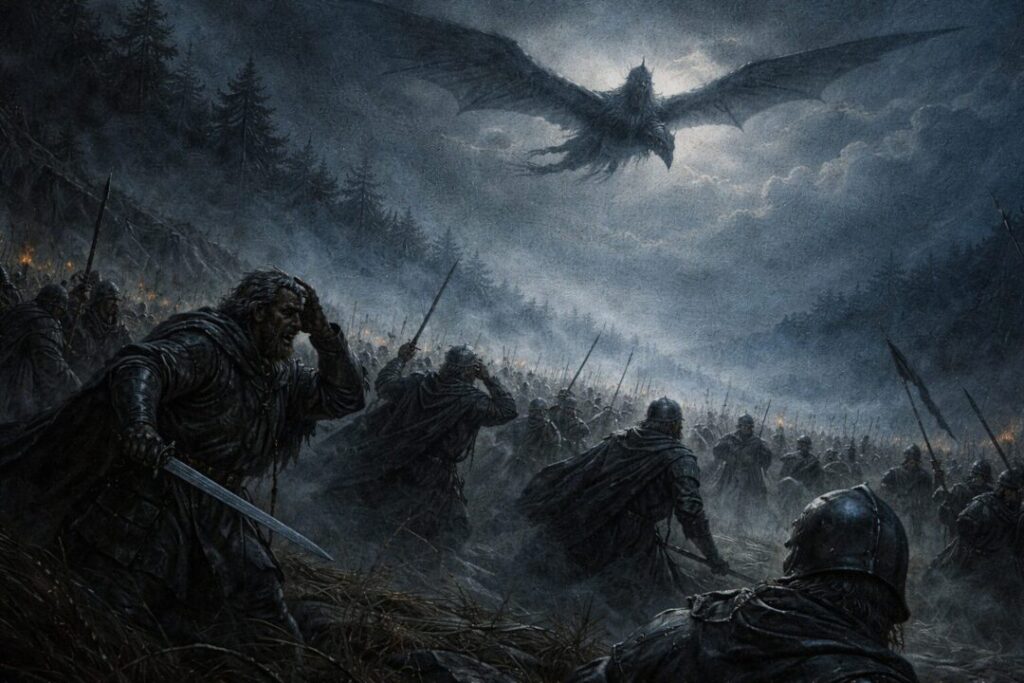
In Tolkien’s world, the Nazgûl do something brutally efficient: they weaponize presence.
Terror is not a side-effect for them; it is a tool that changes how quickly groups collapse into obedience.
The moment a Nazgûl enters a battlefield space, the emotional environment shifts. That means fewer arguments, fewer delays, fewer acts of courage that depend on calm.
A terrified host doesn’t need complex messaging. It needs only a push.
This is one of the reasons the Witch-king is so effective as a war-leader: he doesn’t just give orders—he makes disobedience psychologically difficult.
And that kind of “command” travels faster than couriers.
Sauron doesn’t rely on the Nine alone
Another quiet reality: the Nazgûl are not the entire communications apparatus of Mordor.
They sit at the top of it.
Orcs, Men under Sauron’s shadow, and local captains handle ordinary control. The Nine are used when speed, terror, or absolute reliability matters most—when Sauron cannot risk a messenger with a private agenda.
That matches Sauron’s own reasoning in Unfinished Tales: his “ordinary spies and emissaries” bring him no tidings, and the world is full of interference—watchful Dúnedain and Saruman’s treachery. So he turns to the Ringwraiths.
So the Nazgûl are not “radio towers.” They are the secure channel—deployed when the network is unreliable.
The most unsettling answer: one will can replace many messages
Here is the point that changes the question.
We tend to assume coordination requires lots of communication because we assume leaders and servants are separate centers of decision.
But Tolkien tells you the Nazgûl have “no will but his own.”
That collapses the normal problem.
If your highest agents are bound into your will, then “orders” don’t need to be constantly transmitted in the way modern readers imagine. The relationship between center and field is different.
It becomes less like a chain of emails and more like an extension of a single intent.
Tolkien does not spell out a technical mechanism for mind-to-mind messaging, and we should not claim he does. But he does give you the operational result: agents whose obedience is so complete that the normal friction of command is reduced.
That is the real reason the Nazgûl can coordinate war even while existing on the threshold of the Seen and Unseen.
Not because they are vague spirits who “just know.”
But because Tolkien built them to be the most reliable kind of servant a tyrant can possess: beings for whom resistance is not merely punished—it is structurally impossible.
The open question the texts leave you with
Once you accept that, a sharper question appears—one Tolkien never answers outright:
If the Nazgûl are so tightly bound to Sauron’s will, where does the Witch-king’s leadership style come from? How much is his initiative, and how much is simply Sauron acting through him?
Unfinished Tales shows structure: the Witch-king in Minas Morgul, Khamûl in Dol Guldur, a tryst by Anduin, secrecy as doctrine.
But it also leaves a shadowed space around agency—just enough room for readers to wonder what it means to be a “captain” when your will is not fully your own.
And if you follow that thread to its end, you start seeing the War of the Ring not only as a clash of armies…
…but as a clash of command systems:
One side coordinated by counsel, trust, friendship, and imperfect messengers.
The other coordinated by fear, hierarchy, and a single dominating mind—so centralized it can afford to send its greatest servants out across the world and still keep them aligned.
That is how the Nazgûl coordinate war.
And it’s why they are more frightening as strategists than they are as monsters.