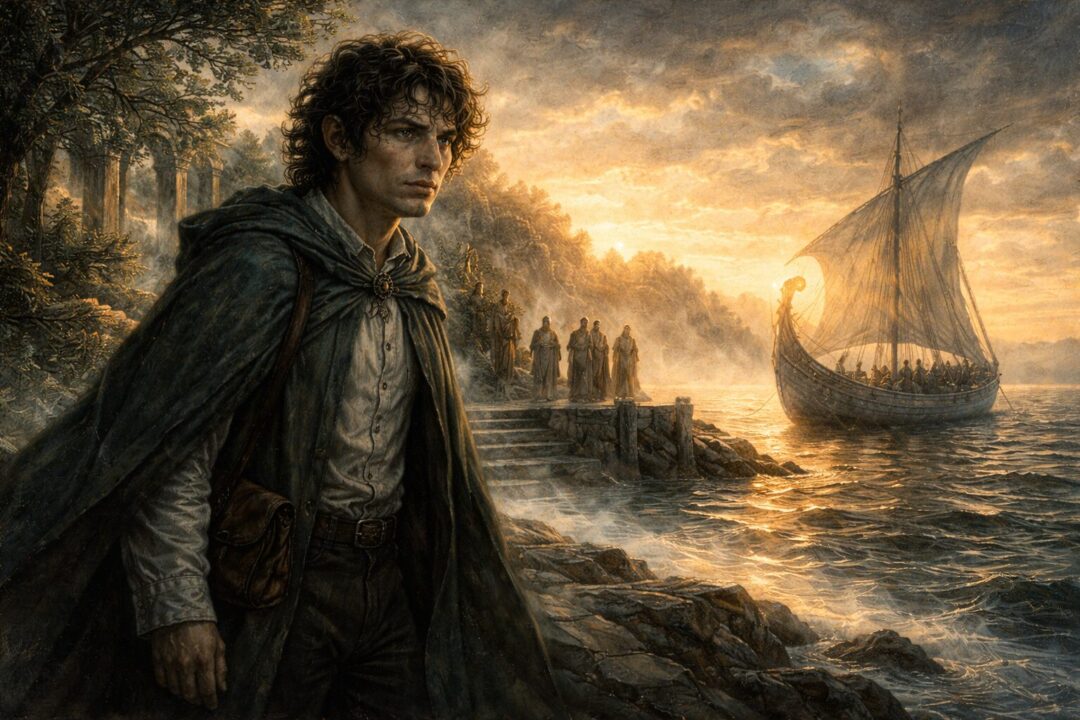
If you trace Frodo Baggins’ journey through Middle-earth, there is a clear turning point — and it does not happen at Mount Doom.
It happens much earlier, on a ruined hill called Amon Sûl, when a single blade slips past his guard and changes him forever.
From that moment on, Frodo is no longer just a hobbit carrying a dangerous object. He becomes someone who has been touched by the Shadow itself. The wound he receives that night never truly heals, and its effects shape the rest of his life — even after the Ring is destroyed.
Understanding the Morgul wound means understanding why Frodo’s story does not end in simple victory.
The Road to Weathertop
By the time Frodo reaches Amon Sûl, he has already been hunted for weeks. The Ringwraiths — the Nazgûl — are closing in, and every mile east feels more dangerous than the last. Frodo is exhausted, frightened, and increasingly aware that something ancient and powerful wants him.
Amon Sûl itself is a place heavy with memory. Once a great watchtower of Arnor, it now stands in ruins, a broken crown of stone on a lonely hill. Tolkien often uses ruined places to signal the lingering presence of past evil, and Weathertop is no exception. It is exposed, windswept, and impossible to defend properly — the worst possible place for a stand.
On the night of October 6th, the fear becomes real.
The Attack on Weathertop
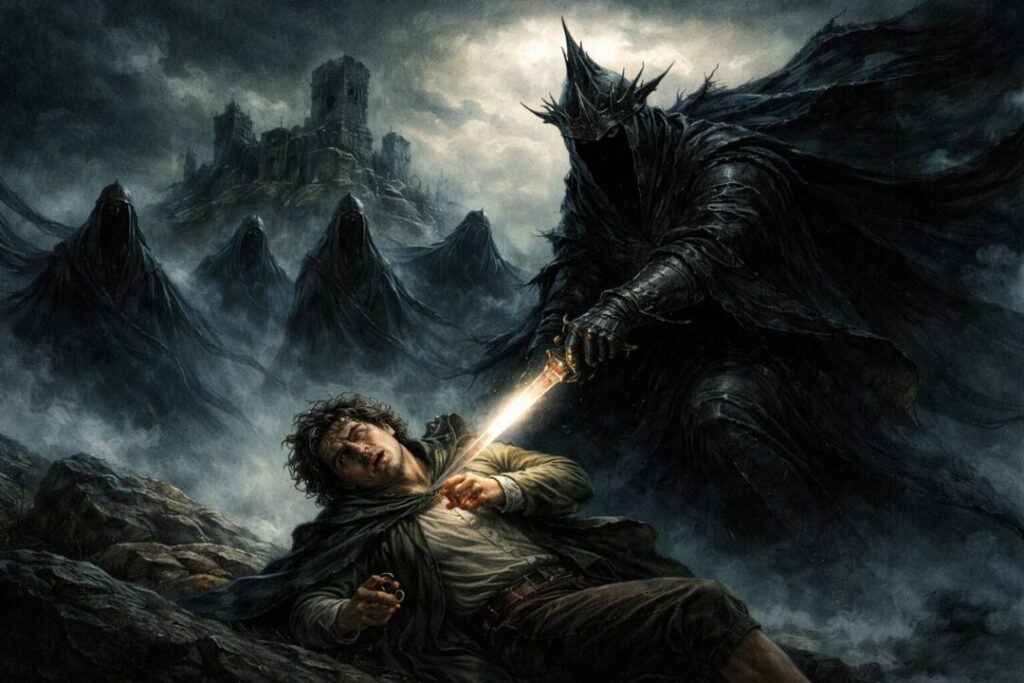
As darkness falls, Frodo and his companions are surrounded. Five Ringwraiths advance, led by the Witch-king of Angmar, the most powerful servant of Sauron in Middle-earth.
In terror and confusion, Frodo does something fateful: he puts on the Ring.
This decision pulls him fully into the unseen world, where the Nazgûl exist in terrible clarity. He can now see the Witch-king’s true form — crowned, towering, and deadly — and in that instant, Frodo becomes completely vulnerable.
The Witch-king strikes with a Morgul-knife.
This is not a weapon meant for a clean death. Morgul blades are forged with a cruel purpose: their shards break off inside the victim, slowly working their way toward the heart. If the process is completed, the wounded person fades into a wraith, enslaved to the Shadow.
Frodo resists, even managing to cry out the name of Elbereth and strike back — a remarkable act for a hobbit. But the blade has already done its work.
The Nature of the Morgul Knife
What makes the Morgul wound so dangerous is that it exists on more than one level.
Physically, it is a stabbing injury. But spiritually, it is far worse. The fragment of the blade remains partly in the unseen world, corrupting Frodo from within. Tolkien is very clear that this is not simply poison or infection — it is a form of domination.
Left untreated, Frodo would have faded. He would not have died as mortals understand death, but become something unnatural, bound to the will of the Witch-king.
This is why time matters so much after the attack.

Aragorn’s Intervention
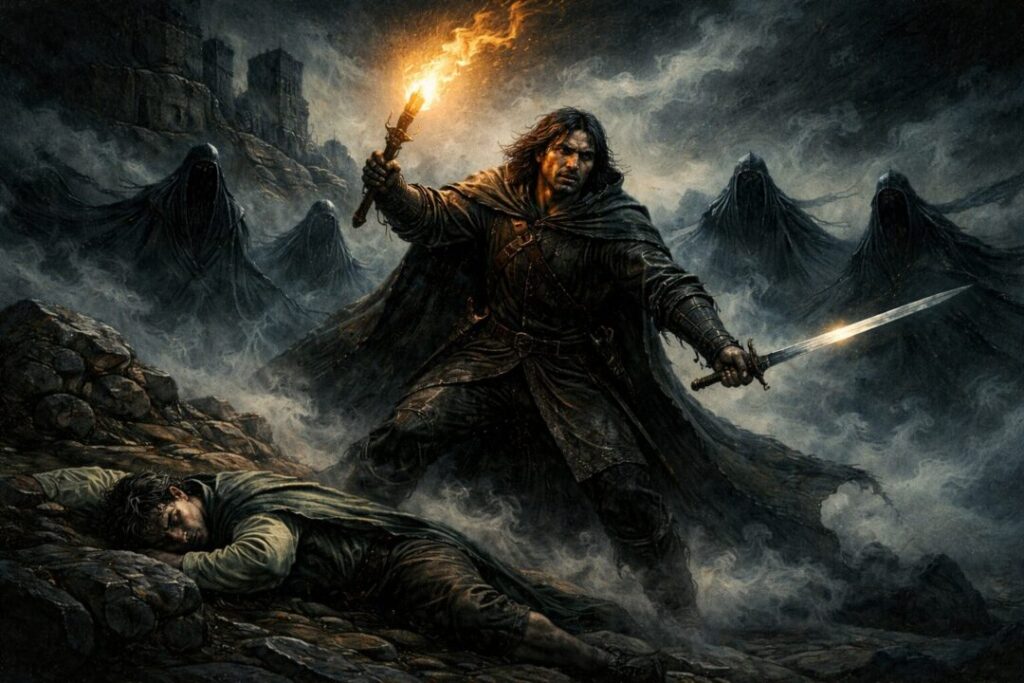
Aragorn drives the Nazgûl away using fire, a weapon they fear. He then immediately begins treating Frodo with athelas, using ancient knowledge passed down through Númenórean tradition.
The herb slows the progress of the wound, but Aragorn knows it is not enough.
He says plainly that Frodo’s life now depends on reaching Rivendell. The splinter is still inside him, moving slowly toward his heart. Every mile is a race against time.
This urgency underscores an important truth: courage alone cannot heal this wound. Frodo survives not because he is strong enough, but because others act quickly and wisely on his behalf.
Why Elrond Couldn’t Fully Heal Him
At Rivendell, Elrond performs the final, critical act. Using his skill and power, he removes the splinter of the Morgul blade before it reaches Frodo’s heart.
This saves Frodo’s life.
But it does not erase the wound.
Elrond explains that some hurts lie too deep for full healing, especially those inflicted by the Shadow. The Morgul wound exists partly in the unseen world, where even Elvish power has limits. What was done cannot be completely undone.
From this point onward, Frodo carries a permanent weakness. On the anniversary of the attack, the wound aches. In cold weather, it burns. When fear or despair grows strong, the pain returns.
It is a reminder that the Shadow has already reached him once — and could do so again.
A Wound That Mirrors the Ring
What makes the Morgul wound so important is that it mirrors the Ring itself.
Both are burdens Frodo did not seek.
Both work slowly rather than suddenly.
Both attack the will as much as the body.
The wound makes Frodo more sensitive to the Ring’s influence. He feels the Nazgûl more keenly. He understands despair more deeply. Over time, this suffering increases his compassion — but it also drains him.
This is why Frodo is able to pity Gollum when others cannot. He knows what it means to be wounded by evil without choosing it.
Why Frodo Could Never Truly Return Home
By the end of the War of the Ring, Frodo has done what no one else could. The Ring is destroyed. Sauron is overthrown. Middle-earth is saved.
Yet Frodo himself is not healed.
The Morgul wound, combined with the long burden of the Ring, leaves him unable to find peace in the Shire. The land is restored, but Frodo is not. He cannot simply forget what he has endured.
When Frodo finally sails from the Grey Havens, it is not an escape — it is a necessity. The Undying Lands offer healing not available in Middle-earth.
This final choice only makes sense when the Morgul wound is understood.
The True Cost of Victory
Tolkien’s world does not promise victory without loss.
The Morgul wound is proof of that. Frodo succeeds not because he remains untouched, but because he is willing to endure damage that cannot be undone.
His greatest sacrifice is not carrying the Ring.
It is living with what it did to him — and accepting that some wounds, once given, shape a life forever.
And in that truth lies the quiet, heartbreaking beauty of Frodo’s story.