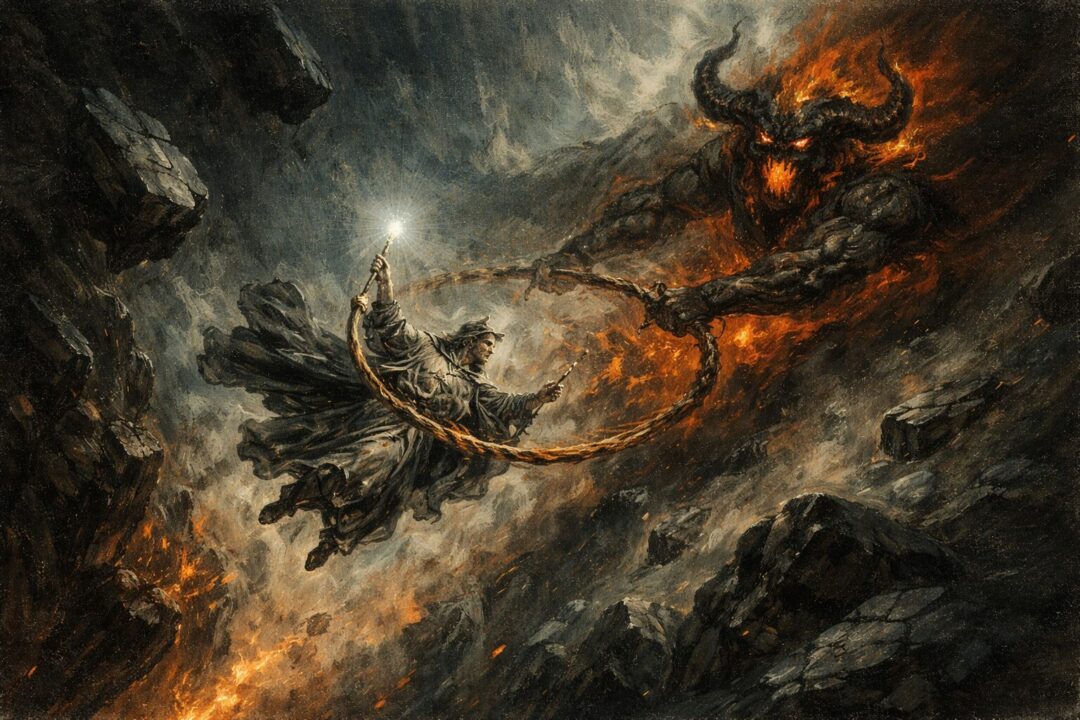
Few moments in the history of Middle-earth are as terrifying—or as misunderstood—as the fall of Gandalf in the depths of Khazad-dûm. To those who witnessed it, the moment looked like a tragic defeat: a wizard dragged down by an ancient terror into fire and darkness. Many believed Gandalf had perished, another victim of the deep places of the world.
In truth, what occurred beneath the Misty Mountains was one of the greatest single combats of the Third Age—a battle not merely of strength, but of will, purpose, and sacrifice.
But what was the Balrog of Moria? And how did Gandalf defeat a being of fire and shadow that had survived since the First Age?
The Terror Beneath the Mountains
When the Fellowship of the Ring entered Moria, they believed the ancient Dwarven kingdom to be long abandoned. Once the greatest realm of the Dwarves, Khazad-dûm had been carved deep into the roots of the mountains, its halls echoing with centuries of craftsmanship, wealth, and pride.
But Moria did not fall to time alone.
In their endless delving for mithril, the Dwarves awakened something far older than their halls—something that should never have been disturbed. During the reign of Durin VI, a terror emerged from the depths, slaying the Dwarf-king and driving his people from the mountain. Since that day, the name Moria had been spoken with fear.
That terror still slept beneath the stone.
On the Bridge of Khazad-dûm, as the Fellowship fled toward the eastern gate, a presence revealed itself—one that had endured unseen for thousands of years. Fire bloomed in the darkness. Shadow took shape. The air itself seemed to recoil.
The creature was a Balrog.
What Is a Balrog?
Balrogs were not mere beasts or monsters. They were corrupted Maiar, spirits of the same order as Gandalf himself. In the earliest days of the world, before the rising of the Sun and Moon, these spirits were seduced and dominated by Morgoth, the first Dark Lord. They became his most feared servants—beings of flame and shadow, engines of terror and destruction.
Clothed in fire, yet wreathed in darkness, Balrogs wielded whips of flame and swords of burning power. They were commanders in Morgoth’s armies during the wars of the First Age, responsible for the fall of great Elven realms and the deaths of legendary heroes.
Most were destroyed in those ancient wars.
The Balrog of Moria was among the last.
After Morgoth’s defeat, this Balrog fled and hid deep beneath the mountains, where it slept through the passing of ages. Its mere presence poisoned the depths of Khazad-dûm, attracting Orcs and driving away all light. For centuries, it waited—forgotten by most of the world, but never gone.
“You Cannot Pass”
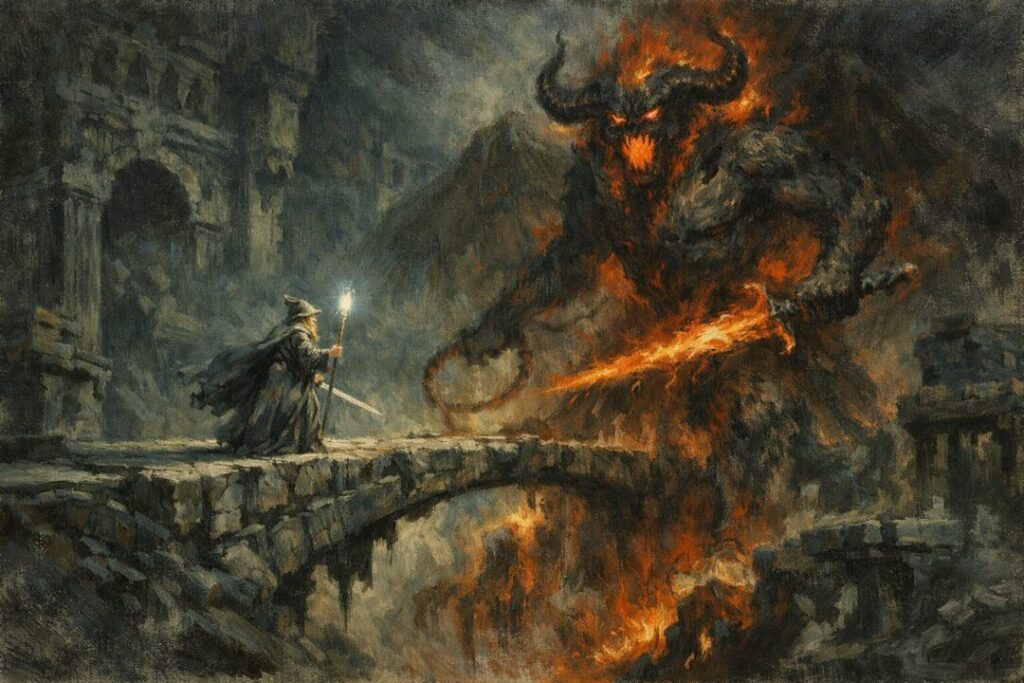
On the narrow Bridge of Khazad-dûm, spanning a vast chasm of fire, Gandalf alone turned to face the Balrog. The rest of the Fellowship fled, powerless to help him. This was not cowardice—it was necessity. None among them could survive such a confrontation.
Here, Gandalf revealed his true nature.
He named himself a servant of the Secret Fire, wielder of the flame of Anor. These were not empty words. They were a declaration of authority, a reminder that he was not merely a wandering wizard, but a Maia sent to oppose the shadows of the world.
For a moment, the Balrog hesitated.
Then it attacked.
The demon struck the bridge with its flaming sword, shattering stone and sending sparks into the abyss below. Gandalf answered with his staff, breaking the bridge beneath the Balrog’s feet. The stone gave way, and the creature fell into the depths.
But the victory was incomplete.
As it plunged, the Balrog’s whip lashed upward, coiling around Gandalf’s knees. With a final, violent pull, the demon dragged him down into the darkness.
To the Fellowship above, Gandalf was lost.
The Battle Beneath the World
What followed was no swift death.
Gandalf later revealed that he and the Balrog fell far beneath the roots of the mountains, into deep tunnels and dark waters untouched by the light of the Sun. There, in places older than memory, the battle continued.
Fire met will. Shadow met light.
Though the Balrog was mighty, its power was bound to domination and destruction. Gandalf, weary and wounded, fought not for conquest but for endurance. Even after the fall, he did not flee. Instead, he pursued the creature.
The Balrog fled upward through winding tunnels and forgotten passages, climbing the Endless Stair—a legendary ascent carved by the Dwarves that led from the deepest pits of Moria to the peak of Zirakzigil. Step by step, through darkness and exhaustion, Gandalf followed.
The battle spanned days.
From the roots of the mountains to the crown of stone and snow, wizard and demon climbed together, neither willing to yield.
Death on the Mountain Peak
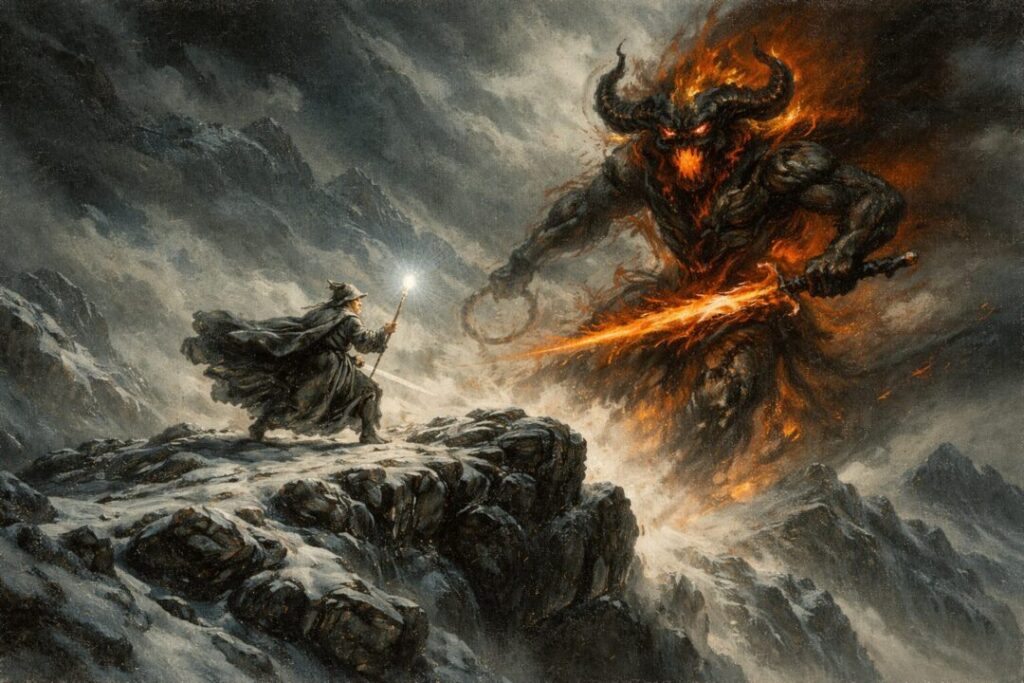
At last, they emerged onto the frozen summit of Zirakzigil. There, beneath an open sky, the Balrog stood exposed. Its fire steamed against the snow, its shadow stark against the white stone.
Here, far from the depths that had sheltered it for ages, the Balrog was vulnerable.
Fire met cold. Shadow met unfiltered light.
Gandalf broke the demon’s power, casting it down upon the mountainside. The Balrog’s physical form was destroyed, its flame extinguished, its spirit dispersed beyond return. One of Morgoth’s last great weapons was finally unmade.
But victory demanded everything.
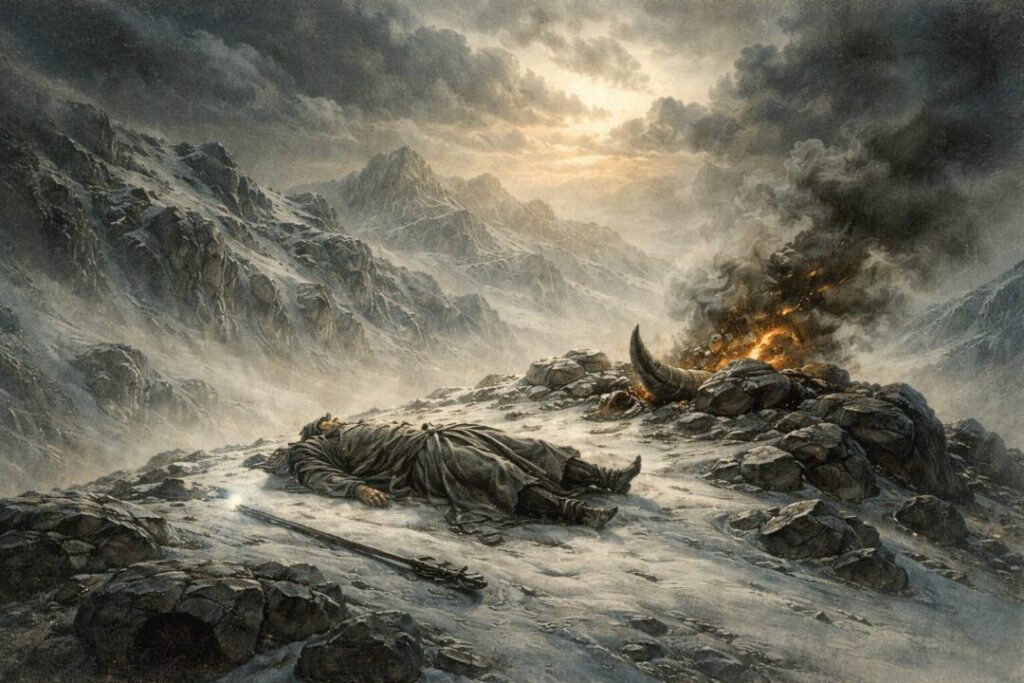
Gandalf’s strength failed. His body, spent beyond recovery, gave way. Alone upon the mountain peak, with the enemy defeated at last, he died.
Why Gandalf Alone Could Win
This was not a victory of brute force.
Gandalf was sent to Middle-earth with limits deliberately placed upon him. He was forbidden to dominate or rule through fear. His task was to guide, to inspire, and to resist evil through wisdom and sacrifice.
Where others would have fled or fallen, he stood—not because he was invincible, but because he chose to spend his life in that moment.
The Balrog relied on terror and destruction. Gandalf relied on endurance, humility, and purpose.
That difference decided the battle.
The Death That Was Not the End
Though Gandalf perished, his task was not yet complete.
He was sent back—changed. Returned to Middle-earth as Gandalf the White, freed from the constraints that had bound him before. No longer merely a guide, he became a force openly opposed to the Shadow rising in the East.
The fall of the Balrog marked more than the clearing of Moria. It removed one of the last surviving terrors of the First Age from the world.
And it proved that even in an age of fading magic, sacrifice could still shape the fate of Middle-earth.
Not all victories are won by surviving.
Some are won by standing fast, even unto death.