
From Glaurung to Ancalagon
When readers think of dragons in Middle-earth, two names usually stand above the rest.
Glaurung, the great worm who ruined Túrin’s life and broke kingdoms not only by force but by speech.
And Ancalagon the Black, who appears at the end of the First Age like the last escalation of Morgoth’s power.
At first glance, they can seem like parts of a finished mythology: one the cunning destroyer of the Elder Days, the other the vast winged terror of the War of Wrath.
But the older texts reveal something more interesting.
The dragons of Middle-earth did not enter the legendarium all at once in their final form. Their place in the mythology developed over time. The earliest material is more experimental. Later versions become sharper, narrower, and more coherent. And across that long development, dragons change from frightening marvels into some of the most concentrated expressions of Morgoth’s malice.
The earliest dragon terror was not yet settled
One of the easiest mistakes to make is to imagine that the fully familiar dragon-lore of Middle-earth already existed from the beginning.
It did not.
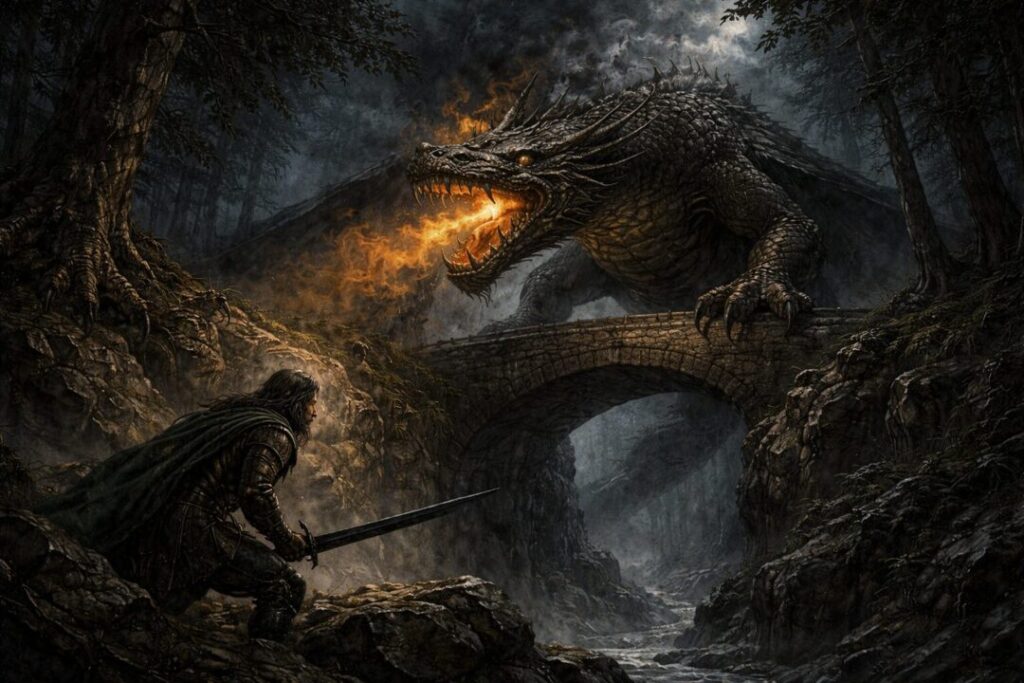
In the early Book of Lost Tales material, the legendarium still contains forms and ideas that were later reduced, revised, or left behind. The early Fall of Gondolin includes not only living fire-drakes but also iron dragon-like war machines built by Morgoth’s forces. These are not the same thing as the later, cleaner image most readers carry from The Silmarillion. They show an earlier stage, when dragon-terror had not yet been narrowed into one stable conception.
That matters because it changes the way we should read the development.
The path is not simply from “small dragon” to “bigger dragon.”
It is from experimentation to concentration.
The older mythology tries several monstrous forms. The later mythology keeps what is most potent.
Glaurung begins early, but not yet as the final Glaurung
The earliest dragon closely tied to the mature legendarium is the one who would become Glaurung.
In Turambar and the Foalókë, the earliest version of the Túrin story, the dragon already stands at the center of catastrophe. This tale is the first known form of that narrative in the old legendarium. But even here, the dragon is not yet presented in exactly the same way readers know from the later texts. His name belongs to an earlier stage, and the surrounding world is still in flux.
Across later stages of composition, the dragon’s name shifts: Glórund, then Glórung or Glómund in intermediate phases, before settling as Glaurung in the later tradition reflected in The Silmarillion and related texts. That changing name is not just a linguistic curiosity. It is one sign that the creature’s place in the mythology was still being refined.
But one thing is already clear very early.
This dragon is not merely an animal.
Even before the later legendarium gives him his most famous role, he belongs to a more dangerous category than a simple monster of teeth and flame.
Glaurung becomes more than a battlefield weapon
In the later tradition, Glaurung is called the first of the dragons and the Father of Dragons. Yet even here caution is needed. The texts support those titles, but they do not fully explain whether he is literally the ancestor of all later dragons or simply the first and greatest of an early kind. The taxonomy of dragons in the legendarium is not laid out in a complete system.
What is clear is more important than what is uncertain.
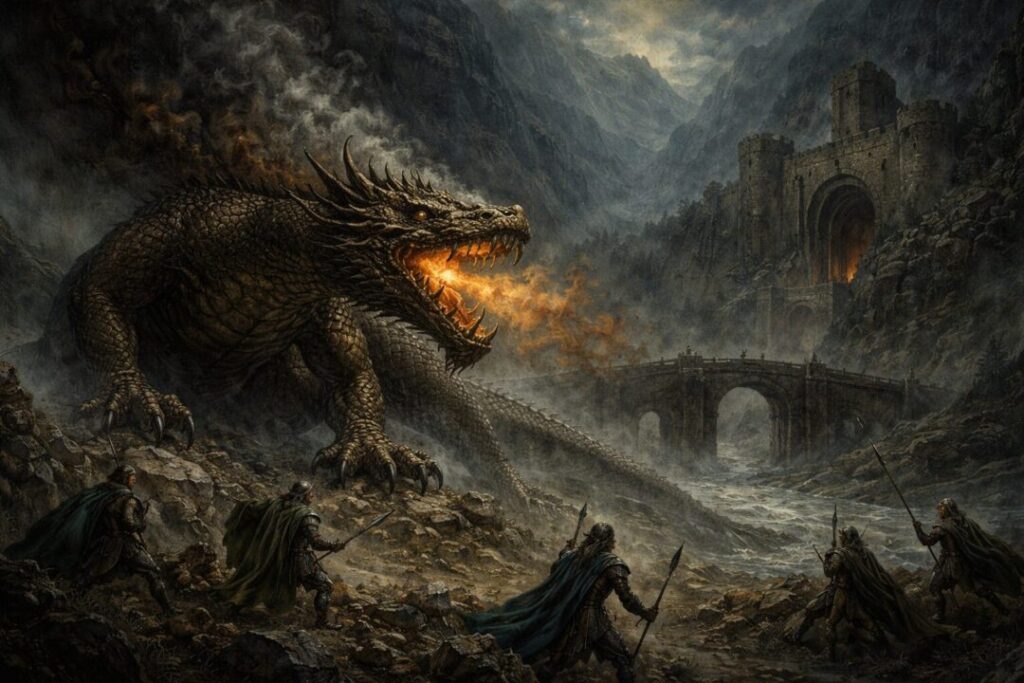
Glaurung is wingless. He has four legs, breathes fire, and cannot fly. In the mature First Age material, that distinguishes him from the later winged dragon-terror that appears only at the very end.
More importantly, Glaurung’s deepest power is psychological.
He does not only burn and crush. He speaks. He deceives. He dominates perception. He bends judgment. In the tragedy of Túrin, his role is so devastating because he attacks the mind as much as the body. He becomes one of the clearest examples in Middle-earth of evil that works through knowledge, mockery, and manipulation rather than brute force alone.
This is where dragon-kind becomes truly distinct.
A Balrog is terror.
An Orc-host is ruin.
But Glaurung is corruption with a voice.
That is a major step in how dragons function in the legendarium.
The later mythology clarifies the kinds of dragons
By the time the mythology reaches its more mature structure, dragon-kind has been narrowed into clearer forms, though never into a complete bestiary.
The surviving texts refer to fire-drakes, cold-drakes, long-worms, and winged dragons. But they do not provide a finished taxonomy that resolves every relationship between them. We know more by example than by system.
That uncertainty is worth preserving.
It would be easy to overstate the case and pretend the legendarium gives a neat evolutionary chart of dragon species. It does not.
Still, one broad movement is visible.
The mature narratives separate Glaurung from the winged dragon-host of the War of Wrath. The latter are said not to have been seen before that final assault. This does not erase earlier dragon material in the drafts, but it shows that the later conception treats the coming of winged dragons as a distinct and climactic development.
In other words, the mythology eventually decides that the worst has been held back.
Glaurung is not the endpoint.
He is the beginning of the true dragon age in war.
Ancalagon arrives late, and that lateness matters
Ancalagon does not belong to the earliest dragon stories.
He appears later in the development of the legendarium, first entering the tradition in the Quenta Noldorinwa material of the 1930s, and then remaining in the later Quenta Silmarillion tradition as the greatest of Morgoth’s winged dragons.
That is significant.
Glaurung is ancient within the story, but also ancient in the writing history of the mythology. Ancalagon is different. He feels like a later intensification of the dragon idea itself.
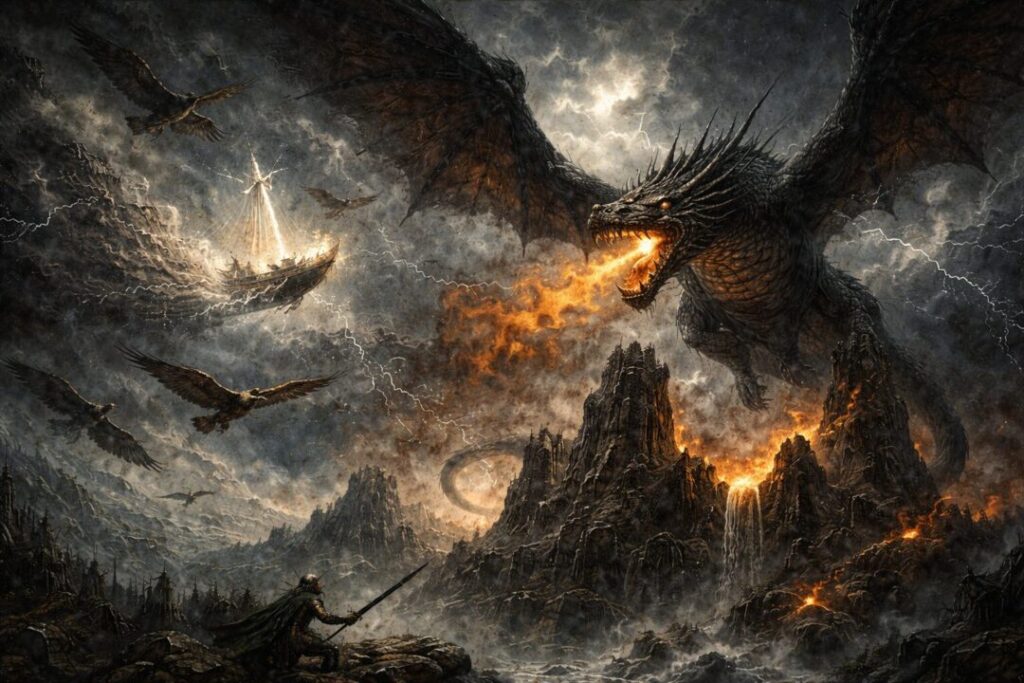
When Morgoth is nearing defeat in the War of Wrath, he unleashes the winged dragons that “had not before been seen.” Ancalagon is their greatest lord. The battle that follows is not a repetition of Glaurung’s work in Beleriand. It is a final, almost cosmic escalation: a war in the sky, answered by Eärendil in Vingilot with Thorondor and the great birds.
This is why Ancalagon feels so different in scale.
Glaurung devastates lives, realms, and destinies.
Ancalagon enters at the edge of apocalypse.
From cunning ruin to apocalyptic spectacle
The contrast between Glaurung and Ancalagon is not only physical.
It is narrative.
Glaurung is intimate terror. He enters the tragedy of Túrin so directly that he becomes part of its moral and emotional machinery. He stares, speaks, deceives, and leaves permanent damage behind him.
Ancalagon, by contrast, is distant in a very deliberate way. He is enormous, sudden, and bound to the final overthrow of Morgoth. He receives less psychological development because that is not his function. He is not there to unravel one family or one hidden kingdom. He is there to show what Morgoth kept in reserve until the very last hour.
So if Glaurung is the dragon as corrupter, Ancalagon is the dragon as final catastrophe.
Seen that way, the movement from one to the other is not random.
It reflects a deepening conception of what dragons mean in Middle-earth.
The early drafts show the road toward that final form
Looking back to the earliest material makes this progression easier to see.
In the Lost Tales, dragon imagery is broader and less settled. The mythology still permits forms that later feel out of place beside the published Silmarillion: iron dragon-machines, experimental naming, and a less finished structure around the great tales.
As the legendarium matures, the excess narrows.
The dragons that remain central are not central by accident.
Glaurung survives because he embodies more than destructive force. He becomes one of the most morally charged monsters in the First Age.
Ancalagon survives because he gives the War of Wrath a final image of unleashed horror that nothing smaller could carry.
The earlier dragon material matters because it lets us watch that selection happen.
Why this evolution matters
This is more than a curiosity about drafts.
It changes how the dragons should be read.
If we begin only with the finished impression of Middle-earth, dragons can seem like part of the scenery of epic fantasy: naturally present, already fixed, already understood.
But when we trace the development, they become more revealing.
They show the mythology learning what kind of terror it wants.
Not just beasts.
Not just obstacles.
Not just treasure-guards.
Glaurung becomes the dragon whose evil enters memory, pride, kinship, and fate.
Ancalagon becomes the dragon whose coming signals that ordinary war has reached its breaking point.
Between them, you can see the legendarium refining dragon-kind from monstrous possibility into mythic necessity.
The deeper pattern from Glaurung to Ancalagon
So how did dragons evolve in Middle-earth’s drafts?
Not in a straight line of size or power alone.
They evolved from a wider and stranger field of possibilities into a more focused mythology where each great dragon carries a distinct symbolic weight.
First comes the early experimentation.
Then comes Glaurung, sharpened into the great speaking destroyer of the First Age.
And only later, when the story requires a final answer to Morgoth’s last reserve of terror, does Ancalagon appear above the ruin of the world.
That is why the two belong together.
Glaurung is not merely an earlier dragon, and Ancalagon is not merely a larger one.
They mark two stages in the legendarium’s understanding of what a dragon can be.
And once that becomes visible, the old wars of Beleriand seem to hold a darker continuity than they first appear to.
Sources & Notes
- J.R.R. Tolkien, The Book of Lost Tales, Part Two, "The Fall of Gondolin" — early dragon-terror includes both fire-drakes and mechanical iron dragons in Morgoth’s assault.
- J.R.R. Tolkien, The Book of Lost Tales, Part Two, "Turambar and the Foalókë" — the earliest Túrin dragon-story, with the precursor of Glaurung/Glórund at the centre of the tragedy.
- J.R.R. Tolkien, The Silmarillion, "Of Túrin Turambar" — Glaurung as the Father of Dragons, a wingless fire-drake whose speech and gaze ruin Túrin and Nienor.
- J.R.R. Tolkien, The Shaping of Middle-earth, "The Quenta" / "Quenta Noldorinwa" — the developing 1930s Silmarillion tradition in which Ancalagon enters the War of Wrath material.
- J.R.R. Tolkien, The Silmarillion, "Of the Voyage of Eärendil and the War of Wrath" — Morgoth releases the winged dragons, not seen before, with Ancalagon the Black as their greatest.