Open a map of Middle-earth from the time of Frodo and look west of the Blue Mountains. There is almost nothing there.
Now read the stories of the First Age.
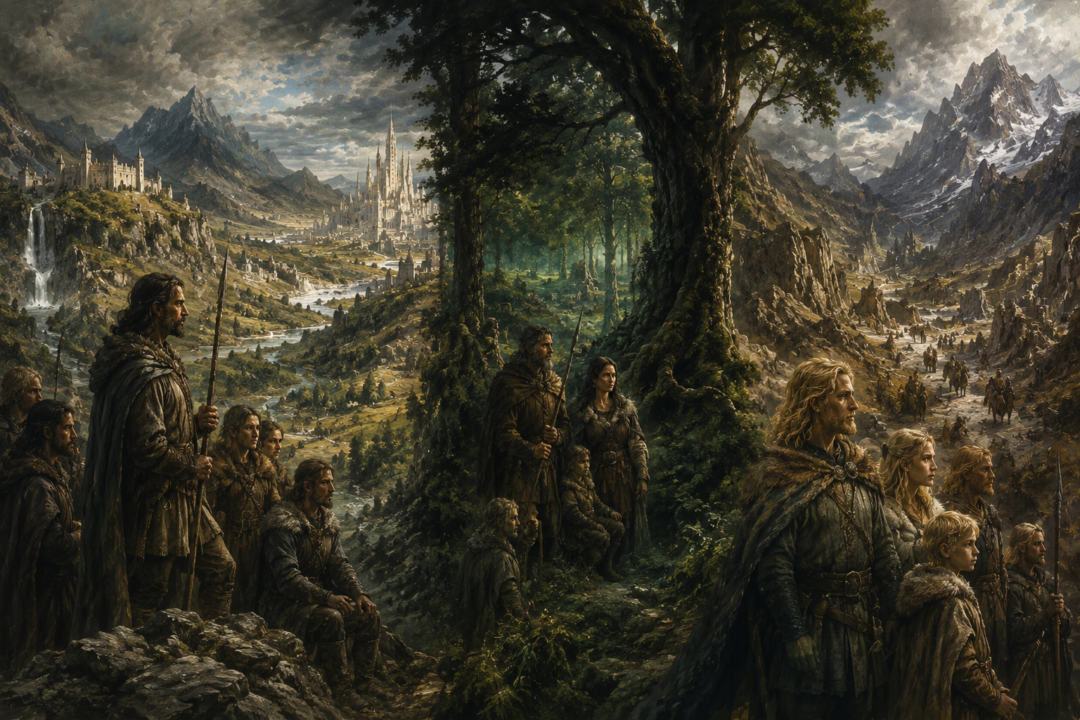
Suddenly that emptiness fills with kingdoms. Doriath lies beneath its enchanted borders. Nargothrond is hidden beside the Narog. Gondolin stands concealed among the Encircling Mountains. The House of Hador holds Dor-lómin. The House of Bëor is associated with Dorthonion and Ladros. The Haladin make their home in Brethil. Rivers connect places whose names carry entire tragedies: Sirion, Narog, Gelion.
Then the geography breaks.
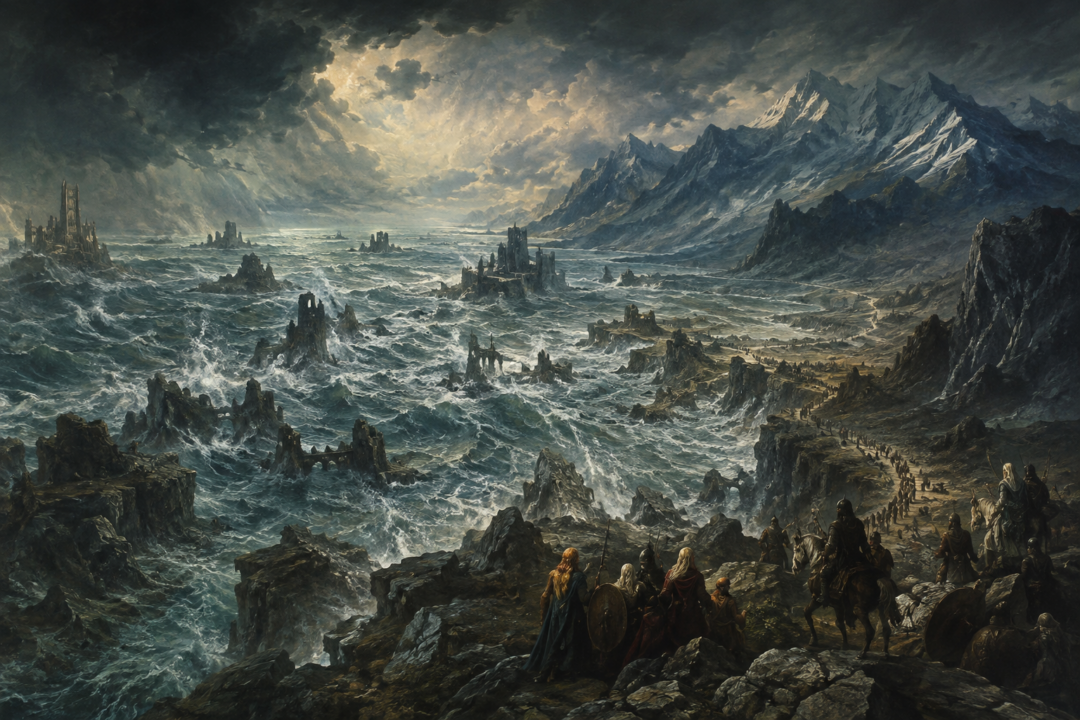
At the end of the First Age, the catastrophic War of Wrath devastates Beleriand, and most of the lands in which these stories occurred are overwhelmed by the sea. The later map cannot simply preserve the First Age by keeping its kingdoms as ruins on the landscape. Much of their landscape is gone.
Yet the First Age does not become inaccessible.
Instead, something remarkable happens in the structure of the legendarium: where geography can no longer provide continuity, genealogy increasingly does.
To understand where the vanished world of Beleriand went, we can follow its families.
A World That Cannot Be Revisited
Many fantasy histories preserve their past geographically. Ancient capitals become ruins. Old battlefields remain identifiable. Roads lead modern travelers toward the remains of earlier civilizations.
Middle-earth certainly has this kind of memory. Weathertop, Moria, the Barrow-downs, and the ruins of Arnor allow the Third Age to exist physically among the remains of earlier history.
The First Age is different.
The War of Wrath ends Morgoth's power in the north-west, but the victory is catastrophically destructive. Beleriand is largely lost beneath the sea. Some portions of the eastern region survive, especially around Lindon and the Blue Mountains, but the political geography described throughout The Silmarillion has ceased to exist.
That matters because Beleriand is extraordinarily geographical.
The struggles against Morgoth are organized around realms and territories: Fingolfin and Fingon in the north, the Sons of Fëanor guarding eastern approaches, Thingol in Doriath, Finrod in Nargothrond, Turgon hidden in Gondolin. The Three Houses of the Edain likewise become associated with particular territories and Elvish allies.
When those lands disappear, the relationships do not.
They survive in descendants.
The Three Houses Turn People into Places
Consider the Edain.
The House of Bëor, the People of Haleth, and the people who become the House of Hador are not merely lists of ancestors. Their histories acquire geographical identities within Beleriand.
Bëor's people become closely connected with the House of Finarfin, and their descendants hold Ladros in Dorthonion. The Haladin eventually settle in the Forest of Brethil. Hador receives the lordship of Dor-lómin, and his descendants become inseparable from the history of Hithlum.
Those territories matter enormously while Beleriand exists.
But later, saying that someone descends from Hador can carry historical information that a surviving map no longer can. The name evokes Dor-lómin, Hithlum, alliance with the Noldor, and the wars against Morgoth.
Genealogy has become compressed geography.
This should not be taken as a literal rule Tolkien establishes. The texts never announce that family trees are intended to replace maps. Rather, it is a useful way of reading their structure after the destruction of Beleriand.
The ancestral line preserves connections to places that history has physically removed.
Beren and Tuor Gather the Lost World into Bloodlines
The effect becomes even stronger in the two great unions of Elves and Men.
Beren belongs to the House of Bëor. His story draws that Mannish lineage into the fate of Doriath through his union with Lúthien, daughter of Thingol and Melian.
Their descendant Elwing therefore carries within one line several immense strands of First Age history: the Edain, the Sindarin royal house of Doriath, and through Melian a connection with the Maiar.
Tuor provides another convergence.
He descends from the House of Hador through Huor, while his mother Rían comes from the House of Bëor. Tuor enters hidden Gondolin and weds Idril, daughter of Turgon.
Then the lines meet.
Eärendil, son of Tuor and Idril, weds Elwing, descendant of Beren and Lúthien.
At that point genealogy begins to resemble a map of vanished alliances.
Doriath and Gondolin have fallen. Dor-lómin has been lost. The old territories of the Bëorians have been overrun. Yet the lines associated with those places converge in Eärendil and Elwing and then in their sons, Elrond and Elros.
The geography is shattered.
The relationships survive.
Elrond Is Surrounded by Places That No Longer Exist
This gives Elrond a particularly unusual position in the later history of Middle-earth.
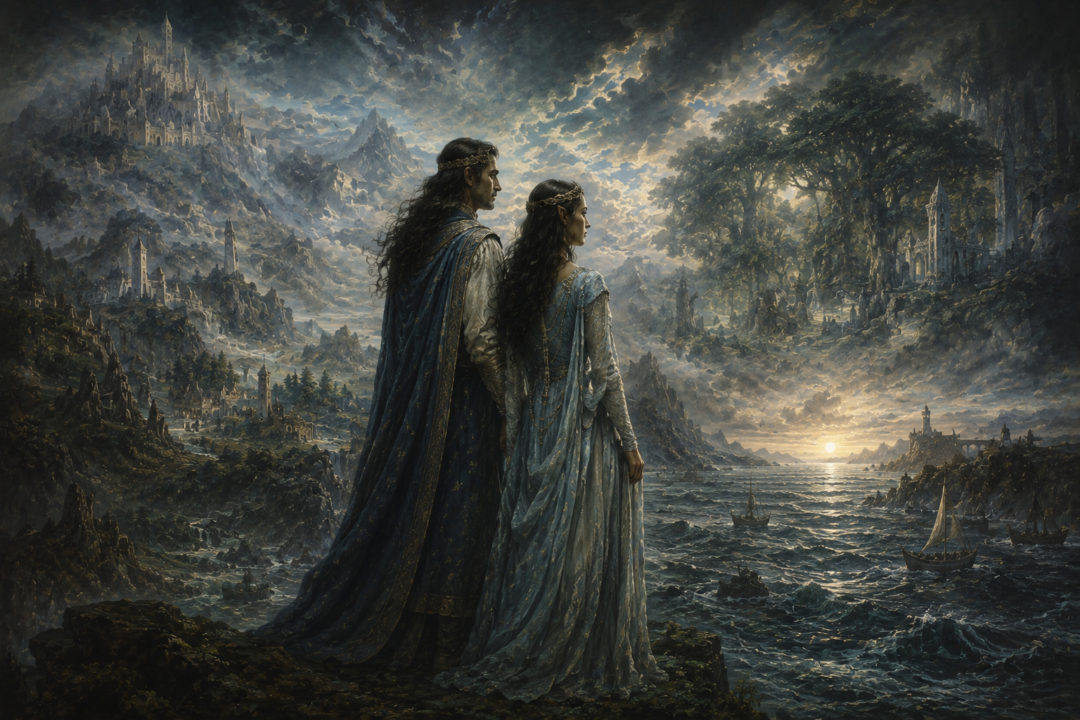
His ancestry reaches into several of the defining peoples and royal houses of the First Age. Through Eärendil come Tuor, Idril, Turgon, and the House of Hador, with Tuor's Bëorian ancestry through Rían as well. Through Elwing come Beren, Lúthien, Thingol, and Melian.
These are not merely famous names.
They are coordinates in the political world of Beleriand.
Mention Turgon and Gondolin appears behind him. Mention Thingol and the memory of Doriath follows. Mention Hador and the history of Dor-lómin enters the story. Mention Beren and the struggle in Dorthonion, the outlaw years, Doriath, and the quest for the Silmaril begin to intersect.
By the Third Age, a traveler cannot journey from Rivendell to Gondolin.
But Elrond's ancestry still connects Rivendell to Gondolin.
That is one of the quiet consequences of the drowned West: history becomes increasingly personal because its original physical setting has vanished.
Elros Carries Beleriand into Númenor
Elrond and Elros then divide this inheritance in a crucial way.
The Half-elven brothers are granted a choice concerning which kindred their fate will belong to. Elrond chooses the Elves. Elros chooses Men.
Elros becomes the first king of Númenor, Tar-Minyatur.
Through him, the surviving Edain do not merely receive a new island. Their royal house is connected genealogically with the great stories of the lost lands from which their ancestors came.
Númenor is not Beleriand rebuilt. The texts do not present the island as a geographical recreation of Dor-lómin, Dorthonion, Doriath, or Gondolin.
The continuity is instead historical and dynastic.
The First Age survives in ancestry.
That distinction becomes important after Númenor itself is destroyed. Once again, geography fails. Once again, descent carries memory forward.
The line of Elros continues through the Númenórean kings and, through later branches of that history, ultimately reaches the Dúnedain of Middle-earth.
The pattern repeats: kingdoms can disappear while lineages cross the catastrophe.
Aragorn's Family Tree Reaches Beyond the Surviving Map
This is why Aragorn's ancestry has significance beyond royal legitimacy.
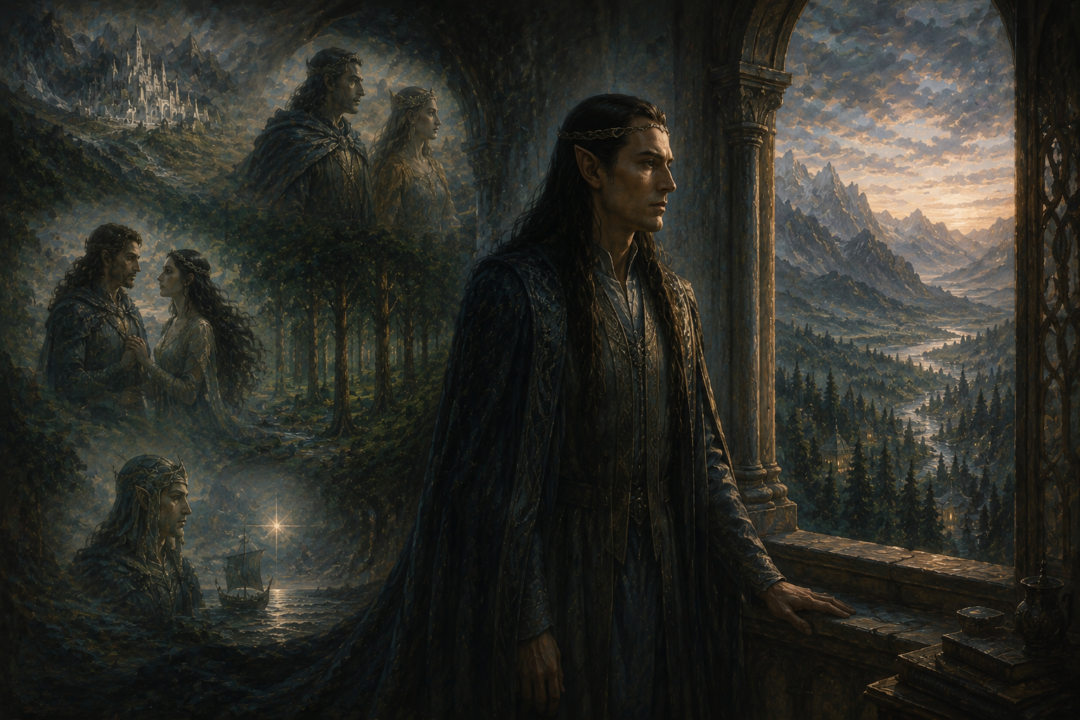
Through the Númenórean tradition and the line descending ultimately from Elros, Aragorn belongs to a history far older than Gondor and Arnor. His ancestral story passes through Númenor and eventually back to the intertwined houses represented in Elros.
Following that line far enough carries the reader toward Eärendil and Elwing, and from them toward Tuor and Idril, Beren and Lúthien, the Houses of Hador and Bëor, Gondolin and Doriath.
The later king therefore stands at the end of a chain whose earliest geographical anchors are mostly underwater.
This does not mean Aragorn inherits every First Age realm politically. He plainly does not. Genealogical descent should not be confused with territorial succession.
Its importance is thematic and historical.
His ancestry allows the narrative to connect the restored kingship of the late Third Age with a world whose actual kingdoms can no longer appear on any contemporary map.
The Marriage of Aragorn and Arwen Closes an Ancient Pattern
Arwen makes the structure even more striking.
She descends from Elrond, while Aragorn belongs to the distant line descending from Elros.
Their marriage therefore reunites two branches descending from Eärendil and Elwing after an immense separation in time.
That does not undo the choice made by Elrond and Elros, nor does it restore Beleriand. But narratively it draws together lines whose divergence began near the ending of the First Age.
Look only at the Third Age map and the marriage belongs to Rivendell and Gondor.
Look at the genealogy and an older landscape appears beneath it.
Gondolin is there through Idril.
Doriath is there through Lúthien.
The Edain are there through Beren, Tuor, and their forebears.
Eärendil and Elwing stand where those histories first converge.
The family tree allows places that cannot physically return to remain structurally present in the ending of The Lord of the Rings.
Names Become Coordinates of Memory
This helps explain why First Age genealogies can initially feel unusually demanding.
The same names recur across generations. Houses intermarry. Elvish and Mannish lines intersect. Characters are repeatedly identified by parentage.
But genealogy is doing more than establishing who is related to whom.
It preserves context.
“Húrin son of Galdor” places Húrin within the House of Hador and the history of Dor-lómin. “Tuor son of Huor” carries that history forward into Gondolin. Eärendil joins that inheritance to the House of Turgon. Elwing brings the line of Beren and Lúthien. Elrond and Elros inherit the convergence.
A map answers: where did this happen?
A genealogy can answer a different question: where did this lost history go?
After the drowning of Beleriand, that question becomes increasingly important.
The Sea Wins the Land but Not the Story
There is a profound melancholy in the geography of the Elder Days.
Doriath cannot be restored. Gondolin cannot be rediscovered in some forgotten valley of the Third Age. Nargothrond does not wait beneath ivy for Aragorn or Frodo to enter it. Most of the landscape that gave the First Age its shape is gone.
But disappearance is not the same as erasure.
The survivors carry memory eastward. Stories preserve names. Elvish characters such as Elrond remember the Elder Days across enormous spans of time. The descendants of the Edain carry ancient lines into Númenor and beyond.
And the genealogies quietly perform their own act of preservation.
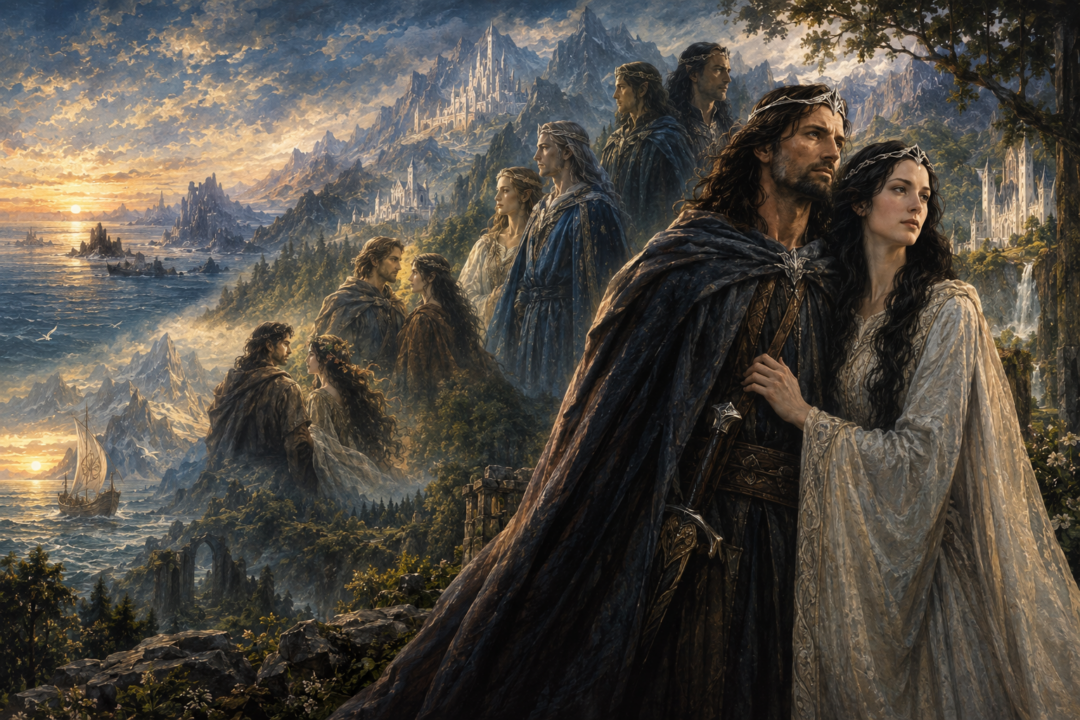
Trace the ancestry of the major surviving lines backward and the drowned map begins to reassemble—not as coastlines and rivers, but as relationships.
Dor-lómin leads to Tuor.
Gondolin leads to Idril.
Dorthonion and the House of Bëor lead toward Beren.
Doriath leads to Lúthien and Elwing.
Those paths converge in Eärendil's household, divide through Elrond and Elros, and echo far into later Ages.
The sea can cover Beleriand.
But once its peoples have become ancestors, the lost country can travel with them.
Sources & Notes
- https://tolkiengateway.net/wiki/Beleriand — Tolkien Gateway: the First Age lands, their regions and peoples, and their drowning after the War of Wrath.
- https://tolkiengateway.net/wiki/War_of_Wrath — Tolkien Gateway: the cataclysm ending the First Age and destroying most of Beleriand’s geography.
- https://tolkiengateway.net/wiki/Edain — Tolkien Gateway: the three Houses of Men, their migrations, kinships, and surviving descendants.
- https://tolkiengateway.net/wiki/Noldor — Tolkien Gateway: the exiled kindreds, their houses and realms across Beleriand, and their survivors.
Sources cover Beleriand’s destruction and the kinship networks that connect surviving First Age peoples and later realms.