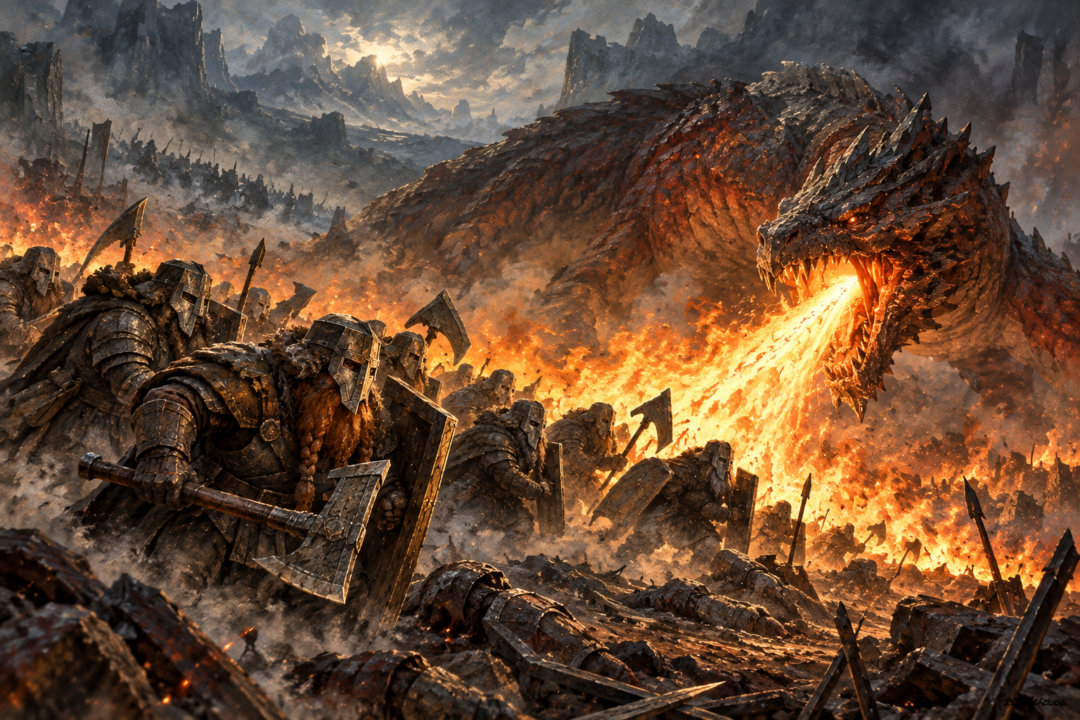
When Glaurung entered the Battle of Unnumbered Tears, ordinary armor was no longer enough.
The Father of Dragons came against the eastern armies with fire, crushing strength, and a hide so formidable that conventional resistance was failing. Elves and Men were driven back. Yet one contingent did something extraordinary: the Dwarves of Belegost stood their ground.
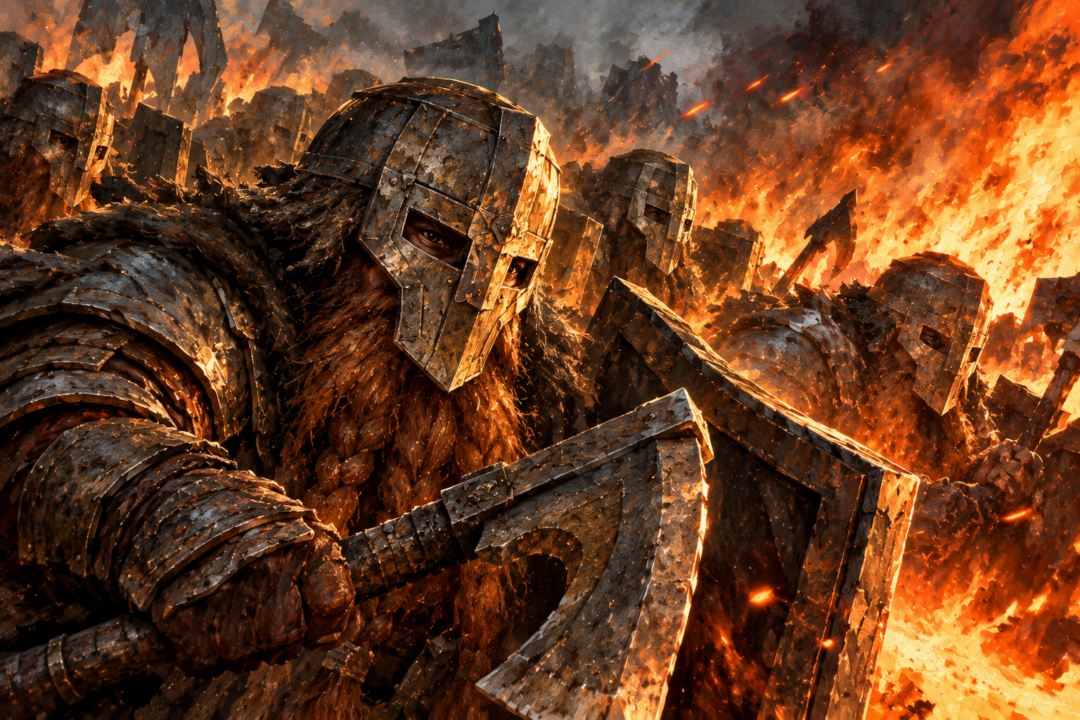
Their success was not because they possessed some forgotten enchanted shield against dragons. The explanation given in The Silmarillion is more interesting. Dwarves were naturally hardier against fire than Elves or Men, and they went into battle wearing great, terrifying masks that proved particularly useful against dragons.
That combination—innate endurance, specialized equipment, disciplined formation, and extraordinary courage—allowed the Dwarves to accomplish something almost no one else could.
They closed with Glaurung.
The Strange War-Masks of the Dwarves
The crucial description appears in the account of the Nirnaeth Arnoediad, the Battle of Unnumbered Tears.
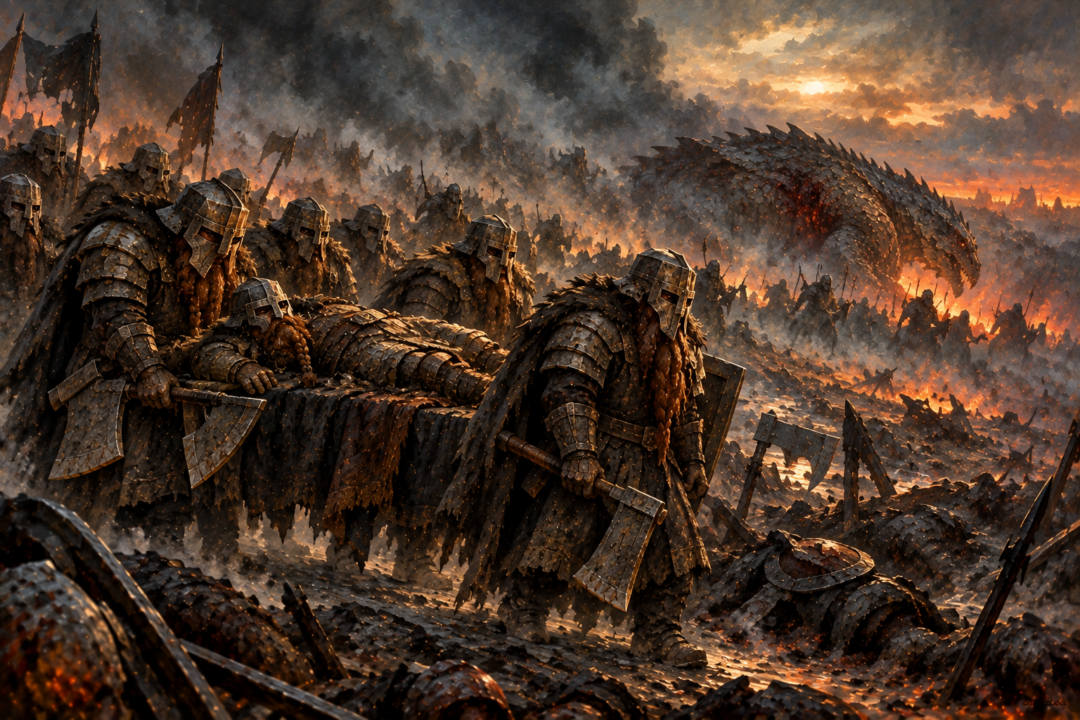
As Morgoth’s forces overwhelmed the Union of Maedhros, the Dwarves of Belegost became the last part of the eastern host to remain firm. The text explains that the Naugrim could withstand fire more hardily than Elves or Men. It then adds another remarkable detail: Dwarves customarily wore great masks in battle, described as hideous to look upon, and these served them well against dragons.
That is essentially everything the text explicitly tells us about the masks.
It does not provide a technical description of their construction. It does not say that they were made from a special fireproof metal. It does not describe enchantments, breathing systems, lenses, or any other elaborate mechanism.
Even the idea that they were created specifically to fight dragons goes beyond what is actually stated. The masks were a Dwarven custom in battle generally; their protective value against dragons was an additional advantage.
That distinction matters.
These were not necessarily “dragon masks” invented as a countermeasure to Glaurung. They were pieces of Dwarven war-gear that happened to become extraordinarily valuable when the battlefield filled with dragon-fire.
Did the Masks Make Dwarves Fireproof?
No.
The episode is sometimes simplified into the idea that Dwarven masks were literally proof against dragon-fire, but the text makes a more careful claim.
Two separate advantages are mentioned.
First, Dwarves themselves endured fire better than Elves or Men.
Second, their masks helped them against dragons.
The natural reading is that the masks offered meaningful physical protection while the Dwarves’ own unusual hardiness allowed them to survive conditions that would incapacitate other warriors more quickly. Exactly how much protection came from the mask and how much came from Dwarven physiology is never quantified.
Nor should the episode be interpreted as immunity.
Glaurung remained immensely dangerous. The Dwarves could approach and fight him, but they were not invulnerable to him. Their achievement was not that dragon-fire became harmless. It was that they could endure enough of the dragon’s assault to remain in close combat.
That is a much more impressive battlefield advantage than simple magical invulnerability would have been.
They still had to advance.
Why Dwarves Could Endure What Others Could Not
Dwarven resilience runs deeper than armor.
In the account of their creation in The Silmarillion, Aulë makes the Fathers of the Dwarves in anticipation of a dangerous Middle-earth. Because the world under Morgoth would be harsh, they are made strong and enduring.
This becomes one of their defining characteristics throughout the legendarium. Dwarves are exceptionally resistant to hardship and difficult to dominate. Their physical toughness does not make them indestructible, but it repeatedly distinguishes them from other peoples.
At the Nirnaeth, that inherent endurance becomes strategically decisive.
Imagine what confronting Glaurung required. His fire was not merely something to survive from a safe distance. To hurt him with axes and knives, warriors had to remain close enough to strike.
For most soldiers, the dragon’s fire prevented exactly that.
The Dwarves of Belegost could do what others could not: stay within the lethal space around him long enough to fight back.
Their masks helped make that possible.
But then came the second problem.
Glaurung was armored.
The Dwarves Did Not Defeat Fire With Fire
There is a revealing simplicity to the Dwarves’ response.
They did not answer Glaurung with sorcery.
They surrounded him.
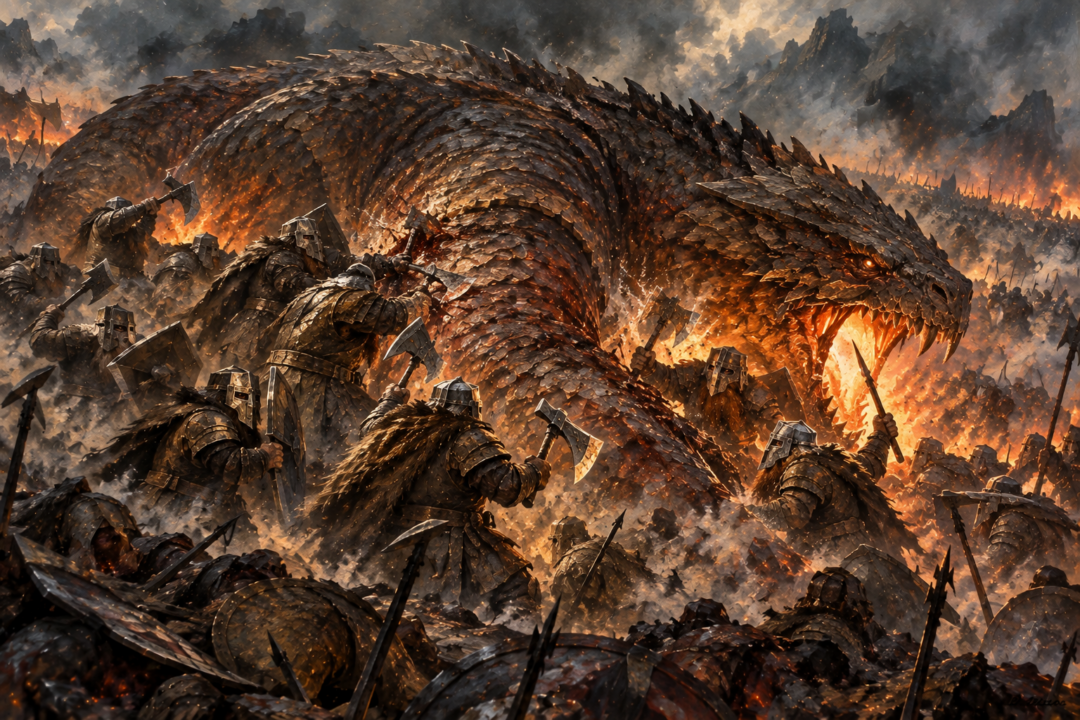
The surviving Dwarves of Belegost formed around the dragon and attacked him with their great axes. Even Glaurung’s formidable armor was not completely proof against those blows.
This tells us something important about the function of their equipment.
The masks did not defeat the dragon. They allowed warriors to remain functional in an environment where they could use the weapons that might.
Protection was therefore only one part of a larger system.
Dwarven hardiness helped them endure the heat. Their masks offered additional protection. Their armor and discipline allowed them to maintain the fight. Their axes could threaten even Glaurung’s armored body.
Together, these advantages transformed a creature that had been devastating an army into an enemy that could actually be surrounded and attacked.
But the price was terrible.
Azaghâl’s Last Blow
At the center of the Dwarven stand was Azaghâl, Lord of Belegost.
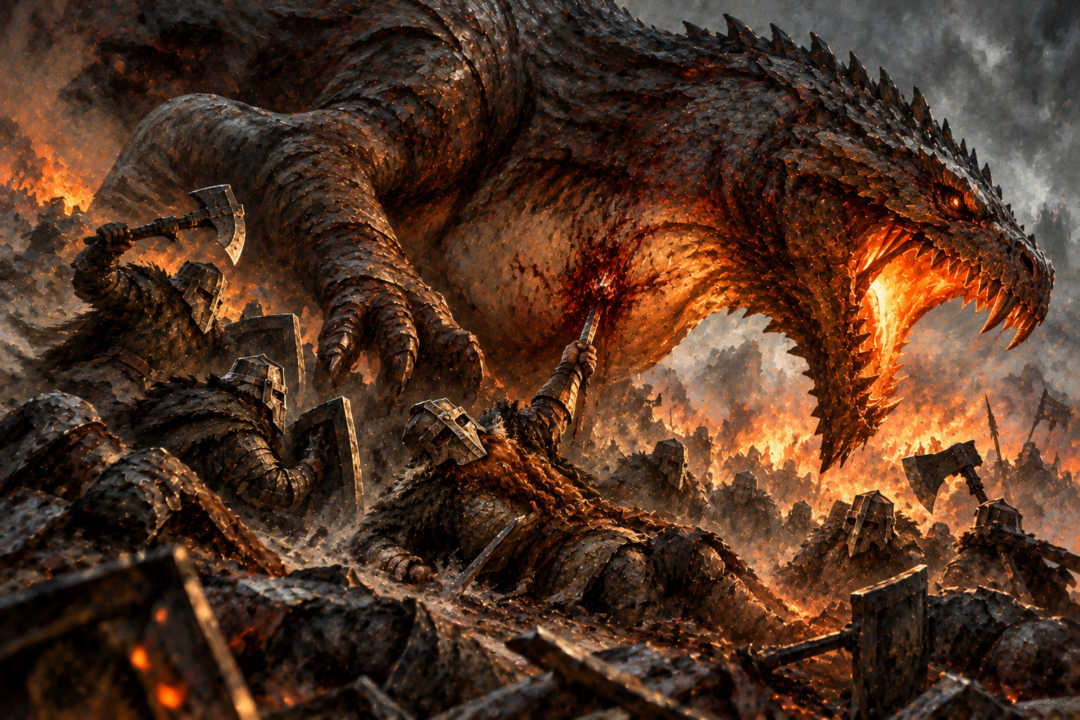
Glaurung, enraged by the assault, turned upon him. The dragon struck Azaghâl down and crawled over him.
The Dwarf-lord was mortally wounded.
Yet before he died, Azaghâl struck upward with a knife into Glaurung’s belly. The wound was severe enough that Glaurung fled the battlefield, and the other creatures of Angband followed him.
It was not the death of Glaurung. That would come much later, through Túrin Turambar at Cabed-en-Aras.
But at the Nirnaeth, Azaghâl accomplished what the collapsing armies desperately needed: he forced the dragon out of the immediate battle.
The Dwarves then did something almost as memorable as their attack.
They stopped fighting.
They lifted their fallen lord and carried him away, walking slowly and singing a dirge in deep voices. They paid no further attention to the battle, and the account says that none dared hinder them.
It is a striking ending because it prevents their stand from becoming a simple tale of technological superiority.
Their equipment worked.
Their resistance to fire mattered.
Their formation succeeded.
And their king still died.
Were the Masks Designed Specifically for Dragons?
This is where lore and inference must be separated carefully.
The text says that wearing these great masks was already a Dwarven battle custom and that the masks stood them in good stead against dragons.
It does not explicitly explain why.
A straightforward interpretation is that covering the face reduced exposure to flame and heat. Given the Dwarves’ extraordinary skill in metalwork, imagining strongly constructed masks is reasonable as artistic interpretation, but details about materials, thickness, ventilation, or special heat-resistant engineering are not supplied by the narrative.
Likewise, nothing establishes that the masks possessed magical properties.
That absence is significant because the Dwarves’ victory does not require magic to explain it. Their advantage comes from traits repeatedly associated with their people: toughness, craftsmanship, formidable weapons, and stubbornness under terrible pressure.
The mask matters because the warrior underneath it is already exceptionally difficult to break.
Why Didn’t Dwarf Masks Solve the Dragon Problem Forever?
If Dwarves were unusually resistant to fire and possessed equipment useful against dragons, later history raises an obvious question.
Why were dragons still able to devastate Dwarven realms?
The answer is that resistance is not immunity.
In the Third Age, Smaug destroyed Dale and drove the Dwarves from Erebor. Earlier, dragons had also afflicted the Dwarves of the Grey Mountains. Nothing in the First Age account suggests that Dwarven armor made a settlement safe from a dragon.
The Nirnaeth involved unusual circumstances.
Glaurung was on a battlefield and surrounded by organized warriors of Belegost. They were able to close around him and attack collectively. Even then, their lord was killed.
A dragon assaulting halls, settlements, gates, treasure chambers, livestock, and fleeing civilians presents a different problem. Fire resistance in close combat does not neutralize the enormous strategic advantages possessed by a dragon.
The First Age masks therefore should not be understood as a universal anti-dragon technology.
They gave Dwarves a better chance of surviving close enough to fight.
That was enough to change one battle.
It was not enough to make dragons cease to be terrifying.
The Hidden Lesson of the Dwarven Stand
The most fascinating detail about the masks may be what they reveal about warfare in Middle-earth.
Victory against overwhelming power does not always come from possessing greater power.
The Dwarves of Belegost could not match Glaurung’s size. They could not breathe fire. They could not simply pierce his armored body from a safe distance.
Instead, their advantages accumulated.
They were naturally hardy against fire.
Their traditional masks offered additional protection.
Their craftsmanship gave them formidable arms.
Their discipline allowed them to surround the dragon.
And Azaghâl was willing to strike even when he had already been crushed beneath his enemy.
Remove any one of those elements and the outcome might have been different.
That is why the masks deserve attention without turning them into magical artifacts they were never said to be.
They were useful precisely because they were part of something larger.
At one of the darkest moments of the First Age, when Glaurung threatened to destroy what remained of the Noldorin forces in that part of the field, the Dwarves of Belegost possessed just enough protection to stand where others could not.
Then they did the rest themselves.
The enduring image is therefore not a warrior untouched by flame.
It is a masked Dwarf walking into it.
Sources & Notes
This article is based on close reading and interpretation of Tolkien's published works and related source material where relevant.