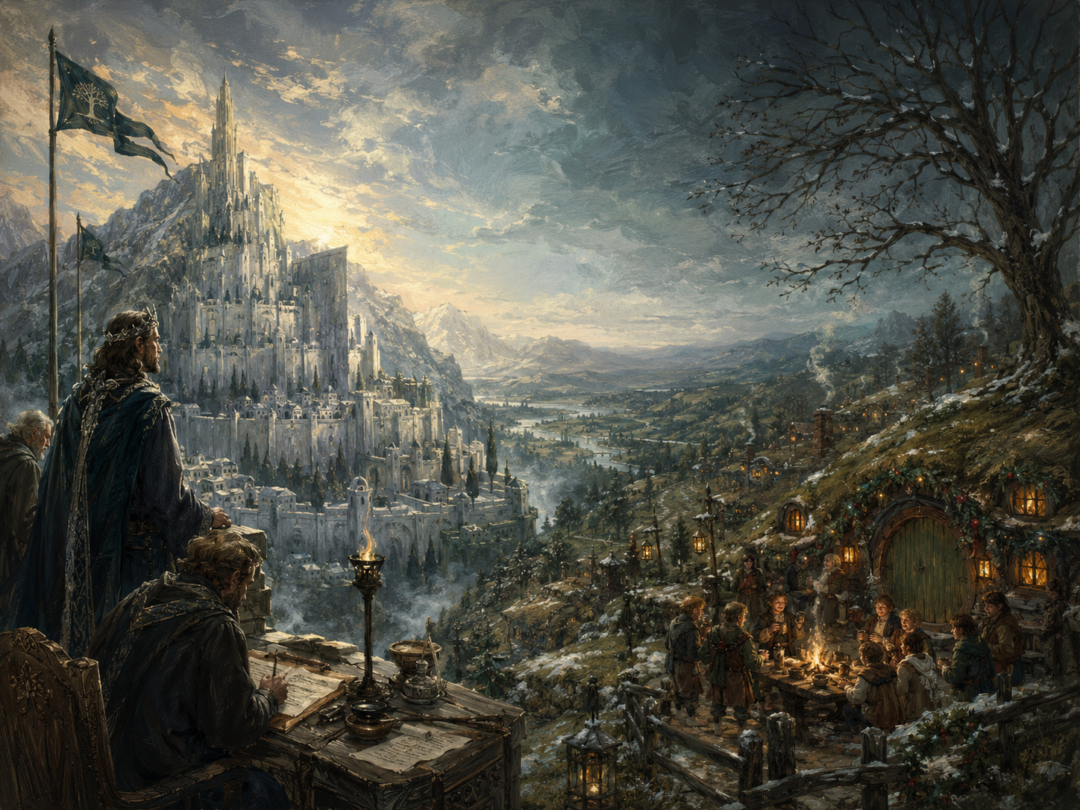
The One Ring was destroyed on March 25, 3019 of the Third Age. That date became so important in the restored kingdom of Gondor that the new royal calendar made it the beginning of the year.
Yet if a hobbit in the Shire had been asked when the Fourth Age began, the answer would not have matched Gondor’s official records.
This is one of the strangest consequences of the War of the Ring. Sauron falls once, the Ring is destroyed once, and the Ring-bearers depart once—but the beginning of the new Age can carry different dates depending on whose records you are reading.
The reason is not an error inside the history. It is that Gondor and the Shire preserve time differently.

The Fourth Age Did Not Begin with Sauron’s Fall
The first distinction is easy to miss.
Sauron was defeated and the One Ring destroyed on March 25, T.A. 3019. But the Third Age continued afterward. Aragorn was crowned, the Fellowship returned north, the Shire was liberated, and Frodo remained in Middle-earth for more than two additional years.
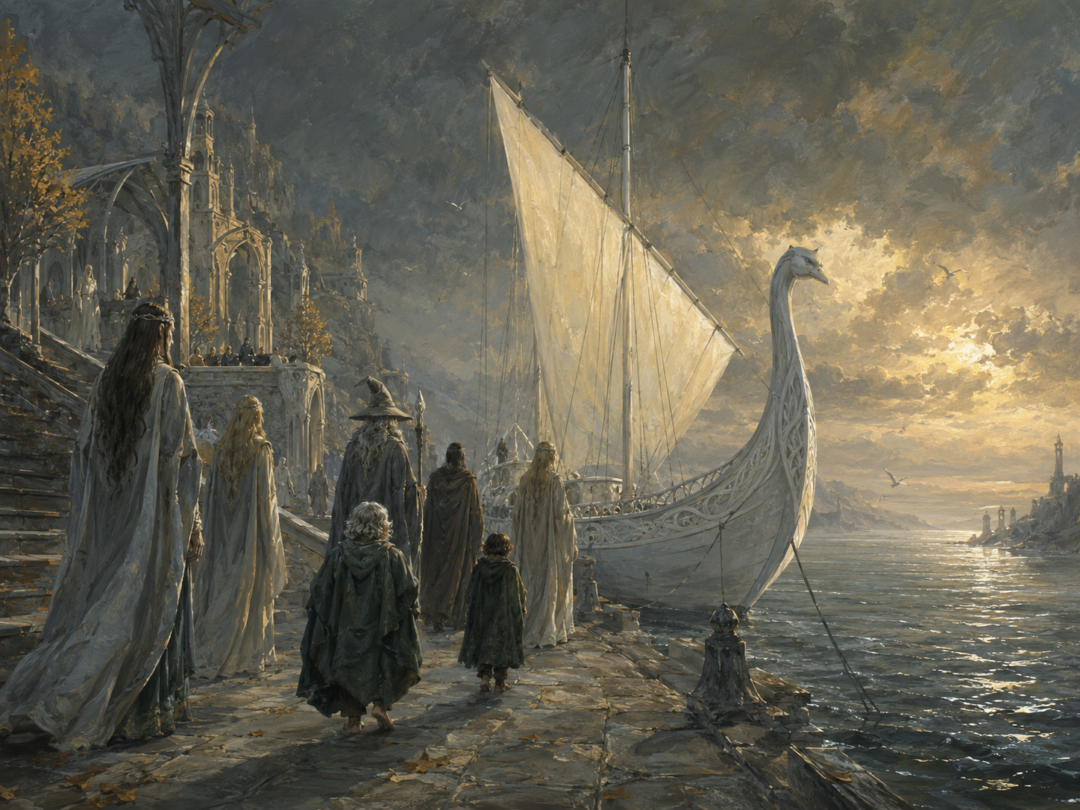
The decisive ending of the Third Age was associated with the departure of the Keepers of the Three Rings. On September 29, T.A. 3021, Elrond, Galadriel, Gandalf, Bilbo, and Frodo sailed from the Grey Havens.
That departure marked the passing of the great Elvish powers that had endured through the Third Age.
But Gondorian record-keeping did not simply begin Fourth Age 1 on September 30.
Instead, Appendix D gives a more unusual arrangement: for purposes of record in the Kingdom, Fourth Age 1 was the year beginning under the New Reckoning on March 25, T.A. 3021 “old style.” In other words, Gondor’s official Fourth Age count reached backward within the final calendar year of the Third Age.
That creates the apparent contradiction.
Historically, the Third Age had not yet ended on March 25, 3021. Administratively, however, Gondor treated the New Reckoning year beginning on that date as Fourth Age 1.
Gondor Rebuilt Its Calendar Around March 25
The choice of March 25 was deliberate.
King Elessar’s New Reckoning replaced the Stewards’ Reckoning in the restored kingdom. Its year began on the anniversary of the destruction of the Ring and the downfall of Sauron. The first day, Yestarë, corresponded to 25 Rethe in Shire terminology; after it came Víressë, the first full month of the new Gondorian year.
This makes the calendar part of Gondor’s restoration.
The kingdom had regained a king after centuries of rule by Stewards. Sauron had fallen. Arnor and Gondor were reunited under Elessar. Even the measurement of the year could now reflect that change.
The date chosen was not the coronation of Aragorn and not the sailing of the Ring-bearers. It was the destruction of the Ring.
That choice gives the calendar a remarkable moral center. The restored kingdom counts its years from the day on which Sauron’s power collapsed—a victory ultimately achieved not through the strength of Gondor’s armies alone, but through the Ring-bearer’s quest.
The New Reckoning even preserved another memory of the hobbits. Frodo’s birthday became a festival in the Kingdom, associated with Cormarë, Ringday.
The royal calendar therefore became, in part, a monument to events that most inhabitants of Gondor never witnessed.
The Shire Simply Kept Counting
The Shire responded very differently.
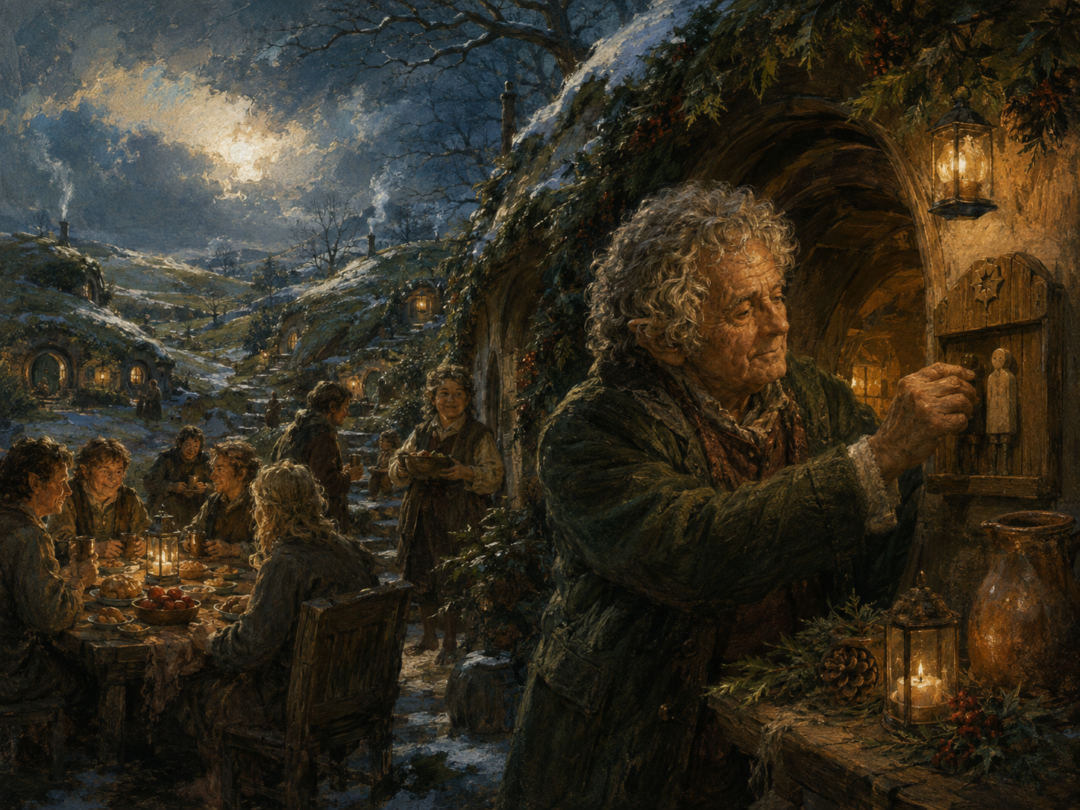
Its people already possessed their own calendar and their own numbering of years. Shire-reckoning began with the settlement of the Shire: S.R. 1 corresponded to T.A. 1601.
That system had continued for more than fourteen centuries by the War of the Ring. Bilbo was born in S.R. 1290. Frodo left Bag End in S.R. 1418. The Battle of Bywater occurred in S.R. 1419.
The end of an Age did not erase that local chronology.
Thus S.R. 1421 was followed normally by S.R. 1422. The hobbits did not restart their numbering at “Fourth Age 1.” Appendix D indicates that, insofar as the hobbits concerned themselves with the change of Age at all, they regarded it as beginning with 2 Yule of 1422—the first day of their new year.
This is perhaps the most characteristically Shire-like element of the entire problem.
Outside their borders, kingdoms had fallen and been restored, Rings had passed away, and the dominion of Men was beginning. In Hobbiton, the calendar still moved from 1421 to 1422.
The great historical transition was acknowledged without allowing it to replace the Shire’s own memory of itself.
So What Is “Fourth Age 1”?
Here is where readers can easily become confused.
Using the convention generally followed by the Shire records, Fourth Age 1 corresponds to S.R. 1422.
But Gondorian official reckoning had already called the New Reckoning year beginning March 25 of S.R. 1421—that is, T.A. 3021—Fourth Age 1.
Both statements appear in the calendrical material.
The difference exists because the two systems begin their years on different dates and because the records do not always use “Fourth Age year” in precisely the same calendrical sense.
The Shire year begins at Yule. Gondor’s New Reckoning begins on March 25 in Shire terms. The Shire also continues numbering its years from its own foundation rather than resetting them when the Age changes.
Consequently, translating a Fourth Age date is not always as simple as subtracting a fixed number from the Shire year. The part of the year matters, and so does the source’s dating convention.
The Red Book Makes the Problem More Interesting
Most later dates familiar to readers come through hobbit records, which makes the Shire convention especially important.
Yet the textual tradition behind the Red Book also passed through Gondor.
The “Note on the Shire Records” describes a copy completed by Findegil, the King’s Writer, in Gondor. His note dates the completion as “IV 172,” while the accompanying Shire date is S.R. 1592.
If one simply treats S.R. 1422 as Fourth Age 1, S.R. 1592 would correspond to Fourth Age 171. The Gondorian notation IV 172 therefore reflects the other system—the New Reckoning’s year count at that point of the calendar. A similar issue appears with Peregrin Took’s later retirement to Gondor, which is given in one context as IV 64 while the Shire chronology places the relevant year in S.R. 1484.
These examples matter because they show that the discrepancy is not merely theoretical.
A manuscript copied in Minas Tirith can preserve a different Fourth Age number from a Shire chronicle describing the same broad period.
The reader is effectively looking across two historical traditions.
Why the Difference Fits Both Cultures
The contrast tells us something deeper than how to convert fictional dates.
Gondor’s New Reckoning is a calendar of restoration.
Its monarchy has returned. Its ancient realm has been renewed. Its year begins with the anniversary of the victory that made that restoration possible. Even the structure of ordinary time announces that the Shadow has fallen and a new political order has begun.
The Shire’s calendar represents continuity.
The hobbits had borrowed ancient calendrical traditions from the Dúnedain long before, but adapted them into something distinctly their own. They fixed their months, maintained their Yule and Lithe days, and numbered their history from the founding of the Shire. Even after becoming connected much more directly with the Reunited Kingdom, they did not abandon that system.
Encyclopedia of Arda
One should be cautious about turning calendrical mechanics into sweeping claims about national psychology. Still, the contrast is striking.
For Gondor, renewal required marking a new beginning.
For the Shire, survival meant that the old count could continue.

One New Age, Two Ways of Remembering It
The Fourth Age therefore does not possess a single universally convenient “Year One.”
In the history of the world, the Third Age ends with the departure of the Ring-bearers and the Keepers of the Three.
In Gondorian records, Fourth Age 1 is attached to the New Reckoning year that began on March 25, T.A. 3021.
In Shire usage, the years continue uninterrupted, and S.R. 1422 is treated as the first year of the Fourth Age for the purposes of the hobbit chronology.
That is why two apparently conflicting Fourth Age dates can both be rooted in the text.
And there is something fitting about the result.
The defeat of Sauron created a shared history, but it did not create a uniform Middle-earth. Gondor remembered the victory by rebuilding the calendar around it. The Shire remembered the same world-changing events while continuing to count from the settlement of its own green country.
The Fourth Age had begun for both.
They simply did not turn the page on the same day.
Sources & Notes
- The Encyclopedia of Arda — Fourth Age: chronological reference on the Age’s beginning and the differing Gondorian and Shire conventions — https://www.glyphweb.com/arda/f/fourthage.php
- The Encyclopedia of Arda — New Reckoning: account of King Elessar’s calendar, whose year began on March 25 in memory of Sauron’s fall — https://www.glyphweb.com/arda/n/newreckoning.php
- The Encyclopedia of Arda — Shire-reckoning: reference on the hobbits’ continuous year numbering from the Shire’s foundation — https://www.glyphweb.com/arda/s/shirereckoning.php
- The Encyclopedia of Arda — Shire Calendar: details of the Shire year, its Yule transition, and local dating system — https://www.glyphweb.com/arda/s/shirecalendar.php
Sources distinguish the historical end of the Third Age from Gondor’s New Reckoning and the Shire’s uninterrupted local calendar.