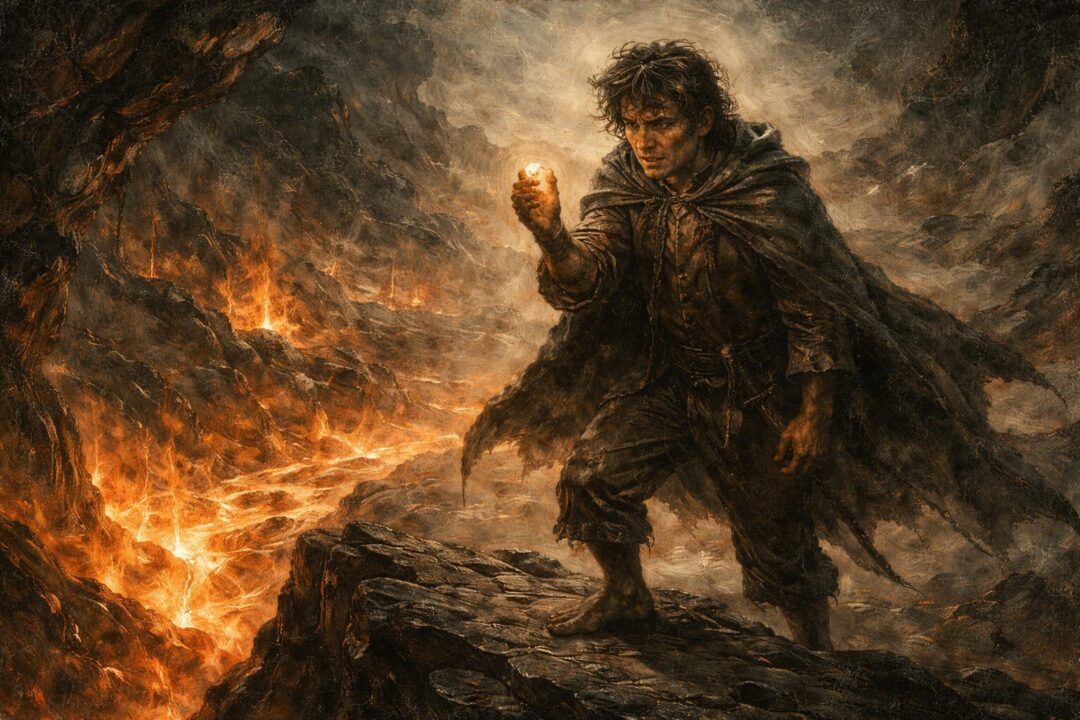
When readers first meet Frodo Baggins, he is not a hero shaped by prophecy or legend. He is a Hobbit of the Shire—quiet, unassuming, and deeply rooted in a land that values comfort over memory. His world is measured in meals, birthdays, gardens, and familiar paths. History, especially the great and terrible kind, has little place there.
The One Ring enters Frodo’s life without ceremony. It is passed to him as an heirloom, odd but unremarkable, spoken of more as a curiosity than a weapon. It turns invisible fingers, prolongs life, and causes mild unease—but at first, it carries no clear name and no visible past.
What Frodo does not know at the beginning of his journey is as important as what he does. In Middle-earth, ignorance is not simply a lack of information. It is the result of centuries of fading memory, broken kingdoms, and deliberate silence.
A World That Forgot the Second Age
By the end of the Third Age, the great wars against Sauron belong to a distant past. Outside of Elvish lands and ancient halls of lore, they are rarely spoken of in full. In the Shire, they are almost entirely absent.
Hobbits do not tell stories of Númenor. They do not sing of Elendil or the Last Alliance. Even the name Isildur holds no meaning for Frodo when the story begins. These events shaped the world he lives in, yet they are invisible to him.
This forgetting is not accidental. Middle-earth is a place in slow decline, where greatness diminishes with each age. Kingdoms rise and fall, languages change, and the memories of past catastrophes blur into legend. The Ring endured, but understanding did not.
By the time Frodo inherits it, the One Ring has survived for nearly three thousand years—long enough for its true history to fade everywhere except among the Wise.
Gandalf’s Long Silence
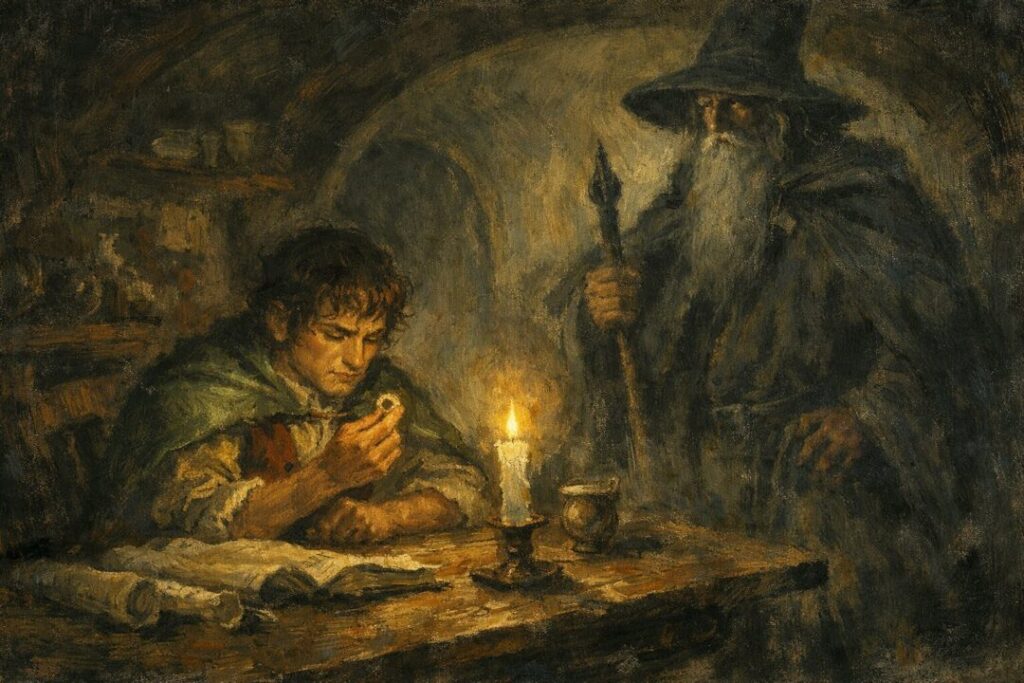
Gandalf knows far more than he reveals at first. When Bilbo first acquires the Ring, Gandalf senses danger, but he does not yet understand its full nature. Even when suspicion grows, he waits.
This delay reflects a recurring pattern in Middle-earth: wisdom is not revealed all at once. Knowledge, especially dangerous knowledge, is given only when the listener is prepared to bear its weight.
For years, Gandalf studies ancient records, tests the Ring, and searches for proof. During this time, Frodo remains unaware that anything more than a strange inheritance lies in his keeping. The silence is not cruelty—it is caution. To name the Ring too soon would change Frodo’s life before necessity demanded it.
When Gandalf finally returns to Bag End with certainty, the truth is devastating. The Ring is not merely magical. It is the One Ring, forged by Sauron in the fires of Orodruin. Frodo learns that it once ruled all the other Rings of Power and that its continued existence means the Dark Lord’s shadow never truly lifted from the world.
Yet even this revelation is incomplete. Frodo learns what the Ring is, but not yet the full cost of what it has done.
The Council of Elrond: History Spoken Aloud
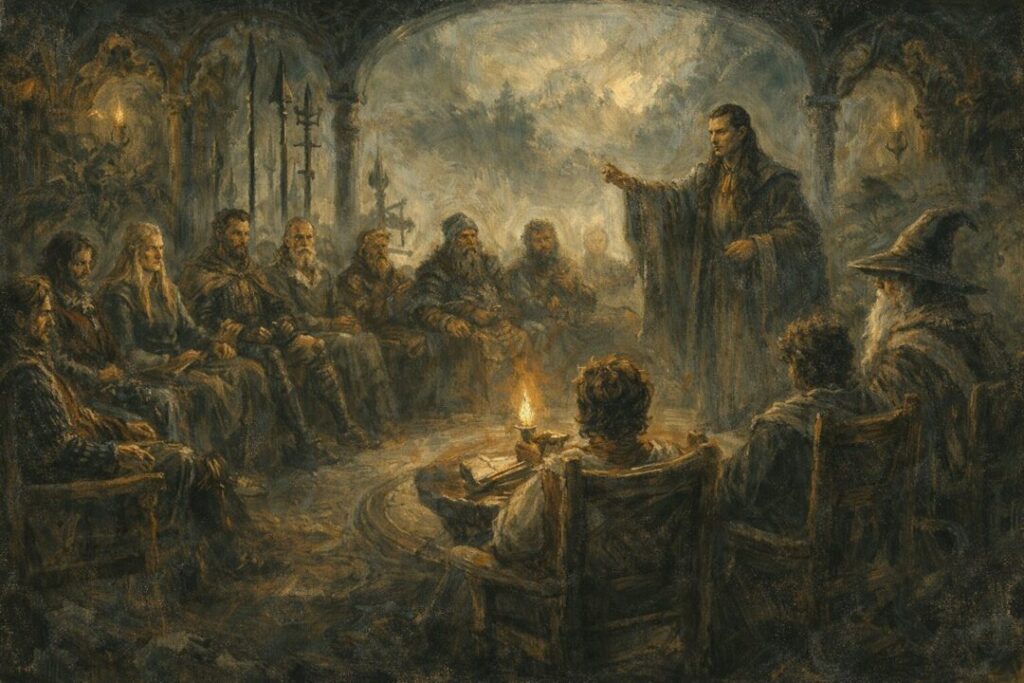
Frodo’s true education begins in Rivendell, during the Council of Elrond. Here, for the first time, the buried history of the Second Age is spoken plainly and without softening.
Unlike the Shire, Rivendell remembers.
At the Council, Frodo hears how Sauron deceived the Elves, how the Rings were made, and how power was divided among the peoples of Middle-earth. He learns that the Ring he carries was never meant to be found again—and that its survival represents a failure, not a victory.
The most important lesson comes with the name Isildur. Frodo learns that Isildur cut the Ring from Sauron’s hand, ending the Dark Lord’s physical form. But he also learns that Isildur did not destroy it. He claimed it, and in doing so, allowed evil to endure.
This moment reframes everything Frodo thought he knew. The downfall of Sauron was not final. The Ring’s existence is not an accident—it is the consequence of mercy, pride, and unfinished choices.
For Frodo, abstract danger becomes inherited guilt. The Ring is not merely evil; it is history unresolved.
Learning from Survivors, Not Scholars
What gives Frodo’s understanding its true weight is not the information itself, but who delivers it.
Elrond was there at the end of the Second Age. He witnessed the failure that allowed the Ring to endure. Others at the Council lost kin, homelands, and centuries of peace because the Ring was not destroyed.
These are not stories preserved only in books. They are memories carried by the living.
Middle-earth places great importance on lived experience. History is not merely recorded—it is remembered by those who endured its consequences. Frodo does not see the fall of Númenor or the battlefield where Sauron was overthrown, but through these voices, he inherits the burden of remembrance.
This transmission of memory is essential. Frodo is not asked to destroy the Ring blindly. He is asked to do what others could not, fully aware of the cost of failure.
Understanding Comes Gradually
Even after the Council, Frodo does not fully grasp what the Ring will demand of him. Knowledge alone is not enough. Understanding comes through suffering.
The journey through Moria, the Watcher in the Water, and the fall of Gandalf show Frodo that the Ring draws danger wherever it goes. Each step toward Mordor strips away remaining illusions. The Ring grows heavier, not physically, but spiritually.
As the Fellowship breaks and Frodo continues with Sam, the lesson deepens: no one can carry the Ring without being changed by it. Not strength, not wisdom, not good intentions offer immunity.
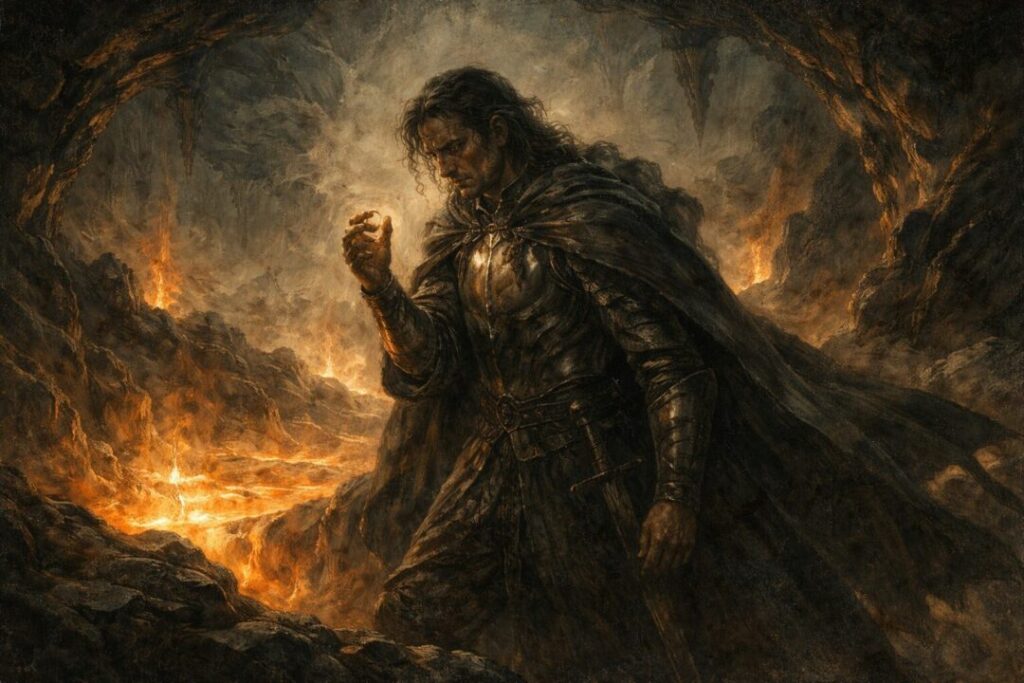
By the time Frodo reaches Mount Doom, he understands something the heroes of the Second Age did not fully grasp. The Ring cannot be mastered, and it cannot be wielded safely—not even for good.
Why This Knowledge Matters
Frodo’s journey is not about acquiring facts. It is about learning cost.
The history of the Ring teaches him humility. It explains why even the Wise failed, why kings fell, and why victory without destruction was no victory at all. Frodo is not stronger than Isildur, nor wiser than the Elves—but he is willing to finish what history left undone.
Middle-earth does not survive because Frodo is powerful. It survives because he understands the weight of the past and chooses to carry it anyway, even when it breaks him.
That is how Frodo learns the true history of the Ring.
Not all at once.
Not safely.
But in time to matter.