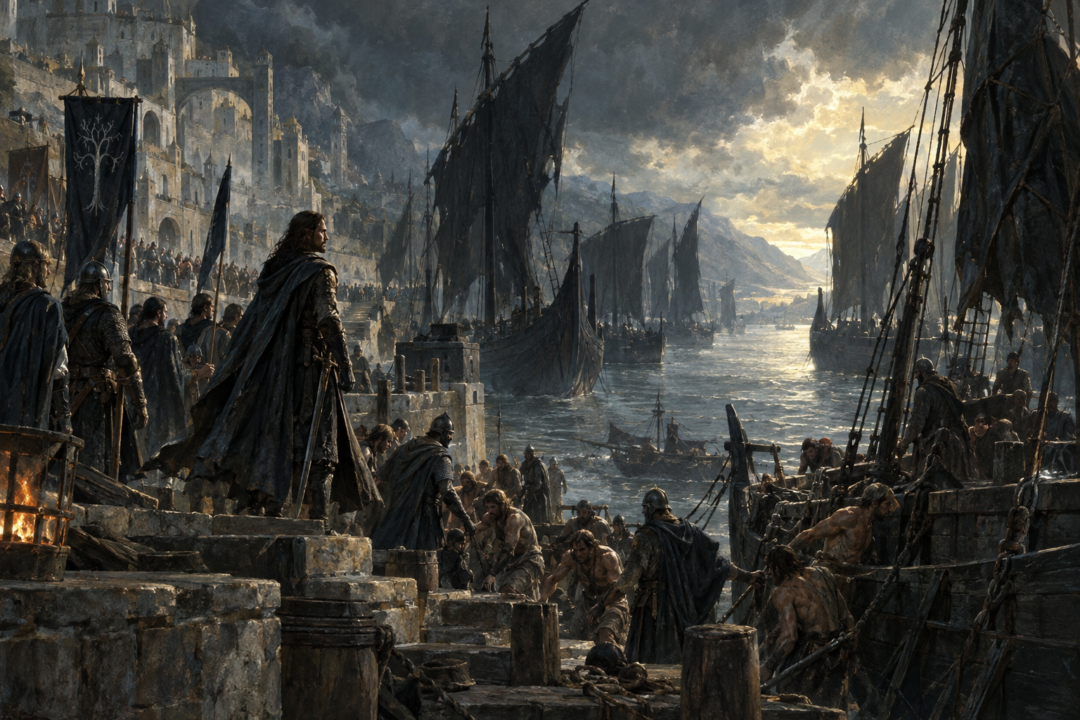
When black-sailed ships appeared on the Anduin during the Battle of the Pelennor Fields, the defenders of Minas Tirith initially had every reason to despair. The Corsairs of Umbar had been one of Gondor’s oldest maritime enemies, and their fleet was supposed to deliver another blow against a kingdom already fighting for survival.
Instead, Aragorn stood aboard the captured ships.
That reversal is one of the great strategic turns of the War of the Ring. Yet it also raises a question the story never directly answers: what happened to those ships afterward?
The texts do not give us a Fourth Age inventory of Gondor’s navy, nor do they describe King Elessar ordering a new fleet into existence. But Gondor’s history, the survival of Pelargir, the capture of the Corsair vessels, and the restoration of royal power allow a careful reconstruction of what the kingdom’s maritime recovery could have looked like.
The important distinction is between what is stated and what is implied. Aragorn unquestionably captures enemy ships and uses them against Sauron. Whether those same vessels became the foundation of a permanent royal fleet is never explicitly said.
Gondor Was Once a Great Sea Power
A restored Gondorian navy would not have been an entirely new institution.
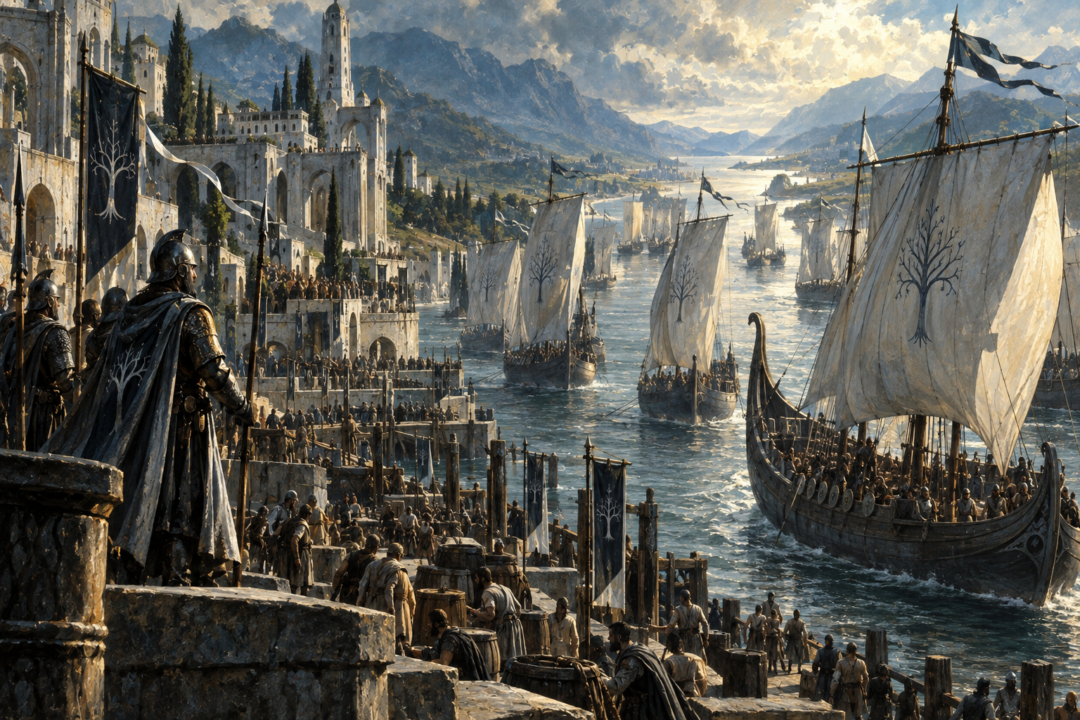
Centuries before the War of the Ring, Gondor had possessed formidable maritime power. Appendix A of The Lord of the Rings remembers four rulers beginning with Tarannon Falastur as the Ship-kings. Under them Gondor expanded along the coasts and southward, and Eärnil I captured the haven of Umbar.
At its height under Hyarmendacil I, the South-kingdom exercised power far beyond the diminished borders familiar to readers of the late Third Age.
Pelargir was central to this maritime tradition. Founded in the Second Age by the Faithful of Númenor, it stood on the Anduin above its mouths and remained one of Gondor’s great southern ports.
But Gondor’s command of the sea did not endure.
The Kin-strife was particularly disastrous. After Castamir the Usurper was defeated, his sons escaped from Pelargir with many followers and, crucially, much of Gondor’s fleet. They established themselves at Umbar, turning ships that had belonged to Gondor into the foundation of a hostile maritime power.
There is a grim symmetry here.
Long before Aragorn captured the Corsairs’ ships, Gondor had already experienced the opposite event: its own fleet had helped create the enemy at Umbar.
Why the Corsairs Were So Dangerous
By the end of the Third Age, Gondor could still fight on its rivers and coasts, but it was no longer the dominant naval empire of the Ship-kings.
Umbar remained a persistent danger. Corsair attacks threatened Gondor’s southern shores, and the danger was serious enough to shape the kingdom’s defense during the War of the Ring.
This mattered directly at Minas Tirith.
When reinforcements came from Gondor’s southern fiefs, they were fewer than hoped. The coastal regions could not simply empty themselves of soldiers while the Corsairs threatened them from the sea.
Sauron therefore did not need the Corsair fleet to conquer Minas Tirith by itself. Its existence already served his strategy. It pinned Gondorian manpower in the south while Mordor attacked the capital.
Aragorn’s intervention at Pelargir did more than destroy a hostile force. It suddenly removed the threat that had been keeping southern Gondor divided.
And he did not merely burn the enemy fleet.
He took it.
The Capture at Pelargir Changes Everything
The book’s account differs importantly from the familiar idea of an army of the Dead arriving at Minas Tirith.
The Dead never fight on the Pelennor Fields.
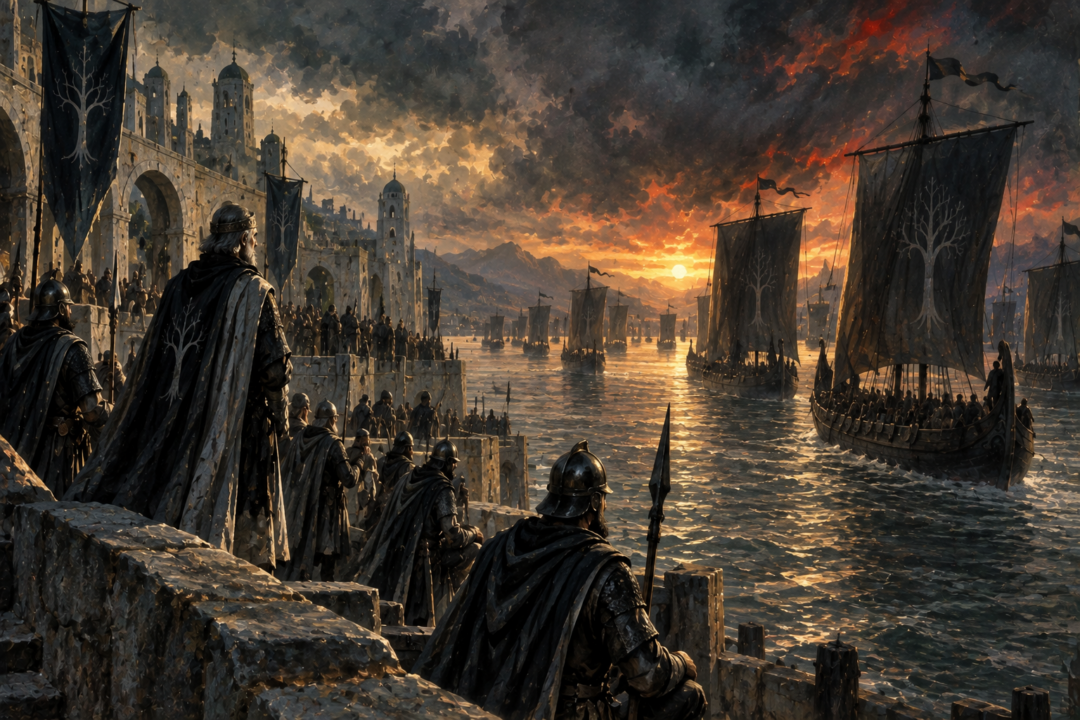
Aragorn leads them through southern Gondor to Pelargir, where the Corsair fleet has gathered. Their terror breaks the resistance of the enemy. Legolas later recounts that the mariners flee from the ships, while the enslaved rowers remain chained aboard.
Aragorn then sends members of the Dúnedain onto the captured vessels. The captives are freed.
Only after the Corsairs have been defeated does Aragorn declare that the oath of the Dead has been fulfilled and release them.
That creates an immediate practical problem.
Aragorn now possesses ships, but his supernatural army is gone.
The answer comes from Gondor itself.
Men from the southern regions rally to him. The forces that had previously been tied down by the Corsair threat can now move. Aragorn fills the captured ships with these men and sails north along the Anduin.
So the fleet arriving at Minas Tirith is physically associated with Umbar, but its fighting strength is Gondorian.
The enemy’s instrument has been turned against the enemy.
The Ships Were More Valuable Captured Than Burned
Aragorn already understood the value of attacking enemy naval infrastructure.
Decades earlier, while serving Steward Ecthelion II under the name Thorongil, he led a raid against Umbar. Appendix A says that he burned many of the Corsairs’ ships and destroyed the Captain of the Haven before withdrawing.
That attack weakened an enemy.
Pelargir presented a different opportunity.
In 3019, Gondor desperately needed transport. Capturing seaworthy ships allowed Aragorn to move a substantial force rapidly up the Anduin toward Minas Tirith.
The vessels therefore had immediate value beyond their destruction.
What happened after the war is not recorded. We should not simply declare that Elessar commissioned every surviving Corsair vessel into a permanent Royal Navy. No text says that.
But neither should we overlook what Gondor had acquired: a body of captured shipping at the exact moment when its ancient monarchy and southern authority were being restored.
If enough vessels survived the fighting and subsequent campaign in usable condition, retaining at least some of them would have been an obvious possibility. That is an inference, not a recorded policy.
Pelargir Matters More Than the Captured Fleet
Ships alone do not make a navy.
A lasting maritime force requires ports, shipwrights, sailors, supplies, timber, commanders, and communities familiar with the sea.
That is why Pelargir may have been more important to Gondor’s recovery than any individual Corsair hull.
The city survived as a major haven into the War of the Ring. Its existence meant that Elessar did not have to recreate Gondor’s maritime world from nothing. Southern Gondor still possessed settled populations, ports and long traditions connected with the Anduin and the coast.
The Corsairs had also relied on forced labor. The account at Pelargir specifically describes slaves chained to the oars, whom Aragorn’s men release.
That detail makes it unsafe to imagine that capturing the fleet automatically gave Gondor complete Corsair crews willing and able to serve its new king.
Instead, the immediate voyage north depended upon Aragorn gathering men from Gondor’s southern lands.
For a permanent fleet, the kingdom would have needed trained free crews of its own. The texts do not describe such a recruitment program, but Gondor’s surviving coastal population provides a far more plausible basis for one than the defeated Corsairs themselves.
The First Task Would Be Securing the Anduin
A Fourth Age Gondorian navy would not necessarily need to begin as a vast ocean-going armada.
Its first strategic artery was the Anduin.
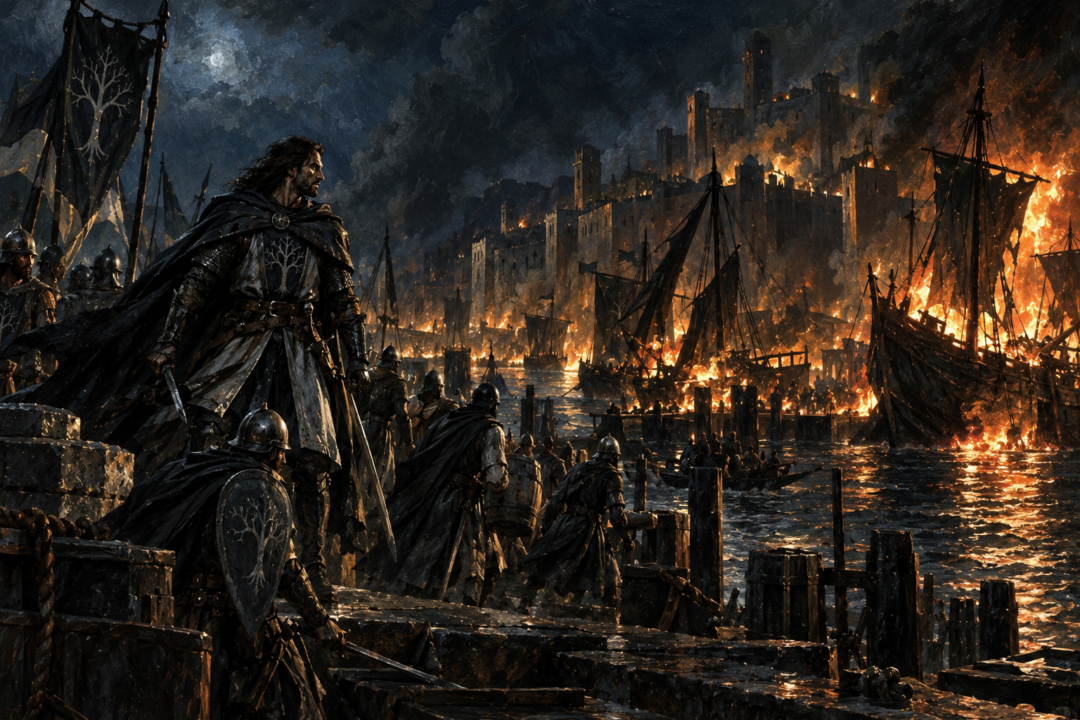
Minas Tirith stood far inland, yet the Great River connected the heart of Gondor with Pelargir and the sea. Aragorn’s journey aboard the captured ships had just demonstrated how strategically powerful that connection could be.
Control of the lower Anduin protected communications between the capital and southern Gondor. It also reduced the danger that another hostile fleet could penetrate toward the kingdom’s interior.
From Pelargir, ships could watch the river approaches and the Mouths of Anduin while supporting Gondor’s coastal regions.
This is partly strategic inference, because no surviving narrative gives us Elessar’s naval doctrine. But the geography that made the Corsair fleet dangerous did not disappear when Sauron fell.
What About Umbar?
Here the evidence becomes especially important.
The War of the Ring ends Sauron’s rule, but it does not magically erase every political problem in the South. The Return of the King says that Elessar later made peace with peoples who had fought against Gondor, and the appendices describe campaigns undertaken by Elessar and Éomer in lands beyond their kingdoms.
The precise postwar status of Umbar is not narrated in enough detail to reconstruct a specific conquest and occupation program.
So it is safer not to imagine an immediate Fourth Age scene in which Gondor simply annexes the haven and takes over its entire naval establishment.
What can be said is that the destruction or capture of the great Corsair force at Pelargir radically changed the maritime balance. Umbar had committed a major fleet to Sauron’s war and lost it.
Gondor, meanwhile, emerged victorious under a king with firsthand knowledge of southern warfare, naval raids, Pelargir, and Umbar itself.
The balance of power had reversed.
Aragorn Had Already Fought This Naval War Twice
There is a remarkable pattern in Aragorn’s life.
As Thorongil, he attacked Umbar and burned Corsair ships.
As the heir of Isildur, he returned to the southern war and captured Corsair ships.
As King Elessar, he inherited a restored realm whose security required that the old southern threat never again be allowed to cripple Gondor as it had during the War of the Ring.
The texts never say that Aragorn personally became another of Gondor’s Ship-kings, and applying that title to him would go beyond the evidence.
Yet his reign begins with a maritime victory of enormous strategic importance.
The irony is difficult to miss. Centuries earlier, rebels had escaped Gondor with much of its fleet and transformed Umbar into a lasting enemy. At the end of the Third Age, the heir of Gondor’s kings seized the enemy fleet at Pelargir and used it to save the kingdom.
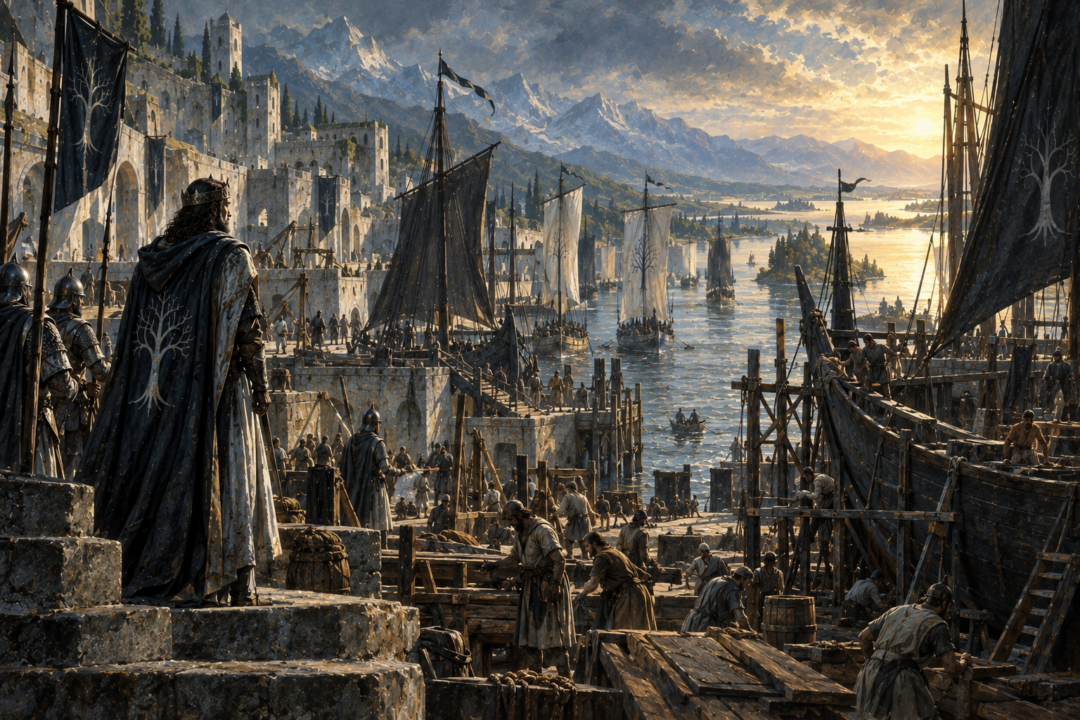
Gondor’s Real Naval Rebirth Was Not About Ships
The captured vessels are the spectacular part of the story, but they are not the deepest reason Gondor could rebuild maritime strength.
Gondor still had Pelargir.
It still had the Anduin.
It still had southern provinces whose soldiers answered Aragorn’s summons once the Corsair threat collapsed.
And after Sauron’s fall, it again possessed something it had lacked for centuries: a crowned king ruling a realm no longer locked into a desperate defensive war against Mordor.
Whether the black ships themselves served for years afterward is unknown. Some may have survived and been reused; others may not have. Tolkien never provides the ledger.
But the larger strategic picture is clear.
Aragorn did not need to conjure a navy from nothing. He inherited the surviving maritime foundations of Gondor at the same moment that he shattered one of their greatest enemies.
The Corsairs came north expecting their ships to help finish Gondor.
Instead, those ships carried Gondor’s own warriors to the Pelennor Fields.
For a kingdom whose ancient fleet had once been stolen by rebels and turned against it, there could hardly have been a more fitting beginning to its return to the sea.
Sources & Notes
- The Encyclopedia of Arda, “Gondor” — https://www.encyclopedia-of-arda.com/g/gondor.php
- The Encyclopedia of Arda, “Pelargir” — https://www.encyclopedia-of-arda.com/p/pelargir.php
- The Encyclopedia of Arda, “Umbar” — https://www.encyclopedia-of-arda.com/u/umbar.php
- The Encyclopedia of Arda, “Aragorn” — https://www.encyclopedia-of-arda.com/a/aragorn.php
Reference entries document the people, places, events, and textual details discussed in this article.