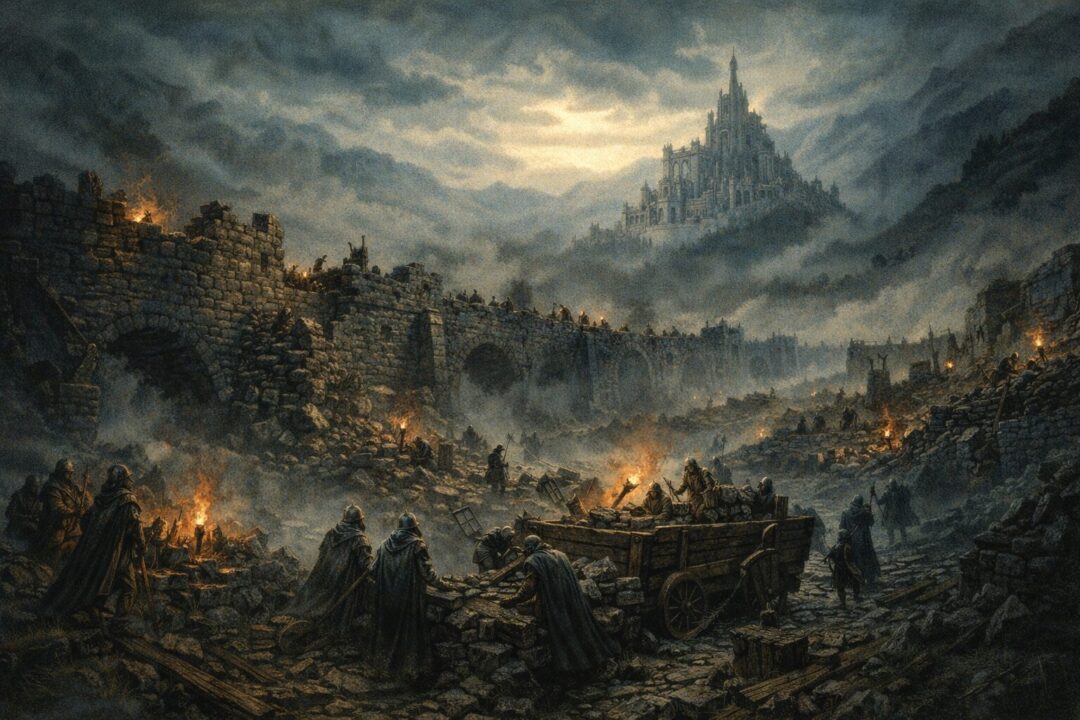
The Siege of Gondor is often imagined as a single crisis.
The Enemy comes. The walls are tested. Minas Tirith stands or falls.
But the texts paint a more unsettling picture than that.
When the siege finally arrives, Gondor is not meeting the assault from a position of intact strength. Its outer defenses still exist, yes. Men are stationed at the crossings. Walls still stand. Orders are still given. Yet nearly every important defensive line east of Minas Tirith carries the same hidden mark: it belongs to a kingdom that has already been yielding ground.
That is what makes Gondor’s border forts so tragic.
They do not fail all at once. They fail gradually, almost quietly, over generations—until the siege only reveals what was already true.
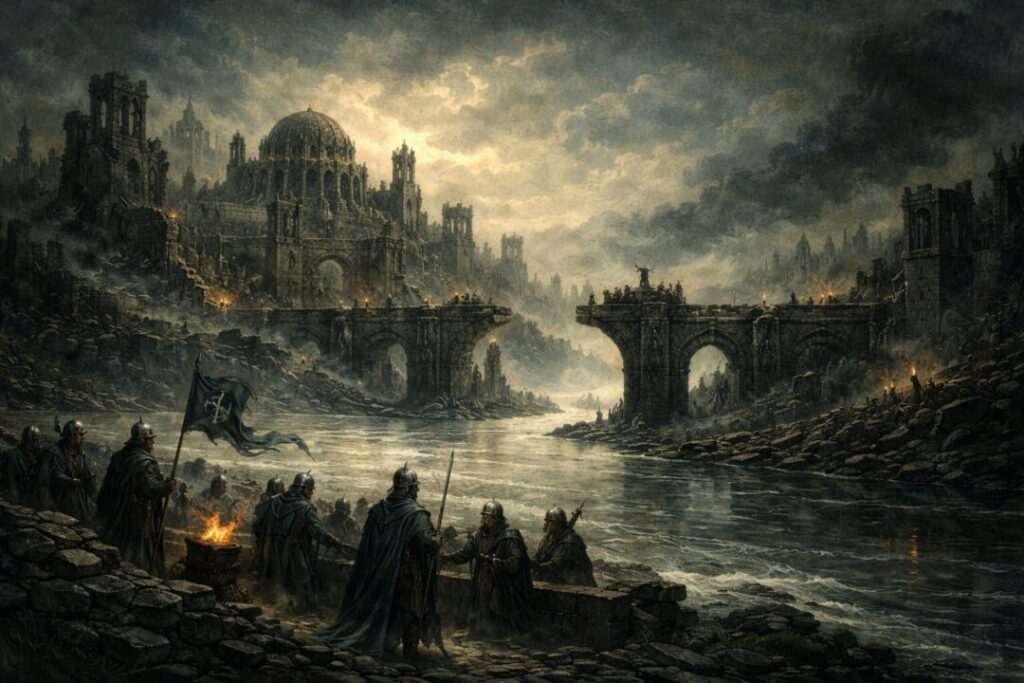
Osgiliath was still a defense, but no longer a frontier city
Osgiliath matters because it shows the difference between possession and strength.
Once, it was Gondor’s chief city: the great capital on the Anduin, seat of royal power, crowned by the Dome of Stars. But by the end of the Third Age, the city is largely a ruin. It still matters militarily because of the river crossing, yet that is already a diminished role. Gondor is no longer holding Osgiliath as a living center of rule. It is trying to deny the Enemy an approach through the wreckage of an older greatness.
That distinction matters.
A strong frontier city projects control. A ruined crossing delays invasion.
By the time Denethor sends Faramir to defend Osgiliath, the aim is not restoration. It is attrition. Faramir himself understands that the defense may inflict heavy losses if the Enemy tries to cross the river—but that the retreat will be dangerous if the crossing is forced. In other words, the line is being held because it must be held, not because Gondor expects it to endure.
This is the first quiet sign that Gondor’s border system has already changed in character.
The kingdom is no longer secure enough to make the river an unquestioned frontier. It can contest the crossing. It cannot prevent the test.
And once Osgiliath becomes that kind of defense, Gondor has already lost something larger than a city.
It has lost depth.
Ithilien had already slipped out of Gondor’s hands
The next loss is even more important, because it explains why later defenses feel so strained.
The Rammas Echor, we are told, was built with great labor after Ithilien fell under the Enemy’s shadow. That phrase does not describe a kingdom confidently extending its protection outward. It describes a kingdom pulling protection back.
This is easy to overlook because Gondor still acts in Ithilien.
Faramir’s men operate there. Hidden refuges like Henneth Annûn still allow Gondor to harry the Enemy. The Cross-roads itself had once been maintained by Gondor, with its kingly statue standing over the meeting of the roads. But by the time Frodo and Sam pass through, the place has effectively fallen under Sauron’s control. The statue is defiled. Orcs move through the land. Gondor’s presence has become irregular, secretive, and temporary.
That is not what it means to hold a province.
It means Gondor still remembers Ithilien, still bleeds for it, still enters it—but no longer governs it openly.
And that matters because forts do not stand alone. They depend on roads, supply lines, communication, and friendly ground between them. Once Ithilien becomes a shadowed land rather than a secured march, every fixed defense west of it becomes more vulnerable. A fort can be manned. A wall can be repaired. But if the country beyond them is already lost, then each strongpoint begins to stand more like an island than part of a living frontier.
That is exactly the condition Gondor seems to be in by 3019.

Cair Andros reveals how thin the defense had become
Cair Andros is one of the clearest examples of strategic importance outlasting strategic comfort.
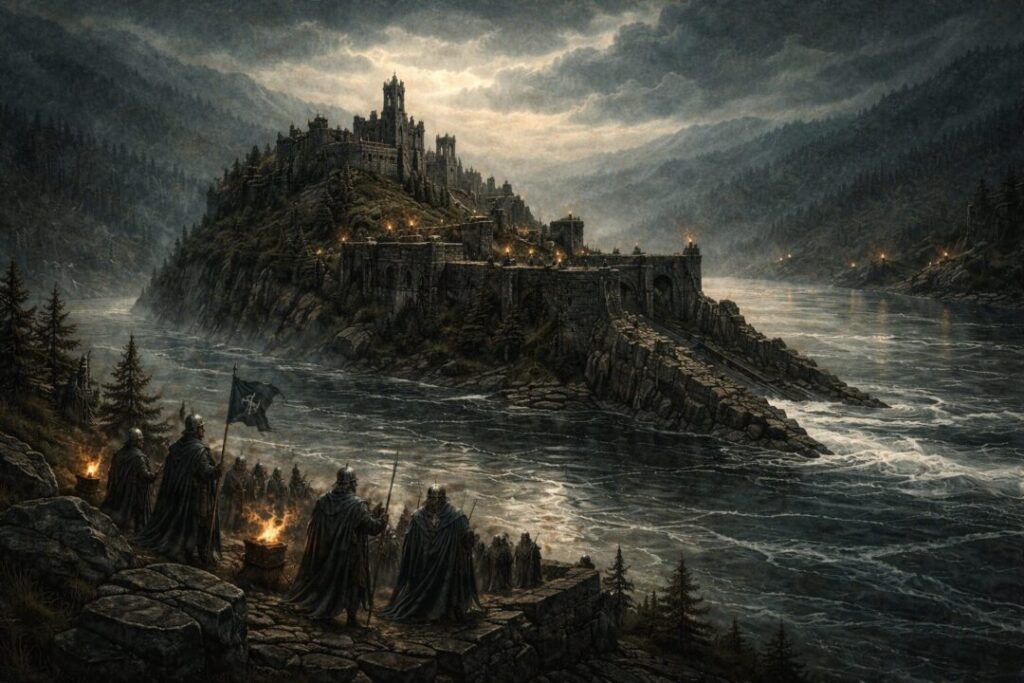
The island sits in the Anduin and is important precisely because it is one of the few practical crossings of the river. Gondor fortified it for that reason. Even late in the Third Age, Denethor insists that it is manned.
But that detail cuts two ways.
On one level, it shows prudence. Gondor has not simply abandoned its northern river defense.
On another, it reveals the problem. Cair Andros is vital, yet distant. Denethor says no more can be sent so far. The fort is held, but it is held under the logic of scarcity. Gondor is not assigning lavish strength to all its threatened points. It is distributing limited resistance across a front that is too broad for complete security.
That is what makes the position fragile.
A border fort is strongest when it belongs to a network: reserves behind it, safe roads around it, and neighboring defenses able to respond. Cair Andros in the late war feels less like that and more like a necessary outpost that cannot be fully reinforced without weakening somewhere else.
So even before it falls, it tells you something alarming.
Gondor is still defending the river.
But it is defending it by stretching.
The Rammas Echor was not the first wall. It was the second answer
The Rammas Echor may be the most revealing defensive work in the whole story.
At first glance it looks like a sign of strength: a great outer wall encircling the Pelennor, protecting the farmlands and approaches around Minas Tirith. It is immense, built with great labor, and tied to the life of the city itself.
But the chronology changes how you see it.
The out-wall was built after Ithilien had fallen under the Enemy’s shadow. So the Rammas is not evidence that Gondor’s outer border remained secure. It is evidence that Gondor had already been forced to defend closer to home. The kingdom had moved from guarding a province east of the river to fortifying the fields of its capital.
That is a strategic retreat made visible in stone.
And when Gandalf approaches Minas Tirith, the text adds an even harsher note: the Rammas is already partly ruinous, and workmen are laboring through the night to repair it. This is one of those details that quietly changes the whole atmosphere. Gondor is not presenting a perfectly kept outer barrier to the Enemy. It is hurrying to patch a neglected shield on the eve of assault.
The wall still matters. It delays. It shapes the battlefield. The Causeway Forts still guard the northeastern gate where the road from Osgiliath enters. Yet when the attack comes, the forts are wrecked and breaches are blasted in the wall, forcing the defenders back across the Pelennor toward the Great Gate.
That is not the failure of a useless defense.
It is the failure of a defense that came too late in a longer decline.
Gondor had begun losing not just strongholds, but the spaces between them
This may be the real heart of the matter.
Readers often think in terms of named places: Osgiliath, Cair Andros, Minas Tirith. But wars are not lost only at named places. They are also lost in roads, crossings, fields, and ordinary control of movement.
The Cross-roads shows this perfectly. It once stood under Gondor’s care; by the War of the Ring it has effectively passed into the Enemy’s sphere. That means Sauron’s power is no longer merely battering Gondor’s walls. It is sitting in Gondor’s old ways, fouling its monuments, and using the land through which Gondor once moved openly.
Once that happens, forts grow lonely.
A lonely fort can still resist. It cannot restore a frontier by itself.
This is why the fall of Gondor’s border defenses feels so quiet in the text. The kingdom is still brave. Its captains are still capable. Faramir’s retreat from Osgiliath is not presented as cowardice or incompetence. The defenders of the Rammas do real work. Cair Andros is not forgotten. But all of these efforts take place inside a larger pattern of contraction.
The siege, then, is not simply the beginning of Gondor’s crisis.
It is the moment when the accumulated losses of years and generations become impossible to hide.
Why this changes the Siege of Gondor
Seeing this makes the siege more impressive—but also sadder.
Minas Tirith does not stand because the outer defenses were sound. It stands because Gondor can still produce courage after much of its strategic inheritance has already been spent.
That is why the defense feels so desperate.
The ruined city at the river.
The shadowed province beyond it.
The island crossing that must be held with limited means.
The outer wall already in repair before the great assault begins.
These are not random details. Together they show a realm that has been fighting a long defensive war for far longer than the siege itself.
So how did Gondor’s border forts fail?
Not by cowardice. Not by a sudden mistake. Not because one wall was weak or one captain faltered.
They failed because Gondor had already been pushed back from frontier to crossing, from crossing to out-wall, from out-wall to city.
By the time the horns sounded before Minas Tirith, the real loss had happened more quietly.
The kingdom had already begun surrendering the land before it was forced to defend the stone.