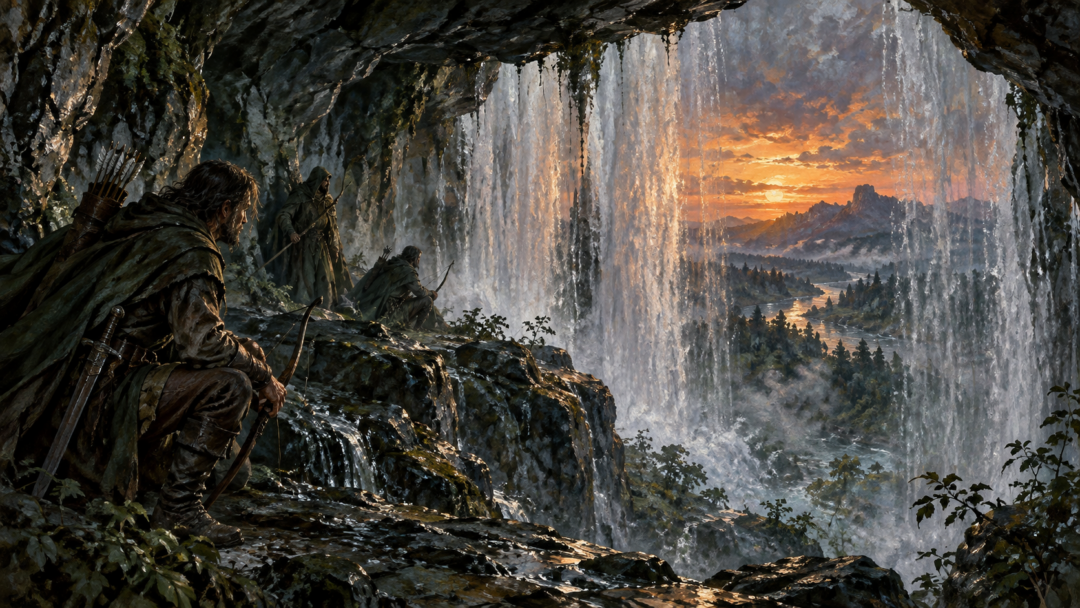
Frodo and Sam do not first see Henneth Annûn as a fortress. They are brought there blindfolded, led through Ithilien by Faramir’s men, and only after entering are allowed to look out through a falling sheet of water toward the westering sun. The effect is beautiful rather than martial: a hidden chamber, a pool below, and sunset broken by the waterfall. Yet that beauty is doing military work. Henneth Annûn gives the Rangers of Ithilien a concealed place inside territory Gondor no longer securely controls, where men can gather, eat, question captives, and find shelter between operations without presenting Sauron with an obvious strongpoint to attack. Calling it a “forward operating base” is a modern analogy, not a term from the story, but it captures the function surprisingly well.
An Army’s Foothold Need Not Look Like a Castle
By the War of the Ring, Ithilien is still Gondorian in memory and claim, but much of its civilian population has long since withdrawn under pressure from Mordor. Gondor therefore faces a frontier problem: it wants armed men active east of Anduin without trying to hold every mile of the old province with walls, towers, and visible garrisons. The Rangers answer that problem through movement, camouflage, local knowledge, and secret refuges.
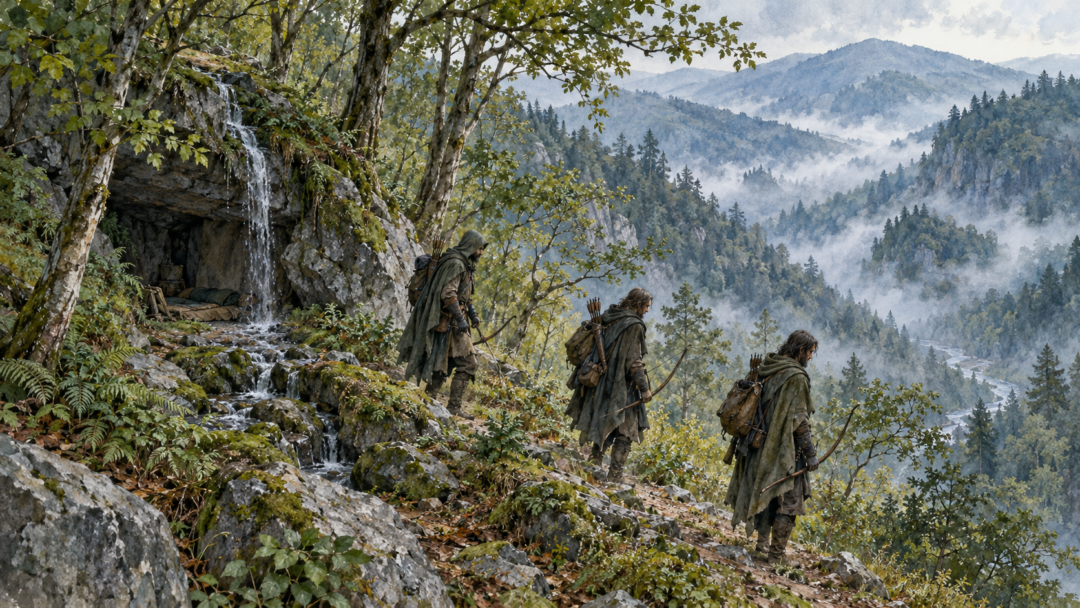
Henneth Annûn belongs to that system. It was established as a hidden refuge in the time of Steward Túrin II, after attacks from Mordor drove most remaining inhabitants from Ithilien. More than a century later, Faramir uses it as a base for Rangers who still move through the land and strike at enemy forces. Its value comes precisely from avoiding the signature of a conventional fortress. A visible fort tells an enemy where troops are concentrated and what ground matters; Henneth Annûn supports soldiers while withholding those answers. The comparison to a modern forward base should stop there: the story gives us a refuge and outpost, not a headquarters with mapped sectors, depots, or a formal logistics staff.
The Landscape Does Most of the Camouflage
The concealment begins with terrain. Henneth Annûn lies in North Ithilien beside a stream descending from the direction of the Ephel Dúath. At the refuge, water passes over rock and falls before a west-facing opening. Behind that curtain lies the recess and access to the Rangers’ shelter. From within, a person can look west through the falling water, especially striking at sunset; from outside, the same water helps mask the opening.
That arrangement is more useful than simply saying the cave is “behind a waterfall.” The waterfall screens a particular opening. It does not turn the entire site into a magically sealed cavern, nor does the story provide enough information to reconstruct an exact floor plan, line of sight, or detection radius. The military advantage is simpler: a natural feature screens a west-facing window so that the refuge can occupy valuable ground without looking like a built defensive work.
The name Henneth Annûn, “Window on the West” or “Window of the Sunset,” captures the double character of the place. To Frodo and Sam, the window is a moment of wonder. To the Rangers, that same westward opening is part of a concealed position. Ithilien itself works this way: a damaged garden-land where war operates among streams, woods, and traces of an older peace. The Rangers’ use of a concealed refuge fits the same pattern. A hidden refuge gives them a point of return without forcing them to defend a gatehouse or skyline visible to hostile scouts.
A Refuge Has to Be Livable
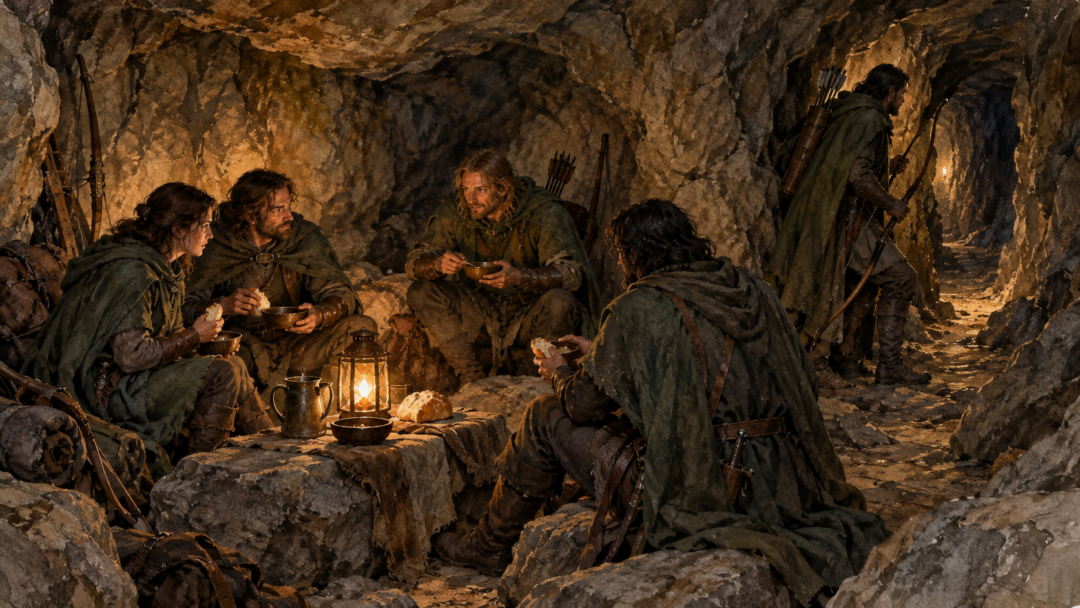
Secrecy alone would not make Henneth Annûn operationally valuable. A crack in the rock can hide a man; a base has to sustain men long enough for them to keep acting. What the story shows is modest but sufficient. Frodo and Sam are brought inside, fed, and questioned by Faramir in an occupied refuge. Rangers occupy the place in an organized enough fashion to keep watch, guard prisoners, and shelter their captain and companions.
Those details justify a limited inference: Henneth Annûn functions as a secure place where troops can recover between movements in contested country. Men who spend their days scouting, shadowing roads, or attacking passing enemies need somewhere safer than an exposed woodland camp every time they stop. A hidden chamber can provide shelter, food, and an opportunity to recover before another movement without advertising their location to every hostile patrol.
That does not prove a large storehouse, a fixed provisioning network, or any particular number of Rangers stationed there. The story gives no inventory, ration schedule, garrison census, or chain of supply. Food being served proves food was available; the occupied refuge proves it could shelter men. The broader context supplies the rest of the functional picture: Faramir’s Rangers are active in land that is neither peacefully governed nor wholly surrendered to the Enemy, and on the day they encounter Frodo and Sam they ambush enemy soldiers moving through Ithilien. Henneth Annûn need not dominate the province. It only has to make repeated Gondorian presence there more sustainable.
The Approaches Are Part of the Defense
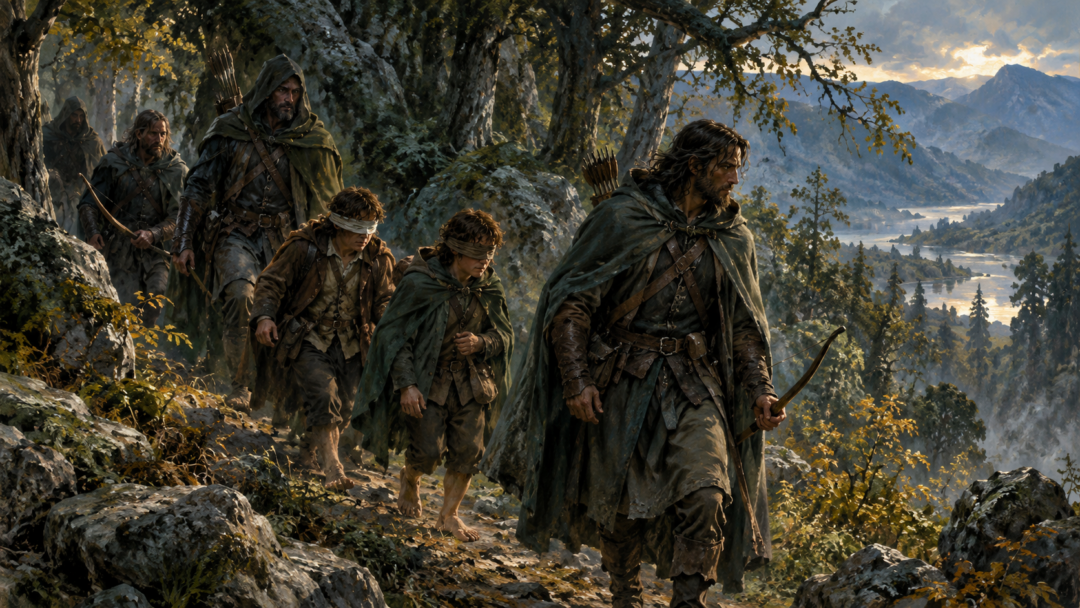
Frodo and Sam are blindfolded before they are brought to the refuge. That is one of the clearest signs that Henneth Annûn’s security depends not only on rock and water but on controlled knowledge. The Rangers do not merely hope strangers will fail to notice the place. They actively prevent outsiders from learning the route to it.
A concealed base can be compromised even when it is visually hard to spot. A captive, traveller, deserter, or spy who learns the approaches may not need to see the waterfall from a distance; knowing how to reach the site can be enough. Blindfolding the hobbits protects the landward route, while the waterfall helps conceal the western opening. These measures solve different problems. Together they show that secrecy is a practice, not just a gift of geography.
The precautions are strong, but they are not perfect. Henneth Annûn remains a physical place in a country crossed by enemies and wanderers. Its survival depends on people not learning too much about it, not on any supernatural guarantee that it cannot be found. That vulnerability becomes clearest at the pool below the falls.
The Forbidden Pool Shows What Secrecy Costs
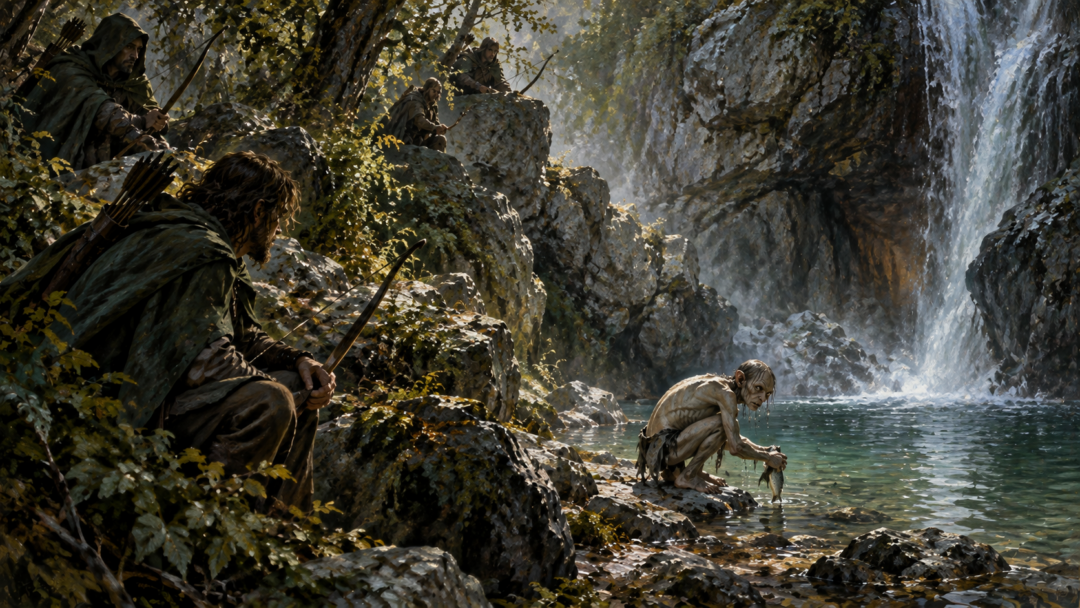
Gollum reaches the pool while searching for fish. He is not conducting reconnaissance for Sauron, and the water itself is not magical. The danger is that he has wandered to a boundary of the Rangers’ hidden stronghold and may now know something he was never meant to know. A quiet pool becomes a security crisis simply because of where it lies.
Faramir’s men treat trespass there as a capital matter, and Faramir is prepared to have Gollum killed under the rule governing the forbidden place. Frodo intervenes because Gollum is his guide and because he understands that the creature has come for fish, not as an enemy scout. Frodo persuades him to leave the water and approach, allowing the Rangers to capture him instead.
The scene prevents an overly romantic view of the refuge. Henneth Annûn is beautiful, but its secrecy is maintained by armed men under wartime discipline. The waterfall does not eliminate risk; it shifts part of the defense from battlements toward control of knowledge. Once an outsider reaches the protected boundary, the problem is no longer camouflage but what that outsider knows. At the same time, the incident should not be inflated into a universal Gondorian law about every pool or every trespasser. It demonstrates something narrower: this hidden refuge is important enough that unauthorized discovery is treated with exceptional seriousness.
A Hidden Base Still Has an Expiration Date
Henneth Annûn helps the Rangers act aggressively without holding Ithilien in the conventional sense. Faramir’s company can attack enemy soldiers, intercept unknown travellers, and then withdraw to a concealed refuge. We are not told that the ambush Frodo and Sam witness was planned in a particular chamber there, or that messages and supplies followed a precise route from the cave. The connection is functional rather than bureaucratic: the refuge supports men who are demonstrably conducting operations in the surrounding country.
But concealment cannot substitute forever for strategic control. On 9 March 3019, after Frodo, Sam, and Gollum have departed, Faramir and his Rangers leave Henneth Annûn as well. Three men accompany Faramir toward Minas Tirith, while the remainder go toward Osgiliath. As Sauron’s final offensive develops, the secret refuge is vacated rather than defended as a fortress. That reveals its built-in limit: it is useful while troops can move, strike, disappear, and return. It cannot by itself stop an army or replace the defenses on the Anduin.
Henneth Annûn works because terrain, shelter, and guarded knowledge reinforce one another. The waterfall hides a usable place; the place lets Rangers remain active in dangerous country; secrecy preserves the advantage. Remove any one of those, and the refuge becomes far less valuable.
Its final image is therefore exactly right: not a citadel bristling above Ithilien, but a hidden window facing west. For a time, Gondor’s strength in the lost garden-land survives by refusing to look like strength at all.
Sources & Notes
- The Encyclopedia of Arda, Henneth Annûn — describes the hidden Ithilien refuge, its waterfall screen, westward name and establishment in Third Age 2901. https://www.encyclopedia-of-arda.com/h/hennethannun.html
- Tolkien Gateway, Rangers of Ithilien — provides references for Gondor's camouflaged troops, secret retreats, Faramir's operations and the departure from Henneth Annûn. https://tolkiengateway.net/wiki/Rangers_of_Ithilien
- Tolkien Gateway, The Forbidden Pool — chapter guide to Gollum's discovery, Frodo's intervention and the security consequences of approaching the hidden refuge. https://tolkiengateway.net/wiki/The_Forbidden_Pool
Primary textual context: The Two Towers, The Window on the West and The Forbidden Pool, and The Lord of the Rings, Appendices A and B. Forward operating base is a modern interpretive analogy, not Tolkien's terminology; the text does not establish a detailed logistics system or floor plan.