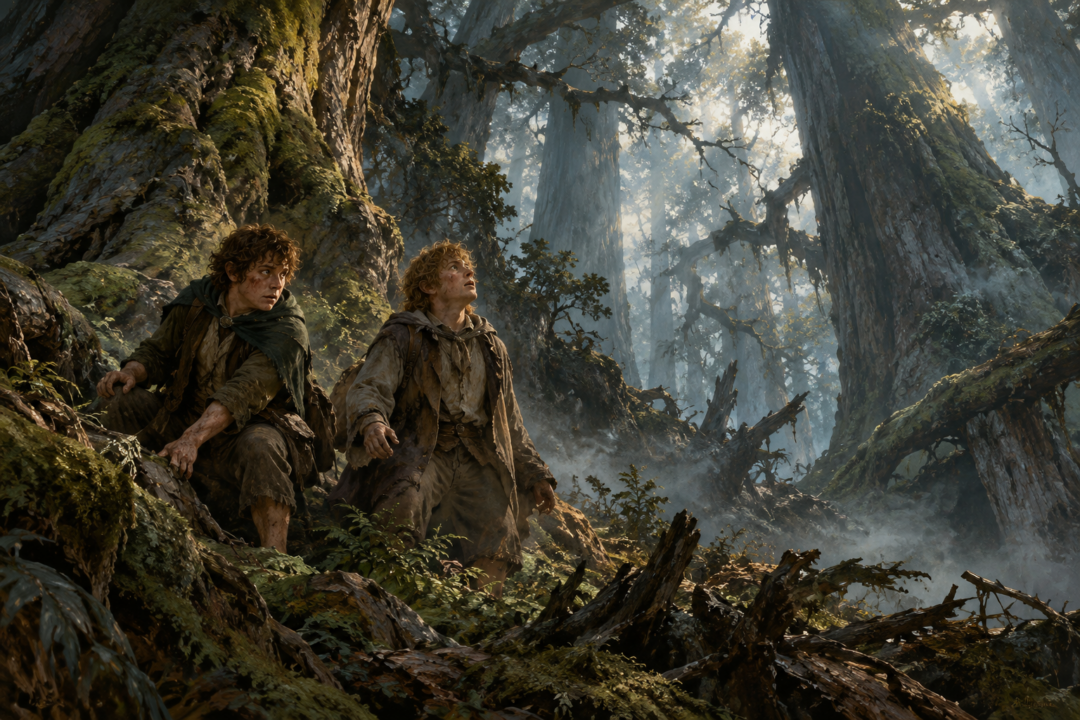
When Aragorn, Legolas, and Gimli finally find Merry and Pippin again, the setting could hardly be stranger.
They have crossed Rohan in desperate pursuit of the captured hobbits. They have fought at Helm’s Deep. Saruman’s army has been shattered. Then they ride to Isengard expecting to confront the stronghold from which that army came—and discover their missing companions sitting among its ruins, eating, smoking, and looking remarkably comfortable.
The comedy is deliberate. But underneath it lies something important.
In “Flotsam and Jetsam,” Merry and Pippin give Aragorn, Legolas, and Gimli something they have not previously possessed: a coherent eyewitness account of what happened inside the crisis surrounding Isengard. They can explain their captivity, their escape, their encounter with Treebeard, the Entmoot, the march on Isengard, Saruman’s attempt to manage the disaster, Gandalf’s brief arrival, and even Gríma’s return to his master.
Calling this a “briefing” is modern language, not Tolkien’s. Nor are Merry and Pippin spies who infiltrated Orthanc. They never enter Saruman’s tower, and much of what they know comes from events they witness alongside the Ents rather than from secret observation inside his government.
Yet structurally, that is exactly why their story matters.
They are witnesses positioned at the one place where the other major characters were absent.
The War Splits Into Separate Worlds
After the breaking of the Fellowship, knowledge becomes fragmented.
Frodo and Sam disappear toward Mordor. Aragorn, Legolas, and Gimli pursue the Orcs who have taken Merry and Pippin. Gandalf is elsewhere until his return. Théoden and the Rohirrim face Saruman’s invasion from within Rohan.
No single group can see the whole board.
This is especially important around Isengard. Gandalf already knows that Saruman has betrayed the Free Peoples; his imprisonment on Orthanc established that long before Merry and Pippin reached Fangorn. Théoden also learns the reality of Saruman’s hostility in unmistakable fashion as Rohan is attacked.
So Merry and Pippin do not reveal Saruman’s treachery to an otherwise ignorant West.
Their role is subtler.
They become witnesses to the part of Saruman’s downfall that happens while nearly everyone else is looking somewhere else.
While Théoden, Aragorn, Gandalf, Legolas, Gimli, and the Rohirrim are occupied with the war culminating at Helm’s Deep, Merry and Pippin are present for the awakening of Fangorn and the destruction of Saruman’s power base.
That gives them a story no one else in their immediate circle can tell.
Their First Important Information Is Surprisingly Small
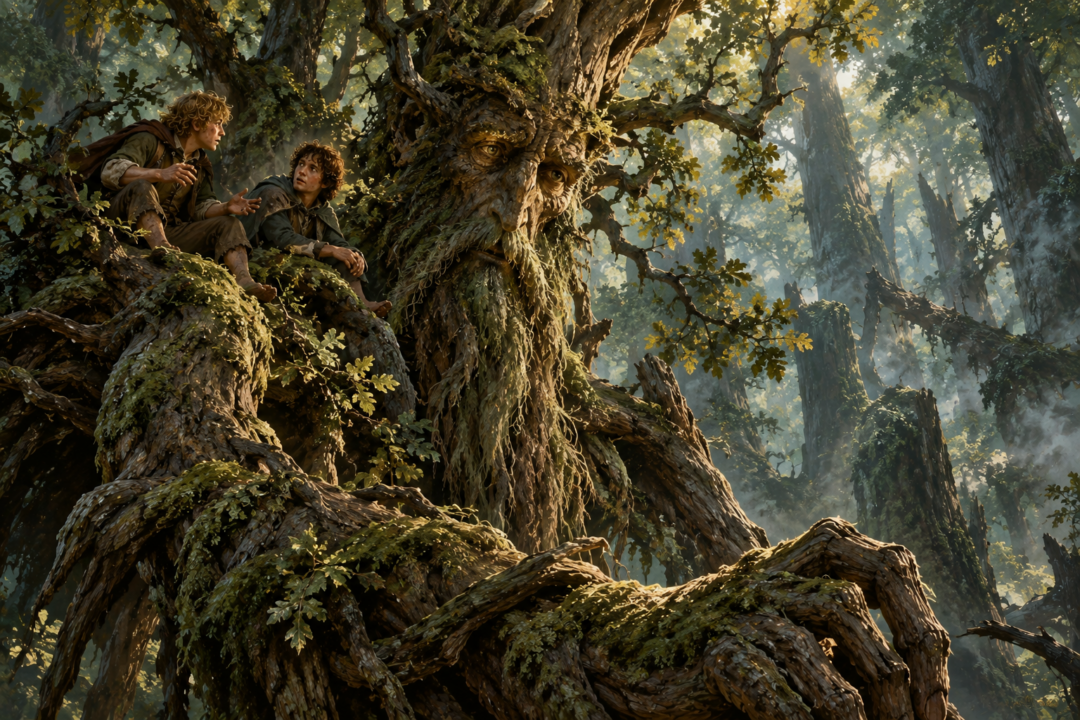
When Merry and Pippin meet Treebeard, they do not arrive carrying a detailed intelligence report about Saruman.
In fact, Treebeard already has reasons to distrust him.
Treebeard knows Saruman has become dangerous. He knows trees have been felled. He speaks bitterly about the wizard’s changed behavior and his growing concern with machinery and power. The hobbits therefore do not “discover” the destruction of Fangorn for him.
What they provide is fresh news from the outside world.
They can tell him about the war, the Fellowship, the Orcs who captured them, and the fact that some of those Orcs came from Isengard. Their account connects Treebeard’s local grievance—the destruction of trees—with a much larger conflict.
That distinction matters.
Treebeard is not a passive creature waiting for two hobbits to persuade him that Saruman is evil. His anger has roots of its own. But Merry and Pippin arrive at precisely the moment when scattered signs can be understood as part of a wider pattern.
Their information does not create the crisis.
It helps give the crisis context.
Merry and Pippin Do Not Order the Ents to War
One of the easiest ways to misremember this episode is to make the hobbits responsible for convincing reluctant Ents to attack Isengard.
The book is more complicated.
Treebeard summons the Entmoot after speaking with Merry and Pippin. The Ents deliberate in their own fashion, slowly and at extraordinary length. Merry and Pippin cannot even follow most of what is being said.
Then the decision comes.
The Ents themselves resolve to march.
That preserves something essential about Fangorn: the Ents are not weapons waiting for heroes to activate them. They are an ancient people making their own judgment about Saruman.
Merry and Pippin matter because their arrival helps bring different strands of knowledge together at the decisive moment. But the choice belongs to Treebeard and the Ents.
The hobbits are witnesses to a decision they helped set in motion without controlling it.
That is a recurring pattern in their story.
Then They See Isengard Fall
Once the Ents march, Merry and Pippin acquire a completely different kind of knowledge.
They are there.
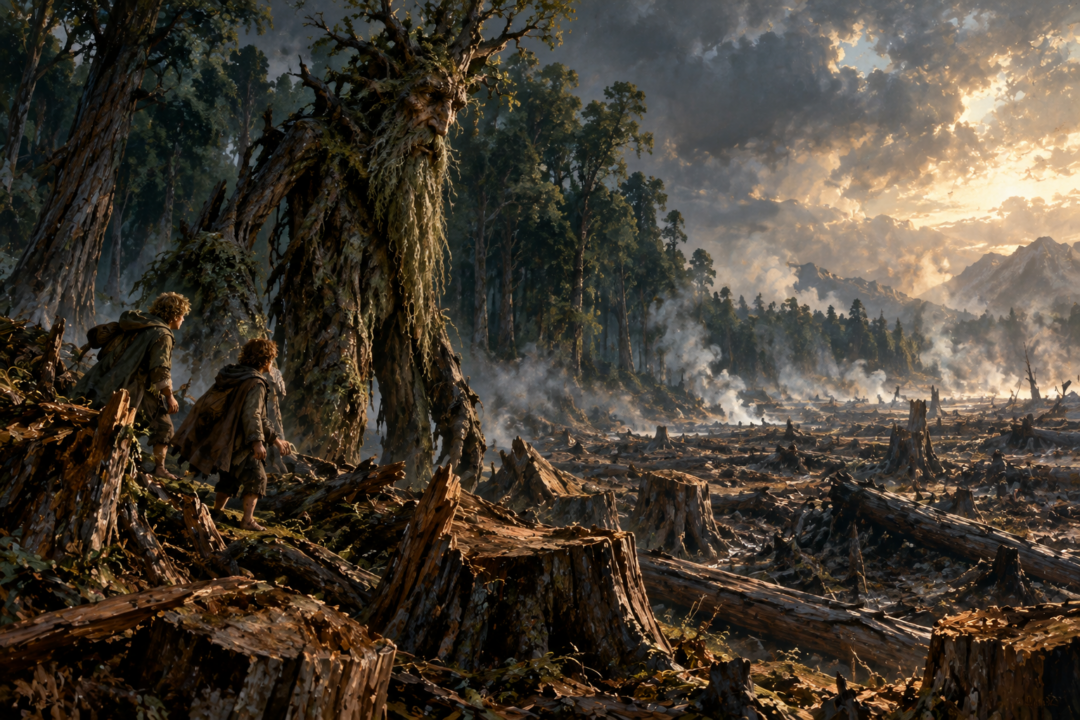
They see the assault on Isengard. They see the Ents break into the Ring. They witness Saruman’s defenses collapsing and his servants being overwhelmed. They learn that Orthanc itself cannot simply be torn apart like the surrounding works.
They also witness Saruman nearly being caught outside his tower before escaping back into Orthanc.
Then comes one of the decisive acts of the attack: the waters released into Isengard, drowning its fires and flooding the works Saruman had constructed.
For anyone trying to understand Saruman’s actual condition after Helm’s Deep, this is enormously valuable.
An army defeated in the field does not necessarily mean that the power behind it has been destroyed. Saruman still possesses Orthanc. He still possesses his voice. He remains personally dangerous.
But his industrial and military base has been devastated.
Merry and Pippin have watched that transformation happen.
Gandalf Knows More—but the Hobbits Know Different Things
It would be inaccurate to call Merry and Pippin the best-informed people concerning Saruman.
Gandalf knows far more about Saruman himself. He understands the wizard’s betrayal, his ambitions, and the larger war against Sauron. After Helm’s Deep, Gandalf also knows that Isengard has been attacked; he rides there during the night and speaks with Treebeard.
But Gandalf does not remain to watch every stage of the destruction.
Merry and Pippin do.
That creates an interesting division of knowledge.
Gandalf understands the strategic meaning of events better than they do. Merry and Pippin possess detailed eyewitness knowledge of events he did not personally observe.
This is why “Flotsam and Jetsam” works so well after the enormous drama of Helm’s Deep.
The narrative suddenly becomes conversational.
Aragorn, Legolas, and Gimli sit with the hobbits, and the missing portion of the story is reconstructed.
The great war is briefly understood through eyewitness testimony.
Their Account Includes Details Nobody Expected
The hobbits’ usefulness is not limited to the battle.
They notice things.
Among the wreckage of Isengard they find stores that include pipe-weed from the Shire. Merry recognizes it as coming from the Southfarthing and is deeply puzzled by its presence so far from home.
At this stage, the discovery does not provide a complete explanation.
Merry cannot tell Aragorn exactly how Saruman obtained it. The significance only becomes clearer later, especially when the hobbits return to the Shire and discover the extent of Saruman’s interference there.
But the detail is important precisely because it remains unresolved.
Good witnesses do not always know what their evidence means.
Sometimes they simply preserve the anomaly.
The pipe-weed is one of those anomalies: a small domestic object in the ruins of a wizard’s war machine, quietly suggesting that Saruman’s reach has extended farther than the heroes yet understand.
Gríma’s Arrival Completes Another Piece
Merry and Pippin are also present when Gríma Wormtongue arrives at ruined Isengard.
This is a remarkable convergence.
Gríma has fled Théoden’s court after Gandalf exposes the hold he has exercised over the king. He heads toward Saruman—only to discover that Saruman’s stronghold has already been overthrown.
Treebeard does not allow him simply to depart.
So when Théoden later reaches Isengard, the two men most associated with the corruption of his kingdom are trapped together in Orthanc.
Again, Merry and Pippin have witnessed the connecting event.
To Théoden, Gríma vanished from Edoras.
At Isengard, the missing part of the story is waiting.
Why “Flotsam and Jetsam” Matters
On the surface, the chapter feels almost like a pause.
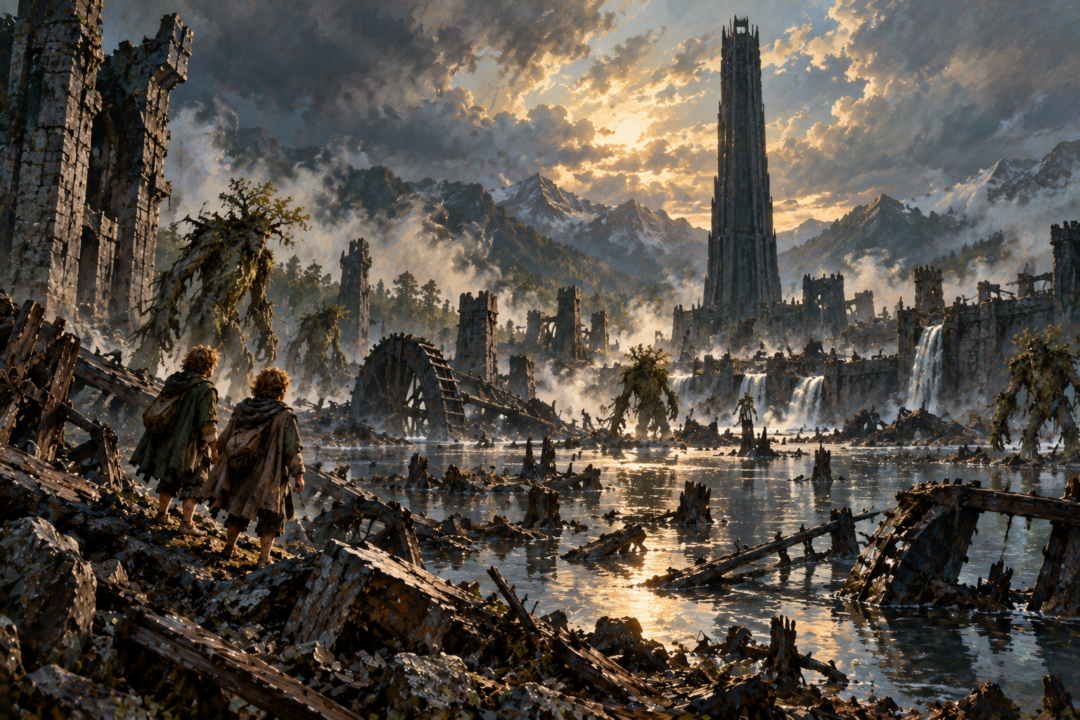
The battle of Helm’s Deep is over. Isengard has already fallen. Merry and Pippin are safe. Food is produced. Pipes are lit. Old friends talk.
Yet this calm is doing serious narrative work.
For much of The Two Towers, the characters have been operating with incomplete information. The reader has also followed separate groups whose experiences overlap only imperfectly.
At Isengard, those threads begin to reconnect.
Merry and Pippin can finally tell Aragorn, Legolas, and Gimli what happened after the Orc-band was destroyed. The hunters can understand why the hobbits vanished into Fangorn. They learn how Treebeard entered the war, how Isengard was broken, what happened to Saruman, and how Gríma ended up inside Orthanc.
The reunion turns chaos into sequence.
That is why the image of the two hobbits casually eating among the wreckage is more than comic relief.
They look like the least likely people in Middle-earth to possess strategically useful information.
And yet they do.
The Limits of Their Knowledge Make Them More Credible
Merry and Pippin do not suddenly become master strategists.
They do not understand everything they have seen. They cannot explain every motive. They do not know the full relationship between Saruman and Sauron. They do not yet understand the meaning of every object or clue around them.
That limitation is important.
Their value comes from observation rather than omniscience.
They can say, in effect: this is where we went; this is whom we met; this is what the Ents decided; this is what happened when they attacked; this is what Saruman did; this is what Gandalf did when he arrived; this is how Gríma came here.
Their account is useful because it remains close to experience.
They supply pieces. Others can interpret them.
The Palantír Shows How Much Still Remains Hidden
The irony becomes sharper almost immediately.
After Merry and Pippin have helped fill one enormous gap in everyone’s knowledge, another mystery emerges from Orthanc.
During the confrontation with Saruman, Gríma throws down a heavy object from the tower. Pippin retrieves it before Gandalf takes it from him.
It is the palantír of Orthanc.
Only later does its terrible importance become clear.
The stone reveals a dimension of Saruman’s relationship with Sauron that Merry and Pippin’s eyewitness account could never have uncovered by itself.
That sequence provides a useful correction to any exaggerated idea of their role.
Their testimony is reliable because they describe what they actually experienced.
It is not complete intelligence on Saruman.
Middle-earth is still full of hidden channels, unseen powers, and intentions that cannot be learned merely by watching the gates.
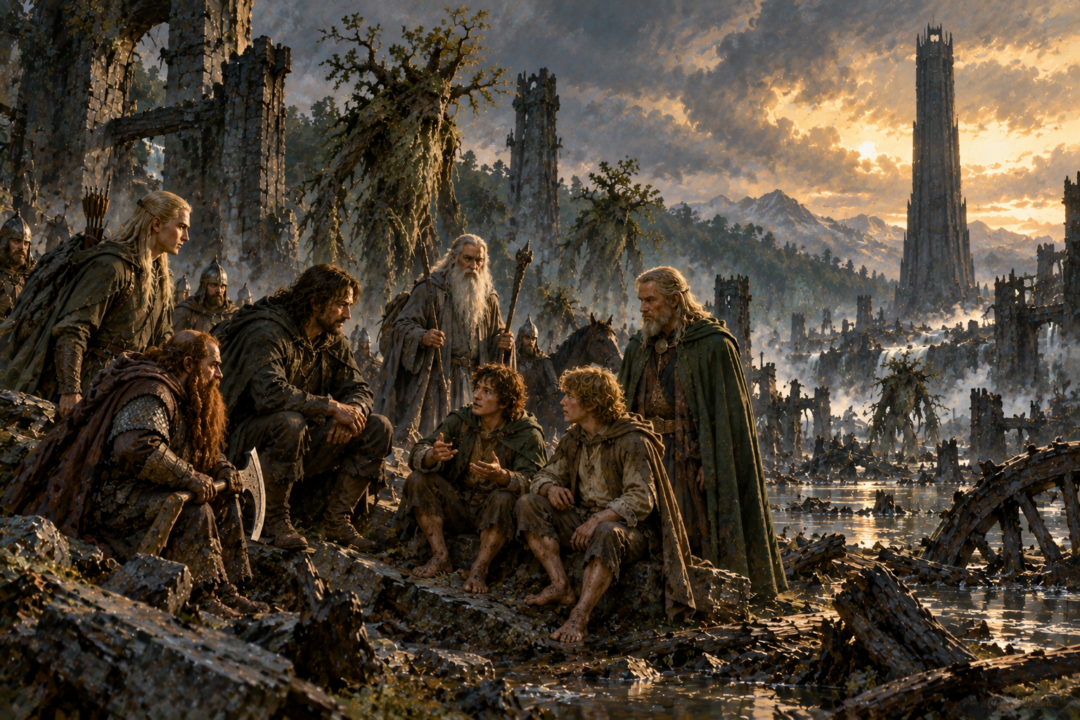
Two Hobbits Become Witnesses to the Fall of a Power
Merry and Pippin begin this part of the story as prisoners.
They are cargo in an Orc-band being carried toward Isengard. They escape largely because their captors are destroyed by the Riders of Rohan. They flee into a forest they barely understand.
Yet within days they have met one of the oldest living beings in Middle-earth, attended the gathering of the Ents, marched with them to war, watched Isengard fall, seen Gandalf coordinating with Treebeard, witnessed Gríma’s arrival, and discovered an unexplained connection between Saruman and the Shire.
Then the people who had been trying to rescue them finally arrive.
And the rescued have to explain the situation to the rescuers.
That reversal is one of the quiet pleasures of the episode.
Merry and Pippin do not defeat Saruman. They do not command the Ents. They do not uncover all of his secrets.
What they do is something less spectacular and, in its own way, indispensable.
They survive.
They watch.
They remember.
And when their friends finally reach the ruins of Isengard, the two smallest members of the Fellowship are the ones who can tell them how an ancient forest went to war—and how Saruman’s fortress fell while the rest of Rohan was fighting somewhere else.
Sources & Notes
- Tolkien Gateway — Flotsam and Jetsam: Merry and Pippin's account of the fall of Isengard — https://tolkiengateway.net/wiki/Flotsam_and_Jetsam
- Tolkien Gateway — Treebeard: meeting the hobbits, the Entmoot and the march on Isengard — https://tolkiengateway.net/wiki/Treebeard
- Tolkien Gateway — Isengard: the Ents' destruction and flooding of Saruman's stronghold — https://tolkiengateway.net/wiki/Isengard
Primary reading: The Two Towers, 'Treebeard', 'The Road to Isengard', 'Flotsam and Jetsam', 'The Voice of Saruman' and 'The Palantír'. The linked guides support the eyewitness account and its setting. 'Briefing' is modern analytical language: the hobbits neither entered Orthanc nor revealed Saruman's already-known betrayal for the first time.