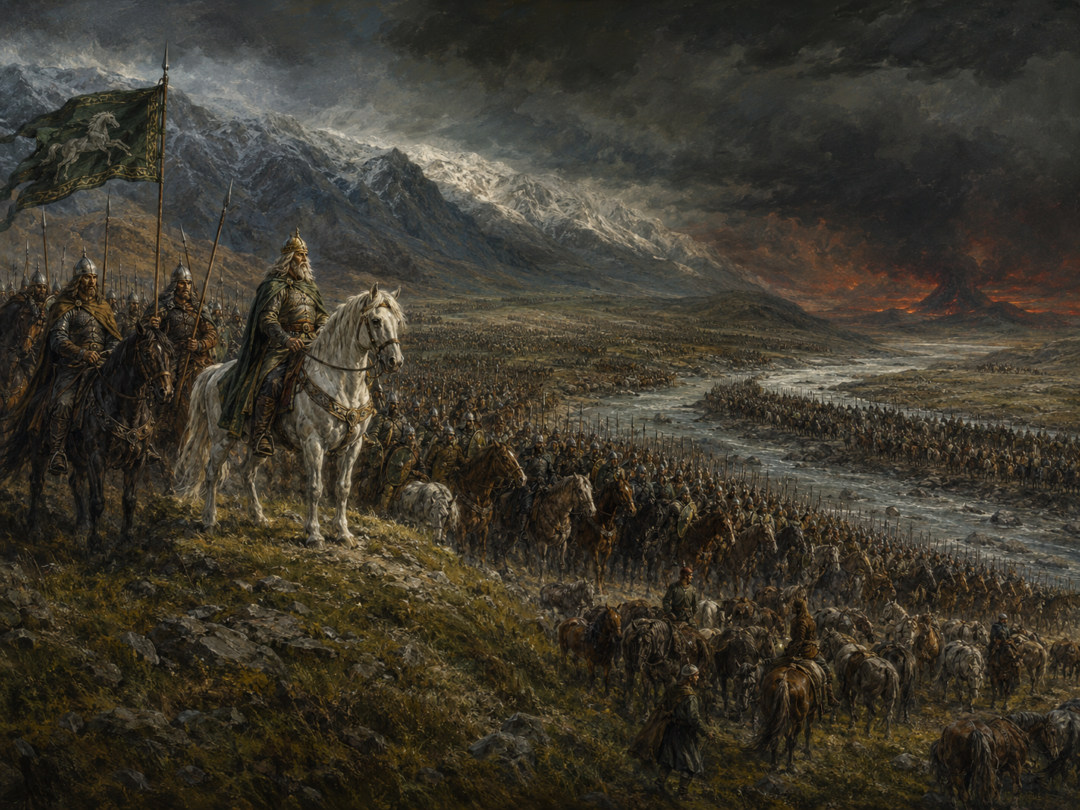
When Théoden finally answered Gondor’s Red Arrow, his problem was not simply whether Rohan could send enough warriors. It was whether thousands of horses could reach Minas Tirith quickly enough to matter—and still have enough strength left to charge.
That distinction is easy to miss.
The Rohirrim did not merely have to move an army roughly a hundred leagues eastward. Their army was almost entirely mounted. Every mile consumed the strength of the very animals on which their battlefield power depended. A cavalry host that arrived with exhausted horses would have fulfilled the oath to Gondor only to lose its greatest advantage.
The Return of the King never gives us a quartermaster’s account of sacks of grain, hay rations, or daily fodder. We should therefore resist inventing one. But the text does give several important clues: Théoden deliberately reduced the baggage carried by the host, spare horses accompanied the Riders, the march was broken by camps and periods of rest, and much of the route passed through country where grass and water were naturally available.
The answer is therefore less dramatic than a giant wagon train—and far more revealing about how the Rohirrim fought.
Théoden Knew the Horses Had to Arrive Ready for Battle
The logistical problem is stated almost explicitly before the army leaves.
Théoden initially tells Hirgon that he could once have sent ten thousand spears, but Rohan has already suffered losses and cannot strip every stronghold of defenders. He promises at least six thousand Riders. More importantly, he warns that the journey cannot simply become an uncontrolled race.
His concern is that “man and beast” must reach the end of the road with strength remaining for the battle. esl-bits.eu
That sentence is the key to the whole march.
Théoden understands that speed has a limit. Killing horses through overwork would not save Minas Tirith. Even under desperate conditions, Rohan has to balance urgency against endurance.
When the Darkness from Mordor changes the timetable, however, that balance shifts. Théoden abandons the slower plan and orders the army onto the open road at maximum practical speed. The host will travel light, carrying only enough meal and water to reach the battle because Minas Tirith has already accumulated great stores.
The text does not specify that the “meal” was horse fodder; it is safer to understand it primarily as provisions for the marching host rather than evidence of a defined equine ration. What matters is the principle: everything unnecessary was left behind.
This was not a self-sufficient expedition designed to remain in the field for months. It was a short, desperate dash toward an ally whose own supplies were expected to support the survivors once they arrived.
Rohan Did Not Send Only Six Thousand Men and Six Thousand Saddles
One overlooked passage makes the army considerably more interesting.
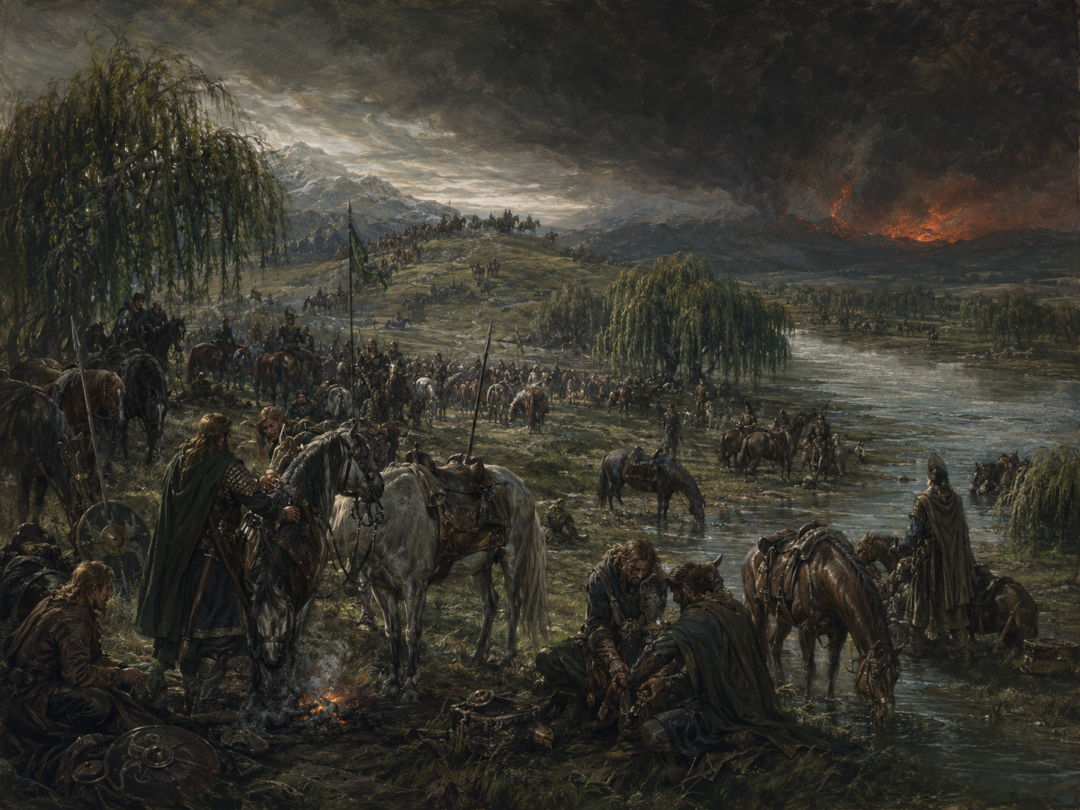
When the Rohirrim form beside the Snowbourn, the narrative describes nearly fifty-five hundred fully armed Riders already assembled, along with “many hundreds” of other men accompanied by spare horses that are lightly burdened. esl-bits.eu
Those spare horses matter.
The text never gives an inventory of their loads, so it would be wrong to claim that Tolkien explicitly describes sacks of oats, horse feed, medical gear, or particular supplies. But clearly the fighting horses were not expected to carry every burden themselves.
A lightly burdened spare horse could distribute equipment that otherwise would have increased the strain on a warhorse. Some may also have provided replacement mounts, though the passage does not specify exactly how the Rohirrim intended to use every animal.
Either way, Théoden’s host was larger than a simple count of six thousand cavalry mounts suggests.
Thousands of warhorses were accompanied by additional horses and support personnel. That increases the amount of grazing required, but it also reveals a sophisticated principle: preserve the combat mounts by shifting unnecessary weight elsewhere.
For the Rohirrim, the horse was not merely transportation. It was the weapon that delivered the Rider into battle.
The Landscape Itself Was Part of the Supply System
The strongest explanation for how such a force could move without an enormous fodder train is the country through which it travelled.
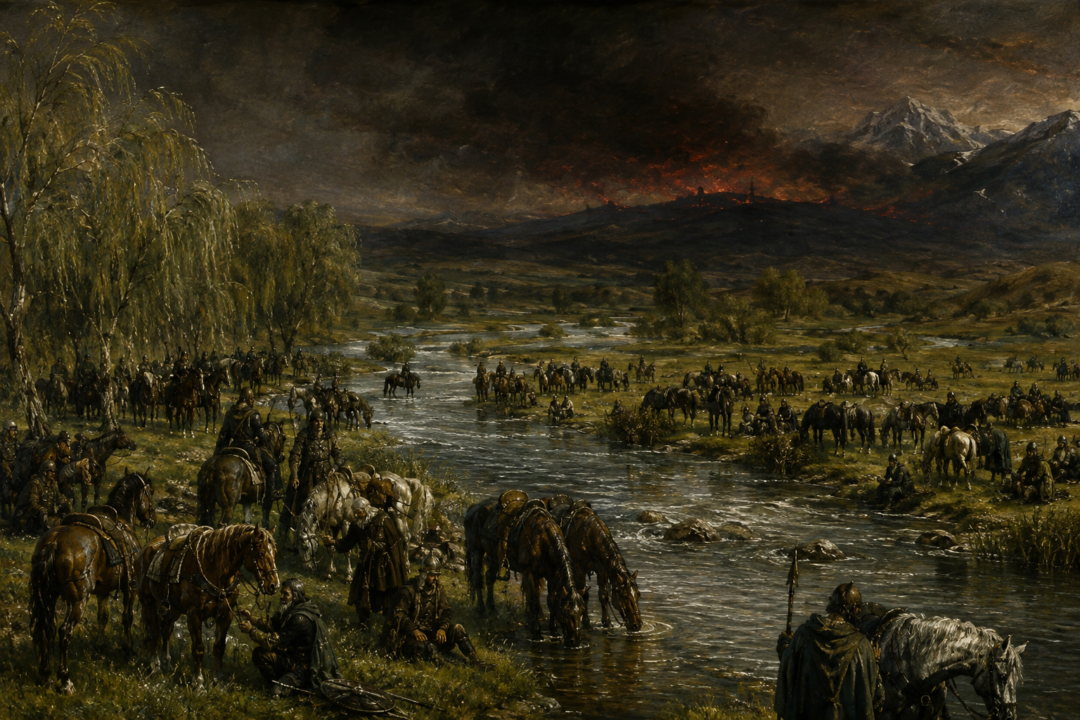
Rohan was famously grassland. Its plains and pastures were precisely the environment in which a horse-breeding people had flourished. On the first night after leaving Edoras, the host camps twelve leagues east where the Snowbourn meets the Entwash, among willow-thickets. It then continues through the Folde and Fenmarch before crossing into Anórien. esl-bits.eu
Watercourses and grazing country repeatedly lie close to the route.
This does not mean the book explicitly tells us, “the Rohirrim stopped here to graze six thousand horses.” It does not. But grazing is the most conservative inference from the environment Tolkien describes, especially because transporting all necessary roughage for thousands of large animals would itself require a tremendous burden of additional animals or wagons.
Even near the end of the ride, Elfhelm notices something revealing. As the Rohirrim prepare for the final seven leagues toward the Rammas Echor, he specifically observes that there is “much grass” beside most of the road. esl-bits.eu
In context, Elfhelm is discussing where the army can make speed quietly, not delivering a lesson in horse nutrition. Yet the detail reinforces the physical character of the route: the Rohirrim were not crossing barren desert.
For much of their journey they rode through or beside usable pasture.
A Forced March Did Not Mean Galloping for Five Days
The famous arrival on the Pelennor can create a misleading picture of the entire journey.
Théoden’s final charge is explosive. The approach to Gondor was not.
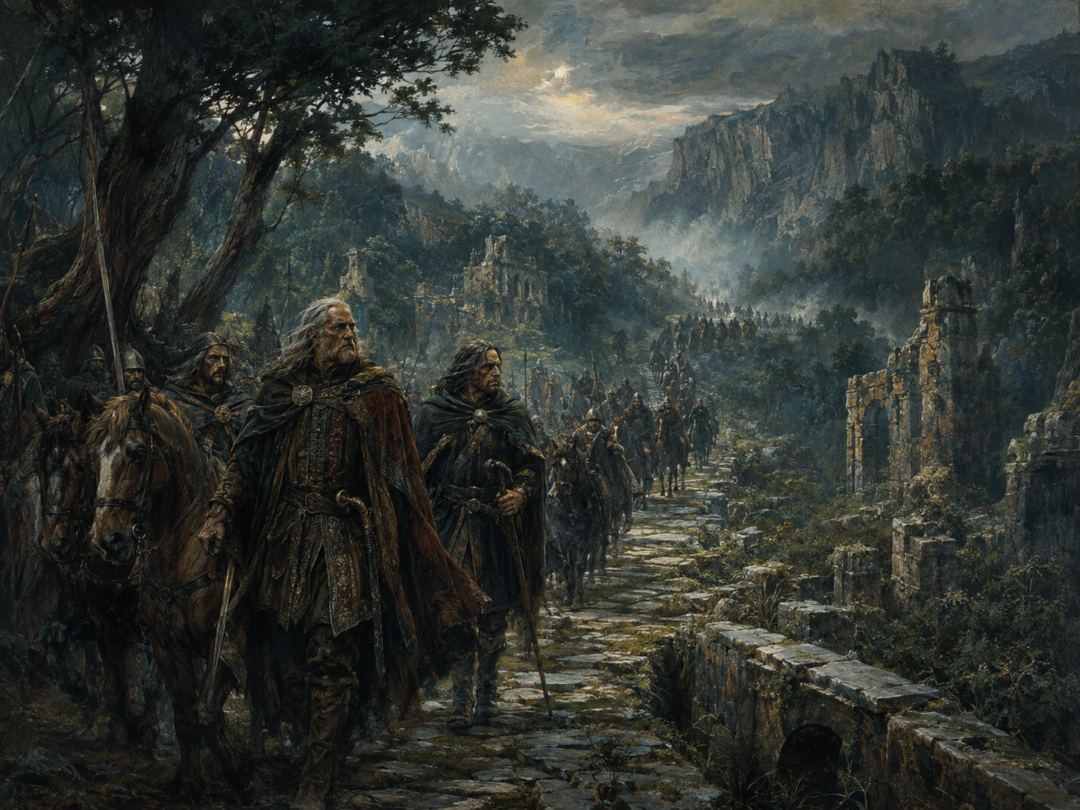
The poetic account says that the Eorlingas rode east for five nights and days, but the narrative repeatedly shows halts, camps, councils, scouting, and periods when the army moved slowly.
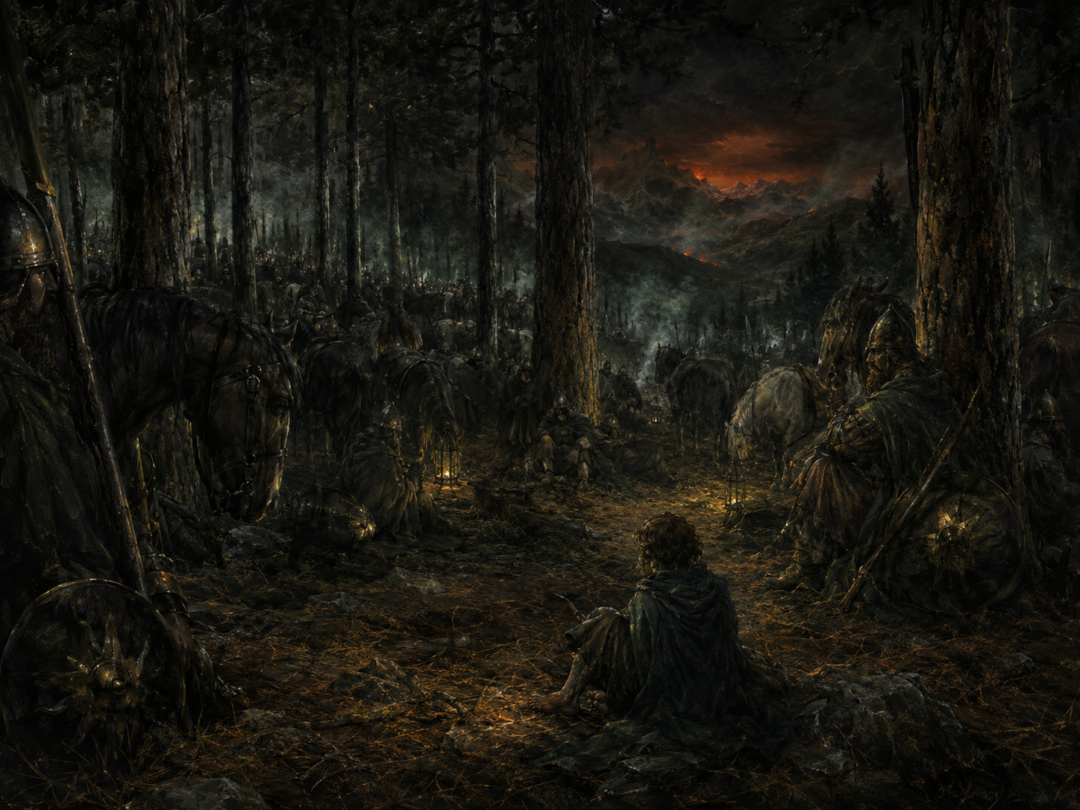
By the time the Rohirrim bivouac around Eilenach in the Drúadan Forest, Merry has ridden for four days and is deeply exhausted. Yet the army has stopped for the night. Horses can be heard shifting and stamping among the trees. esl-bits.eu
The next stage becomes slower still.
Ghân-buri-Ghân leads the Rohirrim away from the occupied highway and onto the forgotten road through the Stonewain Valley. The Riders initially have to walk and lead their horses through wooded ridges. The passage of the whole army takes hours.
That delay may look disastrous in a rescue mission, but it also prevents the horses from being forced endlessly at speed.
When they finally reach the Grey Wood, the leading companies halt while the rest of the enormous column catches up. Only after the army has assembled does Éomer advise another deliberate rest before the final nighttime approach.
His reason could hardly be clearer: they must expect battle and will need all their strength.
Rohan’s commanders were actively conserving their cavalry right up to the moment they intended to use it.
Grass Alone Does Not Solve Everything
It would be too simple to say that the Rohirrim merely let their horses graze and therefore had no logistical problem.
Thousands of horses require enormous amounts of food and water. A large cavalry formation cannot stop anywhere it pleases without stripping an area rapidly, and grazing takes time—exactly what Théoden did not have.
Nor does the text tell us whether the spare horses carried concentrated fodder, whether supplies had been prepared along the established road, or whether individual Riders carried feed for their own mounts.
Those possibilities may be historically reasonable, but they remain possibilities.
The canon gives us something narrower and safer: a horse-breeding people moved through predominantly grassy, watered country; they carried a deliberately light load; they possessed hundreds of additional lightly burdened horses; and their commanders repeatedly scheduled halts rather than treating the journey as one continuous gallop.
That combination is enough to make the march plausible without inventing an unseen network of granaries.
The Rohirrim Were Riding Through Friendly Country
Another advantage is geographical and political.
Until Rohan crossed its own eastern boundary, the army was travelling through the Mark itself. Beyond it lay Anórien, a province of Gondor and therefore allied territory.
This matters because Théoden was not conducting a deep invasion through hostile country. He was moving along the traditional connection between two allied kingdoms.
Elfhelm had personally ridden to Mundburg in peaceful times. Gondorian messengers travelled the same general route and even used fresh horses from established posts. The road was familiar enough that experienced Riders knew its final approaches.
None of this proves that a pre-arranged fodder depot awaited Théoden’s army at every halt. Tolkien never says so.
But it does mean the Rohirrim were not improvising a route through unknown wilderness. They were riding through lands historically connected by communication, trade, diplomacy, and military alliance.
The emergency lay in the speed of the journey and the Enemy occupying the road—not in discovering how to cross the country at all.
The Last Rest Explains the Whole Strategy
The most revealing logistical decision occurs almost within sight of Minas Tirith.
After Ghân-buri-Ghân has brought the Rohirrim safely around the enemy blocking the main road, Théoden could have demanded an immediate rush toward the City.
He does not.
Éomer advises rest.
They have ridden for days. The battle will be severe. The horses and men must recover what strength they can before the last movement onto the Pelennor.
Théoden agrees.
Only later, under darkness, does the host move again. Then comes the broken Rammas, the horns, Théoden’s cry, and the transformation of carefully conserved strength into overwhelming speed.
That is why the charge works.
The horses beneath the Rohirrim are tired, certainly. Nothing in the text suggests an effortless journey. But they have not been squandered on the road.
Rohan’s Real Logistics Were Restraint
So how did Rohan feed thousands of horses during the forced march to Minas Tirith?
The most lore-grounded answer is that we are never given a detailed fodder system.
What we are shown is a cavalry culture exploiting exactly the advantages its homeland and route provided.
The Rohirrim travelled through grass-rich country with access to rivers and streams. They rode with many hundreds of additional lightly burdened horses. They stripped their baggage down because Gondor had supplies waiting. They camped rather than galloping continuously. They slowed when terrain demanded it. And before the decisive attack, they deliberately rested.
The brilliance of the Ride of the Rohirrim is therefore not that Théoden somehow ignored the limits of horses.
It is that he never forgot them.
The march had only one purpose: to deliver thousands of Riders to the Pelennor at the precise moment when horse and horseman could still do what Rohan had come to do.
And when the horns finally sounded beneath Mindolluin, all that conserved strength was spent at once.
Sources & Notes
- https://www.glyphweb.com/arda/r/rohan.html
- https://www.glyphweb.com/arda/r/redarrow.html
- https://www.glyphweb.com/arda/s/snowbourn.html
- https://www.glyphweb.com/arda/e/entwash.html
- https://www.glyphweb.com/arda/d/druadanforest.html
Sources on Rohan’s grasslands and horse culture, the Red Arrow mobilization, and the Snowbourn–Entwash–Drúadan Forest route used during the forced march.