
When readers think of evil in The Lord of the Rings, the mind often goes first to spectacle: vast armies marching beneath black banners, cities burning, towers collapsing, and open war shaking the foundations of Middle-earth. These moments are unforgettable, but they are not where Tolkien places his darkest ideas.
For Tolkien, the most terrifying form of evil is not destruction—it is domination.
This truth becomes clearest when examining how Sauron treats those who fall into his grasp. Sauron does not simply kill his enemies or crush them in battle. Instead, he seeks to break their will, reshape their identity, and turn suffering into a tool of control. What he creates are not merely victims, but instruments—living extensions of his own malice.
In Tolkien’s world, torture is rarely loud or graphic. It is quiet, enduring, and devastating.
Torture in Tolkien Is About the Mind
Unlike much modern fantasy, Tolkien does not dwell on explicit physical pain. When violence appears, it is often brief and understated. Yet the psychological and spiritual consequences linger for generations.
Tolkien understood that the deepest suffering comes not from wounds, but from the erosion of the self. To be dominated—to lose agency, hope, and identity—is worse than death.
The clearest example of this philosophy is Gollum.
Gollum and the Breaking of the Will
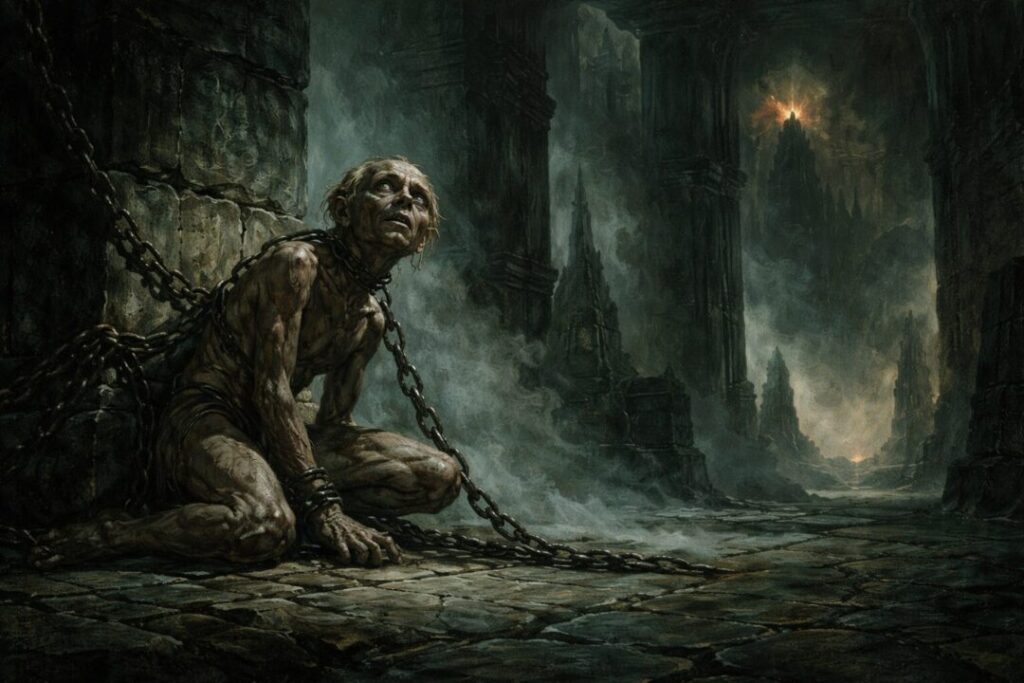
In The Fellowship of the Ring, Gandalf recounts Gollum’s fate after he was captured in Mordor. Gandalf tells Frodo plainly that Gollum was “tortured.” Tolkien does not describe how. There are no lingering details, no catalog of pain.
That omission is deliberate.
The horror is not in what was done to Gollum’s body, but in what was done to his mind.
Sauron learned everything Gollum knew: the Ring, the Shire, the name “Baggins.” The interrogation achieved its goal. But then Sauron did something far more sinister than execution.
He let Gollum go.
Release as a Weapon
Sauron did not release Gollum out of mercy or indifference. He released him because Gollum was already broken.
By the time Gollum left Mordor, his identity was fragmented. His speech was divided. His desires were no longer his own. The Ring’s hold on him was absolute, and the trauma inflicted in Barad-dûr ensured that he would never truly be free.
This is torture extended beyond the dungeon.
Sauron understood that Gollum would become a living beacon for the Ring. He would spread fear, suspicion, and corruption wherever he went. Gollum would be hunted, used, manipulated, and ultimately drawn back toward the very object that destroyed him.
In this way, Gollum becomes both victim and vector.
Even when Aragorn later captures Gollum, the damage is unmistakable. Gollum does not behave as a free being. His thoughts are compulsive. His loyalties fracture. His sense of self is unstable.
This is not simply madness—it is the lasting result of domination.
Saruman: A Different Kind of Punishment
If Gollum shows us direct psychological torture, Saruman reveals another, subtler cruelty: spiritual humiliation.
Saruman is not physically tortured by Sauron. Yet his fate is no less devastating.
Once the head of the Istari and a peer of Gandalf, Saruman seeks to rival Sauron by using his methods—control, deception, and domination. But when he fails, Sauron discards him.
This is crucial.
Evil does not forgive failure. It does not nurture loyalty. It consumes usefulness and abandons the rest.
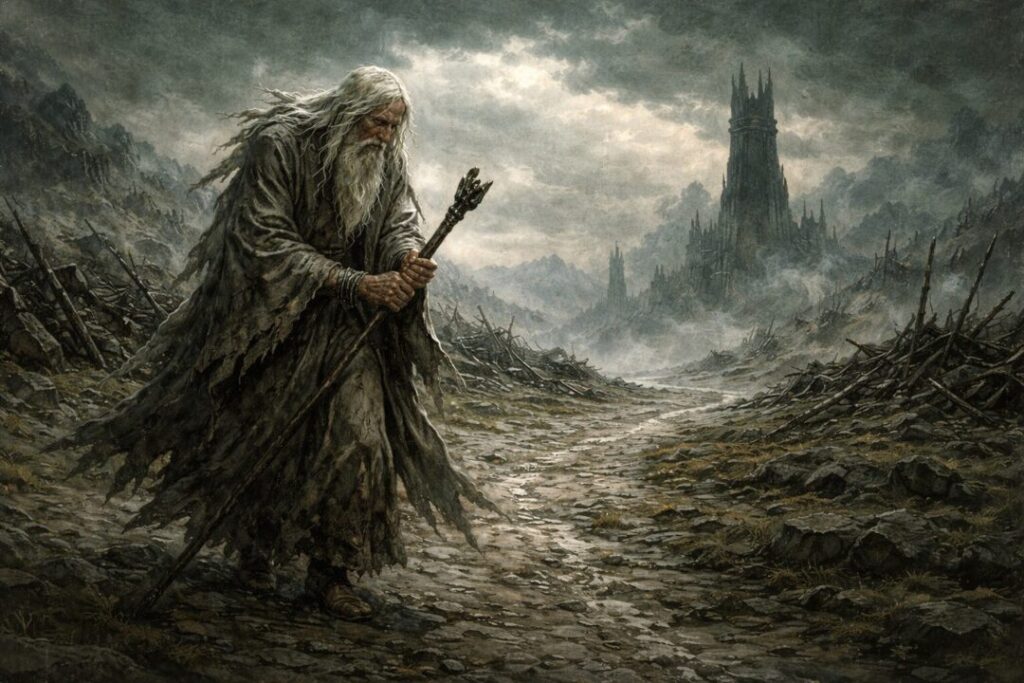
Saruman’s greatest weapon—his voice—is stripped of its power. His authority collapses. His staff is broken. By the end of his story, he wanders Middle-earth as a diminished figure, mocked and ignored, clinging to spite because nothing else remains.
For someone whose identity was built on pride and control, this fate is unbearable.
Saruman’s punishment is not death.
It is irrelevance.
Evil Does Not Reward Its Servants
Through Saruman, Tolkien makes something clear:
Evil offers power, but it never truly shares it.
Evil promises mastery, but always demands submission.
And when a servant can no longer serve, evil empties them out.
This is not unique to Saruman. It is the pattern repeated across Middle-earth.
Morgoth: The Blueprint of Cruelty
To fully understand Sauron, we must look back to his master, Morgoth, the first Dark Lord.
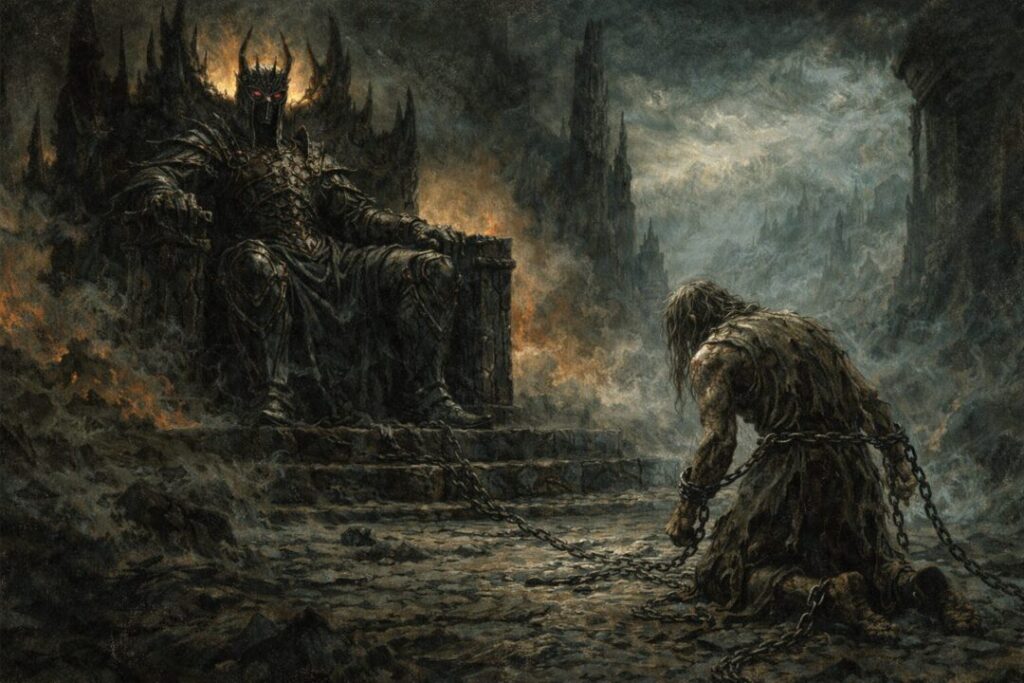
Morgoth’s cruelty shaped the very fabric of Arda. He corrupted what he could not create, twisting Elves into Orcs—a fate Tolkien himself struggled with morally. He chained Húrin to a seat of stone, forcing him to watch the destruction of his family across years, using despair as a weapon sharper than any blade.
Morgoth taught Sauron that domination is more effective than annihilation.
Where Morgoth relied on overwhelming force, Sauron refined cruelty into systems: surveillance, fear, hierarchy, and psychological control. He did not need to be everywhere. Once domination was internalized, his servants enforced it themselves.
The Nazgûl: Eternal Servitude
Nowhere is this clearer than in the Nazgûl.
Once kings of Men, they accepted Rings of Power and were slowly stripped of their will. They did not die. They faded. Their identities dissolved until nothing remained but obedience.
The Nazgûl are not tortured daily. They do not need to be.
They are already broken.
Their existence is endless submission—voiceless, faceless, and bound forever to the will of another.
Why Tolkien’s Evil Feels So Real
Tolkien understood something timeless and unsettling:
The worst suffering is not pain—it is powerlessness.
Sauron does not need to constantly punish his servants. Once broken, they punish themselves.
- Gollum cannot escape the Ring.
- Saruman cannot reclaim his dignity.
- The Nazgûl cannot remember who they were.
This is why Tolkien’s evil feels so disturbingly real. It mirrors real-world tyranny: slow, calculated, and impersonal. It strips meaning, identity, and hope long before it destroys the body.
Mercy as the Antithesis of Domination
Importantly, Tolkien never glorifies this cruelty.
He contrasts it with mercy.
Bilbo Baggins spares Gollum.
Frodo Baggins pities him.
Samwise Gamgee nearly understands him.
Mercy does what domination cannot: it preserves the possibility of choice.
And in the end, it is mercy—not strength—that undoes Sauron.
Final Thought
Tolkien’s darkest truth is not that evil causes suffering.
It is that evil uses suffering to rule.
Sauron does not merely harm his servants. He reshapes them into tools, leaving scars that never fully heal. Even after his fall, those scars remain—etched into memory, identity, and history.
In Middle-earth, domination is the greatest cruelty of all.
And freedom, however fragile, is the greatest victory.