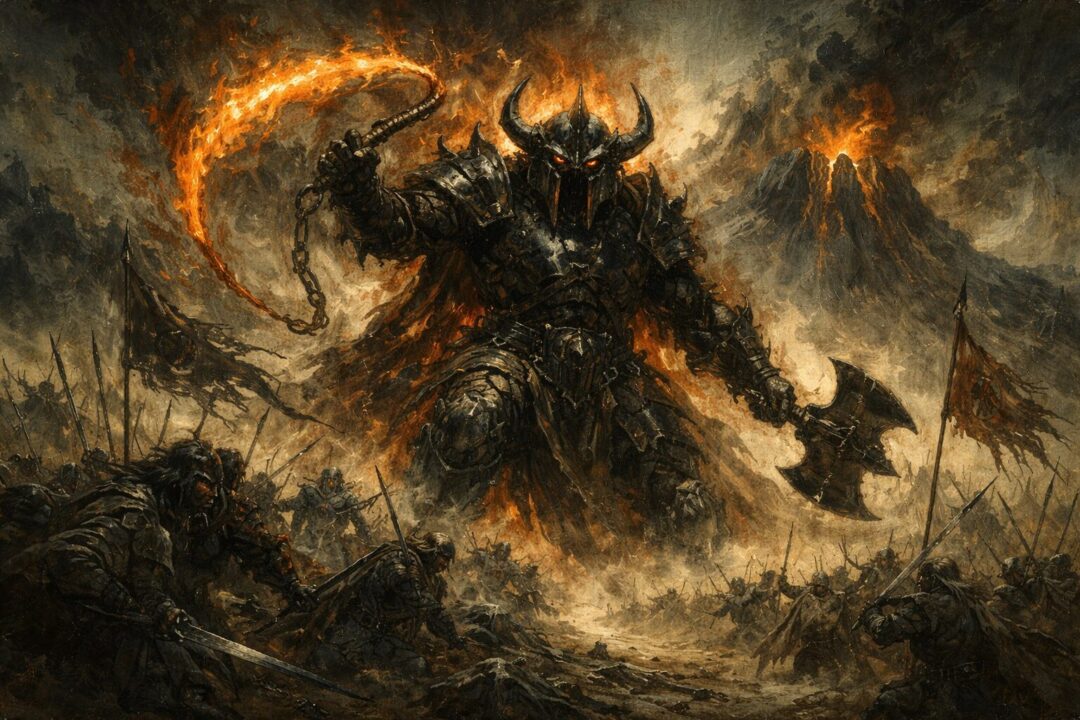
When most readers think of a Balrog, they think of a single overwhelming image.
A being of shadow and flame in the depths of Moria.
A terror so ancient that the whole Fellowship recoils from it.
A creature that Gandalf does not treat as a mere battlefield enemy, but as something catastrophic.
That image feels so complete that it is easy to assume Balrogs were always like this.
They were not.
One of the clearest long-term changes in the legendarium is the change in what Balrogs are, how many there are, and how frightening they are meant to feel. In the earliest material, they belong more visibly to the world of heroic combat and large-scale assault. In the later conception, they become rarer, darker, and much harder to place among ordinary enemies.
That shift matters for more than monster design.
It reveals a deeper change in the tone of Middle-earth itself.
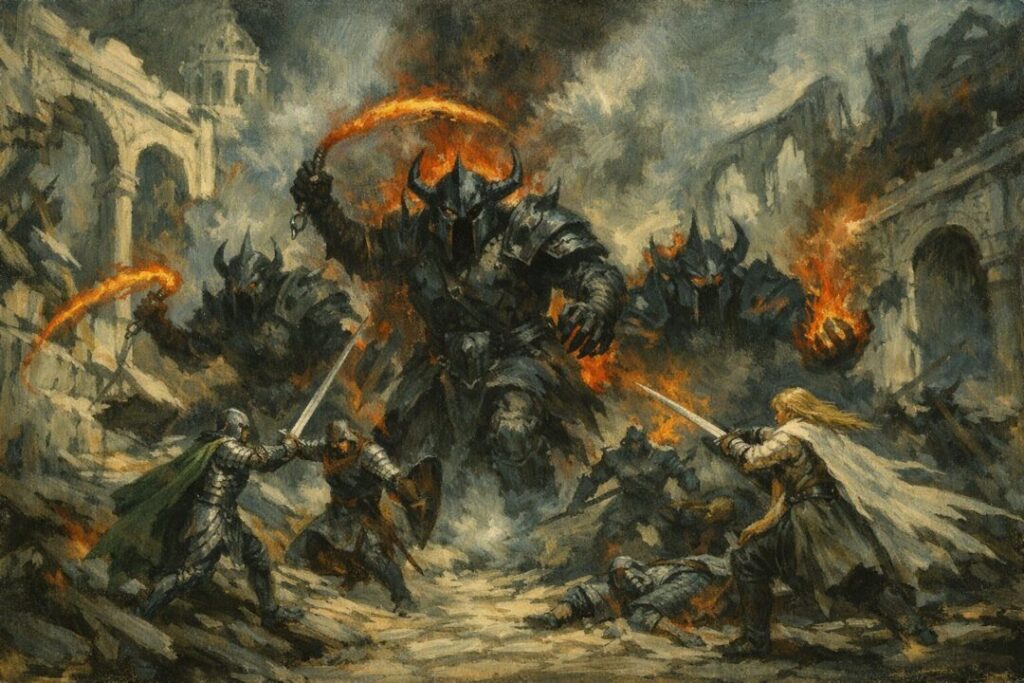
The Early Balrogs Were More Numerous
In the earliest phase of the mythology, Balrogs are not yet the almost singular horrors many readers now imagine.
In The Book of Lost Tales, especially in the early Fall of Gondolin material, Balrogs appear in substantial numbers. They are described as demons with whips of flame and claws of steel, and they are said to be attired in iron armour and helms. Christopher Tolkien also notes that in this early conception they existed in “hundreds,” and that several could be slain in battle during the fall of the city.
That is a very different idea from the later Balrog of Moria.
These early Balrogs are still dangerous. They are still associated with fire and terror. But they are not yet presented as beings whose mere presence changes the metaphysical weight of a scene. They can be fought in numbers. They can be cut down by heroic resistance. They belong to war in a more direct and visible way.
This older version also fits the broader atmosphere of the earliest tales, where the legends can feel sharper, more immediate, and sometimes more openly martial in texture.
The Balrog is dreadful there.
But it is not yet quite solitary.
At One Stage, Their Numbers Became Enormous
The early conception does not merely allow for several Balrogs.
In one version of the Quenta Silmarillion, the number becomes staggering. A passage cited in later commentary gives “Balrogs one thousand.”
That single detail shows how far the idea once stood from the later form.
A thousand Balrogs suggests an army component, a terrifying one, but still part of a host. Even if the number is tied to an earlier stage rather than the mature conception, it shows that Balrogs were once imagined on a very different scale. They were dreadful because there were many of them.
Later, they become dreadful for almost the opposite reason.
They are rare.
And rarity changes everything.
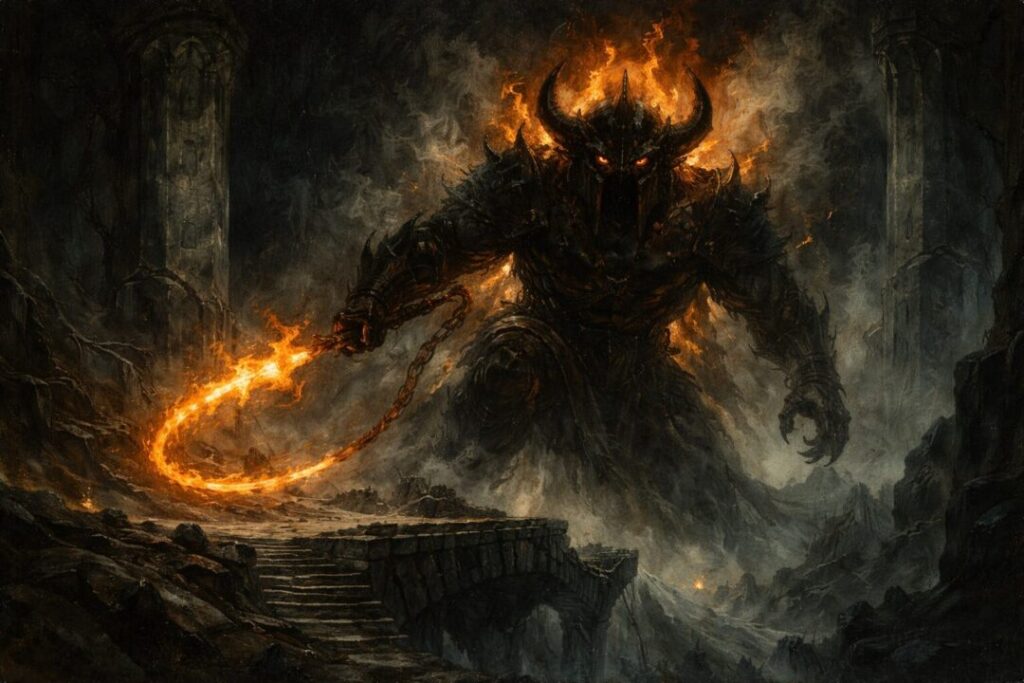
The Later Balrogs Became Greater and More Mysterious
In the later legendarium, the Balrogs are no longer just fiery war-demons in large numbers.
They are identified as corrupted Maiar, spirits of the same general order as Sauron and Gandalf, though fallen into Morgoth’s service. In Valaquenta, they are called the Valaraukar, “scourges of fire,” dreadful spirits among those drawn into Melkor’s darkness. They are described as having hearts of fire, cloaked in darkness, with whips of flame.
That change is enormous.
Once Balrogs are understood as corrupted Maiar, they cease to be simply elite shock troops in the imagination of the world. They become spiritual beings who have assumed terrible form. That does not make them abstract or unreal. Quite the opposite. It makes every appearance heavier.
A later Balrog is not just one more powerful servant.
It is one of Morgoth’s most formidable corrupted spirits.
That helps explain the dramatic difference between early battlefield Balrogs and the effect of Durin’s Bane in The Lord of the Rings. By then, a Balrog no longer feels like part of the background terror of war. It feels like an eruption from an older, darker layer of the world.
Their Number Collapsed From Many to Very Few
The most famous sign of this shift is numerical.
A very late note, preserved in Morgoth’s Ring, says: “There should not be supposed more than say 3 or at most 7 ever existed.” Tolkien Gateway and Encyclopedia of Arda both preserve that note in their summaries of the textual development.
That is not a minor revision.
It completely transforms how Balrogs function in the mythology.
If there are hundreds, or even one thousand, then Balrogs are a terrifying class of demon-warriors.
If there are at most three to seven, then each one becomes a near-unique catastrophe.
That later conception fits far better with the emotional force of the stories readers usually remember most vividly. Fëanor being surrounded by Balrogs and mortally wounded by Gothmog already carries great weight in the later tradition. Ecthelion killing Gothmog, and Glorfindel slaying another Balrog at the cost of his own life, feel appropriate in a world where these are exceptional clashes with exceptional beings.
The fewer they become, the greater they seem.
And the greater they seem, the more the world around them changes shape.
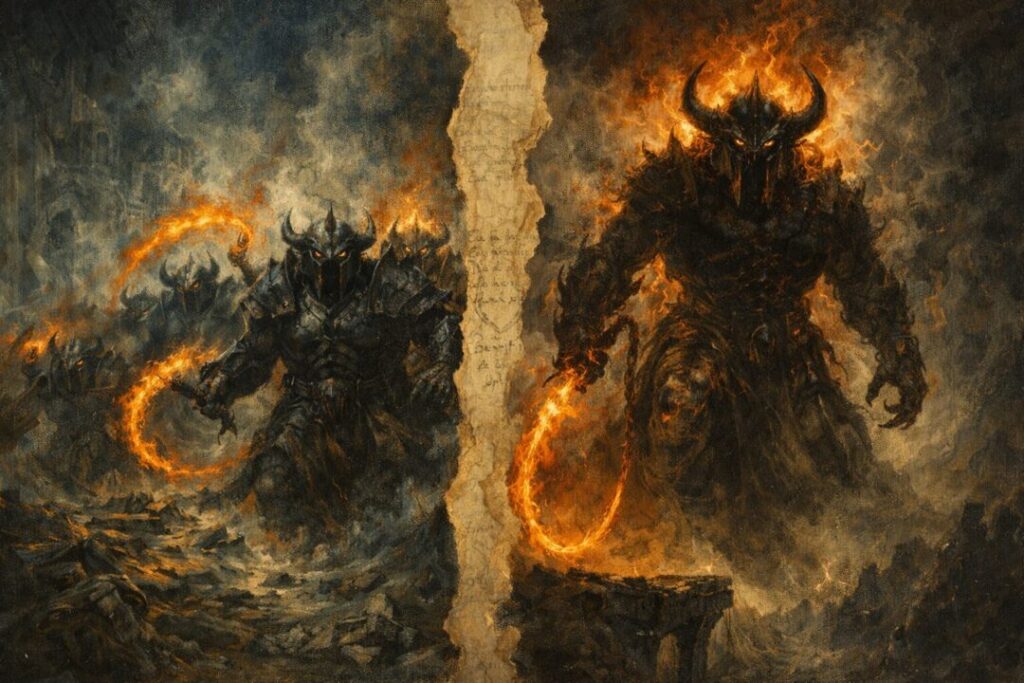
Durin’s Bane Shows the Final Form of the Idea
No single Balrog is more important for the mature conception than Durin’s Bane.
When the Fellowship encounters it, the scene is not written as if a dangerous battlefield monster has appeared. It is written as if something ancient and almost unspeakable has stepped out of buried time. Gandalf calls it a “Balrog of Morgoth.” The phrase lands with force because the story assumes this is not a common thing, nor even a known danger of the present age. It is a surviving horror from the Elder Days.
This is where the later conception fully justifies itself.
A Balrog hidden under Khazad-dûm for ages should not feel like one more surviving captain of evil. It should feel like a remnant of the First Age so terrible that the Third Age has almost forgotten what to call it.
That is exactly how Durin’s Bane works.
The creature is wrapped in darkness and fire. It is not fully defined in the flat, inventory-like way that early combat monsters often are. Even the famous language around its “wings” remains debated, because the text gives an image of shadow expanding like wings without settling the question in a plain descriptive manner. That ambiguity itself belongs to the later mood.
The point is not clean visual taxonomy.
The point is dread.
The Change Reflects a Larger Change in the Legendarium
The Balrogs did not change in isolation.
Their transformation mirrors a broader hardening of the mythology from early adventurous legend into something older, weightier, and more internally ordered. As the world becomes more coherent, some beings grow fewer and more significant. Power narrows. Origins deepen. Threats stop feeling interchangeable.
That is why the later Balrogs feel more mythic.
They are no longer one frightening species among many on a crowded field of marvels. They become relics of primordial rebellion. Their rarity gives them narrative gravity. Their spiritual nature gives them depth. Their appearances become events, not encounters.
In the early material, a hero may cut through Balrogs in the chaos of Gondolin.
In the later imagination, one Balrog can define an entire chapter of history.
That is not just escalation.
It is refinement.
Why This Matters for Reading Middle-earth
This shift helps explain why readers sometimes feel a tension between early Gondolin material and the later mythology.
The tension is real.
It is not necessarily a contradiction to be solved so much as evidence of long development. The Balrogs are one of the clearest places where the legendarium preserves traces of different stages of thought. Early texts show an older conception. Later texts narrow and elevate it. The final image many readers carry is mostly the later one.
That also means caution is needed.
Not every familiar Balrog claim belongs to the same phase of the legendarium. A detail that is true in an early version may not reflect the later conception. A late marginal note may point toward Tolkien’s final thinking without having been fully harmonized into every narrative layer. On this topic especially, conservative phrasing is better than pretending the tradition is perfectly seamless.
But one pattern is unmistakable.
Balrogs move from many to few.
From formidable to exceptional.
From war-demons in a host to almost singular survivals of ancient corruption.
The Real Meaning of the Change
Most people notice the obvious part first.
Early Balrogs are more numerous.
Late Balrogs are fewer.
Early Balrogs can feel more like elite monsters of war.
Late Balrogs feel more like fallen powers.
But the deeper change is tonal.
As Balrogs become fewer, the world becomes older around them.
They begin to carry memory with them.
A later Balrog is not frightening only because it is strong. It is frightening because it has endured. It has come out of Morgoth’s elder darkness and remained in the world like an unfinished sentence from the First Age. Durin’s Bane is terrifying partly because it proves that not all ancient evils are gone. Some were merely buried.
That is why the change matters.
It is not only about what Balrogs look like, or how many there were, or whether an early text lets heroes kill more of them than a later reader expects.
It is about what kind of fear Middle-earth finally chose them to represent.
Not the fear of being overrun.
The fear of something old enough, great enough, and dark enough that even after ages of ruin, one of them is still too much.
Sources & Notes
- J.R.R. Tolkien, The Book of Lost Tales, Part Two, “The Fall of Gondolin” — preserves the early, more martial Balrogs: numerous demons of fire and iron in the assault on Gondolin, with heroes able to slay them in battle.
- J.R.R. Tolkien, The History of Middle-earth, The Shaping of Middle-earth — shows an intermediate textual stage where Balrogs could still be counted on an army scale, including the “Balrogs one thousand” tradition.
- J.R.R. Tolkien, The Silmarillion, “Valaquenta” — identifies the Balrogs, or Valaraukar, as dreadful spirits drawn into Melkor’s service, cloaked in shadow and flame.
- J.R.R. Tolkien, The History of Middle-earth, Morgoth’s Ring, “Myths Transformed” — gives Tolkien’s late narrowing of the conception: no more than about three, or at most seven, Balrogs should be supposed to have existed.
- J.R.R. Tolkien, The Fellowship of the Ring, Book II, Chapter 5, “The Bridge of Khazad-dûm” — presents Durin’s Bane as a surviving Balrog of Morgoth whose shadow, fire, and dread overwhelm the scene rather than functioning as an ordinary battlefield monster.