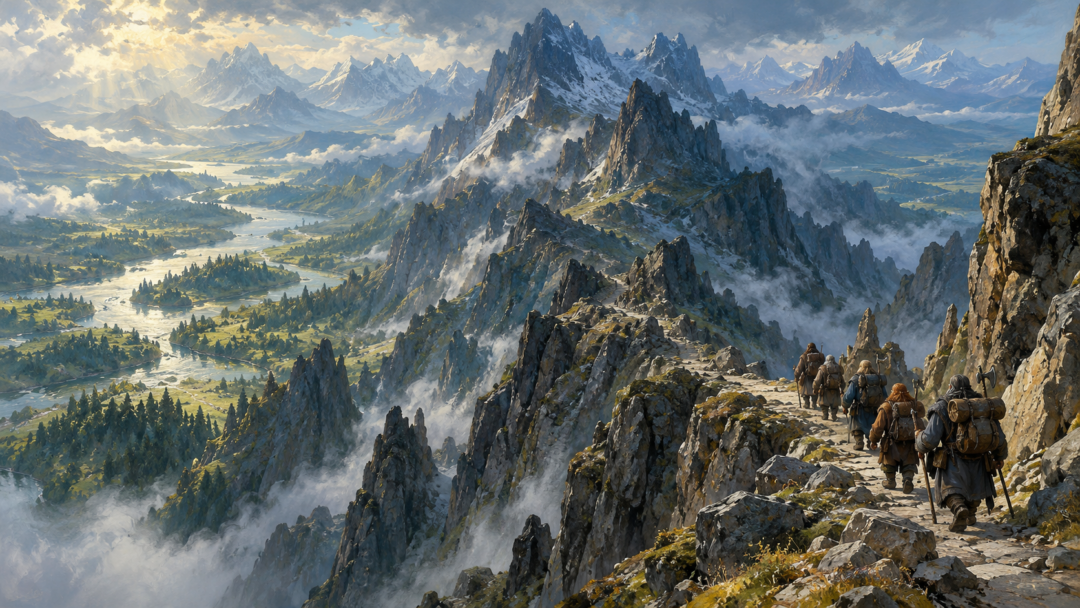
The Blue Mountains stand at the western edge of the familiar map of Middle-earth, beyond the Shire and near the ancient Elven lands of Lindon. To a traveler looking at their long, rugged heights, they might appear to be a natural wall: a barrier separating one region from another.
Yet their history tells a different story.
These mountains were home to two of the greatest Dwarven cities of the First Age. Their inhabitants crossed into neighboring lands, exchanged knowledge with Elves, built roads, and helped shape kingdoms beyond their own borders. Thousands of years later, exiled Dwarves returned to the same mountains and maintained connections with the wider world.
The Ered Luin were certainly a boundary. But they were never simply a place where contact ended.
Their deeper significance lies in a striking geographical contradiction: the mountains separated peoples while also providing the settlements, routes, and relationships through which those peoples could meet.
The First Age: A Mountain Border Between Two Worlds
To understand the Blue Mountains, we must begin with a map very different from the one familiar to readers of The Lord of the Rings.
During the First Age, the Ered Luin formed the eastern boundary of Beleriand, the vast western region where much of the struggle against Morgoth unfolded.
To the east lay Eriador. To the west stretched Beleriand, including Ossiriand, the Land of Seven Rivers, where the Green-elves dwelt.
The mountains marked a major geographical division between these regions.
But a geographical boundary is not necessarily an impassable barrier.
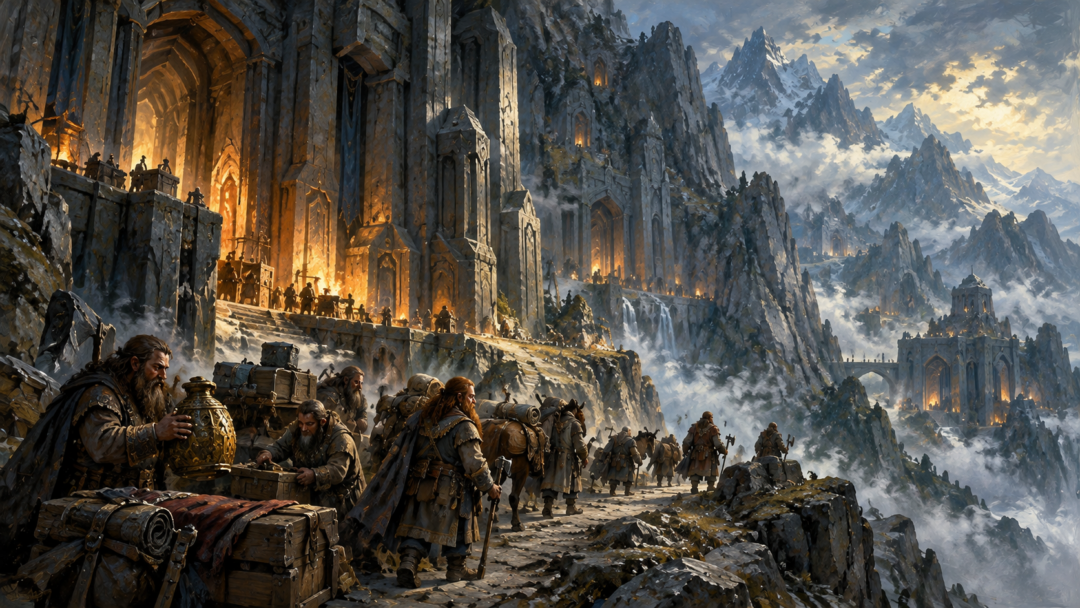
The Blue Mountains contained Dwarven settlements that maintained relationships with peoples living beyond the range. Movement across the mountains was sufficiently established for goods, craftsmen, and eventually armies to travel between their eastern homes and the lands of Beleriand.
This distinction matters because it changes how we understand the western edge of ancient Middle-earth.
The mountains were not merely an obstacle between two separate histories. They were one of the places where those histories became intertwined.
Nogrod and Belegost: Cities Built Along the Boundary
The strongest evidence comes from the two great Dwarven cities of Nogrod and Belegost.
Known in Khuzdul as Tumunzahar and Gabilgathol, these ancient strongholds were established in the Blue Mountains, associated with the region of Mount Dolmed.
They were not remote settlements whose inhabitants remained unknown to the outside world.
The Dwarves of these cities became important participants in the history of Beleriand.
In The Silmarillion, the Sindar encounter the Dwarves who had come westward over the mountains. Their arrival introduces the Elves of Beleriand to another people possessing remarkable skills in stonework, metalwork, and construction.
The Dwarves brought capabilities that could transform the material world of their neighbors.
Their mountain homes therefore served two purposes.
They offered secure places for Dwarven communities to develop their own crafts and traditions. At the same time, they provided bases from which those communities could establish relationships beyond the mountains.
The geographical border did not erase cultural differences. It made those differences especially significant whenever people crossed it.
The Dwarf-road: Evidence That the Mountains Were Crossed
One of the clearest signs that the Blue Mountains functioned as a zone of contact is the ancient Dwarf-road.
The road connected the Dwarven world of the mountains with eastern Beleriand, following the region of the River Ascar and crossing it at Sarn Athrad.
Its existence demonstrates that movement between the mountains and Beleriand was more than an occasional possibility.
A road represents repeated use, practical knowledge of terrain, and a connection important enough to maintain.
That does not mean every part of the Blue Mountains was easily traversed. The texts do not provide a complete network of named passes, crossing stations, or traffic patterns.
But the Dwarf-road establishes the essential point: the mountain boundary had functioning connections.
For the Dwarves, these routes allowed their work and influence to extend beyond their underground cities.
For the peoples of Beleriand, they provided access to craftsmen whose skills were highly valued.
The mountains remained difficult terrain, yet their difficulty did not prevent sustained interaction.
Indeed, the presence of powerful settlements near a mountain boundary could make particular routes more important, concentrating contact rather than eliminating it.
The Elves and Dwarves: Cooperation Across a Natural Divide
The relationship between the Dwarves of the Blue Mountains and the Elves of Beleriand offers an even stronger example.
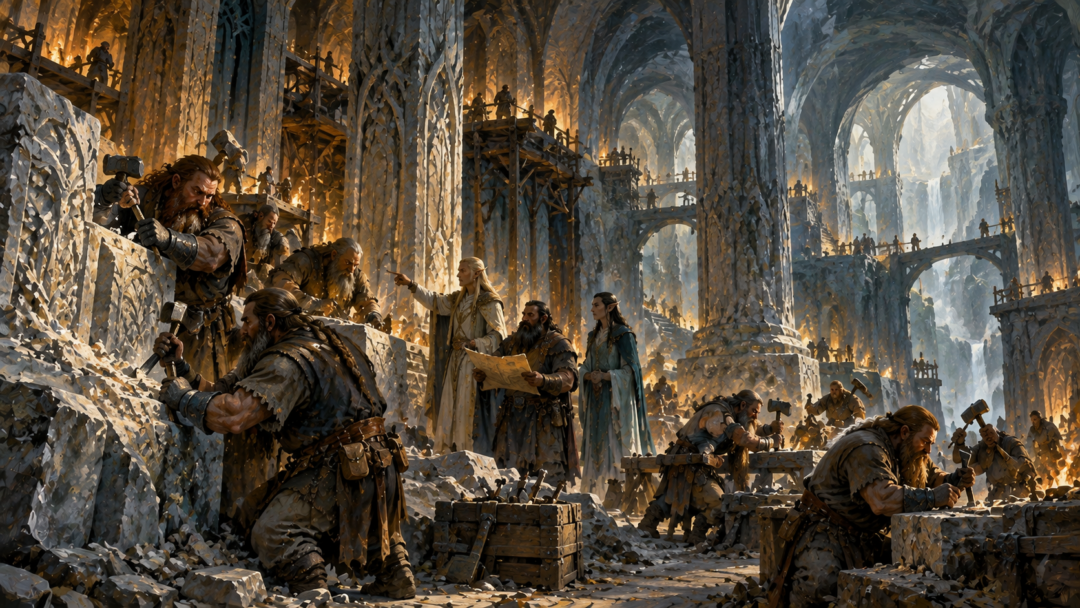
King Thingol of Doriath employed Dwarven craftsmen in the making of Menegroth, his great underground dwelling.
The Thousand Caves became one of the most celebrated works of construction in Beleriand, combining Dwarven skill with the purposes and wealth of an Elven kingdom.
The Dwarves of Belegost were especially renowned for their craftsmanship, including their work in metal and their development of mail armor.
Such achievements reveal that the mountains did not separate two completely independent societies.
Instead, knowledge and specialized labor could move between them.
This was not necessarily a relationship of equality or permanent friendship. Elves and Dwarves remained distinct peoples, with different customs, memories, and interests.
Yet they could cooperate on undertakings neither community would have produced in precisely the same way alone.
The border created distance, but that distance did not prevent mutual influence.
One of the defining features of the Blue Mountains was therefore not isolation, but selective connection.
When Contact Brought Conflict Instead of Friendship
The same connections that made cooperation possible also allowed disputes to cross the mountains.
The tragic story of the Nauglamír provides the clearest example.
The necklace had originally been made by the Dwarves for Finrod Felagund. Later, Thingol sought to have the Silmaril recovered by Beren and Lúthien set within it.
The work led to a bitter confrontation between Thingol and the Dwarven craftsmen of Nogrod.
Thingol was slain, and the conflict escalated into violence between the Dwarves of Nogrod and the Elves of Doriath.
A Dwarven force subsequently marched into Beleriand and attacked Menegroth.
The significance for the Blue Mountains is profound.
The same geographical connections that had enabled craftsmanship, exchange, and cooperation also allowed grievances and armed conflict to spread.
A mountain border does not guarantee peace by keeping communities apart.
Nor does contact guarantee friendship.
The history of Nogrod shows that connected societies can become deeply entangled in one another’s tragedies.
The boundary remained physically real, but it could not contain the consequences of relationships formed across it.
The War of Wrath Changed the Geography Itself
At the end of the First Age, the War of Wrath brought destruction on an almost unimaginable scale.
Much of Beleriand was broken and swallowed by the sea.
The Blue Mountains themselves were altered, and the ancient cities of Nogrod and Belegost were ruined.
This is the crucial distinction between the First Age mountains and the Ered Luin encountered in later history.
The mountain range did not disappear, but its relationship to the surrounding world changed dramatically.
Where the mountains had once marked the eastern boundary of Beleriand, they now stood near the western edge of the surviving lands of Middle-earth.
The Gulf of Lune divided the range into northern and southern portions. West of the mountains lay the surviving land of Lindon, while Eriador extended eastward.
The old Dwarven centers no longer occupied their former position in a flourishing network reaching into Beleriand.
Yet the destruction of those centers did not end the history of Dwarves in the region.
Instead, it began another chapter of movement.
The Second Age: Migration Rather Than Complete Isolation
After the ruin of their ancient cities, many Dwarves of the Blue Mountains moved eastward to Khazad-dûm.
The great Dwarven realm beneath the Misty Mountains received people from the ruined western settlements, strengthening its population and traditions.
This movement is especially important because it reverses the direction of the earlier story.
During the First Age, the Dwarves of the Blue Mountains had extended their influence westward into Beleriand.
After Beleriand’s destruction, many moved eastward into the surviving interior of Middle-earth.
The mountains had been a place from which contact spread. Now they were also a place from which displaced communities departed.
Not all Dwarves vanished from Ered Luin, however. The historical material preserves the presence of Dwarves on the eastern side of the range in later ages.
The evidence does not support reconstructing a detailed network of Second Age settlements or trade routes there.
What it does establish is that the mountains were not simply abandoned and forgotten.
Their Dwarven history continued, even after the destruction of the cities that had once made them famous.
The Third Age: Thorin’s People Return to the Blue Mountains
Long afterward, the Blue Mountains became a refuge for another displaced Dwarven people.
After Smaug seized Erebor in the Third Age, members of Durin’s Folk endured years of wandering and hardship.
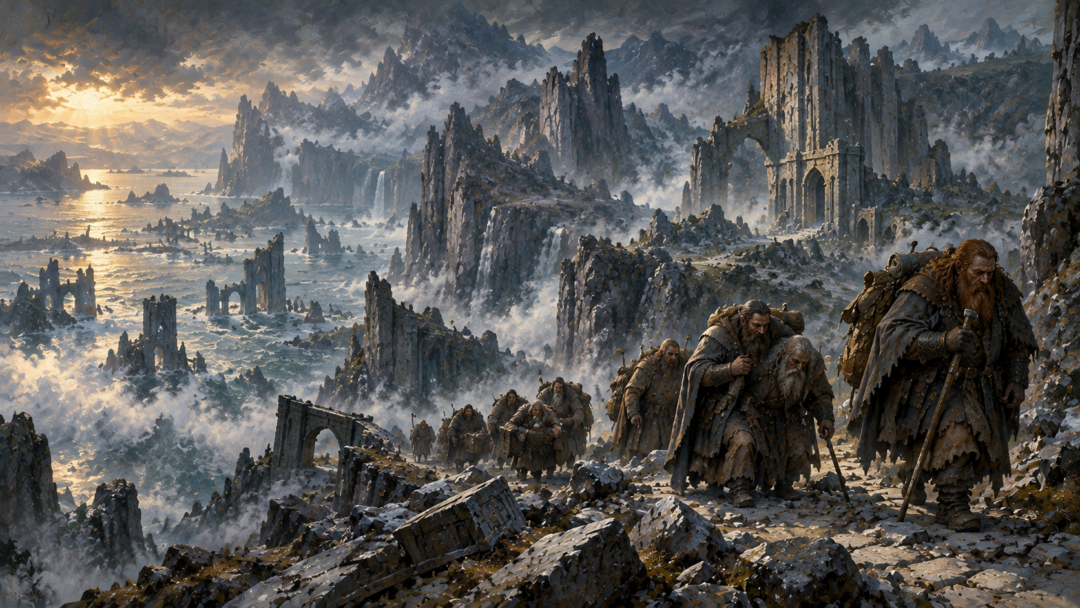
Following the War of the Dwarves and Orcs, Thráin II led his people westward. In the year 2802 of the Third Age, they established themselves in the Blue Mountains.
Thorin Oakenshield later became their leader.
These were not the restored cities of Nogrod and Belegost. They were later settlements associated with Durin’s Folk, whose ancestral kingdom lay far to the east.
Their return reveals another role played by the mountains.
Ered Luin could provide shelter for a people who had lost their homeland without severing their connections to the wider world.
Under Thorin, the Dwarves worked, built, and gradually improved their circumstances. Their wealth was modest compared with the former splendor of Erebor, but their community endured.
The mountains offered a place to survive while the memory of their eastern kingdom remained alive.
From the Blue Mountains to Bag End
The connection between the Blue Mountains and the Shire becomes particularly meaningful in The Hobbit.
Thorin and his companions arrive at Bilbo Baggins’s home as members of a people whose recent history has been shaped by exile and settlement in the western mountains.
Their journey toward Erebor begins far from the kingdom they hope to reclaim.
The Shire lies between the Blue Mountains and the eastern lands through which their quest will pass.
This is a quieter form of geographical connection than the great works of the First Age, but it is no less important.
The Blue Mountains are not an inaccessible realm outside the movements of ordinary Middle-earth.
Dwarves travel from the west into the inhabited regions of Eriador. Roads, settlements, and encounters link their mountain communities to the wider landscape.
The opening of The Hobbit itself depends upon such movement.
A Dwarven company from the western world can reach an unsuspecting Hobbit’s doorstep, and from that meeting a journey across Middle-earth begins.
The mountains shelter the travelers’ community, but they do not confine its ambitions.
The Border That Survived the Loss of Kingdoms
Across the ages, the Blue Mountains repeatedly changed their historical role.
In the First Age, they stood between Beleriand and Eriador, containing great Dwarven cities whose craftsmen worked with the Elves.
After the War of Wrath, their geography was transformed and their ancient centers ruined.
In the Second Age, many of their Dwarves migrated eastward to Khazad-dûm.
In the Third Age, the range received exiles from Durin’s Folk, whose descendants and companions continued to move through Eriador.
These are different communities, different political circumstances, and different landscapes.
It would be misleading to imagine one continuous, unchanged system of mountain crossings surviving from the earliest Dwarven cities to Thorin’s time.
But the recurring pattern is unmistakable.
The Blue Mountains could divide territories without preventing people from moving between them.
Their settlements were sometimes places of exchange, sometimes sources of conflict, and sometimes refuges for displaced peoples.
The mountains influenced where communities lived and how they encountered their neighbors, but they did not determine that those communities must remain separate.
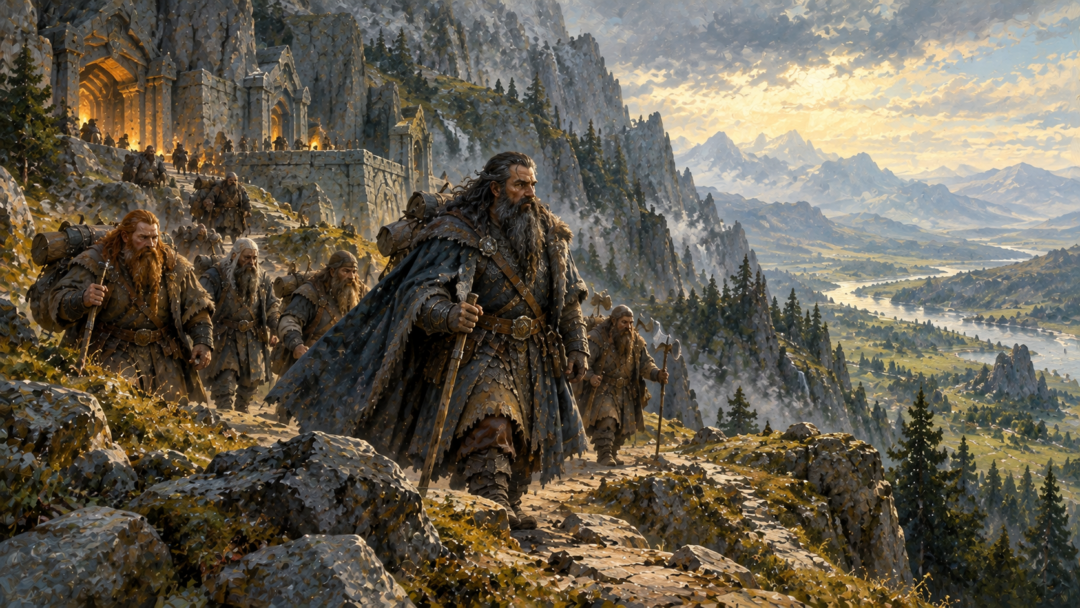
Why the Blue Mountains Matter More Than Their Map Position Suggests
The Ered Luin are easy to overlook because so much of Middle-earth’s most familiar history unfolds elsewhere.
Yet they reveal something fundamental about the geography of this world.
A mountain range is not simply a line separating one land from another.
It can shelter a civilization, shape the routes by which people travel, preserve communities after catastrophe, and become the starting point for journeys that change distant kingdoms.
The Dwarves of Nogrod and Belegost crossed the ancient boundary to work with the Elves of Beleriand. Their descendants and neighboring peoples later experienced the destruction and migrations that followed the First Age.
Thousands of years afterward, Thorin’s people made the mountains a home while still looking eastward toward Erebor.
The Blue Mountains were never merely an isolating wall.
They were a border whose importance came as much from the connections crossing it as from the lands it separated.
And that is their overlooked place in the history of Middle-earth: not at the end of the world, but at one of the points where different worlds repeatedly met.
Sources & Notes
- Tolkien Gateway — Blue Mountains. https://tolkiengateway.net/wiki/Blue_Mountains
- Tolkien Gateway — Dwarf-road of Beleriand. https://tolkiengateway.net/wiki/Dwarf-road_of_Beleriand
- Tolkien Gateway — Belegost. https://tolkiengateway.net/wiki/Belegost
Primary text: The Silmarillion, “Of the Sindar” and “Of Beleriand and Its Realms”; The Lord of the Rings, Appendix A, “Durin’s Folk.” The sources document settlements, crossings, and contact. “Active interfaces” is a geographical interpretation, not Tolkien’s terminology.