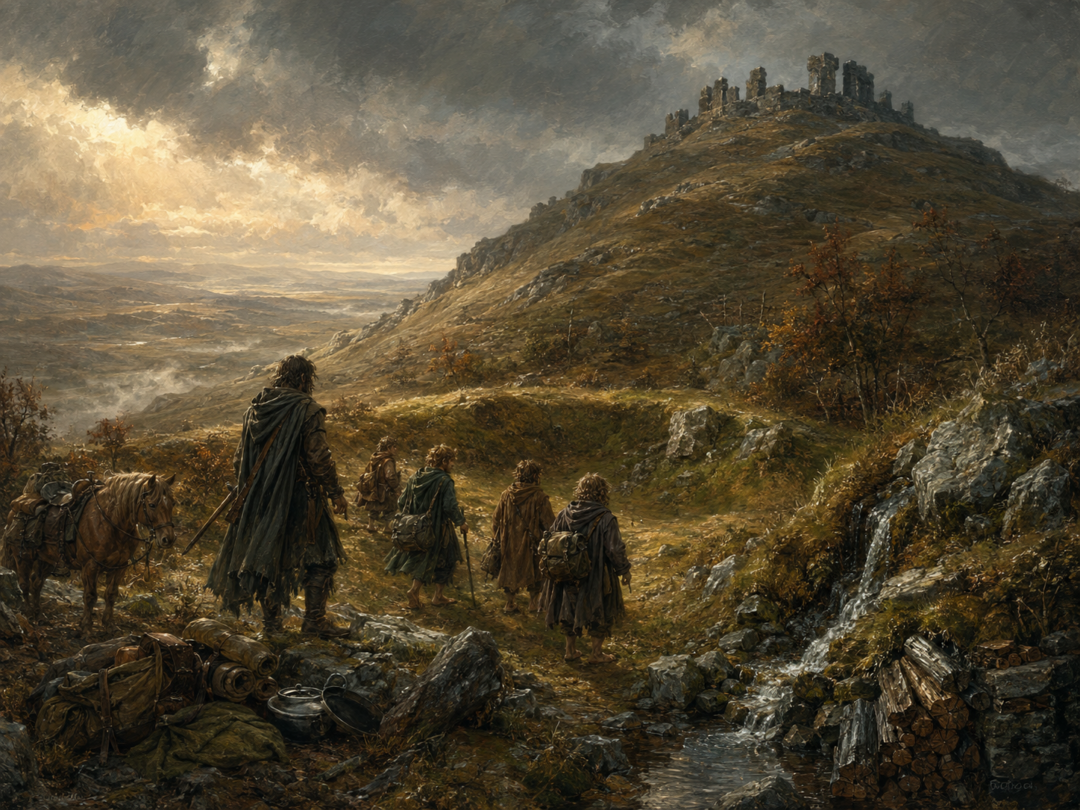
The most dangerous place at Weathertop is not the ruined summit where the ancient watchtower of Amon Sûl once stood. It is the small grassy hollow beneath it.
When Aragorn leads Frodo, Sam, Merry, and Pippin toward Weathertop, the problem is brutally simple: they need information, but information requires exposure. The hill commands the surrounding country. Reaching it might reveal whether Gandalf has passed that way, yet the same height that allows a traveller to see also allows a traveller to be seen.
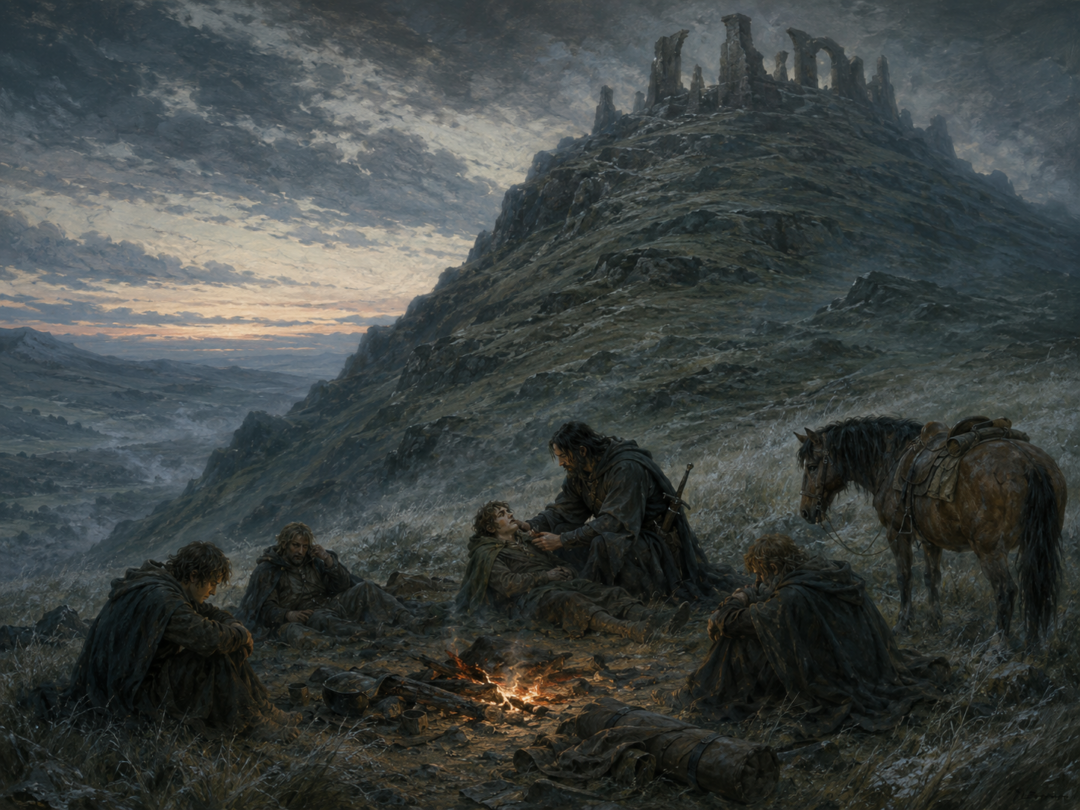
So the company does something sensible. On the western flank of the hill they find a sheltered hollow containing a bowl-shaped dell with grassy sides. Sam and Pippin initially remain there while Aragorn, Frodo, and Merry climb higher. Later the whole company gathers in its lowest, most protected corner.
It looks like exactly the refuge they need.
By nightfall, it has become the place where the Nazgûl can stand above them.
That reversal is what makes the dell beneath Weathertop so effective. Nothing supernatural has to transform it. The geography remains unchanged. What changes is the meaning of shelter once the enemy knows where you are.
Weathertop Is Dangerous Before Anyone Reaches It
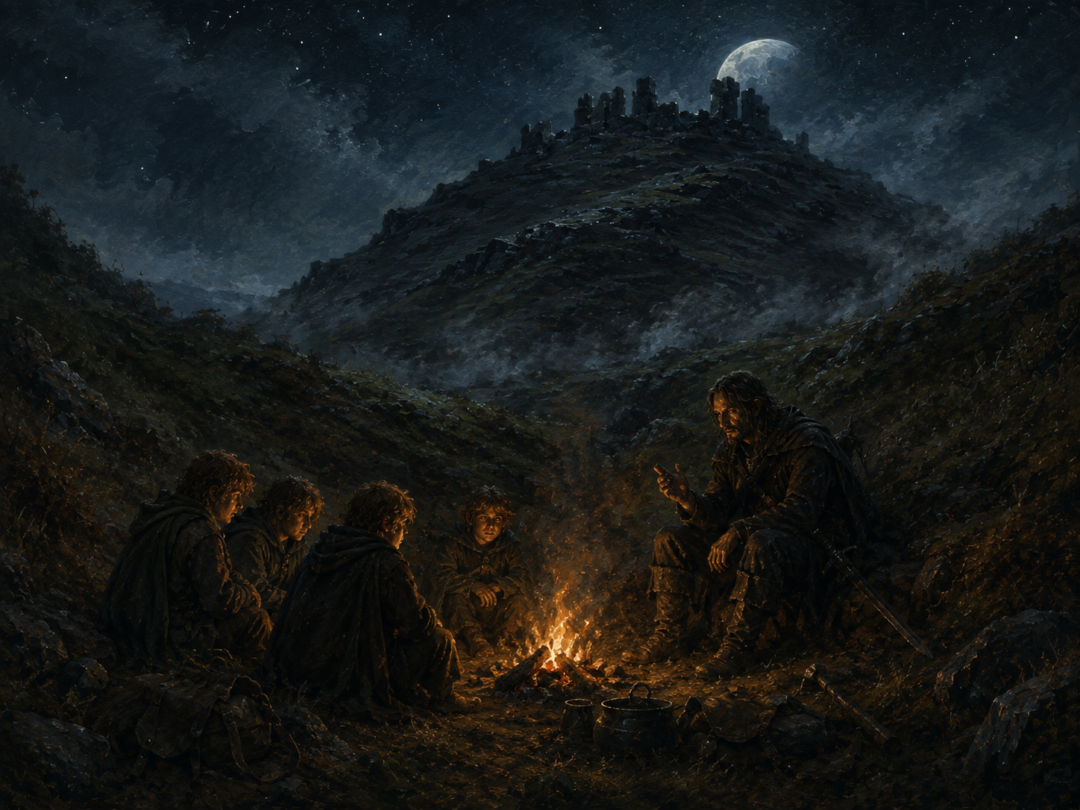
Aragorn understands the risk of Amon Sûl well before the attack. His original plan is not simply to march openly along the Road toward the hill. He leads the hobbits eastward through rougher country and toward the Weather Hills by a less exposed approach.
There is good reason for caution. Weathertop stands near the East Road and commands an enormous view. Aragorn knows that if the Black Riders fail to catch their quarry elsewhere, the hill is an obvious place for them to investigate.
Yet avoiding it entirely carries costs of its own. The travellers are already being hunted, their supplies are limited, and Gandalf may have left some sign there. The hill is simultaneously a danger and one of the few places from which they might learn something useful.
When they finally approach, concealment is effectively over. From the summit they can see the Road stretched beneath them and the Misty Mountains far to the east. But the summit itself is barren and exposed, with neither water nor shelter. The ruins of Amon Sûl offer memory and visibility, not safety. ESL Bits
That distinction matters. The company does not choose the dell because it is an impregnable defensive position. They choose it because it is less exposed than the crown of the hill.
The Dell Solves Several Immediate Problems
The little hollow on Weathertop's western flank is useful in almost every ordinary sense.
Its grassy sides break the open line of the landscape. Nearby, Sam and Pippin find a spring of clear water. They also discover signs that someone has recently camped there: footprints, traces of a fire, and, behind fallen rocks, a neatly stacked supply of firewood. ESL Bits
Those details make the place feel almost providential.
The travellers need water. They need somewhere to rest. Evening is approaching, and October cold is settling over the hills. Most importantly, they need some protection from eyes ranging across the empty lands.
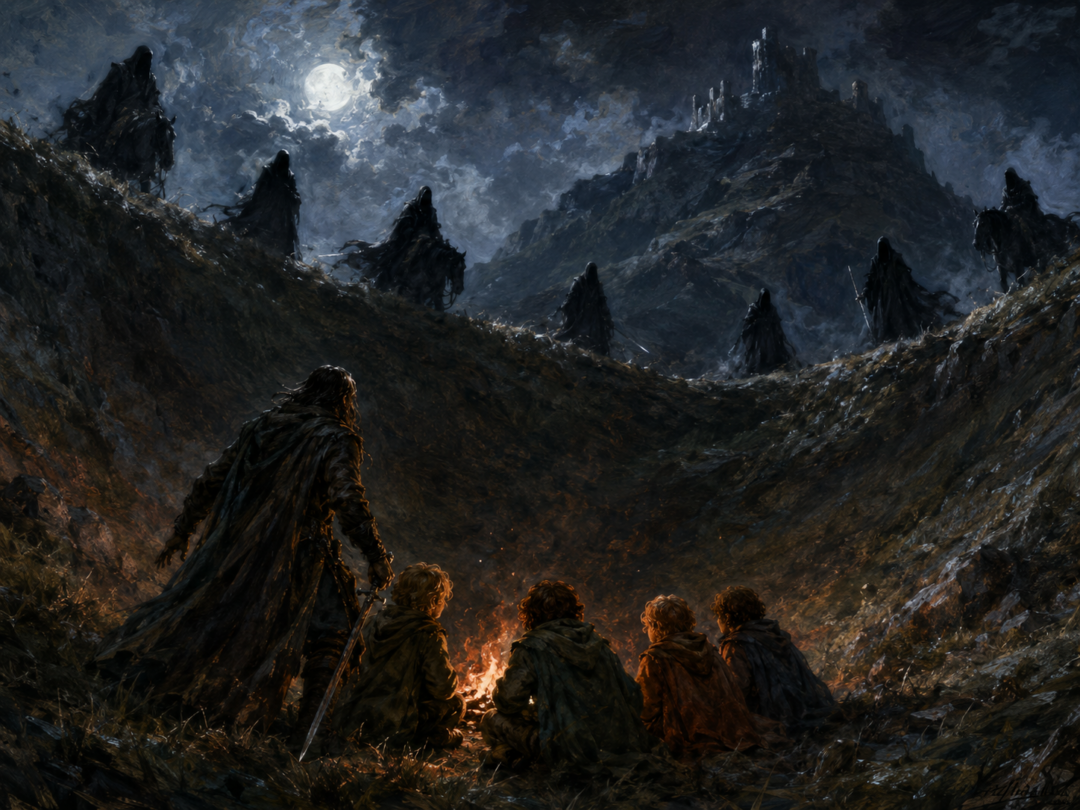
The lowest corner of the dell provides precisely that. From inside it, the wider countryside disappears behind the surrounding slopes. The hill itself blocks part of the horizon. When darkness comes, Frodo and his companions huddle around a fire while Aragorn tells them stories from the Elder Days.
For a few hours, the place functions as shelter in the oldest possible sense: earth around them, fire at the centre, companionship against the dark.
Yet every advantage is conditional.
The surrounding slopes hide the hobbits from distant sight, but they also hide what is approaching them.
The Fire Is Both Defence and Signal
The most revealing detail is the fire.
Aragorn knows that the Nazgûl are near. He explains that the Riders perceive the living in ways ordinary travellers do not, and that the Ring itself draws them. Frodo immediately grasps the terrible contradiction: moving may expose him to pursuit, while remaining still does not make him safe.
Aragorn therefore chooses fire.
He admits that the dell offers little real defence, but the Riders fear those who can wield flame against them. Fire can therefore serve as both protection and a substitute for stronger fortifications. Sam immediately sees the other half of the problem: a bright fire also announces their position. ESL Bits
Neither of them is wrong.
Without fire, the hobbits would be colder, more frightened, and less able to resist an enemy that is strongest in darkness. With fire, they possess one of the few practical things available to them that the Nazgûl dislike.
But the light makes their tiny refuge visible.
This is the deeper logic of the dell. Every measure that makes it habitable also weakens its secrecy.
The travellers require shelter because they are vulnerable. Their vulnerability requires warmth and defence. Warmth and defence create signs that an enemy can find.
There is no perfect choice.
The Terrain Reverses Itself at Night
During daylight, being below the lip of the hollow feels safer than standing on the exposed summit.
During the attack, that same lip becomes high ground for the enemy.
The change is described with extraordinary simplicity. As the company waits around the fire, Sam feels afraid to leave the dell. Merry believes he has seen black shapes moving across the country. Aragorn orders everyone to remain close to the flames and face outward.
Then the Nazgûl appear above them.
The travellers initially perceive the Riders not as ordinary men walking into camp but as shadows rising over the rim. Soon several tall black figures are standing on the slope and looking downward into the hollow. ESL Bits
The geography has inverted.
The depression that hid the company from distant observers now confines their view. The slope that protected them from wind and exposure becomes the ground down which the enemy advances.
This does not mean Aragorn foolishly selected an obvious death trap. The text gives no reason to think a safer fortress was conveniently available nearby. Quite the opposite: Aragorn explicitly recognizes that there is little shelter or defence.
The tragedy lies in the limits of wilderness survival. The best available refuge need not be a good refuge.
Sometimes it is merely less dangerous than the alternatives.
Frodo Carries the Real Trap With Him
There is an even harsher reason the dell cannot truly protect them.
Frodo is carrying the One Ring.
Walls, slopes, darkness, and distance can conceal ordinary travellers. The Ring-bearer faces an enemy for whom those defenses are incomplete. Aragorn says that the Ring draws the Riders, and the attack reveals how little ordinary concealment can accomplish once they close in.
The decisive danger then becomes internal as well as external.
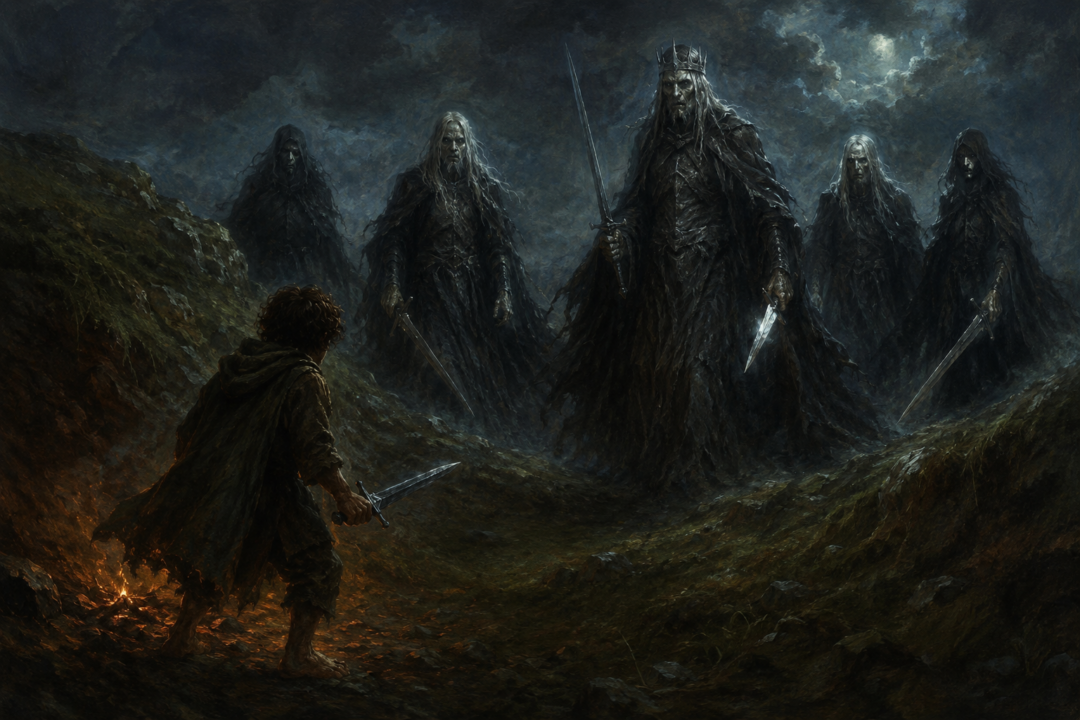
As the Nazgûl advance, Frodo experiences an overwhelming desire to put on the Ring. Significantly, he does not do so because he has formed a clever plan of escape. The compulsion becomes almost an end in itself. He struggles against it until resistance becomes unbearable and finally puts the Ring on. ESL Bits
At that moment the apparent darkness changes.
The Riders become horrifyingly clear to him. Frodo sees five figures, including their leader, who advances with sword and knife. Frodo cries out to Elbereth and strikes at his enemy's feet, but the Witch-king wounds him in the shoulder with the Morgul-knife before Aragorn rushes forward carrying flaming brands. ESL Bits
The dell therefore contains two traps.
One is geographical: the enemy occupies its rim.
The other is spiritual: the thing Frodo might instinctively use to escape their sight brings him more fully into their world.
Even the History Above Them Makes the Scene Darker
There is another layer to Weathertop that the travellers cannot escape.
The broken stones above their camp belong to Amon Sûl, once a great watchtower of Arnor. By the late Third Age its kingdom is gone, its tower destroyed, and its summit reduced to a circle of ancient masonry covered in grass.
The ruin does not save Aragorn and the hobbits.
That is part of the scene's melancholy. They stand amid the remains of a civilization that once possessed the strength to build and hold such places, yet they are now five travellers hiding beneath its broken watchtower.
Even Gandalf's possible sign on the summit offers uncertainty rather than reassurance. The scorched ground shows that something violent has recently happened there, and Aragorn can only infer what the markings on a stone may mean.
Weathertop once existed to see danger coming.
Now danger has already passed across it.
The surviving travellers can read the traces, but they cannot restore the security that the lost kingdom once represented.
The Dell Is Not a Mistake So Much as a Warning
It is tempting to read the attack as proof that the company should simply have camped somewhere else.
The text supports a more complicated conclusion.
Aragorn knows the position is weak. He knows the Riders may be nearby. He knows fire carries risk. What he does not possess is a magically safe alternative.
The company is crossing largely empty country on foot while mounted enemies search for the Ring. Their choice is not between danger and safety. It is between different kinds of danger.
The dell hides them from ordinary sight but restricts their own vision. Fire protects them but reveals them. Weathertop provides information but exposes anyone who climbs it. Remaining still offers rest, yet the Ring means that stillness cannot guarantee concealment.
That is why the scene works so well even before a blade is drawn.
The trap is not a secret mechanism hidden in the earth.
It is the realization that everything the travellers need for survival has a cost.
And when the black shapes finally rise above the grassy rim, the little hollow has not stopped being a shelter.
That is exactly what makes it frightening.
It is still the best shelter they have.
Sources & Notes
- https://www.glyphweb.com/arda/w/weathertop.html — The Encyclopedia of Arda, ‘Weathertop’: overview of the prominent hill, its commanding position beside the Great East Road, and Frodo’s wounding there by the Nazgûl.
- https://www.glyphweb.com/arda/a/amonsul.html — The Encyclopedia of Arda, ‘Amon Sûl’: history of the ruined watchtower and specific reference to Frodo being wounded in a hollow beneath the hill.
- https://www.glyphweb.com/arda/l/lordofthenazgul.html — The Encyclopedia of Arda, ‘Lord of the Nazgûl’: reference account of the Witch-king’s pursuit of the Ring-bearer and his attack on Frodo at Weathertop.
- https://www.glyphweb.com/arda/m/morgulwounds.html — The Encyclopedia of Arda, ‘Morgul-wounds’: background on the supernatural wound inflicted by the Witch-king’s Morgul-knife and its danger to Frodo.
Sources cover Weathertop’s geography and history, the Nazgûl attack, and the Morgul wound central to the article’s interpretation.