When Frodo, Sam, Merry, and Pippin leave Crickhollow, they encounter something surprisingly formidable for the Shire: a defensive barrier.
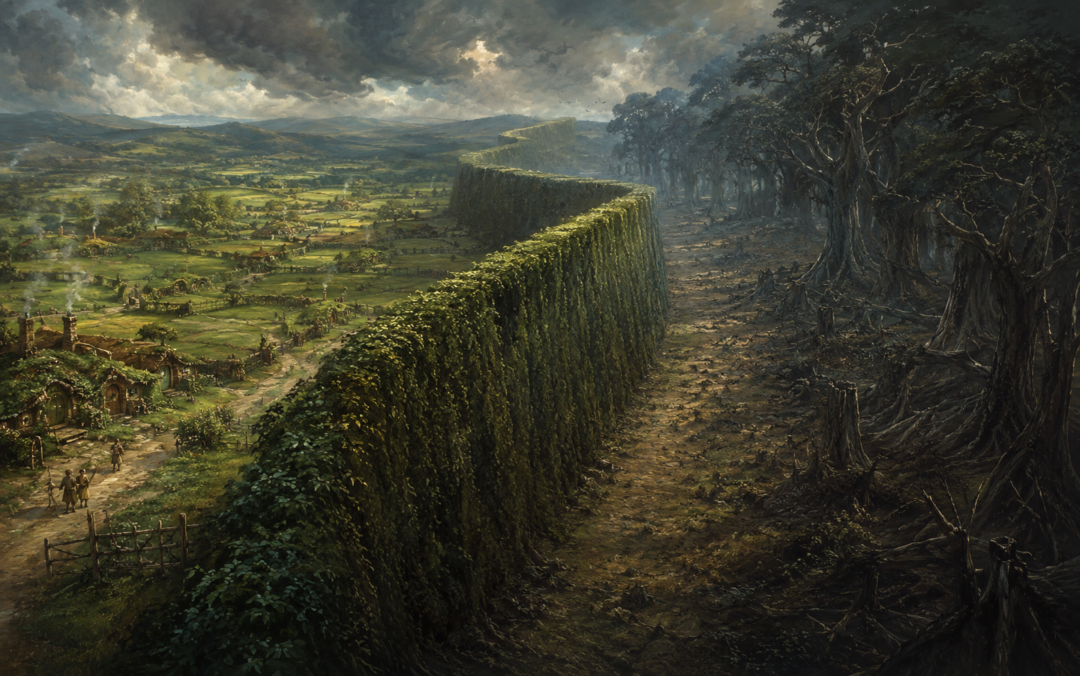
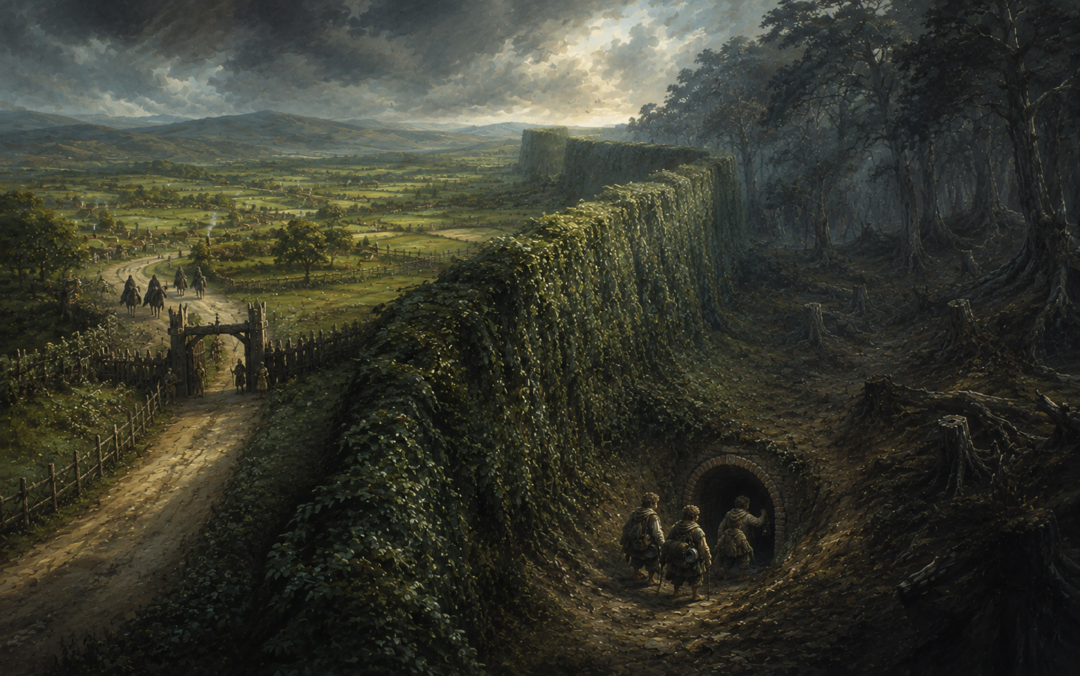
The High Hay, usually called simply the Hedge, rises along the eastern edge of Buckland between the hobbit settlements and the Old Forest. It is not a decorative boundary. It is tall, thick, carefully maintained, and difficult to cross. At its northern end, passage is controlled through a guarded gate. Near Crickhollow, the Brandybucks possess another, far more secretive way through: a tunnel beneath the Hedge closed by an iron gate.
For generations, this barrier has done exactly what the Bucklanders intended. It keeps the Old Forest at a distance.
But when Frodo needs to escape the Shire without being followed, the same defensive system creates a strange problem. The safe routes are also the obvious routes. The Hedge channels movement toward known exits, while the secret alternative leads directly into one of the most dangerous places anywhere near Hobbiton.
The protection of Buckland therefore becomes part of the danger of Frodo’s journey.
Buckland Is Not Quite Like the Rest of the Shire
Buckland occupies an unusual position in hobbit geography.
It lies east of the Brandywine, settled by hobbits under Gorhendad Oldbuck, whose descendants became the Brandybucks. Unlike the comfortably enclosed heartlands farther west, Buckland presses against the Old Forest.
That proximity matters.
The Old Forest is not merely an especially dense woodland. Merry knows from Buckland tradition and his own experience that its trees can behave with hostile purpose. He describes trees moving, communicating, and attempting to press against the Hedge.
The Bucklanders responded in a remarkably un-hobbitlike fashion: they fortified their frontier.
The High Hay stretches for more than twenty miles along Buckland’s eastern side. Generations of maintenance have made it a substantial living barrier. At the northern end, near the Brandywine Bridge and the East Road, stands the guarded Buckland Gate.
This immediately tells us something about Buckland.
The Hedge is the physical expression of a community that knows danger exists.
Most Shire-folk can afford to treat frightening stories as distant curiosities. Bucklanders live beside something genuinely threatening. Their society has therefore developed boundaries, guards, alarms, and a stronger awareness of the world outside ordinary hobbit life.
The Hedge exists because the wilderness has already come too close.
The Old Forest Once Came to the Hedge
The hostility between Buckland and the Forest is not theoretical.
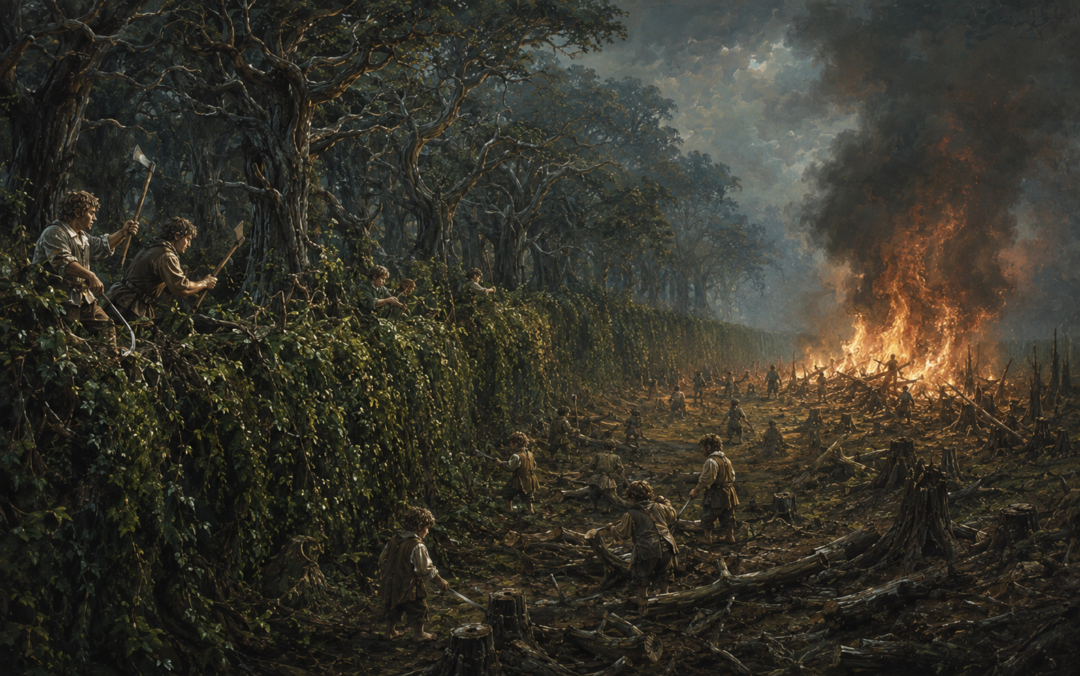
After Frodo’s company passes through the secret tunnel, Merry explains that long ago the trees came close to the Hedge and leaned over it. The Bucklanders answered aggressively. They cut down many trees and burned them in a great fire, leaving the place afterward remembered as the Bonfire Glade.
They also cleared a strip along the outside of the Hedge.
The result was successful in one limited sense: the trees withdrew.
But Merry’s account does not suggest reconciliation. The Forest became more hostile toward the hobbits.
That history changes the meaning of the Hedge. It is not simply a fence placed against a passive wilderness. It marks the front line of an old conflict between settlement and a forest possessing forms of awareness that the hobbits only partly understand.
The Bucklanders have created security by drawing a line.
On one side are tilled fields, lanes, smials, houses, and familiar social order.
On the other is the Old Forest.
The Hedge keeps those worlds apart.
That is exactly why crossing it feels so consequential.
Frodo Cannot Simply Take the Normal Road
Frodo’s difficulty is that he is not merely travelling east. He is trying to disappear.
By the time he reaches Buckland, the Black Riders have already transformed his journey. He knows that mysterious pursuers are searching for him, and the crossing of the Brandywine by the Bucklebury Ferry has only temporarily put distance between them.
The obvious route eastward would eventually bring travellers toward the main road.
But secrecy matters more than comfort.
This is where Buckland’s geography becomes a trap of choices rather than a literal imprisonment.
The Hedge does not prevent Frodo from leaving Buckland altogether. There are established routes around or through the region, and the text should not be read as saying that the hobbits have only one physically possible escape.
Rather, Frodo’s need to avoid predictable roads makes the ordinary exits dangerous.
A defensive frontier works partly because movement is concentrated through manageable passages. That is useful when you are protecting a community.
It is less useful when someone outside is hunting you.
Frodo needs the opposite of a normal traveller’s route.
He needs a way nobody expects him to take.
Merry has one.
Unfortunately, it opens into the Old Forest.
The Secret Tunnel Reveals How Seriously Buckland Takes Its Border
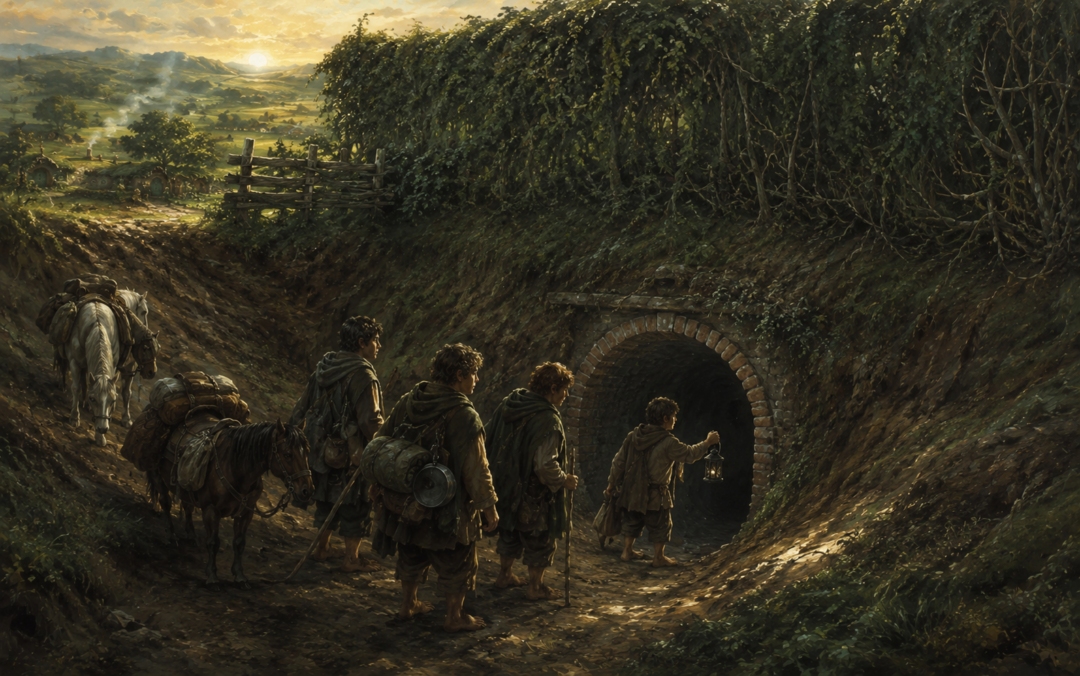
Near Crickhollow, Merry leads the company northward until they reach a hollow beside the Hedge.
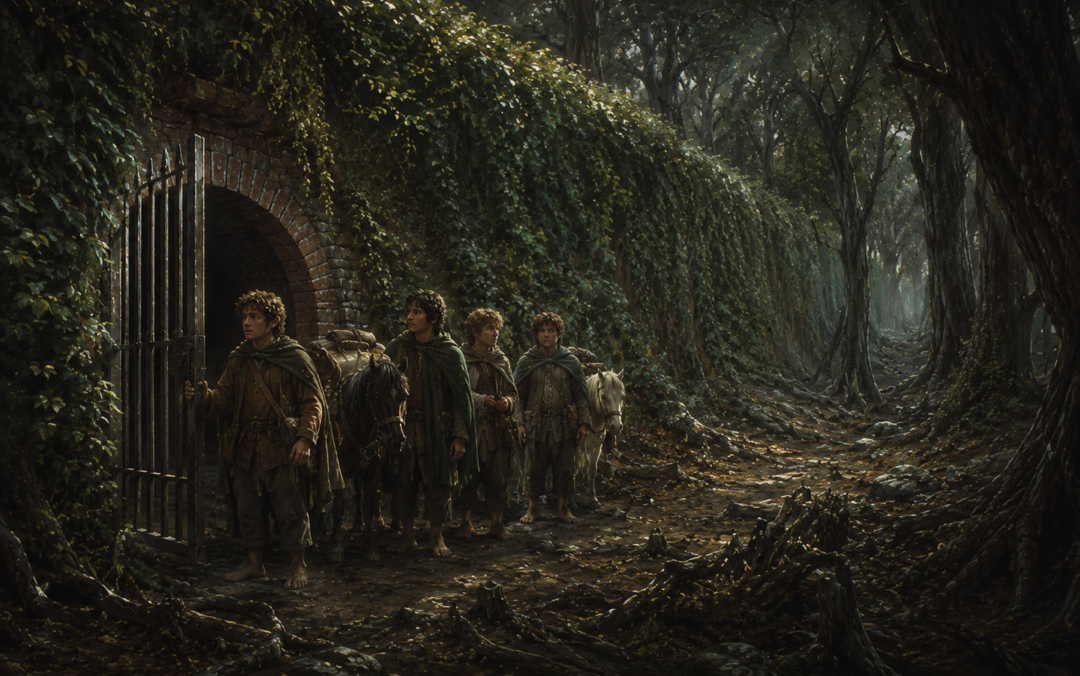
There they descend into a cutting and find a tunnel passing beneath the great barrier. The passage is brick-lined, demonstrating that this is not an accidental gap or improvised hole. At the far end stands a gate made with thick iron bars.
Merry has the key.
The details are important.
The Bucklanders have not made the Hedge absolutely impenetrable. They have created controlled access to the dangerous country beyond it.
The tunnel allows certain hobbits to enter the Old Forest without weakening the defensive line itself. The iron gate can be locked behind them.
For Frodo, however, the gate represents something larger.
Once the companions pass through it, Merry announces that they are finally outside the Shire.
Behind them is an engineered boundary designed to keep the Forest out.
Ahead of them is the Forest itself.
The protection has become one-way.
Closing the Gate Makes the Decision Real
After passing through, Merry locks the gate again.
That small action gives the scene much of its force.
The Hedge towers behind them. Returning is technically possible because Merry has the key, but psychologically and strategically the company has committed itself to the dangerous route.
They have deliberately placed Buckland’s strongest local protection between themselves and the safety they have known.
This is one of the earliest moments when Frodo’s journey begins to resemble the larger Quest that awaits him.
Again and again, apparent safety will come with a cost, while forward movement will require entering places from which retreat becomes increasingly difficult.
Here, that pattern is still small enough to understand in ordinary terms.
Four hobbits stand outside a locked gate.
The danger is a forest.
Yet almost immediately they discover that Merry’s knowledge is insufficient to master what lies beyond the Hedge.
The Forest Turns Their Escape Route Against Them
The hobbits enter the Old Forest hoping to cross it and regain more useful country farther east.
Instead, the Forest appears to influence their direction.
Paths alter or become obstructed. Trees crowd them. Their attempts to maintain their intended course repeatedly fail until they are driven toward the valley of the Withywindle.
This is precisely what the Hedge had protected Buckland from.
Inside Buckland, the Forest’s power is kept beyond a maintained boundary. Once the hobbits cross that boundary, they enter an environment where familiar assumptions about roads and directions become unreliable.
Their attempt to avoid the Black Riders has traded one kind of danger for another.
On the roads, they risk being found.
In the Forest, they risk becoming lost.
The irony deepens because Merry is the member of the company best acquainted with the Old Forest. His knowledge is genuine. He understands its reputation, remembers Buckland’s history with it, and knows the secret entrance.
But knowledge of danger is not the same thing as control over it.
Eventually the Forest draws the travellers toward the Withywindle and Old Man Willow, whose influence is associated with much of the hostility and strange movement of the wood.
The escape route almost ends before the Quest has properly begun.
The Hedge Works — Which Is Why Crossing It Is So Dangerous
There is an important distinction here.
The Hedge does not fail.
Nothing in Frodo’s experience suggests that Buckland’s defenses are useless. Quite the opposite: the condition of the Old Forest after the hobbits cross helps explain why generations of Bucklanders continued maintaining such an enormous barrier.
The Hedge successfully separates domestic space from hostile wilderness.
The danger comes because Frodo deliberately crosses it.
That makes the High Hay one of the clearest physical boundaries in the opening chapters of The Lord of the Rings. On one side lies a community capable of defending itself through cooperation, memory, and preparation. On the other lies an older world that does not obey hobbit expectations.
The Hedge therefore protects by limiting movement.
And limiting movement inevitably shapes escape.
Frodo cannot have both complete secrecy and complete safety. The roads are easier but exposed. The hidden route is secret but dangerous.
His circumstances force him to choose which danger he understands least.
Buckland’s Wall Is Also a Warning
The High Hay can easily be overlooked because greater fortifications soon appear: the walls of Bree, the defenses of Minas Tirith, the towers and mountains surrounding Mordor.
Yet the Hedge introduces the same basic principle on a domestic scale.
Walls tell you something about what people fear.
The Bucklanders do not maintain more than twenty miles of Hedge because they are unusually fond of gardening. Their frontier records generations of experience with the Old Forest.
Frodo benefits from that protection when he reaches Crickhollow.
Then, because the Enemy is pursuing him, he must abandon it.
That is the deeper irony of the Hedge.
It was built to keep danger outside.
For Frodo, Sam, Merry, and Pippin, the safest way to keep their pursuers from knowing where they have gone is to put themselves on the wrong side of it.
The barrier that protects Buckland narrows their secret route until the Old Forest becomes attractive precisely because almost nobody would willingly choose it.
And once the iron gate closes behind them, they discover why.
Sources & Notes
- Tolkien Gateway, “High Hay” — documents the Hedge’s defensive purpose, twenty-mile extent, guarded North Gate, and the private brick-lined tunnel with its iron gate near Crickhollow. https://tolkiengateway.net/wiki/High_Hay
- Tolkien Gateway, “Old Forest” — summarizes the Forest’s hostile awareness, misleading paths, and conflict with Buckland, supporting why the concealed crossing trades pursuit risk for wilderness danger. https://tolkiengateway.net/wiki/Old_Forest
- Tolkien Gateway, “Buckland” — covers Buckland’s position between the Brandywine and Old Forest, its founding by Gorhendad Oldbuck, and Frodo’s departure through the High Hay toward the Forest. https://tolkiengateway.net/wiki/Buckland
- Encyclopedia of Arda, “High Hay” — independently details the maintained defensive hedge, guarded northern gate, secret tunnel, Bonfire Glade conflict, and Frodo’s choice of this secret route out of the Shire. https://encyclopedia-of-arda.com/h/highhay.html
Sources verify the High Hay’s geography and defenses, Buckland’s frontier history, the Forest’s hostility, and the route chosen by Frodo’s party.