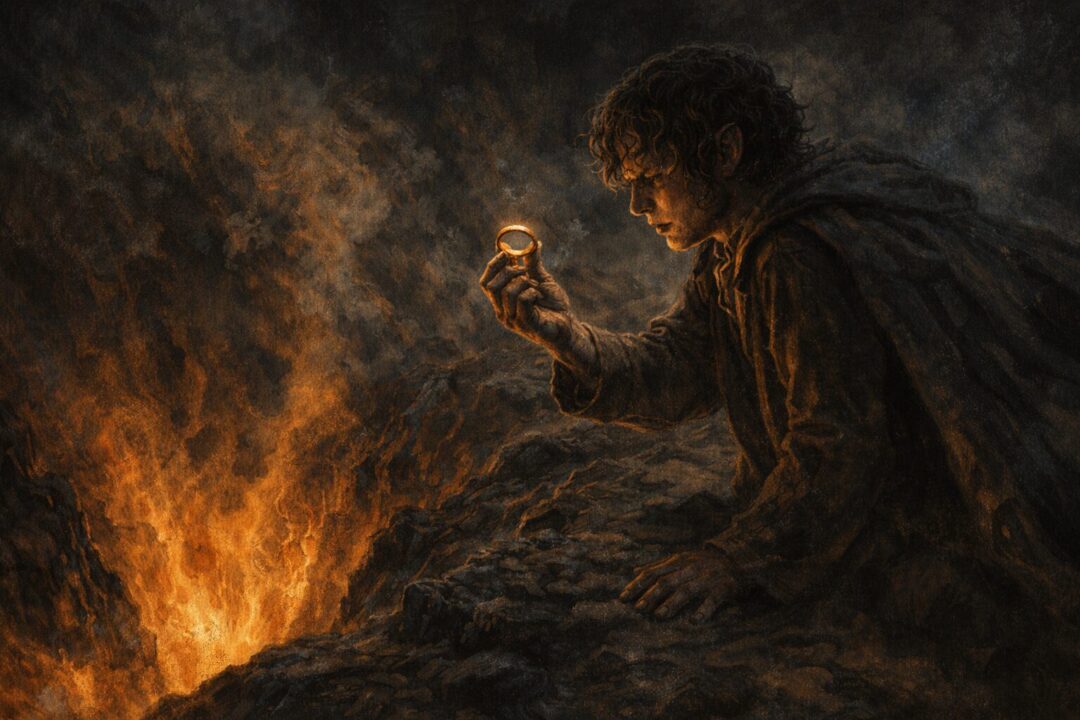
The One Ring is easy to describe too simply.
Most readers remember its power to corrupt. They remember obsession, possessiveness, invisibility, and the long moral damage it leaves behind. All of that is true.
But the texts give the Ring another quality that is harder to classify.
It does not merely sit on a hand and radiate temptation. It behaves.
Sometimes it clings. Sometimes it slips. Sometimes it seems to change in size. Sometimes it appears to abandon one bearer only to place itself in the path of another. Gandalf does not talk about this as metaphor. He speaks as if the Ring has a kind of active will directed toward one end: returning to Sauron.
That is where the mystery begins.
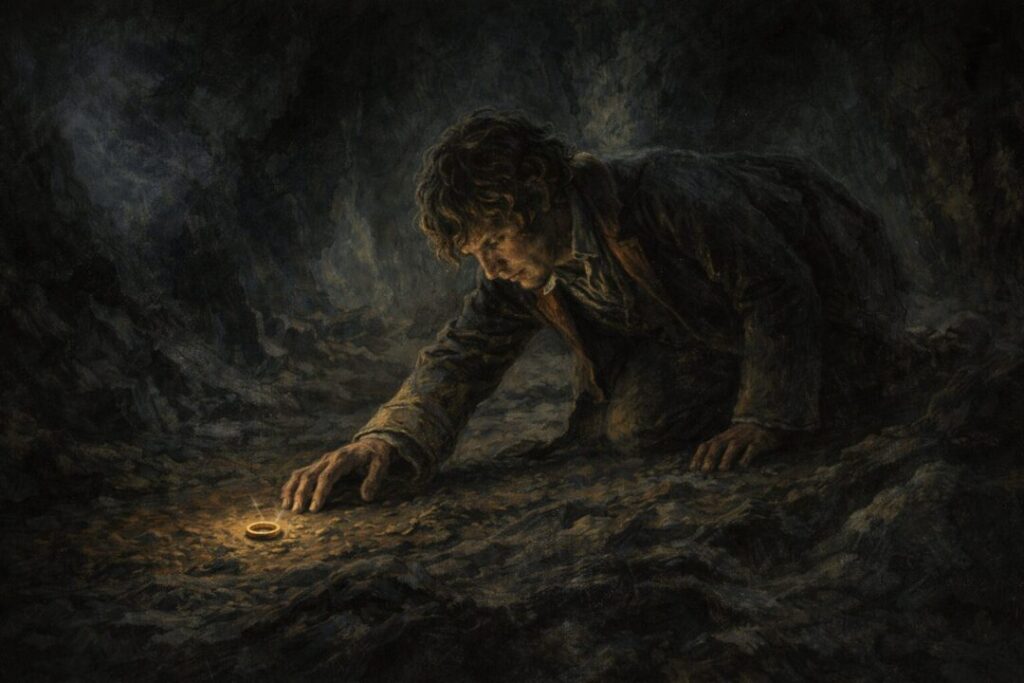
The Ring is not passive
In The Shadow of the Past, Gandalf gives the clearest framework readers ever get. He says that a Ring of Power “looks after itself,” that it may slip off “treacherously,” and that Gollum did not simply lose the Ring by accident. In Gandalf’s telling, “the Ring itself” decided matters and left him. He says the same of Isildur: the Ring slipped from him and betrayed him while trying to get back to its master.
That wording matters.
The text does not fully explain the Ring as a conscious mind with thoughts like a human being. It does not pause to describe inner deliberation or strategy in psychological detail. But it absolutely does attribute directed action to it. Conservative phrasing is safest here: the Ring possesses a will aligned with Sauron and can act in limited but meaningful ways upon its bearer and its own immediate circumstances.
So when readers say the Ring “chooses its moments,” that is not pure invention.
It is a shorthand for something the narrative itself repeatedly suggests.
Why it betrayed Isildur
The first great betrayal is also the clearest.
After the fall of Sauron, Isildur takes the Ring for himself. Later, at the Gladden Fields, he uses it in an attempt to escape the Orcs by becoming unseen. But the Ring slips from him in the water, and that loss exposes him to death. Gandalf explicitly interprets this as betrayal, not misfortune: the Ring was trying to get back to Sauron. Tolkien Gateway’s summary of Isildur’s end follows the same line from the text, noting that the Ring slipped from his finger during his escape and that this became the foundation of “Isildur’s Bane.”
This is the first pattern.
The Ring does not simply help whoever wears it. It helps only so long as the bearer’s survival and the Ring’s long-term return are compatible. The instant those interests separate, the Ring’s loyalty is exposed.
That is why “betrayal” is the right word.
The strange evidence that it changes size
The Ring’s slipping would already be unusual enough. But the texts go further.
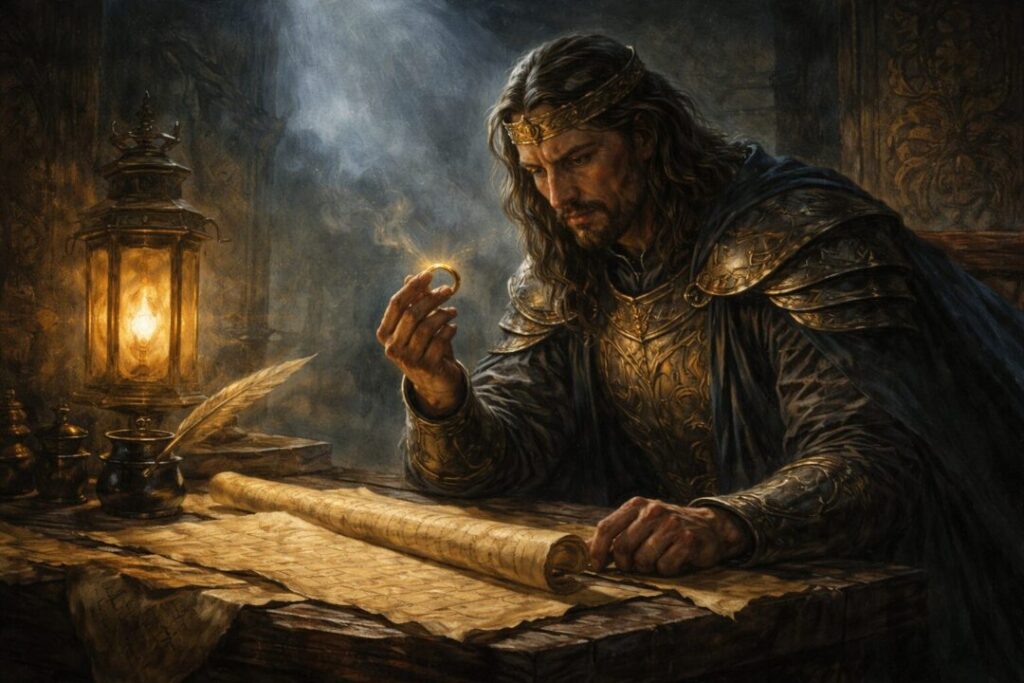
In the scroll preserved in Gondor, Isildur writes that the Ring seemed to shrink even as it cooled after being taken from Sauron. That is one of the earliest direct textual hints that the Ring is not fixed in the way ordinary metal is fixed. It keeps its beauty and shape, but it does not remain entirely stable in relation to the one holding it.
Later, Gandalf says Bilbo had discovered something similar from experience: the Ring did not always seem the same size or weight, and it might suddenly slip off a finger where it had once been tight. Frodo confirms that Bilbo warned him of this, which is why he keeps it on a chain.
That does not prove the Ring is constantly resizing with conscious precision every moment it is worn. The texts do not describe a mechanism, and they do not invite scientific explanation.
But they do support a narrower claim: the Ring can alter how it sits, how it feels, and when it holds or releases. That is enough to explain why “slips” and “shrinks” belong together as part of the same pattern.
The Ring is not inert gold.
Why it abandoned Gollum
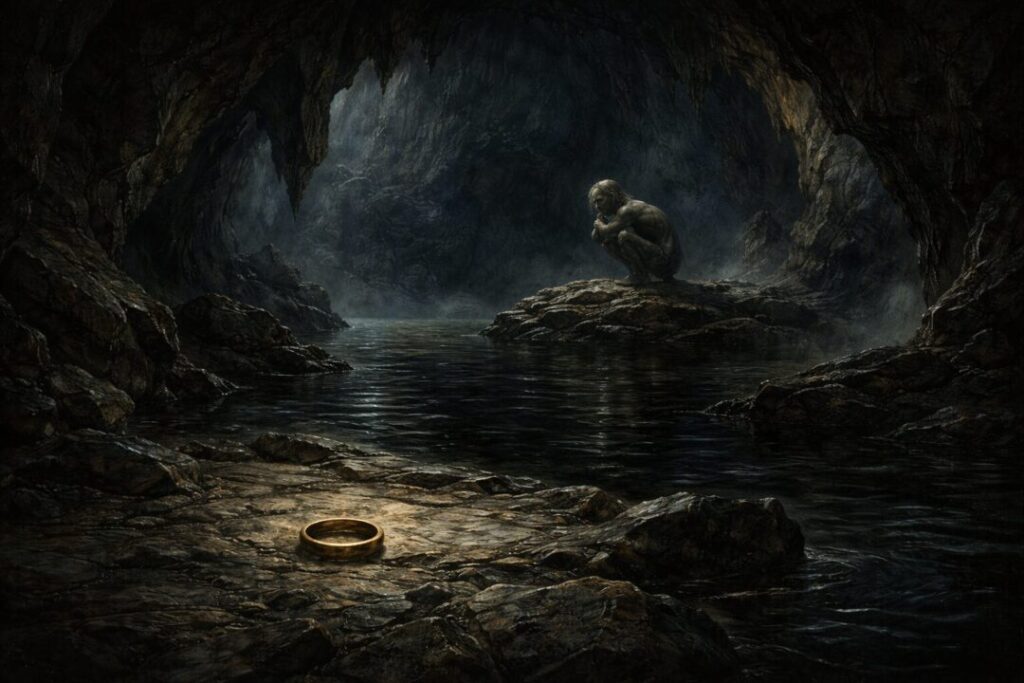
Gollum’s case is even more revealing because it shows that the Ring can also leave a bearer when staying would trap it.
Gandalf says the Ring had “devoured” Gollum, but could make no further use of him. Gollum had become too isolated, too small in scope, too buried in darkness. As long as the Ring remained with him under the Misty Mountains, it would never move back into the wider world. So the Ring left him.
That is an important distinction.
The Ring is not merely drawn to wickedness in the abstract. If it were, Gollum would have been a perfect keeper forever: obsessed, secretive, possessive, and wholly consumed. But the Ring’s deeper aim is not simply corruption for its own sake. It is movement toward power, toward exposure, toward the possibility of recovery by Sauron or his servants. Gollum had become a dead end.
So it leaves him.
This is one of the strongest pieces of evidence that the Ring’s actions are purposeful rather than random.
Did it choose Bilbo?
This is where many readers go one step too far.
It is true that the Ring leaves Gollum and that Bilbo finds it at exactly that moment. On the surface, it is tempting to say the Ring chose Bilbo as its next bearer.
But Gandalf immediately complicates that conclusion.
After explaining that the Ring left Gollum, he tells Frodo that Bilbo’s finding of it was “the strangest event” in the Ring’s history so far. Then he adds that “behind” the Ring’s own design there was “something else at work, beyond any design of the Ring-maker.” His conclusion is famous: Bilbo was meant to find the Ring, but not by its maker.
That means we need to separate two ideas.
The Ring did act. It did leave Gollum. It was trying to get back to Sauron.
But Bilbo’s arrival at that exact point is presented as providential, not as the Ring’s triumph. The Ring may have wanted an Orc, a servant of the Enemy, or some other path more useful to Sauron. Instead, it came into the hands of the last kind of bearer its maker would likely have chosen: a Hobbit, and then another Hobbit after him.
So the Ring “chooses,” yes—but not absolutely.
It acts within a larger story it cannot fully control.
Why the Ring grows more dangerous near Mount Doom
The Ring’s changes are not limited to slipping and fit. Its very force increases as it comes closer to the place where it was forged.
When Sam bears it in Mordor, the text says that as it drew near the great furnaces where it had been made, its power grew and it became more fell and less manageable except by some mighty will. That does not mean the Ring becomes a new object there. It means its native environment intensifies what it already is.
This matters for how we understand its “moments.”
The Ring does not behave identically in every place. It is more dangerous near its source. Its power presses harder on the mind. It becomes more difficult to resist, more difficult to master, and more capable of asserting itself in the crucial final approach.
That helps explain why the destruction of the Ring is never presented as a simple matter of carrying an item to a destination and dropping it in.
The object is fighting, in the only ways it can, all the way to the end.
The final irony of the Ring’s will
And yet the last victory over the Ring is not achieved by anyone mastering it.
Frodo reaches the Cracks of Doom and fails to surrender it. He claims it. The text is unambiguous about that. But the chain of mercy stretching back to Bilbo and then Frodo’s own pity for Gollum creates the condition in which the Ring is destroyed anyway. Later commentary associated with Tolkien’s letters emphasizes exactly that point: Frodo is saved through the situation his mercy helped create.
This is the final answer to the idea that the Ring always “chooses” perfectly.
It does choose in a real sense. It slips, clings, betrays, tempts, and acts toward Sauron.
But the greatest turn in its history comes from something outside its own will.
That is why Gandalf’s explanation earlier matters so much. There was more than one power at work. The Ring is active, but it is not ultimate. Its betrayals are real, yet they unfold inside a world where providence, pity, and moral choice can still overturn what evil intends.
So why does the One Ring slip, shrink, and betray its owners?
Because the texts present it as an object with a will of its own, bound to Sauron and always leaning toward his return.
But the deeper reason its story remains so fascinating is that even the Ring does not control the whole story.
It chooses its moments.
It just does not choose the ending.