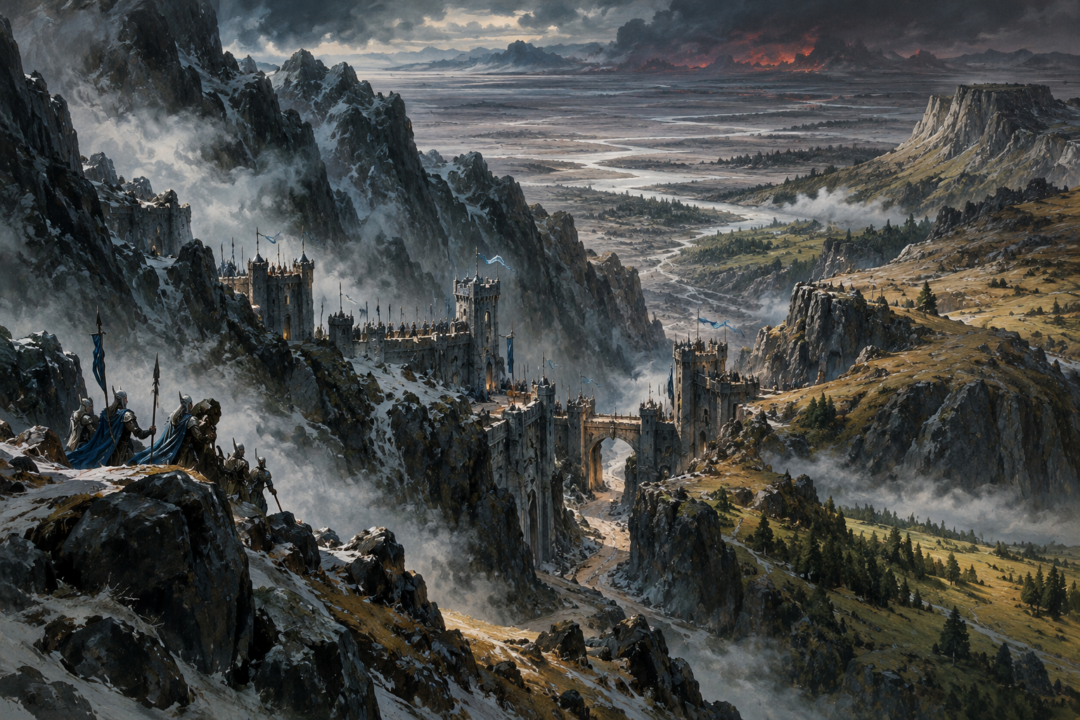
The Pass of Aglon was not a glittering city, a mine, or the seat of some legendary treasure. It was a cold opening between highlands, swept continually by a bitter wind from the north. Yet Celegorm and Curufin fortified it heavily and held it with great strength.
That apparent contradiction reveals something important about the wars of the First Age.
Himlad, the territory immediately south of Aglon, belonged to Celegorm and Curufin. But the surviving descriptions do not present Himlad as a realm whose importance rested on exceptional wealth. Its real value was geographical. Aglon stood on the vulnerable northeastern approaches to Beleriand, and the pass controlled a road by which Morgoth's armies could move south.
When the pass finally fell during the Dagor Bragollach, the consequences demonstrated exactly why so much strength had been concentrated there.
A Realm Built Around a Gate
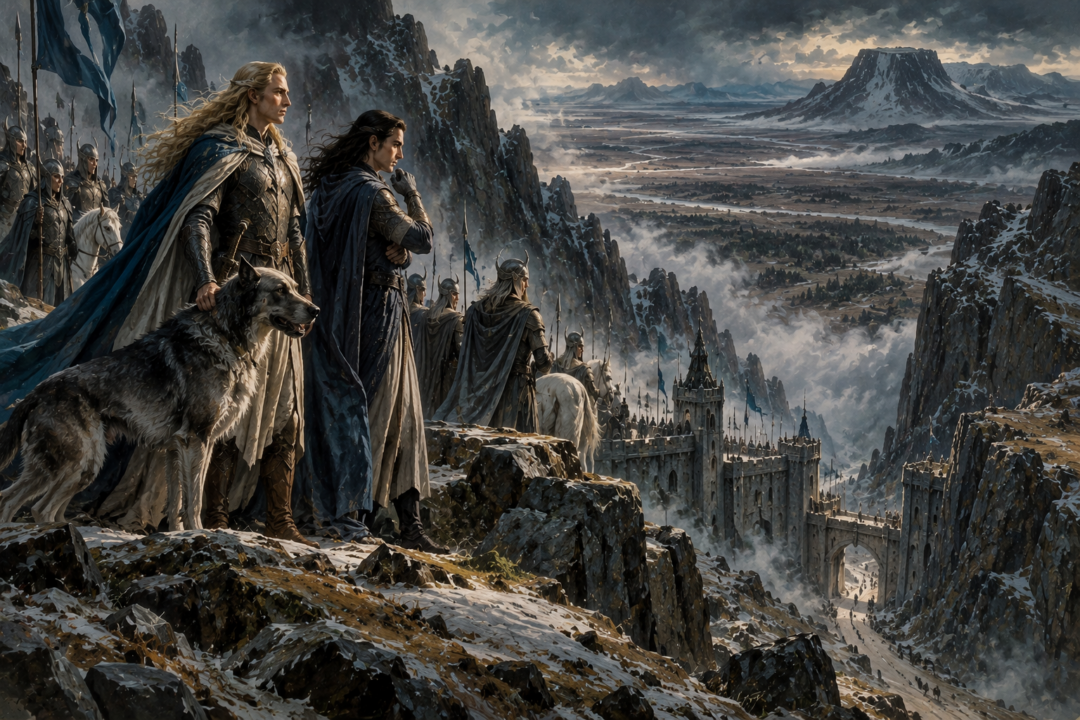
After the Noldor established their realms in Beleriand, the sons of Fëanor occupied much of the exposed eastern frontier.
Maedhros established his chief stronghold on Himring, the great bare hill that dominated this defensive region. Celegorm and Curufin held Himlad farther south, between the rivers Aros and Celon.
Between Himring and Dorthonion lay Aglon.
The Silmarillion describes the western side of the pass as exceedingly steep and identifies Aglon as a gate toward Doriath. A bitter northern wind continually passed through it. Celegorm and Curufin therefore fortified the pass and held it strongly.
This arrangement makes more sense when the wider geography is considered.
East of Dorthonion, the northern marches of Beleriand were particularly exposed. The mountains and high barriers protecting other regions were weaker here. Beyond them stretched Lothlann, the broad northern plain watched by the horsemen of the sons of Fëanor.
Aglon was one of the places where that frontier narrowed.
Whoever controlled it could obstruct movement from the dangerous northern lands into the regions farther south.
Himlad's Importance Was Strategic, Not Material
It is tempting to imagine every Elven realm of the First Age as possessing extraordinary riches. Some certainly did. Nargothrond contained the accumulated works of Finrod's people, while Doriath possessed the wealth and craftsmanship of Thingol's kingdom. Elsewhere, the Noldor maintained important contacts with the Dwarves.
Himlad is different.
The texts do not emphasize fabulous mineral wealth, treasure-houses, or great cities there. Its name is associated with its cool character, and its political importance comes primarily from the position occupied by Celegorm and Curufin.
So the strongest lore-grounded reading is not that Aglon somehow protected a famously wealthy realm.
Rather, the pass itself was the prize.
A field can be burned. A settlement can be rebuilt. Treasure can be moved or lost. But a mountain corridor remains where the land has placed it.
That is what made Aglon so difficult to replace.
Aglon Was Part of a Larger Defensive System
The sons of Fëanor did not defend eastern Beleriand through one fortress alone.
Their territories formed something closer to a chain of positions.
Maedhros held Himring. Celegorm and Curufin guarded Aglon and Himlad. Maglor watched the vulnerable gap farther east, while Caranthir occupied Thargelion beyond the Gelion. The mounted forces of the Fëanorians also watched the northern plains.
None of these positions was completely independent.
A stronghold mattered partly because of the roads and approaches around it.
Himring could survive an assault, but if enemy armies passed around it through open country or neighboring gaps, Maedhros could be increasingly isolated. Likewise, Himlad was safer while Aglon remained blocked.
The defense therefore depended on controlling movement rather than merely holding territory.
That distinction became brutally clear when Morgoth finally shattered the Siege of Angband.
The Dagor Bragollach Proved Aglon's Value
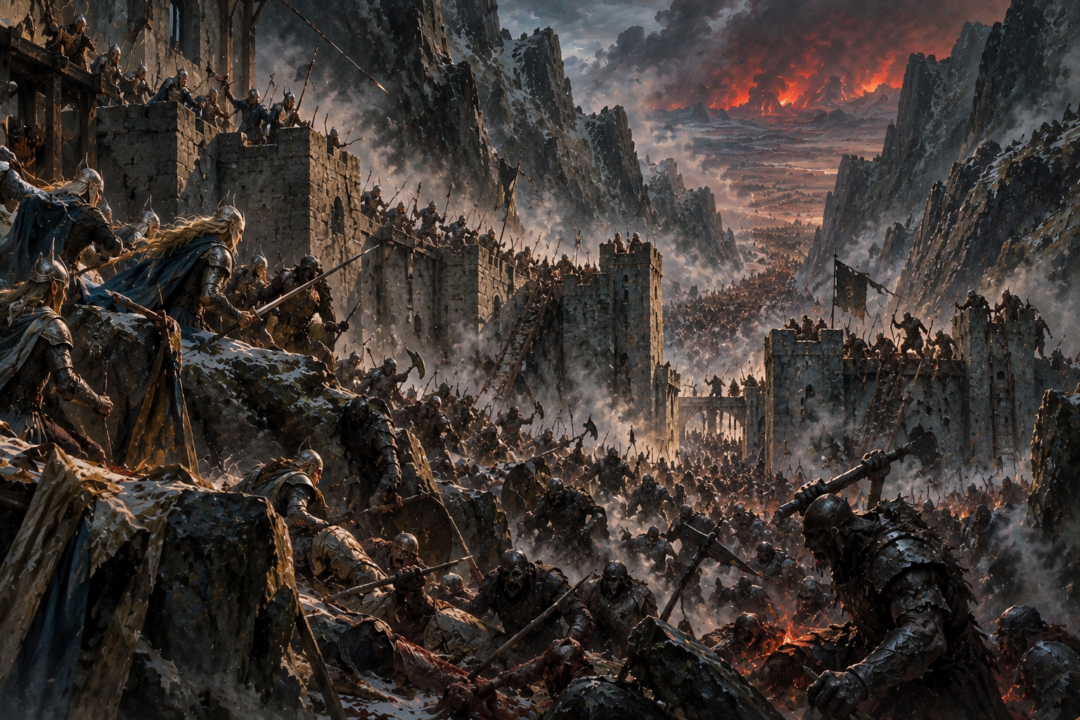
In the year 455 of the First Age, Morgoth launched the Dagor Bragollach, the Battle of Sudden Flame.
The northern defenses of the Noldor collapsed across a vast front. Dorthonion was overwhelmed. The eastern marches suffered heavily. Glaurung and the armies of Angband broke into lands that had remained protected during the long Siege.
Aglon was attacked as part of this wider offensive.
Celegorm and Curufin were defeated, but the victory was not cheap. The account specifically notes that Morgoth's forces forced the Pass of Aglon only at great cost.
That detail matters.
Morgoth possessed enormous armies and was attacking simultaneously across northern Beleriand, yet breaking this narrow passage still demanded heavy losses.
Once the position failed, Celegorm and Curufin fled south and west and eventually reached Nargothrond.
Their territorial realm in Himlad had effectively ceased to function as before.
But Aglon's story was not finished.
Maedhros Took the Pass Back
Himring survived the catastrophe.
Maedhros held his fortress when much of the surrounding eastern defense collapsed, and survivors from Dorthonion and the eastern marches gathered there.
Then he achieved something revealing: for a time, he closed Aglon again.
The stated consequence was straightforward. Orcs could not enter Beleriand by that road.
That may be the clearest evidence for Aglon's strategic importance.
The significance of retaking the pass is not described in terms of recovering estates, resources, or treasure. What mattered was denying the enemy a route.
Aglon functioned as a door.
Even after the lands around it had been devastated and the old political arrangement broken, closing that door still had military value.
The Landscape Multiplied the Defenders' Strength
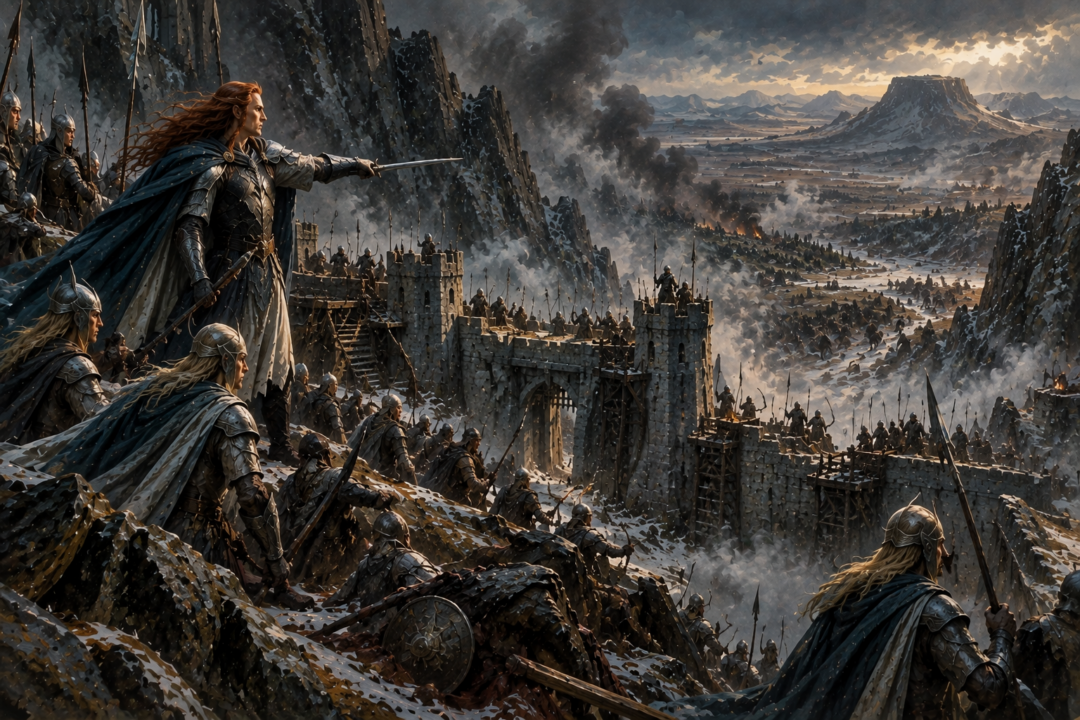
A narrow pass can transform warfare because numbers cannot always be used effectively inside it.
Aglon's steep terrain naturally restricted movement. Fortifications added by Celegorm and Curufin strengthened that advantage.
This does not mean the pass was impregnable. The Dagor Bragollach proved otherwise.
But the enormous cost of forcing it suggests why the Fëanorians invested so heavily in its defense. An army approaching through constrained terrain could not treat Aglon like the open plains of Lothlann.
Geography effectively became part of the fortification.
The defenders were not merely holding walls. They were using the shape of Beleriand itself.
That principle appears repeatedly throughout the wars against Morgoth. The Pass of Sirion was likewise enormously important because it controlled another major north-south route. Mountains, rivers, passes, and guarded crossings repeatedly determined where armies could penetrate the defended lands.
Aglon belongs to that same strategic pattern.
The Pass Also Guarded the Approaches Toward Doriath
There was another reason Aglon mattered beyond Himlad.
The text explicitly calls it a gate toward Doriath.
That does not mean Aglon opened directly into Menegroth or that its fall automatically exposed Thingol's halls to immediate attack. The geography of eastern Beleriand was more complicated than that.
But it does establish that Aglon belonged to the network of approaches leading toward the protected southern lands.
While Celegorm and Curufin held the pass, they were therefore doing more than defending their own territory. Whether or not this was their principal motive, their position contributed to the wider containment of Morgoth's forces in the north.
Once northern gates and passes began failing, war could spread into regions that had previously stood behind the front.
The strategic value of Aglon therefore extended beyond the political borders of its rulers.
Aglon's Lesson Is the Difference Between Possession and Control
The history of Aglon exposes a recurring truth in the wars of Beleriand.
The largest realm is not necessarily the most important piece of ground.
Himlad could be possessed by Celegorm and Curufin, but possession of the surrounding country depended partly upon control of the routes entering it. Once Morgoth could force those routes, territorial boundaries became increasingly meaningless.
That is why Aglon mattered so much.
It compressed a vast strategic problem into one defensible place.
Instead of attempting to prevent every Orc from crossing an enormous frontier, defenders could concentrate strength where the landscape itself forced enemies together.
Morgoth understood the same logic from the opposite direction. His armies did not need to occupy every league of northern Beleriand before advancing south. They needed to rupture the defensive system at its vulnerable passages.
The Dagor Bragollach was devastating precisely because several such protections failed almost together.

The Cold Pass Was Worth Fighting for Twice
Aglon's history contains a striking final irony.
There was little romantic about the place itself. It was narrow, steep, cold, and exposed to the northern wind. No great jewel was hidden there. No famous palace made it desirable.
Yet armies fought bitterly for it.
Celegorm and Curufin fortified it because leaving it open endangered everything behind them. Morgoth's hosts paid heavily to force it. Maedhros, after surviving the ruin of the eastern marches, closed it again because denying that road to the Orcs still mattered.
That sequence tells us more about Aglon's importance than any catalogue of riches could.
The true treasure of the pass was control.
As long as the defenders held Aglon, the geography of Beleriand worked for them. The cliffs, highlands, fortifications, and narrow road combined to obstruct the power of Angband.
When the gate opened, the same geography became a road south.
And in the First Age, where entire kingdoms survived only while the Shadow could be contained beyond their borders, a narrow road could be worth more than all the wealth of the country behind it.
Sources & Notes
- Tolkien Gateway — Pass of Aglon: fortification, breach and Maedhros's recapture; references to The Silmarillion, chapters 14 and 18 — https://tolkiengateway.net/wiki/Pass_of_Aglon
- Tolkien Gateway — Himlad: Celegorm and Curufin's territory and its connection through Aglon — https://tolkiengateway.net/wiki/Himlad
- Tolkien Gateway — Dagor Bragollach: the costly forcing of Aglon and collapse of the eastern defences — https://tolkiengateway.net/wiki/Dagor_Bragollach
Primary reading: The Silmarillion, 'Of Beleriand and its Realms' and 'Of the Ruin of Beleriand and the Fall of Fingolfin'. The links below are secondary reference guides to that material. The comparison with material wealth and the tactical interpretation are the article's analysis, not an explicit ranking stated by Tolkien.