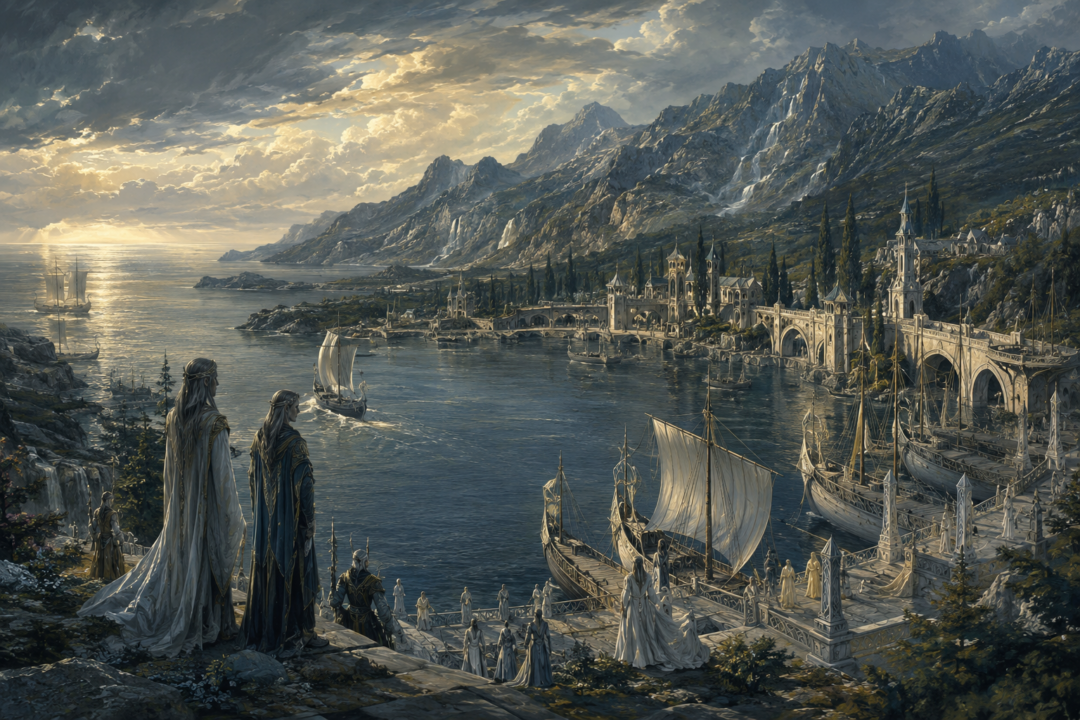
At the beginning of the Second Age, the most important road in Middle-earth may be the one leading west.
The War of Wrath is over. Morgoth has been defeated and thrust from the world. Beleriand, where so much of the First Age unfolded, has been broken and largely swallowed by the Sea. Survivors stand on unfamiliar shores, looking at a transformed map.
But what exactly is the Second Age beginning from?
That question matters more than it first appears. The Age can be introduced as the aftermath of Morgoth’s banishment, as the end of the long exile of the Noldor, or as the beginning of a different departure: the Edain leaving Middle-earth for Númenor. All three belong to the same historical transition, but foregrounding one rather than another changes the emotional meaning of the opening.
The chronology stays the same. The story does not.
The Most Obvious Beginning: Morgoth Is Gone
The cleanest historical dividing line is the fall of Morgoth.
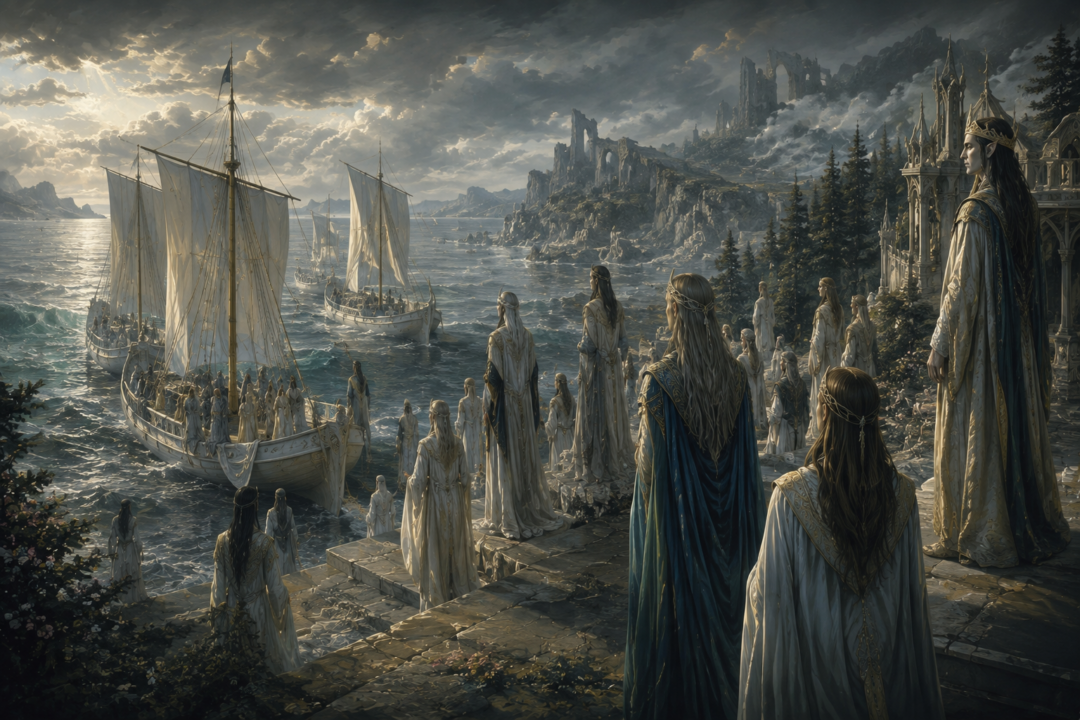
The First Age culminates in the War of Wrath, when the power of the West comes against Morgoth. His dominion is destroyed, Beleriand is devastated, and Morgoth himself is cast out of the world.
Seen from this angle, the Second Age begins as an age after catastrophe.
That distinction is essential because Sauron does not begin the Second Age as another Morgoth already ruling openly from a vast northern fortress. The older Dark Lord has been removed. His great wars have ended. The geopolitical world that produced Doriath, Nargothrond, Gondolin and the sons of Fëanor has effectively vanished with Beleriand.
The surviving peoples inherit ruins, memories and consequences rather than a restored version of the First Age.
This framing makes the opening of the Second Age feel almost like peace.
Almost.
Sauron survives the overthrow of his master. According to the account in The Silmarillion, he initially shows signs of repentance before ultimately refusing to return into the West for judgment. He then hides himself.
So the Age opens with an enormous absence: Morgoth is gone, but evil has not been eradicated.
That is one of the central ironies of the Second Age. The great visible tyranny has ended, leaving room for a more patient and deceptive form of domination to grow.
Yet Morgoth’s expulsion is only one possible lens.
For the surviving Noldor, the end of the First Age also closes something far older.
The Noldorin Exile Has Reached Its End — But Not Everyone Leaves
Long before the War of Wrath, the Noldor had departed Aman in rebellion and pursued Morgoth into Middle-earth.
Their history in Beleriand was therefore not simply a migration. It was an exile shaped by Fëanor’s oath, the Kinslaying at Alqualondë, the Doom pronounced upon the rebels, and generations of war beneath Morgoth’s shadow.
By the end of the First Age, that terrible cycle is finally broken.
After Morgoth’s defeat, the surviving Exiles are permitted to return into the West. Many do.
That makes the early Second Age strangely dependent upon refusal.
Middle-earth is no longer a prison for the remaining Noldor. For many of them, staying is now a choice.
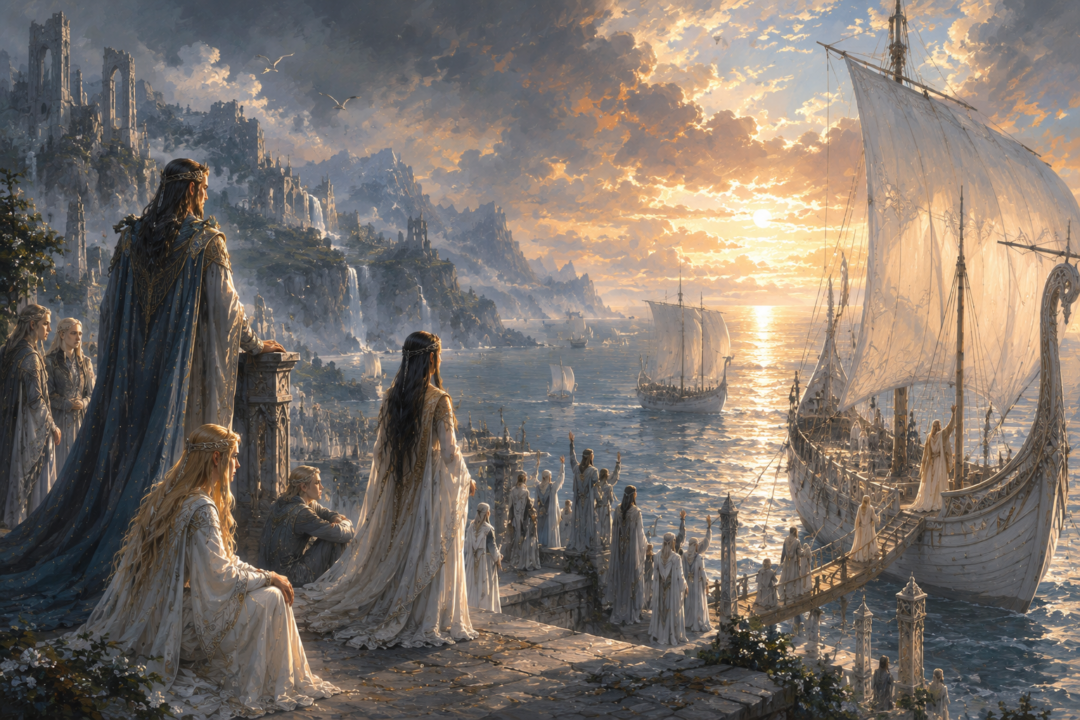
Gil-galad rules in Lindon, the surviving western remnant beside the Sea. The Grey Havens are founded at the beginning of the Age, and from them ships can depart westward. Appendix B describes Gil-galad as the last heir of the kings of the Noldor in exile, preserving the First Age’s political memory inside the new era.
This creates a profound change in what “exile” means.
During the struggle against Morgoth, the Noldor were cut off from easy return. After the War of Wrath, the road West is open again.
Yet some remain.
Their motives should not be flattened into a single explanation. Different surviving traditions concerning figures such as Galadriel complicate any attempt to make one universal rule out of the choice. What can safely be said is that significant Eldar continue to dwell in Middle-earth even though departure has become possible.
That decision becomes foundational to the Second Age.
Without Elves remaining east of the Sea, there is no Lindon as the great western Elvish realm of the Age, no later Eregion in the form we know it, and no setting in which Sauron can exploit Elvish longing through the Rings of Power.
The Second Age therefore begins partly because an exile ends — and partly because some of the Exiles do not go home.
Lindon Is a Kingdom Built at the Edge of Loss
If the Noldorin exile is foregrounded, Lindon becomes the natural opening image of the Age.
It is not simply another Elven kingdom replacing the fallen realms of Beleriand.
Its geography itself is evidence of disaster.
Most of Beleriand has vanished beneath the Sea. The coastline has been remade. The Gulf of Lhûn cuts through what had once been a different landscape, and the remaining land west of the Blue Mountains becomes the heart of Gil-galad’s realm.
In S.A. 1, the Grey Havens are established there.
This is one reason the Havens are such a powerful symbol for the entire Second and Third Ages. They are simultaneously a settlement and an exit.
Ships can be built there.
Elves can live there.
Elves can also leave from there.
The beginning of the Second Age is therefore not a triumphant founding in the usual sense. Lindon exists beside an open door out of Middle-earth.
That tension becomes especially important when compared with the other great people whose destiny is reshaped after the War of Wrath.
The Edain are also offered a new future.
But theirs requires travelling west for a very different reason.
The Edain Leave Middle-earth — and a New History Begins
The Men who aided the Eldar against Morgoth are rewarded after the wars of Beleriand.
For them, a new land is prepared in the Great Sea: Númenor.
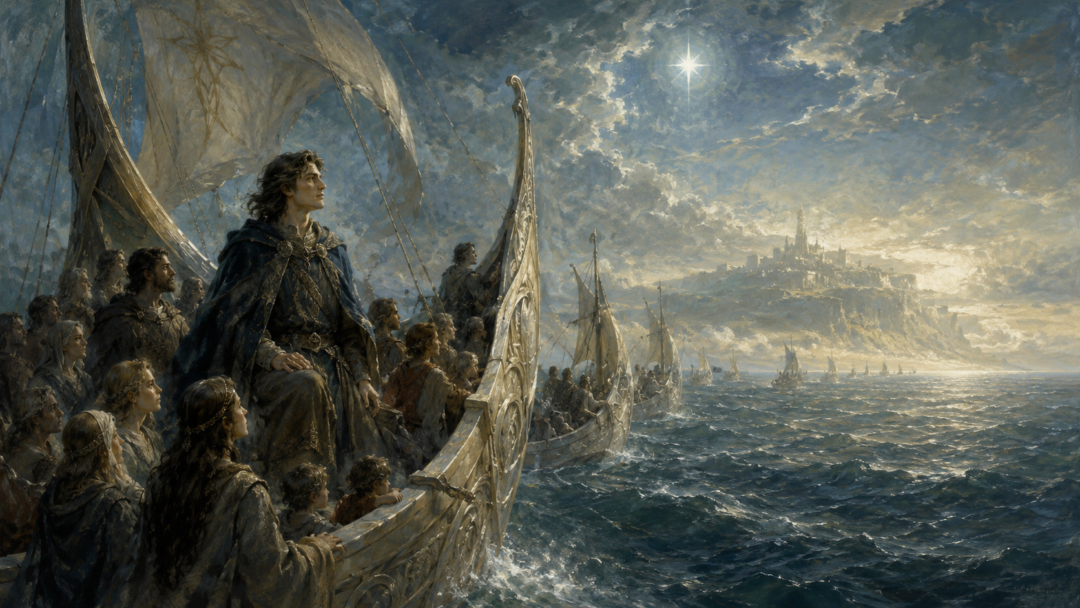
The migration does not occur in the first numbered year of the Age. The traditional chronology places the arrival of the Edain in Númenor in S.A. 32, when Elros becomes their first king, Tar-Minyatur.
That thirty-two-year difference matters.
Strictly speaking, the Second Age does not begin with Númenórean civilization already functioning at full strength. Its first decades belong to transition: the survivors of the Elder Days are reorganizing themselves while Númenor is still becoming the great Mannish center that will dominate the Age.
Yet narratively, the creation and settlement of Númenor can easily feel like the true beginning.
That is because so much of the Second Age’s long tragedy grows from this departure.
The Edain travel away from Middle-earth toward a land nearer the Blessed Realm than the mortal lands they have known. They receive long life, knowledge and prosperity. Their descendants eventually become the greatest maritime power among Men.
But the Gift has a boundary.
They remain mortal.
The Númenóreans may sail widely, yet they are forbidden to seek the Undying Lands. Over centuries, gratitude turns increasingly toward resentment of death. Resentment becomes fear. Fear becomes envy. And under Sauron’s manipulation, envy finally becomes rebellion against the West itself.
The irony is severe.
The Edain leave Middle-earth because of their faithfulness in the wars against Morgoth.
Their descendants ultimately destroy themselves by attempting to seize what was never given to mortals.
Foreground their departure, and the Second Age begins not primarily with Elven survival, but with a gift carrying the seed of a future test.
Two Westward Movements, Opposite Meanings
This is where the opening becomes especially revealing.
At almost the same historical threshold, Elves and Men are both confronted with the West.
For the Noldor, the West is home reopened.
For the Edain, the West is a new home granted to them — but only partway toward Aman.
The distinction defines much of what follows.
Elves may ultimately leave the changing world and sail into the West. Their continued presence in Middle-earth therefore becomes increasingly connected with memory, preservation and reluctance to surrender what they love.
Men cannot escape mortality by sailing farther west. Númenor is a blessing precisely because it remains a mortal kingdom.
The two peoples begin the Age looking toward the same horizon under radically different conditions.
One can return.
The other must know where to stop.
The tragedy of the Second Age grows partly from the refusal of both Elves and Men to accept forms of loss appropriate to their condition.
This should not be made into a simplistic equivalence. Their situations are not morally identical. But the structural parallel is difficult to miss.
The Elves of Eregion eventually desire to preserve beauty against the fading and alteration of Middle-earth. That desire helps make Sauron’s teaching attractive.
The Númenóreans eventually desire to preserve their own lives against death. That fear helps make Sauron’s later lies catastrophic.
Different peoples. Different temptations.
The same deep discomfort with passing away.
If the Noldorin Exile Is Foregrounded, the Age Begins With Lingering
Choose the Exile of the Noldor as the principal background event, and the beginning of the Second Age becomes a story about those who stay after they are free to leave.
Gil-galad’s Lindon is then the crucial realm.
Celebrimbor’s later Eregion becomes part of the unfinished history of the Noldor.
Even the forging of the Rings gains sharper context.
Sauron does not merely tempt skilled craftsmen with technological power. He approaches Elves who live in a world already marked by irreversible loss. Beleriand is gone. Their ancient kingdoms are gone. Mortals change. Lands change. Time itself threatens what they value.
The Rings cannot simply be reduced to nostalgia, but the preservation of what is loved becomes central to the Elvish side of the Ring story.
From this perspective, the Second Age is the long afterlife of the First.
The Exiles have survived Morgoth.
Now they must decide whether they can live without trying to hold Middle-earth unchanged.
If the Edain’s Departure Is Foregrounded, the Age Begins With Ascent
Choose the migration to Númenor instead, and the opening initially appears much brighter.
The Edain have suffered enormously in the wars against Morgoth. Now their descendants receive a kingdom beyond ordinary mortal experience.
Númenor rises.
Its people grow in knowledge and skill. They become mariners. After centuries, they return to Middle-earth and initially come as teachers and helpers to other Men.
The early trajectory is upward.
That makes the Downfall far more tragic.
Nothing requires Númenor’s story to end in the worship of Morgoth and the assault on Aman. Its corruption unfolds gradually across generations.
Foreground Númenor, then, and the Second Age becomes a study of how a gift can be transformed into grievance when its recipient begins measuring it against the one thing withheld.
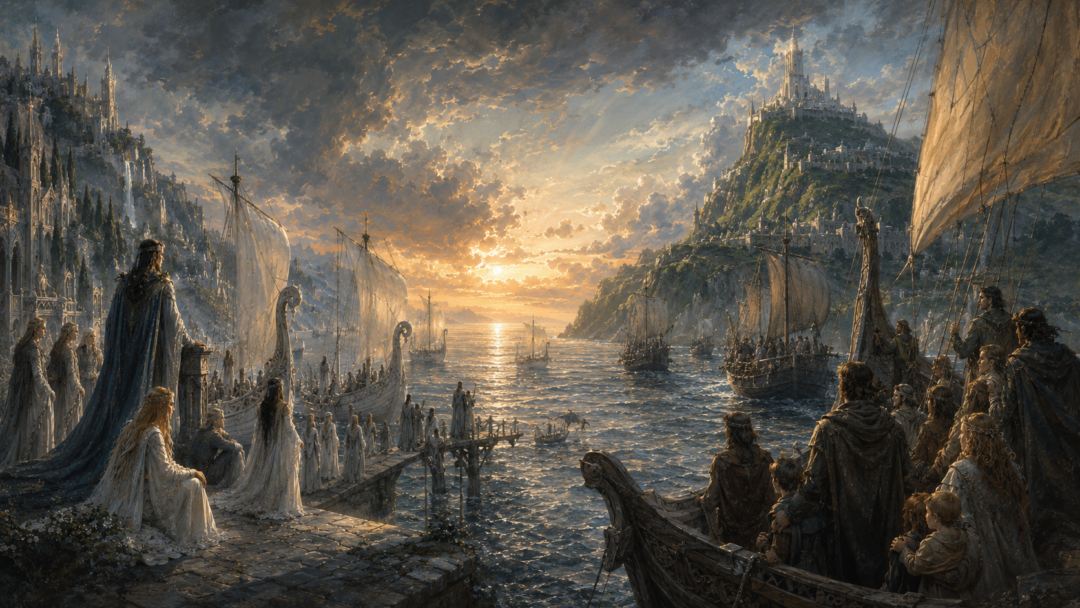
The Second Age Actually Begins Between These Stories
No single exile or departure completely explains the transition.
Morgoth is banished.
The Noldorin Exiles are permitted to return.
Many Elves sail West, while others remain.
The Edain depart Middle-earth and establish themselves in Númenor.
Beleriand disappears beneath the Sea.
Lindon rises beside new shores.
These are not separate introductions competing for the “correct” beginning. They are different views of the same historical rupture.
But each produces a different Second Age.
Begin with Morgoth, and the Age is about the survival and return of evil after apparent victory.
Begin with the Noldor, and it is about memory, lingering and the inability to release what is passing.
Begin with the Edain, and it is about mortality, reward, pride and the corruption of gratitude.
The chronology begins in S.A. 1.
The deeper story begins wherever we choose to place the wound.
And perhaps that is why the Second Age feels so different from the heroic wars of the Elder Days. Its defining catastrophes do not simply come from people losing what they possess.
They come from powerful peoples being given a future — and struggling to accept the limits built into it.
Sources & Notes
- https://tolkiengateway.net/wiki/War_of_Wrath
- https://tolkiengateway.net/wiki/Exile_of_the_Noldor
- https://www.encyclopedia-of-arda.com/s/secondage.html
- https://www.encyclopedia-of-arda.com/n/numenor.html
Sources cover the War of Wrath, the end of Noldorin exile, the opening chronology of the Second Age, and the Edain's migration to Númenor.