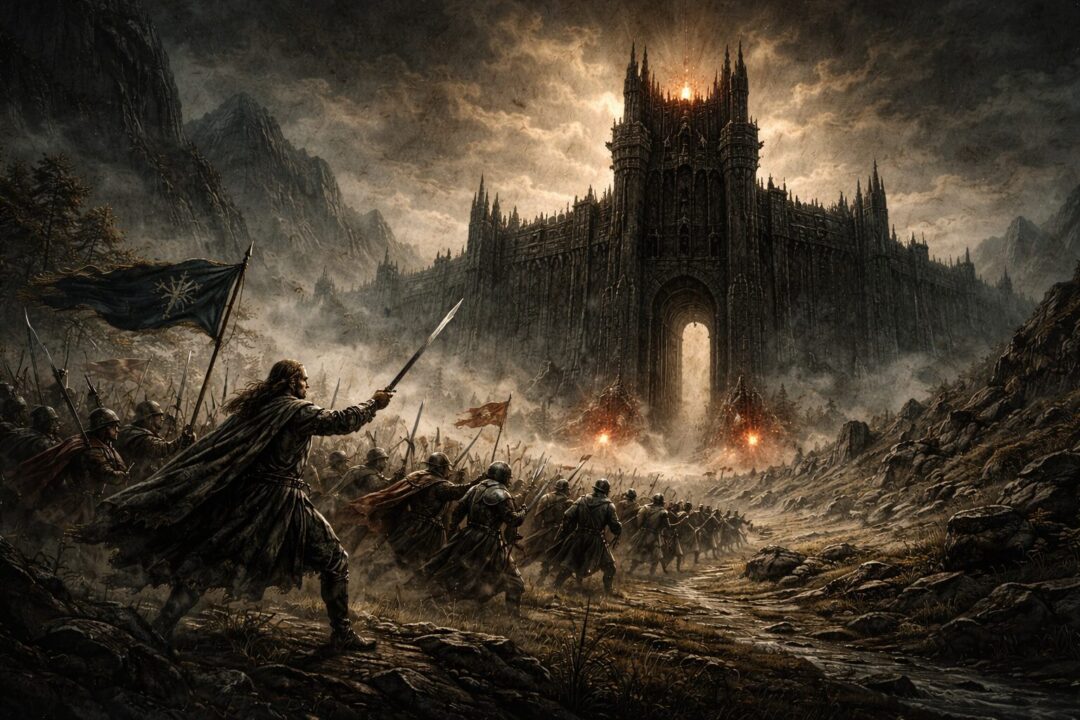
Sauron is often described as patient—and rightly so. He does not rush blindly into war. He waits centuries to rebuild his strength. He allows kingdoms to weaken before striking. He understands delay better than almost any other figure in Middle-earth.
And yet, by the end of the Third Age, that patience becomes his greatest liability.
Sauron does not fall because he is hasty, reckless, or short-sighted. He falls because his understanding of time is rooted in an older world—one that no longer exists.
To understand why Sauron ultimately fails, we need to stop thinking of him as a villain who acts too quickly—and start seeing him as one who never truly grasped how the age itself had changed.
A Mind Formed in the First Age
Sauron’s worldview is shaped by the First Age and the early Second, eras when history moved violently and decisively.
In those ages, power announced itself.
Great beings clashed openly.
Cities were destroyed in single nights.
The fate of the world turned on catastrophic confrontations.
When Morgoth fell, it happened through a war so immense that entire regions of the world were broken and reshaped. When Númenor fell, it happened in a single moment of divine judgment—sudden, absolute, and irreversible.
These were not slow endings. They were overwhelming conclusions.
Sauron learned his lessons in that world.
Victory came through domination.
Defeat came through annihilation.
History turned when power moved openly.
It is no surprise that he expects the same rhythm to govern the Third Age.
But the Third Age is fundamentally different.
The Third Age Is Not an Age of Collapse
The Third Age is not defined by sudden destruction. It is defined by erosion.
Kingdoms do not fall overnight—they thin out.
Peoples do not vanish—they diminish.
Power does not explode—it leaks away.
The great realms of Men fade slowly. The Elves do not depart in defeat, but in weariness. Even the memory of ancient victories becomes fragmented, half-remembered, and uncertain.
This is the world Sauron inhabits.
But it is not the world he truly understands.
He still expects decisive moments, clear turning points, and unmistakable declarations of power. He prepares for a final confrontation that resembles the wars of earlier ages.
What he fails to grasp is that the defining struggle of the Third Age will not look like a war at all.
Why Sauron Watches the Wrong Things
Throughout the War of the Ring, Sauron’s attention is fixed on figures who resemble the powers of earlier ages.
He fears a restored king in Aragorn.
He tracks Gandalf relentlessly.
He watches the great Lords of Elves and Men, expecting one of them to rise openly against him.
This is not arrogance.
It is logic—outdated logic.
In Sauron’s experience, history turns when great powers move into the open. Therefore, he assumes that the Ring, once found, will be claimed by someone who seeks mastery. Someone ambitious. Someone visible.
What he never seriously considers is refusal.
The idea that the Ring might be carried quietly, without being wielded, does not fit the older pattern of the world. It contradicts everything Sauron has learned about power, desire, and conflict.
By the time he realizes this possibility exists, the Ring is already beyond his reach.
Time as Concealment
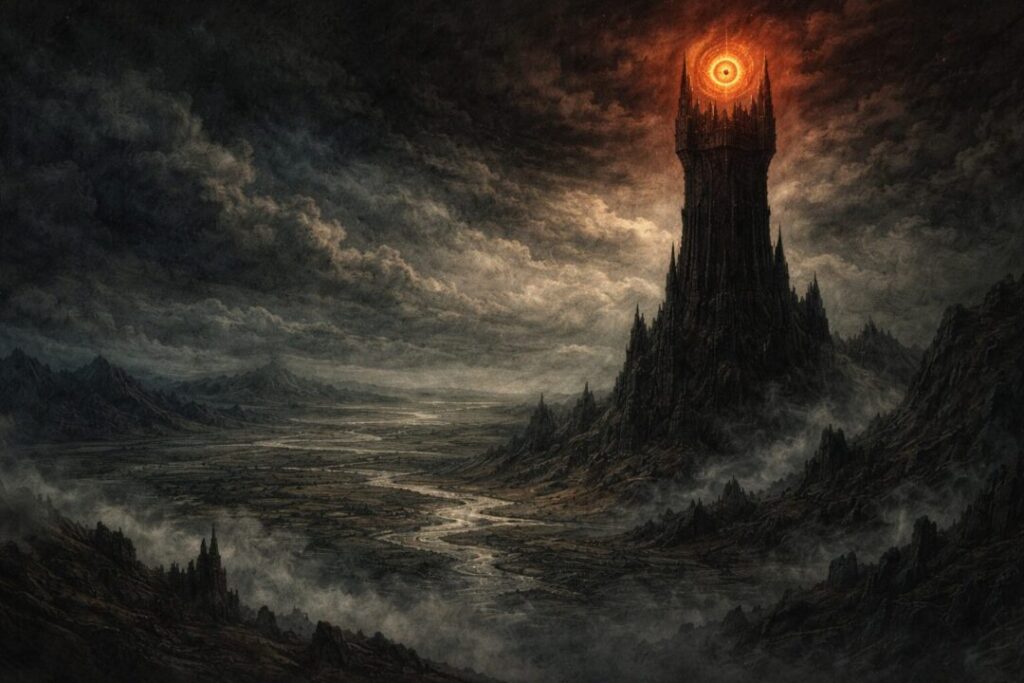
One of the Free Peoples’ greatest advantages is not secrecy alone—but slowness.
The Fellowship does not race.
Frodo does not hurry.
Decisions are delayed, debated, and often postponed.
From Sauron’s perspective, this looks like weakness.
Threats do not materialize when they should.
Movements occur out of sequence.
Opportunities appear to be wasted.
But what looks like hesitation is actually survival.
The Ring moves through Middle-earth not by force, but by endurance—measured in days, weeks, and months that do not announce themselves. There are no banners. No declarations. No unmistakable signs of intent.
Sauron watches for fireworks.
The Ring passes in silence.
Time itself becomes a kind of concealment. By refusing to accelerate events, the Free Peoples deny Sauron the decisive moment he expects—and relies upon.
The Blind Spot of Immortality
Sauron’s immortality gives him reach, memory, and patience. But it also distances him from the lived reality of change.
Mortal beings adapt because they must. Their time is limited. They notice subtle shifts because their lives depend on them. They respond to fading, decay, and delay intuitively.
Sauron does not experience urgency in the same way.
He assumes there will always be time to correct mistakes.
Always another year.
Always another campaign.
Always another opportunity to tighten his grip.
Ironically, this makes him slow in the moments that matter most.
The War of the Ring is not won by speed, but by arriving just in time. Repeatedly, Sauron acts too late—not because he is unaware, but because he believes delay is still on his side.
He cannot imagine a victory slipping through his fingers quietly.
The Final Miscalculation at the Black Gate
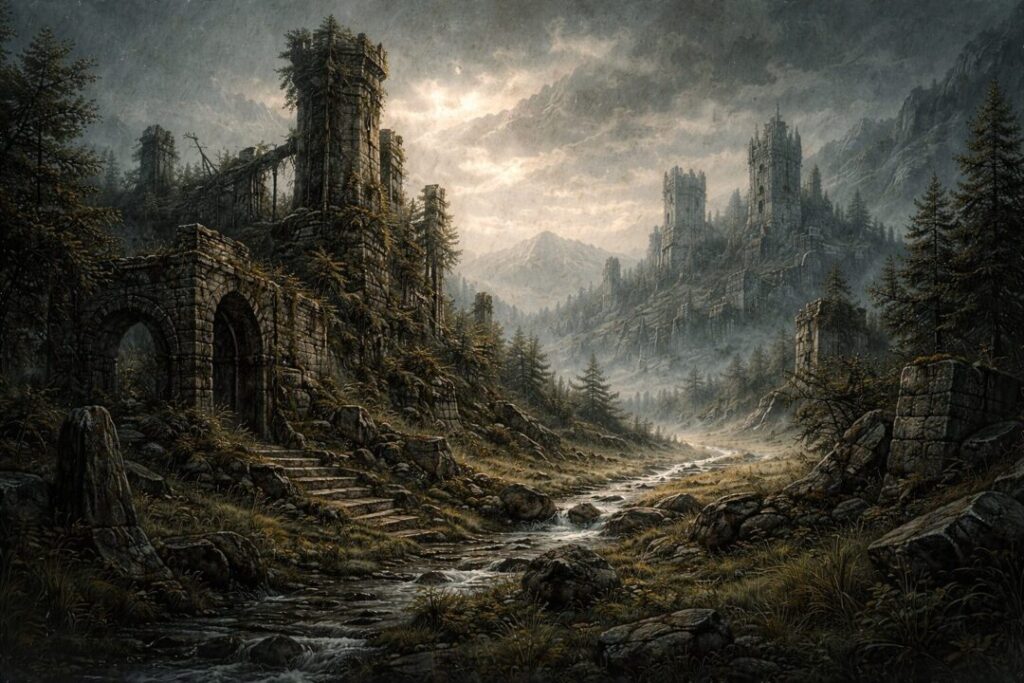
At the Black Gate, Sauron believes he has finally understood his enemies.
He sees Aragorn challenge him openly.
He sees armies march in desperation.
He believes the old pattern has returned at last.
To Sauron, this looks familiar. It resembles the wars he understands: power answering power, force meeting force.
What he does not see is that this confrontation is shaped entirely by time.
The war he sees is a delay.
The challenge he answers is a distraction.
The victory he prepares for has already slipped past him.
While Sauron focuses on what looks like a decisive confrontation, the true threat moves invisibly through the cracks his worldview cannot perceive.
He does not lose because he is reckless.
He loses because he is predictable—locked into a vision of history that no longer applies.
Middle-earth defeats him not by overwhelming him, but by outlasting him.
Why This Matters
The world of The Lord of the Rings does not reward domination.
It rewards humility.
It rewards endurance.
It rewards the willingness to let time do its work.
Sauron is powerful—but he cannot imagine a victory that looks like quiet persistence instead of conquest. He expects resistance to announce itself. He expects power to declare its intentions.
The Free Peoples win precisely because they refuse to do either.
In the end, Sauron is not defeated by a stronger force, a clever trick, or a sudden reversal.
He is defeated by a world that no longer moves at the speed he understands.
And in that failure to adapt—to patience, to slowness, to fading—time itself becomes his undoing.