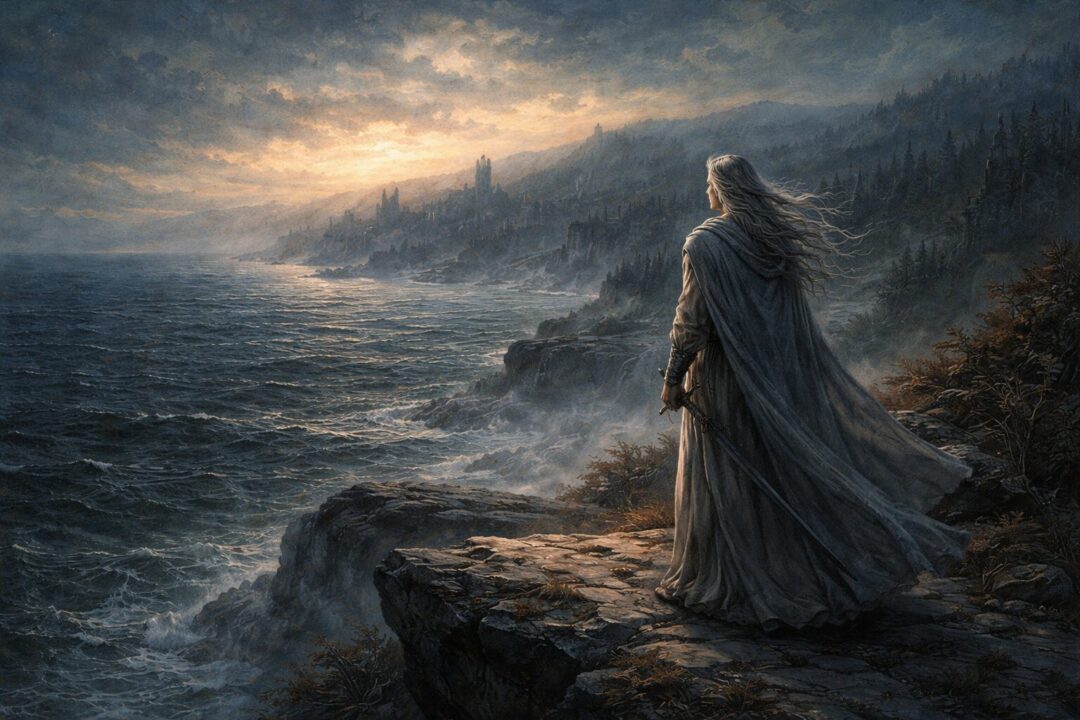
Most people think Middle-earth divides its peoples in a simple way.
Some are immortal.
Some are mortal.
At first glance, that seems true enough. Elves endure. Men die. Dwarves live longer than Men, but not forever.
But that is not actually the deepest divide.
The deeper divide is fate.
Middle-earth does not treat Elves, Men, and Dwarves as three versions of the same created life moving toward the same end at different speeds. It gives them different relationships to the world itself. Different endings. Different kinds of hope. Different kinds of loss.
And once that becomes visible, the emotional structure of the legendarium starts to change.
Because an Elf does not merely live longer than a Man.
An Elf is bound to a different kind of doom.
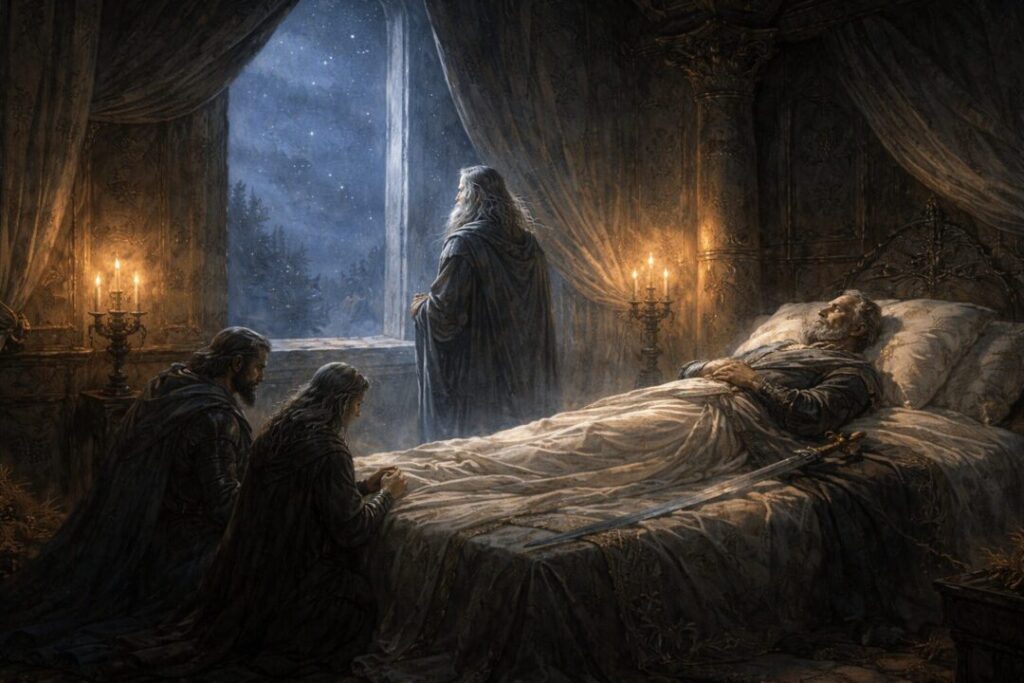
Fate in Middle-earth Is Not Just About Death
In Tolkien’s world, “doom” and “fate” do not simply mean prediction. They often mean the appointed nature of a being: what sort of end belongs to it, what relation it has to time, and whether it remains within the life of Arda or passes beyond it. That is why the differences between Elves, Men, and Dwarves matter so much.
The texts are clearest about Elves and Men.
Elves are bound to Arda. Their lives are linked to the life of the world, and even death does not free them from that bond. Their bodies may perish, but their spirits do not depart the world as Men do. In the larger metaphysical writings, Elvish fate is repeatedly described as remaining with Arda until its end.
Men are different in the most radical way imaginable.
They die, and that death is not merely loss. It is the Gift of Ilúvatar: the power to leave the circles of the world. Even the Valar do not fully know where Men go in the end. Their destiny lies beyond the created order in a way that the fate of the Elves does not.
Already, then, “fate” does not mean one thing.
It means being bound.
It means being released.
And then, when the Dwarves enter the picture, it means something harder to classify.
The Elves Are Bound to the Life of the World
Many readers envy the Elves because they do not die of age or disease.
But the texts never present this as simple blessedness.
Elves endure for as long as Arda endures. Their spirits are bound to the world, and even when their bodily life is interrupted, their story remains inside that same world-order. In later writings, death for Elves is a severance, but not a departure from Arda itself. They may remain in Mandos, and in some cases be re-embodied.
That makes Elvish fate beautiful, but also heavy.
An Elf does not escape history.
An Elf sees the long defeat.
An Elf remembers what is lost.
An Elf remains while kingdoms fall, forests diminish, languages change, and whole ages close.
This is why Elvish immortality in Middle-earth so often carries sorrow with it. The permanence that Men imagine as enviable is tied to endurance, memory, and an inability to step outside the wounds of the world. That is one reason the fading of the Elves matters so deeply: they are not just leaving lands behind, but living out the logic of a fate that has always bound them to Arda’s long wearing-down.
So when the story speaks of the Elves’ “immortality,” it is not describing freedom.
It is describing attachment.
Their fate is to remain.
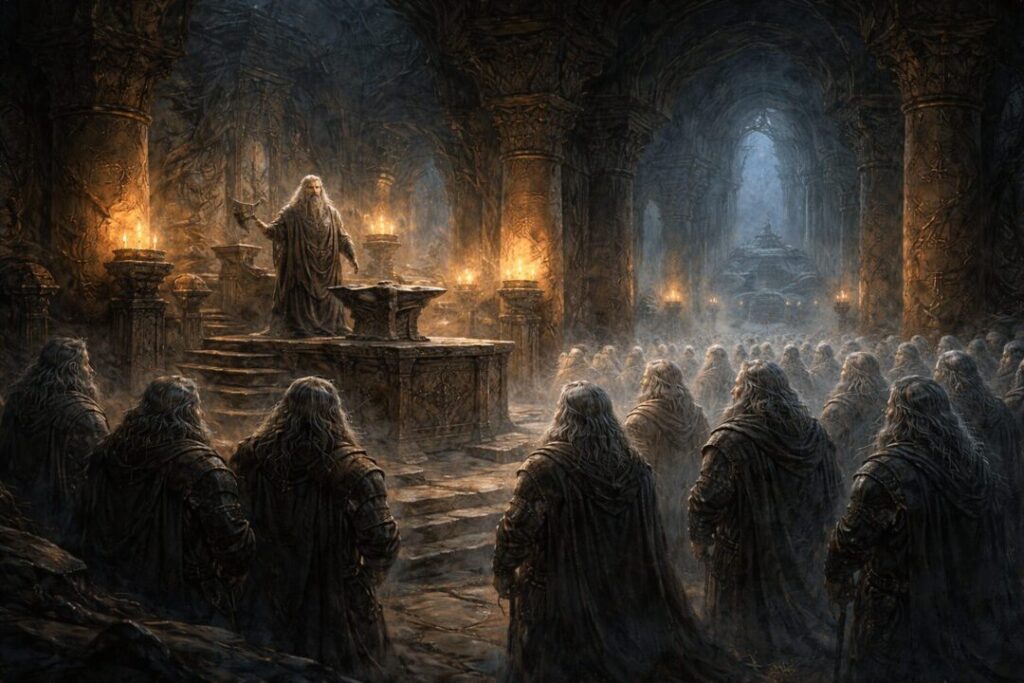
Men Receive the Gift That Looks Like a Loss
If the Elves are defined by remaining, Men are defined by departure.
That is why the language around Men is so startling.
The texts do not merely say that Men die. They say death is their Gift. They say Men leave the circles of the world. They say their destiny goes beyond the knowledge of the Valar. And in the wider tradition, Men are associated with a freedom that lies beyond the Music of the Ainur, which is described as “fate to all things else.”
That does not mean Men are carefree or untroubled by death.
Quite the opposite.
One of the recurring tragedies of Men in Middle-earth is that they often fear their own gift. Númenor is the greatest example: the attempt to turn mortality into a wrong, rather than a mystery, becomes one of the great corruptions of the history of Men. The problem is not that Men are doomed unfairly, but that they come to hate the very thing meant to distinguish them.
This makes the fate of Men more unsettling than Elvish endurance.
Elves know they are bound.
Men are asked to trust an ending they cannot see.
That trust is one of the deepest pressures placed on human life in the legendarium.
To die as a Man is not simply to stop.
It is to go where the world cannot follow.
The Dwarves Stand in a Category of Their Own
And then there are the Dwarves, who do not fit cleanly into either pattern.
They are mortal. On that point, the texts are clear enough. They do not possess the serial longevity of the Elves, and they do die. But their origins and their destiny are treated differently from both Elves and Men.
The Dwarves were made by Aulë before the awakening of the Elves, and only truly became living beings when Ilúvatar accepted them. Their people therefore enter the world under unusual conditions from the very beginning. They are not outside Ilúvatar’s design in the final sense, but their history carries the mark of being a people with a distinct making and a distinct memory of that making.
That distinctness continues into their beliefs about death.
The tradition of the Dwarves says that Mahal gathers them to halls in Mandos set apart from the spirits of Elves and Men. It further says that Ilúvatar will hallow them in the end and give them a place among the Children, and that they will aid Aulë in the remaking of Arda after the Last Battle.
Here caution matters.
This is presented as Dwarvish tradition. It is not laid out in the same fully elaborated theological language used for Men in the “Gift of Ilúvatar,” nor as repeatedly across the legendarium as the binding of the Elves to Arda. But it is not mere rumor either. It appears in a serious textual context and is clearly meant to show that the Dwarves understand their own fate as neither Elvish nor Mannish.
So the Dwarves do not simply “die like Men.”
Nor are they bound exactly as Elves are bound.
They occupy a third pattern.
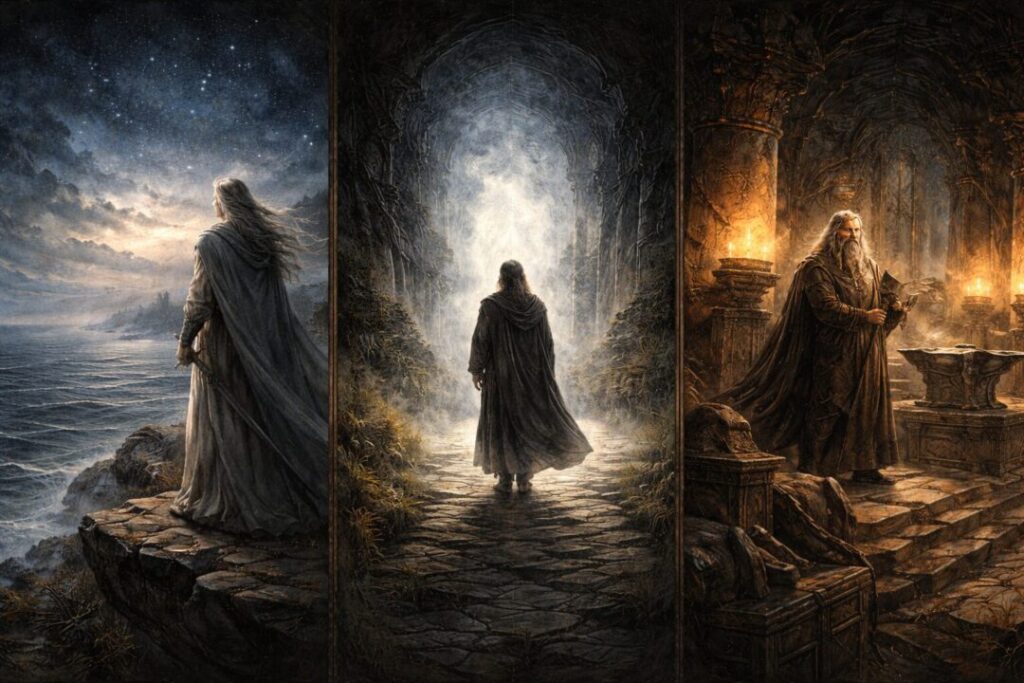
Why This Difference Matters So Much
At first, this may sound like abstract metaphysics.
It is not.
It changes the emotional meaning of nearly every race in Middle-earth.
For the Elves, tragedy is often tied to memory, endurance, and the impossibility of leaving the world’s long grief behind. Their fate gives them depth, but also weariness.
For Men, tragedy is tied to fear, uncertainty, and the temptation to seize permanence inside a world they were never meant to keep forever. Their danger is not that they are too bound to history, but that they rebel against passing through it.
For Dwarves, the emotional pattern is different again. Their tradition looks toward endurance of lineage, memory of craft, and a hope preserved within their own people. Even their belief about the end is not framed as departure beyond the world in the manner of Men, but as a future place in the remaking of it.
That helps explain why Middle-earth never feels like a world with one theology mechanically applied to everyone.
Its peoples do not merely differ in culture.
They differ in destiny.
Fate Is Also a Clue to What Each People Is For
The pattern goes deeper still.
Elves are the people of preservation, memory, beauty, and loss within time. Their bond to Arda matches their role as those who remember its ancient light and bear its diminishment most keenly.
Men are the people of change, succession, risk, and trust. Their gift of leaving the world makes them the least secure within history and, in another sense, the most open to a future beyond it.
Dwarves are more guarded in the texts, so any larger pattern must be stated carefully. But the material does suggest a people defined by making, endurance, inheritance, and a loyalty to their own memory of origin under Mahal. Their fate, as they remember it, preserves that identity rather than dissolving it into one already familiar pattern.
So fate in Middle-earth is not random decoration.
It is part of the design of each people.
It tells us what kind of burden they bear.
It tells us what kind of hope they can have.
And it tells us why they do not misunderstand one another merely by accident, but by nature.
The Most Striking Truth Is That None of These Fates Is Simple
The Elves are not simply lucky.
Men are not simply cursed.
Dwarves are not simply a lesser version of either.
That is the great correction.
Elvish fate contains sorrow.
Human fate contains mystery.
Dwarvish fate contains reserve.
And Middle-earth is richer because it refuses to flatten them into a single answer.
The Elves remain in a world that wounds them.
Men leave a world they cannot keep.
The Dwarves hold to an end remembered in their own tradition, apart from both.
Once that is seen, “fate” in Middle-earth stops meaning inevitability.
It starts meaning identity.
Not merely what happens to a people.
But what kind of people they were always made to be.
And that is why the difference matters.
Because the legendarium is not only asking who lives longest, or who dies first.
It is asking what ending belongs to each people at all.