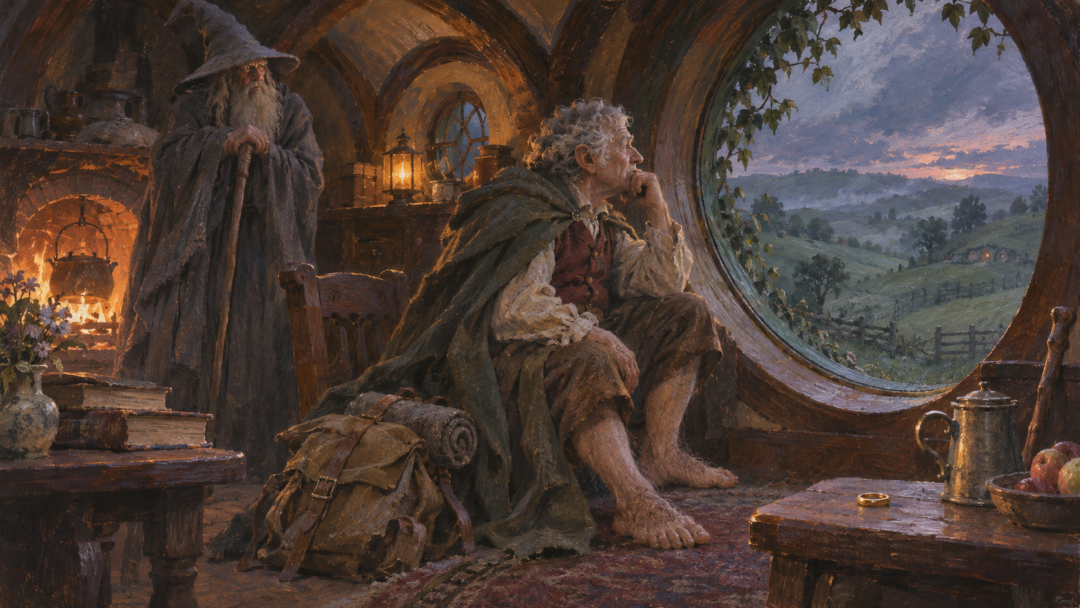
After the fireworks and his remarkable disappearance at his eleventy-first birthday party, Bilbo Baggins slips back into Bag End, changes into travelling clothes, and retrieves an old, weather-stained cloak. He is preparing to leave the Shire. Yet the most unsettling object in the hobbit-hole is not his packed bag. It is the small golden Ring he is supposed to leave for Frodo, and somehow cannot quite put down.
Is Bilbo’s longing for a holiday really the Ring calling him toward its maker in Mordor? The Ring has certainly begun to harm him: his unnatural weariness and painful possessiveness are unmistakable warnings. But the text does not show it giving him a destination. His wish to see mountains belongs to an older part of his character, and his departure follows his surrender of the Ring. Gandalf’s account of Gollum helps explain why those are different claims.
The holiday Bilbo actually wants
The holiday conversation appears in A Long-expected Party, the first chapter of The Fellowship of the Ring. Earlier, seated with Gandalf beside a window overlooking his garden, Bilbo admits his affection for the Shire but says he needs a holiday. He tells the wizard he made up his mind months ago. This is no sudden compulsion striking him at the feast. Advance planning cannot prove his desires are untouched by the Ring, but it defeats the idea of an unexpected command that evening.
After his disappearance, Bilbo describes a withdrawal from familiar life. Though unusually well preserved, he feels old within, comparing himself to butter spread over too much bread. The image conveys an unnatural sense of being worn thin, not literal physical wasting. Gandalf takes the remark seriously. Beneath the comic complaints of a hobbit weary of visiting relations, something is genuinely wrong.
Bilbo’s goal is specific in mood but not on a map. He says, “I want to see mountains again, Gandalf, _mountains,_” then speaks of finding peace away from visitors, somewhere to finish his book. He wants to see wild country again before he dies. These details describe travel followed by rest, not a mission to a dark fortress. The mountains recall adventure; the book and hoped-for quiet suggest a wish to finish his story.
His plans also make room for Frodo. Bilbo says Frodo offered to join him once, but believes his heir still loves the Shire, with its woods, fields, and little rivers. Leaving Bag End to Frodo is part of the arrangement. This is the thinking of someone trying to arrange a future for another person while changing his own life. The holiday has a domestic purpose as well as a taste for travel.
Mountains mattered to Bilbo before he found the Ring
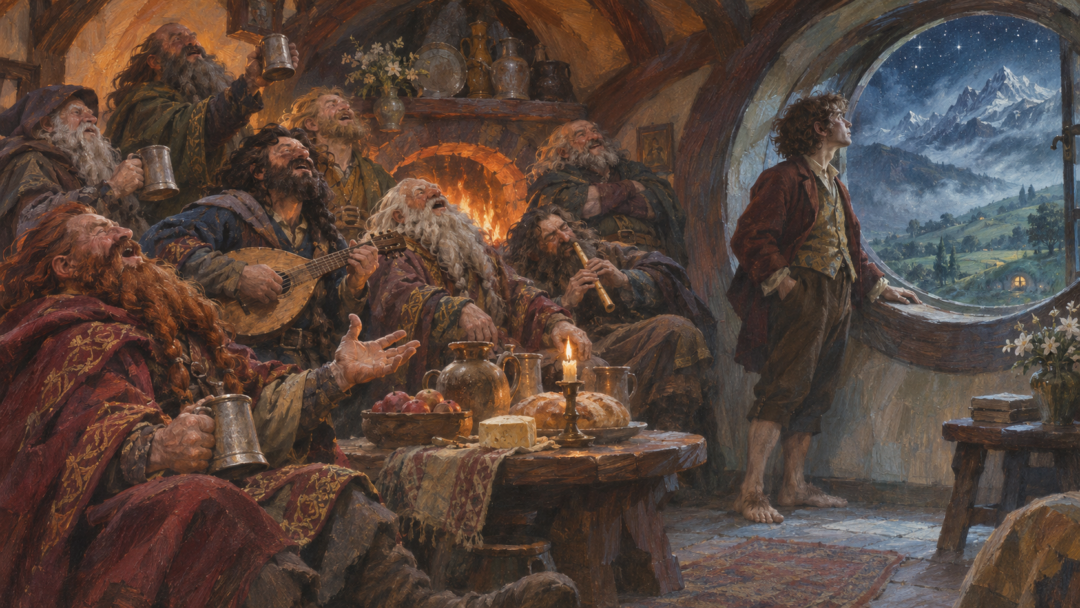
Return to An Unexpected Party in The Hobbit, before Bilbo has entered Gollum’s cave or found the Ring. The Dwarves gather in his home, play instruments, and sing of their lost mountain kingdom. Their music fills the comfortable room with visions of remote country, caverns, treasure, and fire. Bilbo, occupied until then with guests and supper, suddenly wants to see mountains, forests, waterfalls, and the wider world.
The narrator calls this awakening Tookish, describing the adventurous streak beneath Bilbo’s respectable Baggins habits. It is not a hereditary spell. Indeed, the thought of dragons soon frightens him back toward the safety of Bag End. Both impulses are already present: love of home and fascination with distant places. His later wish to revisit mountains has a clear predecessor requiring no Ring to explain it.
By his eleventy-first birthday, Bilbo has actually lived the adventure his younger self imagined. He crossed the Misty Mountains, visited Rivendell, passed through perilous country, and reached the Lonely Mountain. Those places are now memories and material for the book he is writing. Nostalgia and curiosity are plausible reasons to seek them again. That does not rule out mixed motives after decades of Ring-bearing; it simply means that travelling toward mountains cannot itself diagnose corruption.
The real danger appears when Bilbo must leave the Ring
After the party, Bilbo places the Ring and its chain in an envelope for Frodo, then takes it off the mantelpiece and puts it back in his pocket. Gandalf notices. When pressed to honour their agreement, Bilbo becomes suspicious and angry. He insists on his ownership and begins calling the Ring by the possessive name associated with Gollum. The change is alarming because it interrupts a conversation between old friends.
Bilbo admits that the Ring has increasingly occupied his thoughts. He checks whether it is safe, feels drawn to use it to disappear, and cannot rest when it is locked away. These are not vague hints buried in geography: they are habits of fixation, followed by a struggle when he is asked to surrender the object. Gandalf recognizes that its hold on Bilbo has become dangerous.
Still, Bilbo intends to provide for Frodo and eventually agrees to part with the Ring. Even then, his hand recoils at the final act and the envelope falls before Gandalf sets it in place. Another flare of anger gives way to relief. His freedom is not effortless. The resistance reveals damage concealed by a life that outwardly looks almost untouched by age.
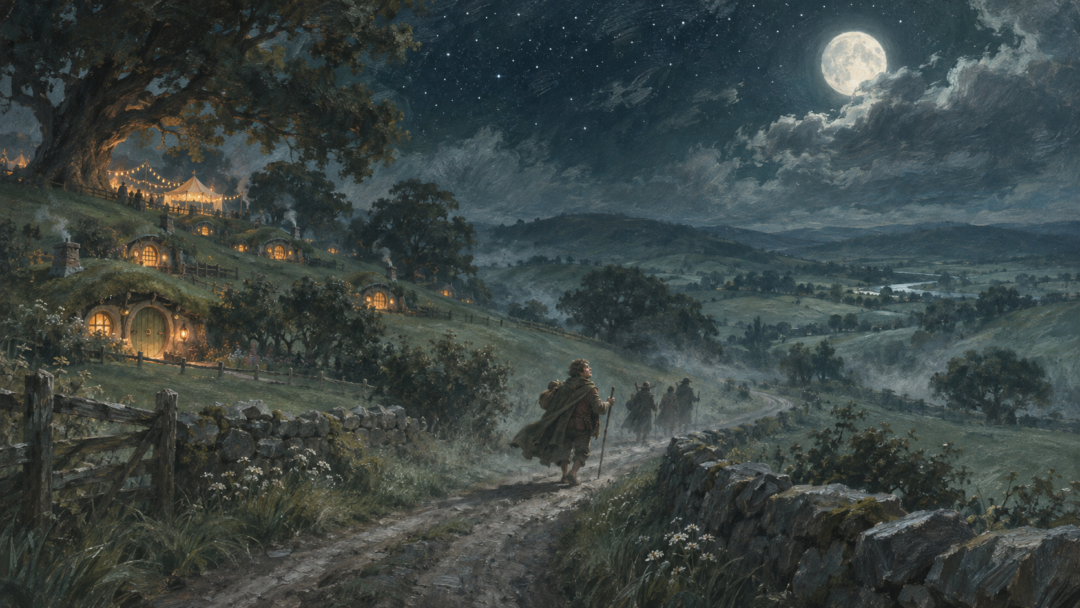
Only after the Ring is left behind does Bilbo step into the starlit night with his travelling things. His pleasure in setting out again follows a scene of release. Surrender need not instantly erase every consequence of long possession. But the sequence is decisive for the theory: the Ring’s grip is displayed inside Bag End, and Bilbo departs without carrying it. He is not transporting the One Ring toward Sauron.
Why Gollum’s road south is different
The strongest case for a pull toward Mordor comes from Gandalf’s account of Gollum in The Shadow of the Past, the following chapter of The Fellowship of the Ring. There Gandalf later explains the Ring’s history and danger to Frodo. It is not the location of Bilbo’s holiday speech. The passages can illuminate each other, but they concern different people in very different circumstances.
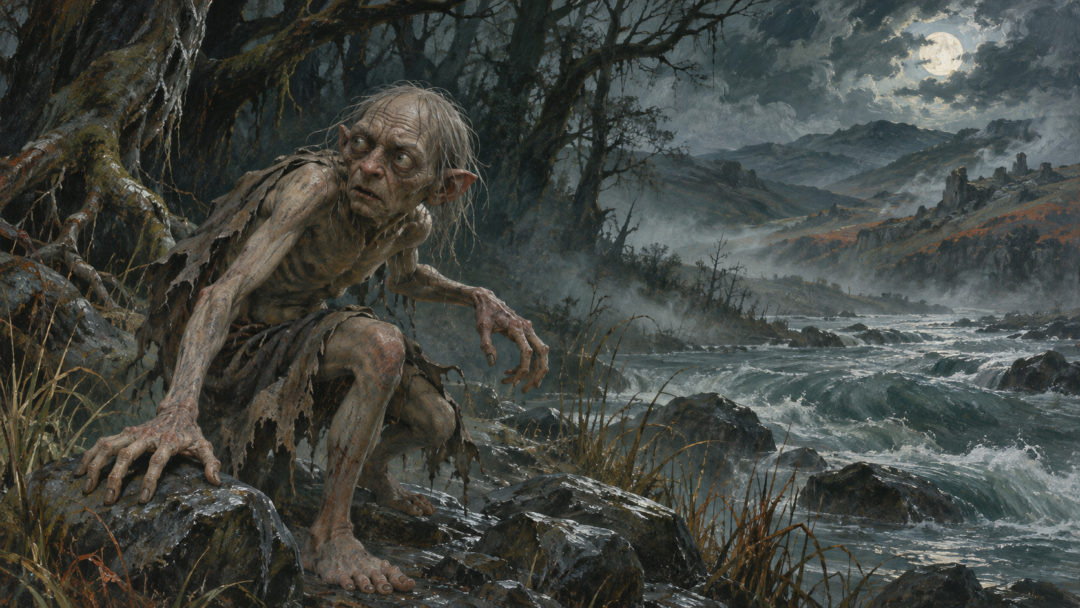
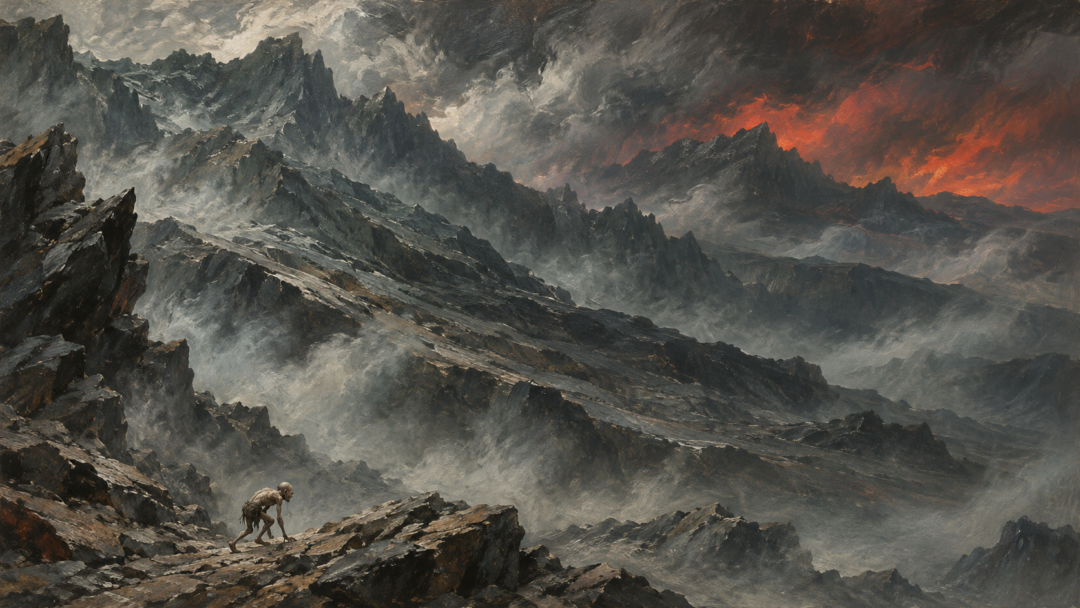
After losing the Ring, Gollum searches for his thief. He gathers information around the Long Lake and Dale, where Bilbo’s name and his home in the West are known. Gandalf believes Gollum initially tries to follow that trail, going west toward the Great River. Then he turns aside. The Wood-elves follow his tracks through Mirkwood, but the trail veers south and is lost. Gandalf later learns that Gollum reached Mordor.
Gandalf names several forces involved. Mordor attracts wicked things; the Dark Power is gathering them; and the Ring’s former possession “would leave its mark, too, leave him open to the summons.” Gollum remains vulnerable without holding the Ring. Yet this is not an object acting as a navigational compass. Gollum has lost it, remains obsessed with recovering it, and encounters a separate attraction from Sauron’s gathering power.
Nor is Gollum merely a passenger dragged across the map. His resentment of Bilbo, wish to reclaim the Ring, and opportunities for mischief all matter. Gandalf describes the terrible outcome: Gollum is captured and questioned in Mordor, and the Enemy learns clues about the Ring and the name Baggins. Several motives can shape a journey while leaving its traveller vulnerable to exploitation by a stronger will.
The posthumously edited Hunt for the Ring material supplies a further example. Tolkien Gateway’s summary of an account in Unfinished Tales describes Sauron releasing Gollum and sending spies after him, expecting him to hunt for his thief. Sauron exploits an existing obsession; that does not establish control over every step. The surviving accounts vary in details, so they should not be combined into one exact itinerary. Gandalf’s earlier explanation already establishes the crucial point: a former bearer can answer Mordor’s summons without possessing the Ring.
A road east is not necessarily a road to Mordor
The Shire lies in the West, while much of Bilbo’s beloved wild country lies east. His old adventure led through the Misty Mountains toward Erebor, so eastward travel might sound ominous once the Ring’s origin is known. But Middle-earth contains many destinations east of the Shire. Bilbo names mountains and peace, not Mordor. A direction on a map is weak evidence of a supernatural summons.
At the party, Gandalf is troubled by Bilbo’s Ring and the hold it has over him. The fuller identification of it as Sauron’s One Ring comes in The Shadow of the Past. Rereading with that knowledge, we may project a hidden command into every remark Bilbo makes. His strange condition warrants suspicion, but neither a stated destination nor an observed command supports that leap.
There is a quiet irony: Bilbo talks about distant mountains while his most urgent battle happens at home, beside the mantelpiece. Gandalf does not forbid the journey; he insists that the Ring stay behind. The immediate danger lies not in wanting a holiday, but in the object Bilbo cannot easily release. His longing for travel and his need for freedom from the Ring meet in the same farewell without becoming the same desire.
When Bilbo leaves Bag End, the party lights are behind him and the stars are over the road. His age, his memories, and his hope of a quieter ending travel with him. The Ring does not. That absence gives the farewell its force: he has been wounded by what he carried, but the road ahead is not shown as a summons to Mordor. At last, it is a road he can walk without it.
Sources & Notes
This article is based on close reading and interpretation of Tolkien's published works and related source material where relevant.