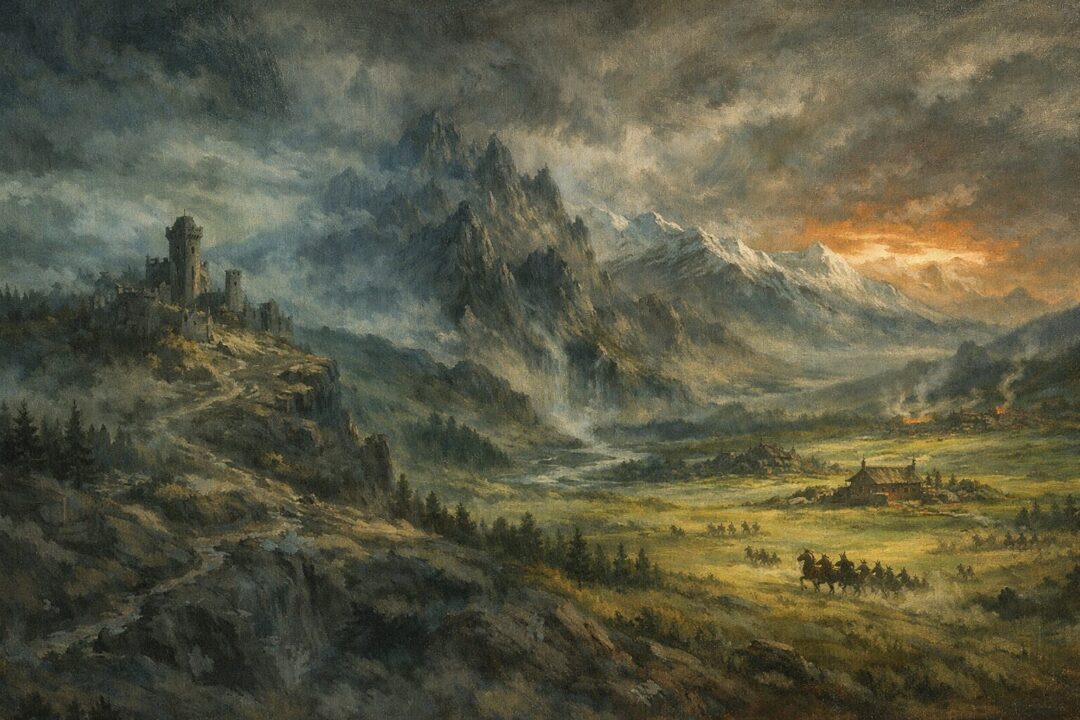
At first glance, the question sounds simple.
No. Rohan is not Arnor.
But in Middle-earth, the simple answer is rarely the interesting one.
Because the confusion does not come from nowhere. Both are kingdoms of Men. Both stand within the western story of resistance to the Shadow. Both are linked, directly or indirectly, to Gondor. And by the end of the Third Age, both fall under the restored order shaped by Aragorn’s kingship. So it is easy to feel that Rohan is somehow just another version of Arnor, or perhaps a later southern branch of the same old realm.
The texts do not support that.
They show something more precise, and more revealing.
Rohan is not Arnor reborn.
It is not a surviving fragment of Arnor.
It is not a renamed piece of the North-kingdom.
It is a separate kingdom, with a different origin, a different people, and a different political place in the history of Middle-earth.
Arnor belongs to the old Númenórean order
To understand the difference, Arnor has to come first.
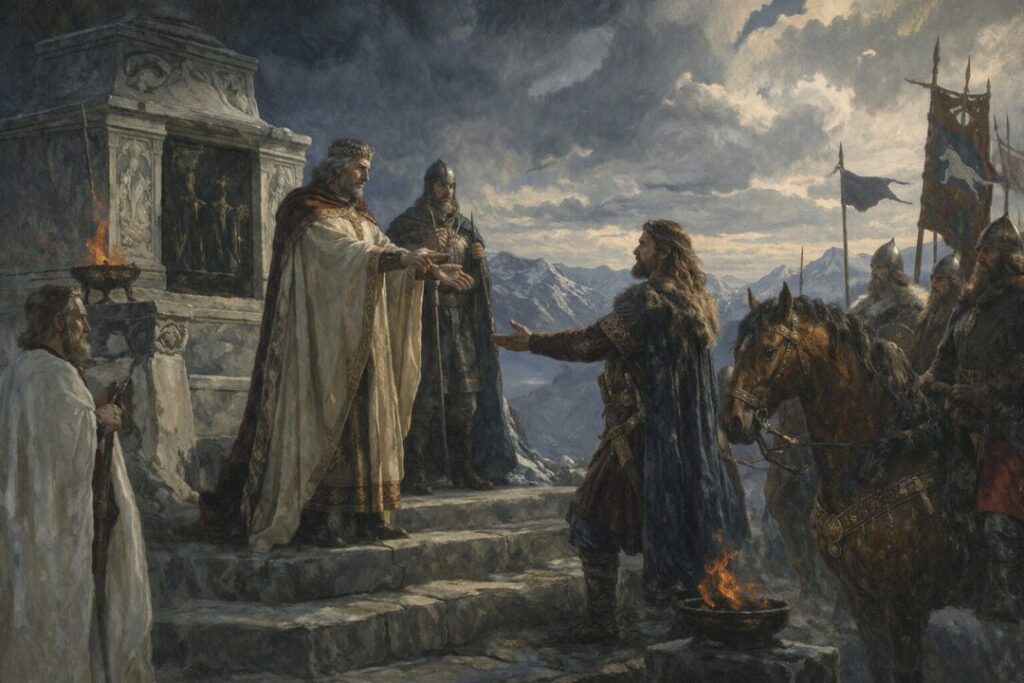
Arnor is one of the two great realms in exile founded after the Downfall of Númenor. Elendil and his sons established Arnor in the north and Gondor in the south, and together these became the Númenórean kingdoms in Middle-earth. Arnor is therefore not just an ordinary Mannish country. It belongs to the highest political order Men achieve in the West after Númenor’s fall. It is a Dúnedain kingdom, tied to Elendil’s line and to the inheritance of the Faithful.
That is why Arnor carries such weight in the background of The Lord of the Rings.
Even though it has long fallen by the end of the Third Age, it remains part of Aragorn’s claim. He is not inventing a new northern kingship when he rises. He is restoring an old one. The lost North-kingdom still matters because its line never fully ends. It survives in the heirs of Isildur and in the Rangers of the North.
So Arnor is ancient in a very specific way.
Its authority comes from descent, from Númenórean foundation, and from the line of Elendil.
That matters when Rohan enters the story, because Rohan does not begin there.
Rohan begins as Calenardhon, not as Arnor
Rohan starts as Calenardhon.
That name matters because it tells us what the land was before the Rohirrim ever arrived. Calenardhon was a province of Gondor: the wide green region north of the White Mountains. It was not part of Arnor, and it was not treated as northern Dúnedain territory. It belonged to Gondor’s sphere. Over time, Gondor’s population thinned and its strength was stretched, making the region difficult to hold.
Then comes the decisive change.
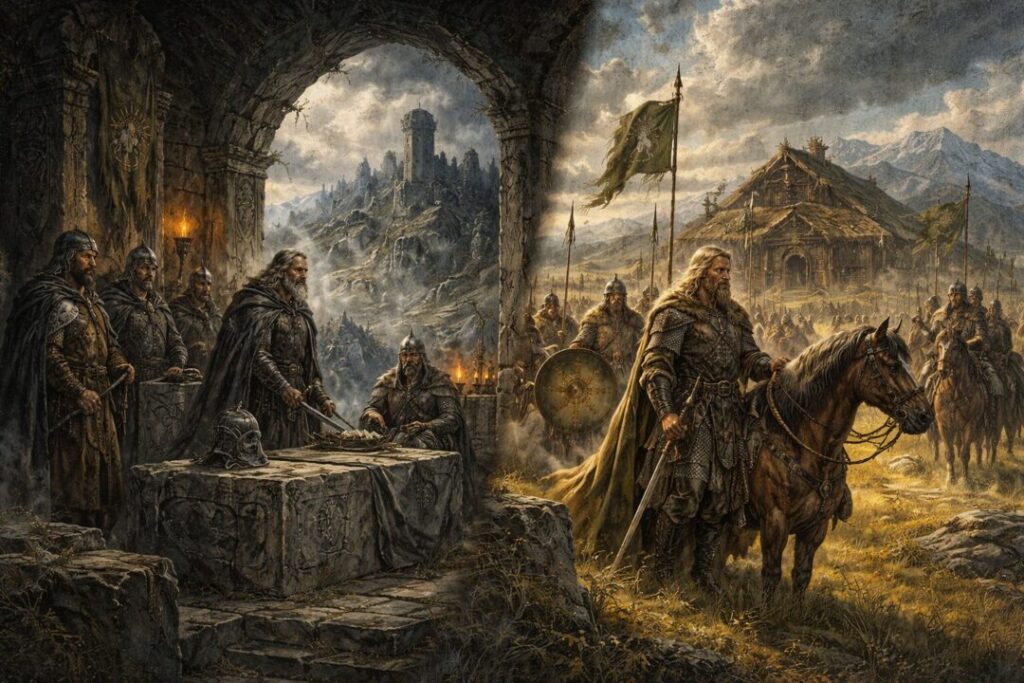
In the days of Steward Cirion, Gondor faced grave danger, and Eorl the Young led the Éothéod south to aid them at the Field of Celebrant. After that victory, Cirion granted Calenardhon to Eorl and his people. That grant is the political beginning of Rohan. The kingdom is born not as a continuation of Arnor, but as a new realm established on land once held by Gondor and given in perpetual alliance to a different people.
This is the first major distinction.
Arnor is founded by Elendil as one of the great Realms in Exile.
Rohan is founded much later when Gondor cedes Calenardhon to Eorl.
Those are not the same kind of beginning.
The Rohirrim are not the Dúnedain of Arnor
The second difference is even more decisive.
The people of Arnor and the people of Rohan do not come from the same branch of Men.
Arnor is a kingdom of the Dúnedain: descendants of the Númenórean exiles who came out of the wreck of the West. Its ruling line belongs to Elendil’s house, and its identity is inseparable from that inheritance.
The Rohirrim are not Dúnedain.
Their ancestors are the Éothéod, and the Éothéod are a people of the Northmen. The Northmen are related, in a broad and ancient sense, to the Edain, but they are not the Númenórean High Men. In Gondorian thought they are closer in friendship and nobility than many other peoples of Men, but they are still distinct in descent, culture, and status.
This matters because it keeps us from collapsing all “good Men of the West” into one political family.
Rohan is close to Gondor, and honorable in its own right, but it does not derive its kingship from Elendil.
Its royal house descends from Eorl.
Its people come from the horse-lords of the North.
Its language and culture are its own.
That is why the kingdom feels different even before the history is explained. The Rohirrim are not faded northern Dúnedain. They are another people entirely.
Why the confusion still feels natural
And yet the confusion persists because Rohan is not just any separate kingdom.
It is unusually close to the old Númenórean order.
That closeness begins at its foundation. The alliance of Cirion and Eorl is not a casual treaty. It is solemnized in deeply charged terms, and the oath is connected to the memory of Elendil. That gives Rohan, from its first moment as a kingdom, a symbolic link to the older western inheritance. Not because it becomes Arnor, but because it is deliberately joined to Gondor’s fate.
This is why Rohan feels more central than many other Mannish realms.
Dale matters.
The Beornings matter.
The Men of Bree matter in their own smaller way.
But Rohan enters the high political story of the West through covenant. It becomes Gondor’s chief ally. In the late Third Age, when so much of the old world has diminished, that bond carries extraordinary weight.
So the resemblance people feel is partly real.
It is just not identity.
Rohan is not Arnor. But it does stand nearer to Gondor and the legacy of Elendil than most other kingdoms of Men do.
Rohan is outside the Reunited Kingdom for a reason
One of the clearest pieces of evidence comes after the War of the Ring.
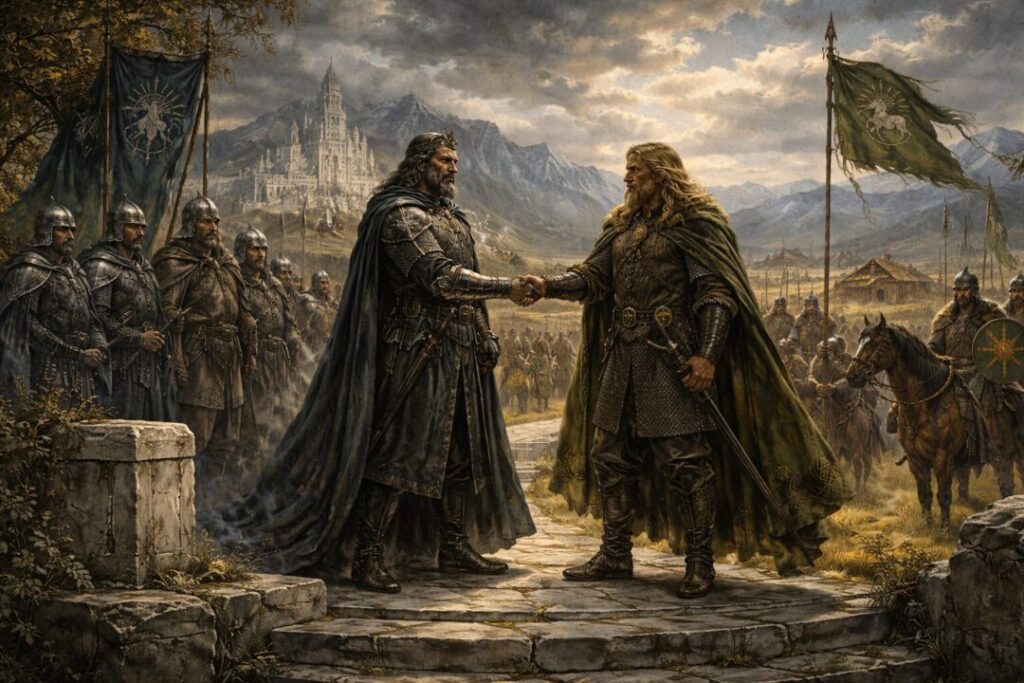
When Aragorn becomes king, the old realms of Arnor and Gondor are reunited under him. That restored realm is specifically the union of those two ancient kingdoms. And yet Rohan is not simply folded into it as if it had always been one of the same political body. The grant of Rohan is renewed. In other words, Rohan remains a separate kingdom under its own king, allied to the High King but not absorbed as a lost province of Arnor or Gondor.
That is a decisive detail.
If Rohan were somehow “the same country” as Arnor in a deeper constitutional sense, this would be the moment for that truth to appear.
It does not.
Instead, the texts preserve the distinction.
Aragorn restores Arnor and Gondor because they are his inheritance.
He honors Rohan because it is not.
That contrast says almost everything.
So what is Rohan, in relation to Arnor?
Not the same realm.
Not the same people.
Not the same line of kings.
But not unrelated either.
Rohan is best understood as a later allied kingdom of Men that enters the western political tradition through friendship with Gondor, not through descent from Arnor. It stands beside the Dúnedain world without originating from it. It shares in the defense of the West without being one of the Realms in Exile. It is honored by Aragorn not as recovered property, but as an enduring partner.
That is why the question is more revealing than it first appears.
Because once you separate Rohan from Arnor properly, you start to see one of the quiet strengths of Middle-earth: the West is not upheld by one bloodline alone.
The Dúnedain matter.
But they do not stand alone.
When the great test comes, Gondor does not survive by inheritance only. It survives because another people, from another history, rides when called. And that people is not Arnor reborn.
It is Rohan.
And that difference is exactly why their alliance matters so much.
Sources & Notes
- J.R.R. Tolkien, The Lord of the Rings, Appendix A, “Annals of the Kings and Rulers,” I “The Númenórean Kings” — gives Arnor and Gondor as the Realms in Exile founded by Elendil and his sons after Númenor’s fall, with Arnor belonging to the Dúnedain line.
- J.R.R. Tolkien, The Lord of the Rings, Appendix A, “The House of Eorl” — identifies the Rohirrim as descendants of the Éothéod/Northmen and recounts Eorl’s ride to aid Gondor at the Battle of the Field of Celebrant.
- J.R.R. Tolkien, Unfinished Tales, “Cirion and Eorl and the Friendship of Gondor and Rohan” — details Cirion’s grant of Calenardhon to Eorl and frames Rohan as a new allied realm on former Gondorian land, not a remnant of Arnor.
- J.R.R. Tolkien, The Lord of the Rings, Appendix B, “The Tale of Years” — places the fall and fragmentation of Arnor centuries before the founding of Rohan, separating the North-kingdom’s history from the Rohirrim’s later settlement.
- J.R.R. Tolkien, The Lord of the Rings, Book II, Chapter 2, “The Council of Elrond” — supports Aragorn’s surviving northern claim through Isildur’s heir and the Rangers, contrasting Arnor’s inheritance with Rohan’s independent royal house.