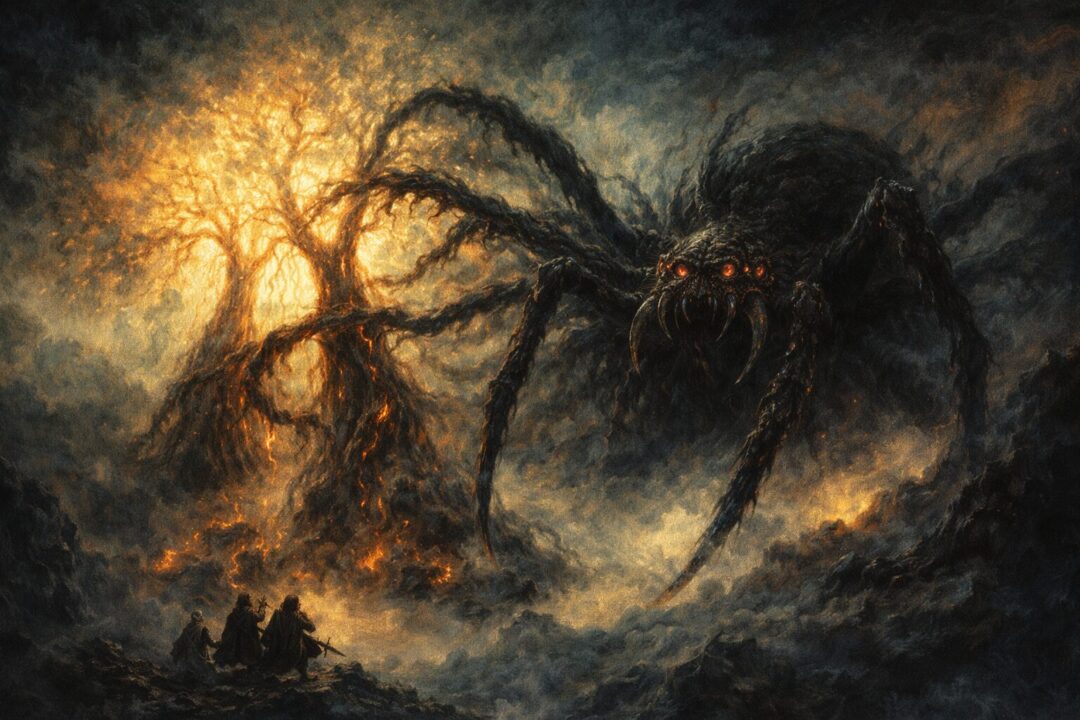
Shelob is one of the few creatures in The Lord of the Rings who feels less like an enemy and more like a force of nature.
She has no allegiance.
No ideology.
No ambition beyond hunger.
When Frodo and Sam enter her lair above Cirith Ungol, they are not stepping onto a battlefield or into a confrontation shaped by strategy or moral choice. They are crossing a threshold into something older and colder—an ecosystem built entirely around predation. The tunnels do not feel occupied. They feel claimed.
Because of this, many readers come away with the impression that Shelob is unique.
A one-of-a-kind monster.
A singular horror.
An isolated remnant of a darker, more savage age.
But Tolkien’s writings—when read carefully and across the wider legendarium—suggest something far more unsettling. Shelob is extraordinary, yes. But not because she is alone.
She is extraordinary because she is what remains.
Shelob Is Old—but Not Primordial
Shelob is ancient by Third Age standards, but she does not belong to the very beginning of the world.
She is the daughter of Ungoliant—a being older than Sauron, older than dragons, and possibly older than Morgoth’s corruption of Arda itself. Ungoliant does not fit neatly into any category Tolkien provides. She is not counted among the Valar or Maiar, nor is she clearly one of Morgoth’s creations. She comes instead from the darkness beyond the ordered world, a void that existed before light was shaped into stars.
Ungoliant feeds on light itself. She drinks it, devours it, and grows as a result—until even Morgoth fears her. After the destruction of the Two Trees of Valinor, she flees into the south of the world, swollen with stolen radiance, and eventually vanishes from recorded history.
But she does not vanish without consequence.
Tolkien states directly that Ungoliant bred.
This single detail is easy to overlook, but it changes everything. Shelob is not an accident, nor is she a singular mutation. She is one of Ungoliant’s offspring—perhaps the greatest and longest-lived, but not necessarily the only one ever born.
Shelob’s existence, then, is evidence of a lineage.
The First Age Was Not Free of Such Creatures
Long before Shelob settled near Mordor, giant spiders haunted the western lands of Middle-earth during the First Age.
They infested the forests of Doriath.
They served Morgoth’s purposes, though not always by command.
They hunted Elves and Men alike.
These creatures were not described as natural animals scaled up to monstrous size. They were intelligent. Malicious. Capable of malice that went beyond instinct. Their webs were instruments of terror, choking ancient forests and turning once-safe realms into death traps.
Their presence tells us something crucial: Shelob’s kind was once widespread enough to matter.
By the end of the First Age, however, much of this terror is destroyed or driven away. The War of Wrath reshapes the world. Beleriand sinks beneath the sea. Many creatures of the old darkness are annihilated, scattered, or forced into hiding.
But Tolkien is careful with his language.
Destroyed does not always mean eradicated.
Scattered does not mean extinct.
Shelob is one of those who fled.
A Survivor, Not a Servant
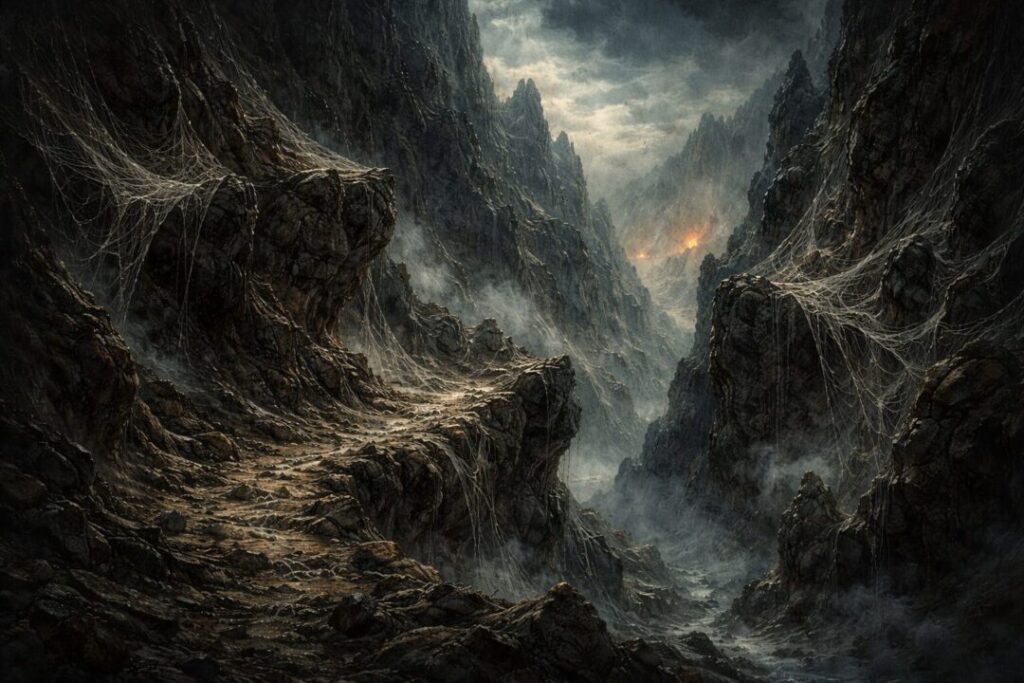
After the fall of Beleriand, Shelob moves east. Eventually, she establishes herself in the Ephel Dúath above Mordor, carving out a domain that suits her perfectly—dark, narrow, and isolated.
What is most striking about this arrangement is not Shelob’s presence, but Sauron’s response to it.
Shelob does not serve Sauron.
She does not answer to him.
She is not commanded or controlled.
Instead, she is tolerated.
Sauron allows her to dwell near one of his most important strongholds. He feeds her prisoners. He uses her hunger as a weapon against intruders—but he does not rule her. Tolkien makes it clear that Shelob would devour Orcs, Men, or even servants of Sauron without hesitation if they strayed too close.
This relationship tells us something vital.
Shelob is not part of Sauron’s hierarchy. She predates it.
She belongs to an older order of evil—one that does not seek domination or structure, but simply consumption. Sauron represents tyranny, control, and the perversion of order. Shelob represents something more ancient and less intelligible: the desire to consume until nothing remains.
That kind of evil cannot be commanded. It can only be avoided—or endured.
Why Shelob Feels Singular in the Story
From a narrative perspective, Shelob feels fundamentally different from every other threat Frodo encounters.
The Nazgûl tempt through fear.
Boromir tempts through good intentions.
Gollum tempts through pity and familiarity.
Sauron tempts through power and domination.
Shelob tempts nothing.
She does not speak.
She does not bargain.
She does not promise.
She simply is.
This aligns perfectly with Ungoliant’s nature and suggests that Shelob is less a character in the conventional sense and more a manifestation of a kind of evil that no longer shapes history directly.
By the Third Age, beings like Shelob are fading.
Not because they are weak—but because the world itself is changing.
The Fading of Monsters and the Passing of Ages
One of Tolkien’s most consistent themes is decline—not as failure, but as transition.
The Elves are leaving Middle-earth, not because they are defeated, but because their time has passed. The great kingdoms of Men rise as the Elder Days recede into memory. Even the Wizards, powerful as they are, are restrained and limited in how openly they can act.
The same is true of monsters.
Dragons grow fewer and smaller.
Balrogs vanish into legend.
Creatures of pure terror retreat into the margins of the world.
Shelob belongs to this pattern.
She is not “the last” because Tolkien never says she is. But she is one of the last visible survivals of a kind of evil that once roamed freely and shaped entire regions through fear alone.
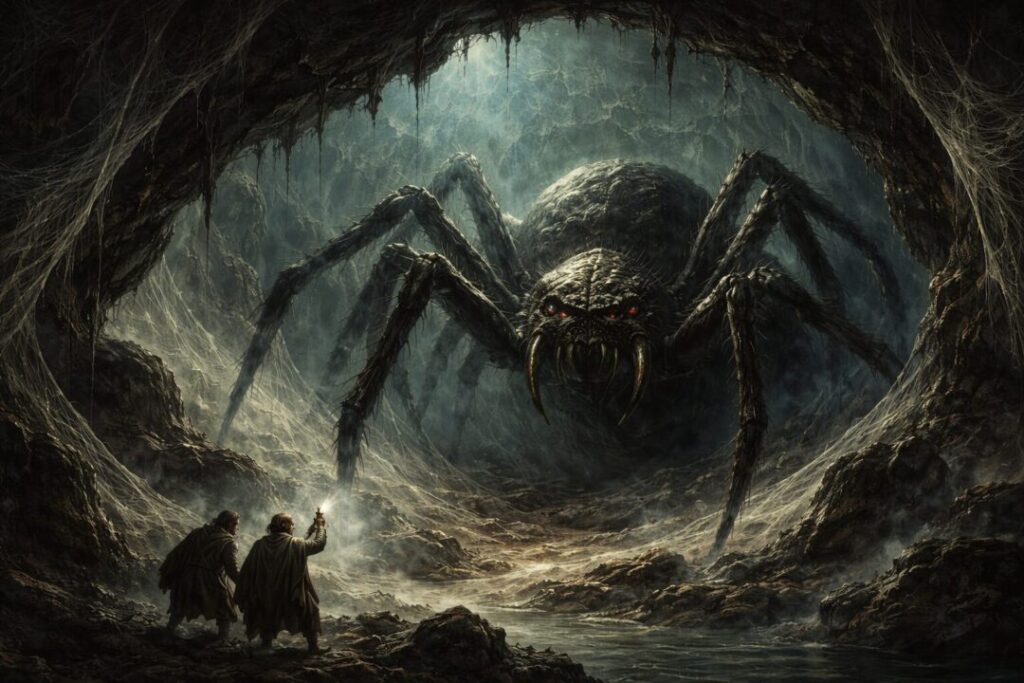
Her lair is not a throne.
It is a relic.
Why Shelob’s Defeat Changes Nothing—and Everything
When Shelob is wounded and driven back by Samwise Gamgee, the world does not change.
No armies fall.
No kingdoms rise.
No prophecies are fulfilled.
And that is precisely the point.
Shelob’s defeat does not matter in a geopolitical sense. It matters thematically. A being who does not belong to the coming age is removed—not through a great war, but through courage, humility, and light carried by the smallest hands.
Shelob does not fall with grandeur. She retreats, broken and diminished, into the shadows.
Just as her kind has been doing for centuries.
Not Unique—But the End of an Era
Tolkien never claims Shelob is unique in the sense of being singular.
What he shows instead is something subtler.
Shelob is unique because the world has outgrown creatures like her.
She is a leftover from an age when darkness could take physical form and roam freely. By the time of the War of the Ring, such evils can no longer dominate openly. They linger instead in forgotten tunnels, surviving on scraps, feeding on those who wander too far from the light.
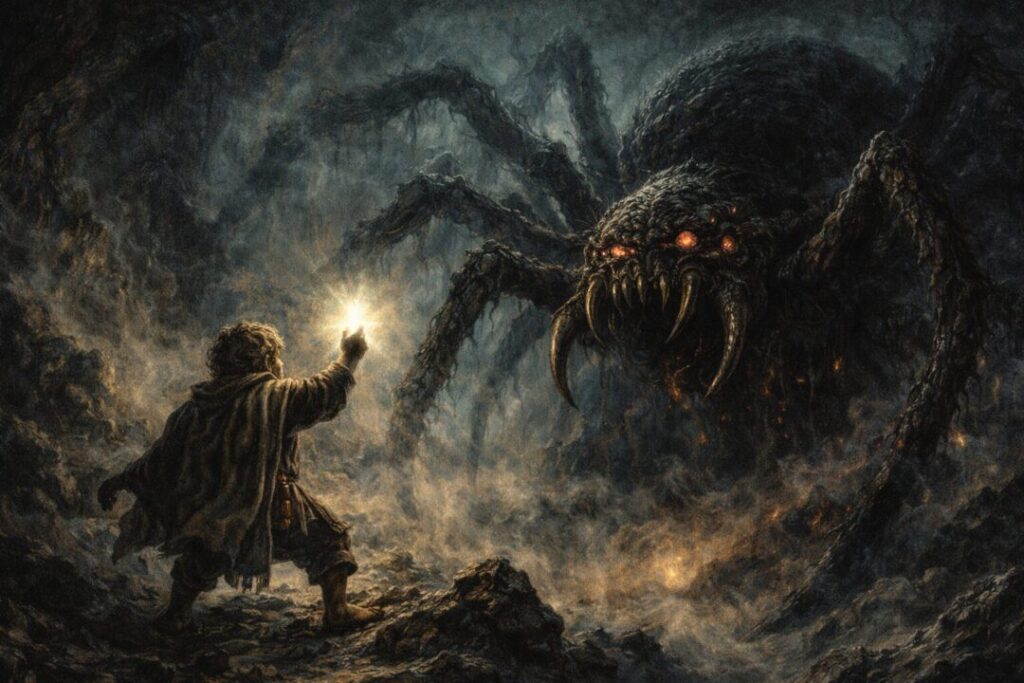
By the time Sam stands alone with a blade and a phial, the age of primeval devourers is already ending.
Not with glory.
Not with conquest.
But quietly.
One dark tunnel at a time.