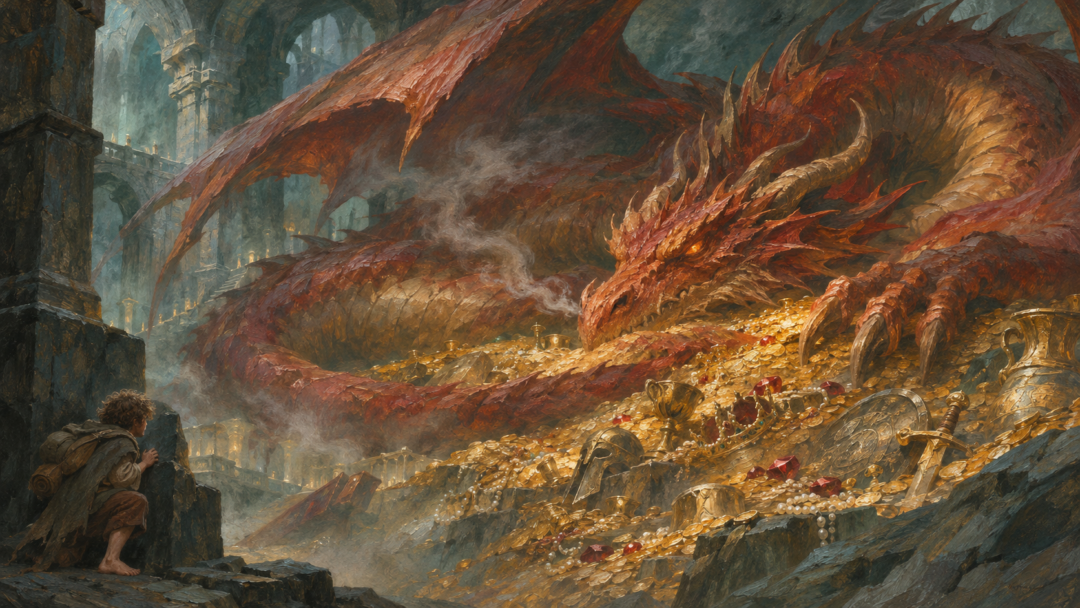
Bilbo enters the treasure hall beneath the Lonely Mountain and finds Smaug asleep upon the wealth of a vanished kingdom. He takes a great golden cup, and the dragon notices its absence almost as soon as he wakes. Smaug knows what he owns. But does he know what it is worth today, rather than when he first acquired it? And could the riches beneath Erebor tell us whether prices throughout Middle-earth are rising or falling?
The stories offer a surprisingly useful starting point: goods have prices, people bargain, scarce materials become more desirable, and treasured objects can matter far beyond their practical uses. What they do not supply is a record of general inflation or deflation. A pony sold at an outrageous price, a metal becoming nearly unobtainable, and an heirloom prized by its owner are three different economic stories. Confusing them would make Middle-earth seem much more measurable than its surviving accounts allow.
What a pony in Bree can—and cannot—tell us
Inflation means a sustained rise in the general level of prices for goods and services; deflation means a sustained fall. That is the distinction made in explanations from the Federal Reserve Bank of Cleveland and the US Bureau of Economic Analysis. A price index follows many purchases over time, not one spectacular bargain or robbery. Prices of individual things can move in opposite directions while the overall price level follows its own course.
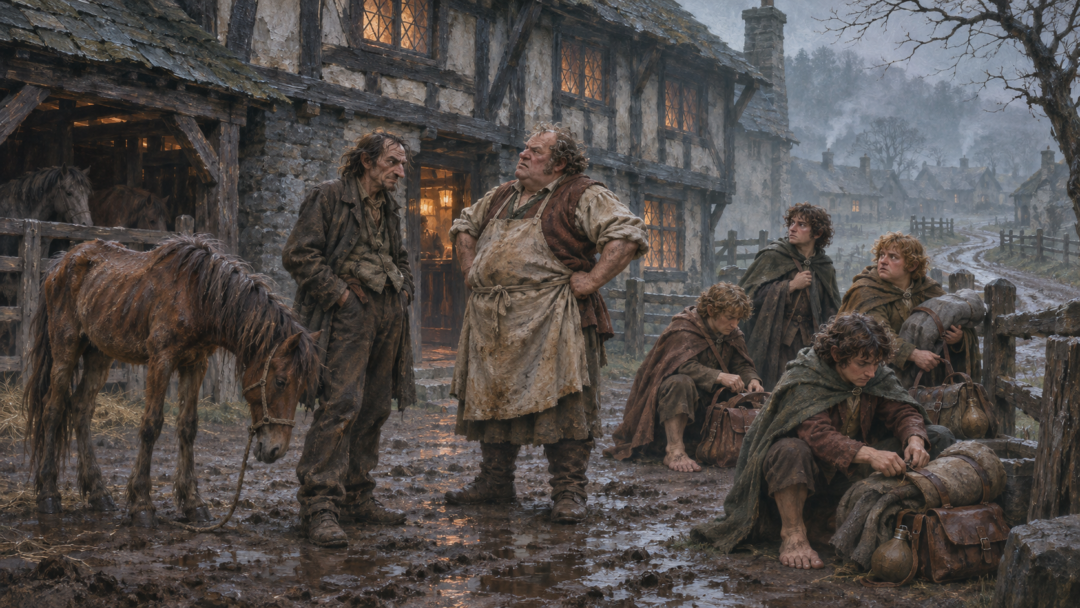
Now consider the morning after the hobbits' disastrous night at the Prancing Pony. Their animals have disappeared, and Bill Ferny has a miserable, underfed pony for sale. He demands twelve silver pennies. Barliman Butterbur pays, partly because he feels responsible for the loss of the other animals. It is hardly the leisurely purchase of a well-fed pony from a seller competing with a dozen others.
The narrator provides the crucial comparison: Ferny's demand is at least three times the pony's ordinary value in those parts. That tells us the price is exceptional, not merely expensive to modern eyes. It also tells us that a local notion of ordinary value exists. Butterbur understands that he is being cheated, and his loss hurts even though he is relatively prosperous by Bree's standards. The scene makes economic sense because a bad deal can be recognized as a bad deal.
Yet nothing shows that ponies were becoming dearer year after year. Ferny exploits buyers with no practical alternative. His price is evidence of bargaining power, urgency, and a very particular shortage. We do not know what comparable ponies cost in Bree before or after the episode, much less how bread, clothing, lodging, and tools changed in price alongside them. Nor does the presence of silver pennies establish one uniform currency system across every realm.
Mithril: when a relative price changes dramatically
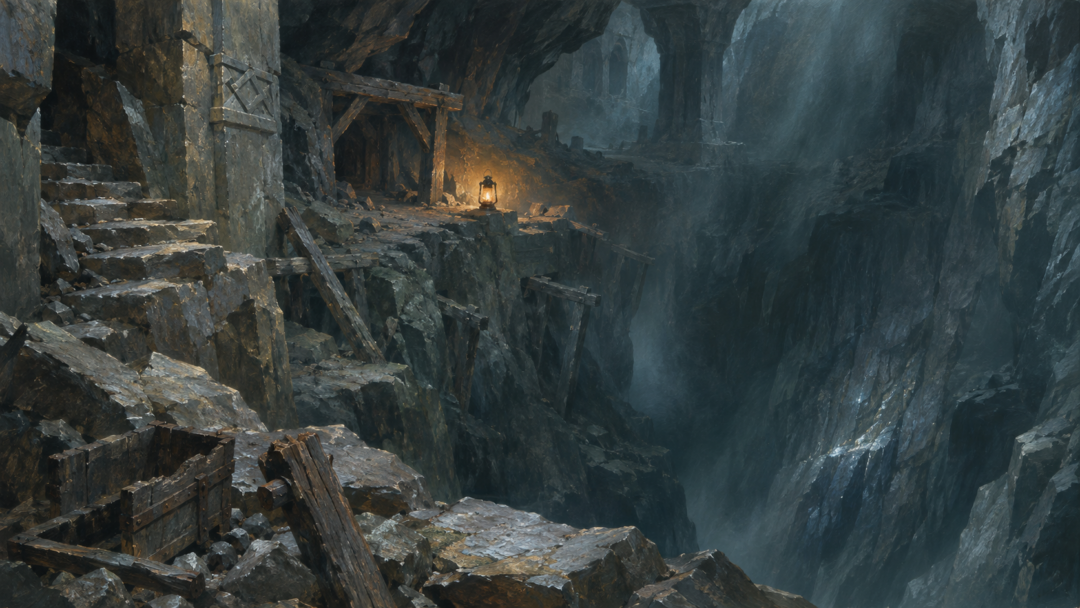
Far beneath the Misty Mountains lies a stronger example of value changing over time. In the deserted halls of Moria, Gandalf explains why the Dwarves once delved so deeply: mithril, the extraordinary metal associated with Khazad-dûm. He compares its former worth with gold, saying it had been valued at ten times as much, and describes its later value as beyond price. This is an explicit comparison between earlier and later conditions.
The explanation is chiefly about access. Little mithril remains above ground. The old mining realm has fallen, its deepest places are dangerous, and the Orcs do not undertake the work needed to recover new supplies. Gandalf also says that much of what the Orcs gathered was sent to Sauron as tribute. A desirable material that once flowed from working mines has become extraordinarily difficult to obtain. Scarcity here is not an abstract guess; the narrative supplies reasons for it.
Even so, gold provides a comparison, not a complete monetary standard. Gandalf does not tell us that gold, food, ponies, and every other good all became dearer together. Nor does calling mithril beyond price assign it an infinite number. It conveys extraordinary scarcity. A relative value can soar while the general price level remains unknown. In principle, deflation elsewhere could even coexist with a rising price for one scarce material.
There is another distinction inside the treasure itself: raw material and finished object. The coat of mithril mail that Bilbo receives and later passes to Frodo has the metal's rarity, but also craftsmanship and the ability to turn a deadly blow. Its importance to Frodo in Moria is immediately practical. A collector, a warrior, and someone who needs only ordinary clothing could judge the same garment very differently. None of those judgments requires a change in the prices of everyday necessities.
The Arkenstone is not an auction result
At Erebor, the Arkenstone raises the stakes from scarcity to attachment. It is a magnificent stone bound to the history of Thorin's house and to his claim upon the Mountain. Thorin measures its importance against a river of gold and places it beyond price to himself. Those last two words are essential to understanding him: this is a declaration of personal value, not a public quotation for a gemstone traded repeatedly among strangers.
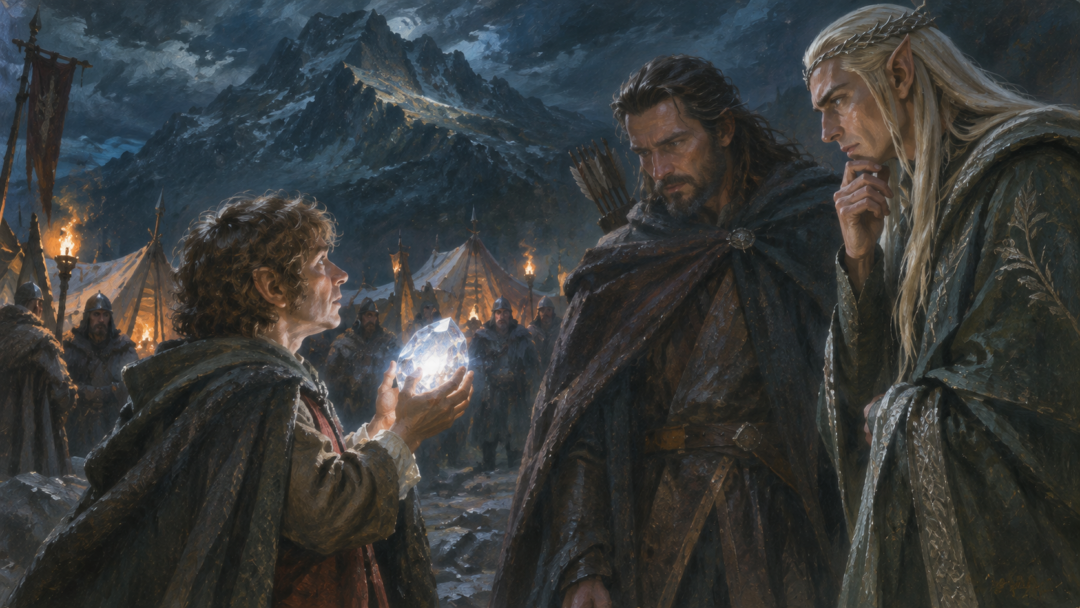
Bilbo understands that attachment well enough to use it. Hoping to avert fighting outside the Mountain, he takes the Arkenstone to Bard and the Elvenking. The stone becomes leverage in negotiations over the hoard and the claims of those harmed by Smaug. Thorin offers a fourteenth share of the silver and gold, excluding gems, charged against Bilbo's portion. After the battle, Dáin honors the arrangement and the Arkenstone is laid with Thorin.
This is more revealing than a hypothetical price tag: an offer under siege and a settlement honored after Thorin's death. We do not see an open market discovering what several unpressured buyers would pay. Bard wants redress and peace, Bilbo wants to prevent bloodshed, and Thorin wants back an irreplaceable emblem of his house. They are not simply shopping for the same beautiful stone.
Antiquity contributes to the Arkenstone's meaning, but age alone cannot explain its force. Its association with Thráin and the kings under the Mountain, its beauty, and its place in Thorin's sense of inheritance all matter. A nameless old cup could be older than an important heirloom without commanding the same devotion. Equally, an object can have enormous political or family significance without anyone intending to sell it. The act of keeping something off the market is part of its story, not evidence of a hidden universal price.
Old objects, new owners, changing tastes
The swords found in the trolls' hoard offer another way to think about artifacts. Elrond recognizes Glamdring and Orcrist as blades made long ago in Gondolin. Their workmanship remains useful, but their histories also travel with them. The goblins who later encounter the weapons recognize and fear them. An ancient object can therefore carry reputation across generations, and that reputation can mean admiration to one observer and terror to another.
That is not quite the same as a market in antiques. If a buyer prizes Elvish workmanship, the blade's origin could make it more desirable than an otherwise serviceable sword. Someone interested only in cutting wood would have little reason to pay extra for that history. These are reasonable inferences about possible buyers, not recorded bids in the stories. The recognition of Gondolin's weapons proves the survival of memory and distinctive craft; it does not prove a steadily rising resale price across centuries.
Changing fashion makes the problem more interesting. A community might favor ancient patterns during one generation and newer workmanship during another. A period of peace could alter who wants weapons; a new appreciation of an older style could increase demand for surviving examples. Those are possibilities, not an observed sequence of prices. The passages give us objects admired for their origins, but no dated series of sales showing taste turning toward or away from them.
Even the idea of a single artifact market is slippery. Treasure taken in war, a royal heirloom, equipment used for survival, and a gift between friends enter people's hands in different ways. Bilbo's return to Bag End, where his belongings are being sold because he has been presumed dead, shows that ordinary possessions can enter a recognizable sale. But their sale says little about what the Arkenstone might fetch. What matters is who can use it, who recognizes it, and whether its holder would part with it.
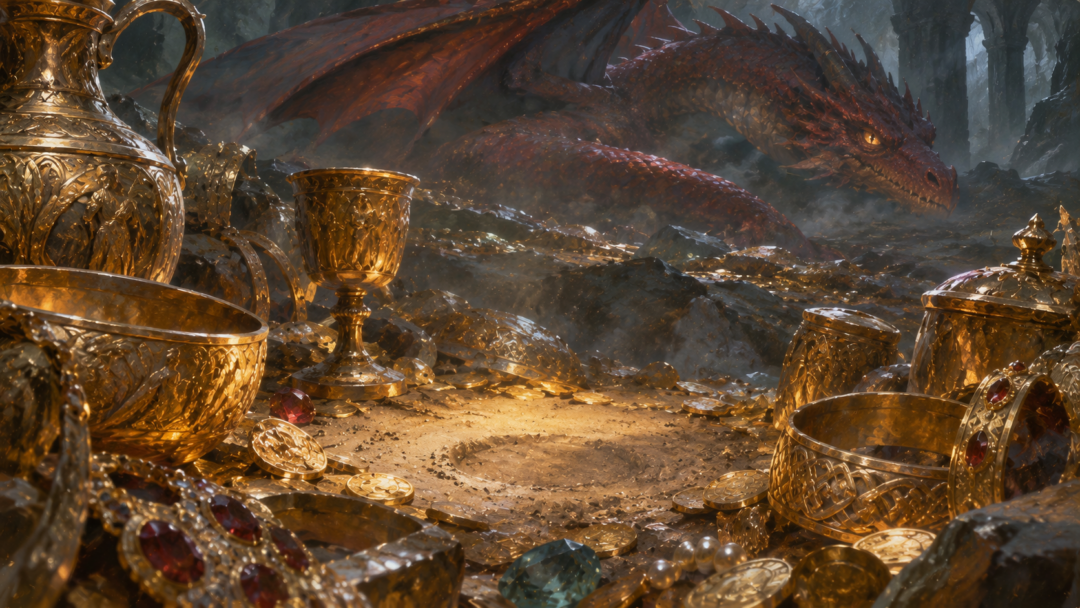
What Smaug actually knows about value
Smaug presents the most tempting shortcut. The narrator of The Hobbit describes dragons as astonishingly familiar with treasure they have possessed for a long time. The stolen cup does not vanish unnoticed among the heaps: its absence is enough to provoke his fury. His knowledge reaches into the inventory itself, even when the intruder is small and the hoard enormous.
But inventory is not appraisal. Nothing in that episode shows Smaug testing the cup against a current offer, revising its worth when styles change, or consulting the tastes of buyers beyond his lair. Equally, nothing proves that his judgments are frozen forever at the moment of acquisition. A dragon may remember a thing perfectly without the story revealing what he would accept for it. The narrator says dragons generally have a good notion of current market value, but the mechanism, precision, and updating frequency of Smaug's valuations remain unexplained.
Middle-earth thus gives us established prices, recognizable overcharging, and treasures whose relative importance changes with scarcity, use, history, and ownership. It is reasonable to infer that broader economic changes could happen there; neither inflation nor deflation is ruled out. What remains unmeasured is the general price level, just as Smaug's method of appraisal remains unexplained. In his cavern the missing cup leaves a visible gap. The price it might have fetched elsewhere leaves no such trace.
Sources & Notes
This article is based on close reading and interpretation of Tolkien's published works and related source material where relevant.