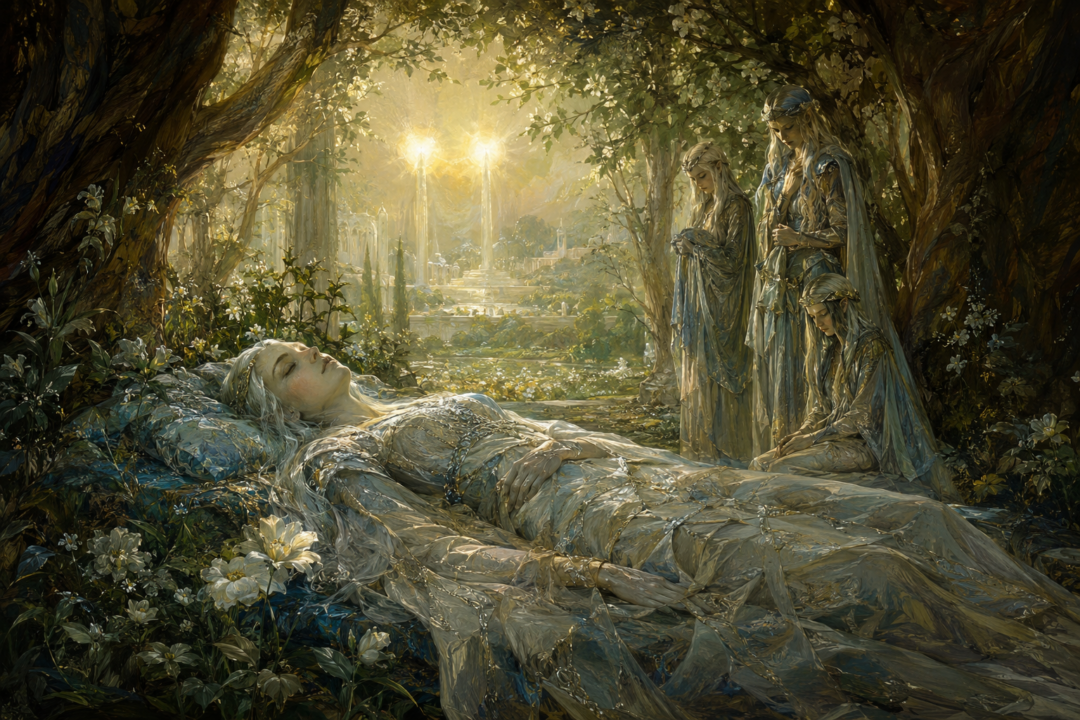
Míriel Þerindë eventually wanted to live again.
That fact creates one of the strangest problems in the history of the Eldar. If Míriel could reconsider her refusal of bodily life, why could she not simply return? Why could Finwë not acknowledge that his first wife had changed her mind? And why should a decision made in exhaustion bind her after the circumstances had changed?
The answer reaches far beyond one unhappy marriage.
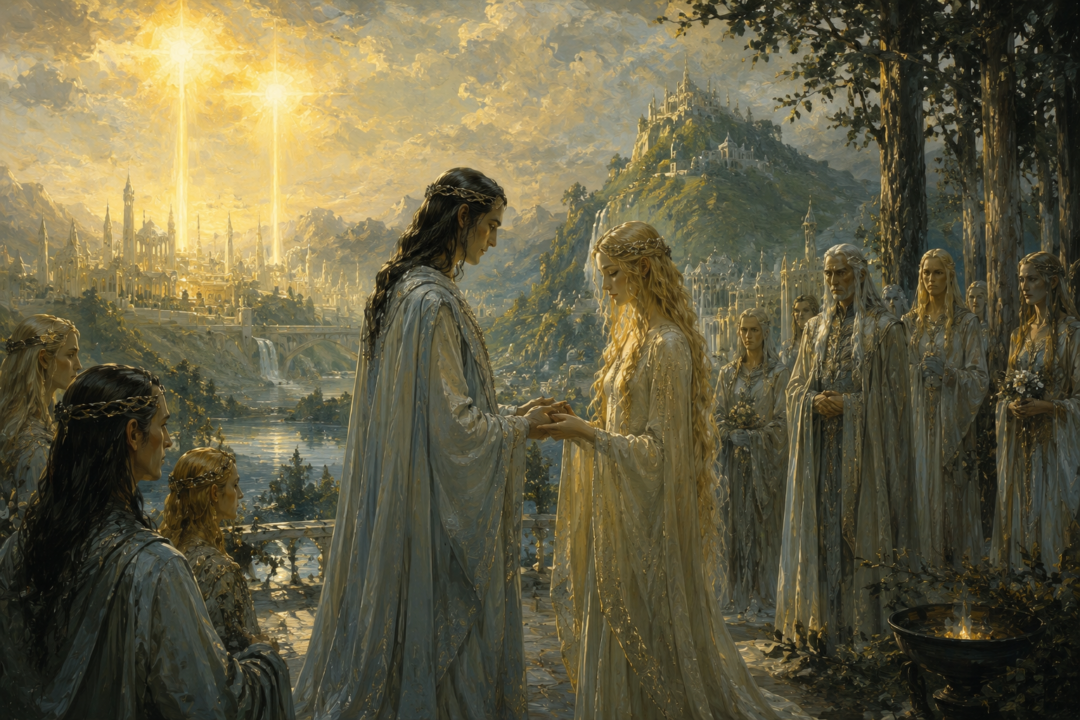
For the Eldar, death normally did not erase marriage. Their spirits endured, and the possibility of restoration to embodied life meant that a dead spouse was not simply gone in the mortal sense. Finwë’s desire to marry Indis therefore required something unprecedented: a lawful way for his union with Míriel to become permanently incapable of resumption.
Once Finwë actually married Indis, the problem changed completely.
It was no longer merely a question of whether Míriel wished to return.
Now there was another wife whose marriage was real.
Míriel’s Death Did Not Automatically Make Finwë Free
The essential difficulty begins with the nature of Elvish marriage.
In the material surrounding the “Statute of Finwë and Míriel” and “Laws and Customs among the Eldar,” marriage among the Eldar is treated as something intended to endure throughout their life in Arda. Bodily death interrupts embodied life, but the spirit, or fëa, continues to exist. Death therefore does not function as a convenient termination of marriage in the way it can among mortals.
That made Míriel’s case extraordinary.
After bearing Fëanor, she became so weary that she relinquished her body and went to Mandos. Finwë grieved, but Míriel did not wish to return. He eventually appealed to the Valar because he desired release from a situation that otherwise appeared permanent.
The Valar could not solve the problem merely by declaring Míriel dead.
Her fëa still existed.
Nor could they compel her to return to bodily life simply because Finwë wanted his wife back. Her own will mattered.
Yet if she remained permanently disembodied, Finwë faced an equally severe consequence: he would effectively lose the possibility of married life and further children because of another person’s decision never to return.
The resulting judgment attempted to preserve both freedoms.
That solution came with a terrible price.
The Statute Was Not Permission for Two Marriages
The Statute allowed Finwë to take another wife under exceptional conditions connected to Míriel’s refusal to return.
But it was not an acceptance of successive marriages in which both spouses might later live simultaneously.
That distinction is crucial.
The Eldar did not regard the existence of Finwë, Míriel, and Indis as an ordinary romantic triangle requiring personal negotiation. The deeper issue was that Finwë could not have two living wives.
The legal solution therefore depended upon Míriel remaining disembodied if Finwë made use of his freedom to remarry. In versions of the account preserved in Morgoth’s Ring, there is a period before the decision becomes final, allowing reconsideration. But once the second marriage has actually occurred, the situation is no longer reversible merely because the first spouse changes her will.
Before Finwë married Indis, Míriel’s return could have restored the original marriage.
Afterward, her return would create the very contradiction the Statute had been designed to prevent.
Finwë would have two spouses alive in Arda.
Indis Is the Person an Easy Reversal Would Wrong
It is tempting to see the story almost entirely through Míriel.
She suffered extraordinary weariness. Her choice was made under conditions unlike anything previously experienced by the Eldar in Aman. Later she desired embodiment again.
From that perspective, permanent exclusion from ordinary bodily life can seem unbearably severe.
But after Finwë remarried, Míriel was no longer the only person whose rights had to be considered.
There was Indis.
Indis married Finwë under the liberty granted by the judgment of the Valar. Her marriage was not provisional. She was not merely occupying Míriel’s place until Míriel recovered. Nothing in the arrangement made her a temporary wife who could be displaced if the first marriage became possible again.
This point becomes explicit when Míriel later desires to return.
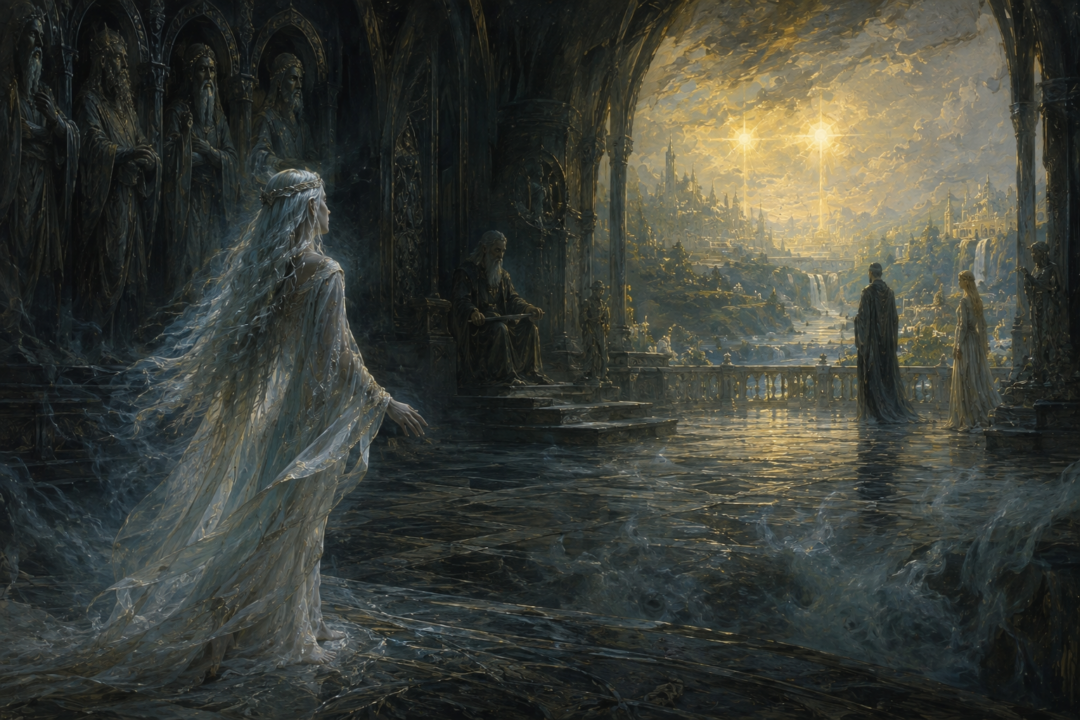
Mandos rejects a simple restoration because Míriel would then be among the Living while Finwë had another living spouse. The objection also includes the injury that would thereby be done to Indis, who had entered her marriage under the terms established by the Statute. b3.ewinerysolutions.com
That transforms the moral problem.
Restoring Míriel without some further sacrifice would not merely correct an old injustice.
It would create a new one.
Why Míriel Could Change Her Mind but Not Simply Reverse the Consequences
This is the hidden distinction at the heart of the story:
A person can sincerely change a choice without thereby erasing everything that happened because of that choice.
Míriel’s later desire for life does not mean her earlier refusal was fraudulent. Nor does the later account require us to imagine that she had secretly intended to return all along.
Her will changed.
But Finwë’s life had changed too.
He had married Indis. Children had been born from that marriage. A new family existed, with consequences extending through the entire history of the Noldor.
The Statute could not function if the second marriage remained permanently vulnerable to cancellation by the first spouse.
If that had been possible, Finwë’s permission to remarry would never have been genuine freedom to establish another permanent marriage. Indis would have entered a union that could potentially be overturned by Míriel at some unknown future date.
The texts instead treat the second marriage as producing an irreversible condition while both marriages would otherwise compete in embodied life.
Míriel remained capable of changing what she wanted.
What she could not do was make the intervening reality disappear.
Finwë Eventually Finds a Way — by Giving Something Up
The later story does not leave Míriel eternally trapped without resolution.
After Finwë is slain by Morgoth at Formenos, Finwë himself comes to Mandos. There he learns of Míriel’s changed desire.
Now something extraordinary becomes possible.
Finwë chooses to remain without bodily life so that Míriel may return.
This is not a cancellation of his marriage to Indis, nor is it a declaration that the original judgment was meaningless. Instead, the new arrangement preserves the central restriction: Finwë will not be simultaneously embodied with both wives.
His own renunciation makes Míriel’s restoration possible. The later account has Míriel return to her body, while Finwë remains in Mandos; Míriel subsequently enters the service of Vairë.
The symmetry is striking.
At first, Míriel surrendered bodily life, and Finwë eventually received permission to continue his own life through another marriage.
Later, Finwë surrendered his own return so that Míriel could regain the embodied existence she had once rejected.
Neither gets everything.
That seems central to the tragedy.
The Cruel Irreversibility Behind Fëanor’s Family
The consequences become even more painful when viewed through Fëanor.
His mother’s refusal to return made Finwë’s second marriage possible. Finwë’s marriage to Indis produced Fingolfin and Finarfin, among others, and the divisions within Finwë’s house became inseparable from later Noldorin history.
Yet it would go beyond the texts to claim that the Statute itself mechanically caused Fëanor’s later crimes. Fëanor remained responsible for his own choices.
What can safely be said is that his father’s remarriage deeply affected him. The published Silmarillion explicitly connects it with his lack of love for Indis and her sons, while the fuller material surrounding Finwë and Míriel exposes just how exceptional the family situation was.
The tragedy is therefore larger than “Míriel should have returned sooner.”
Every available solution had costs.
Force Míriel back, and her will is violated.
Forbid Finwë from ever remarrying, and his future is bound indefinitely by Míriel’s refusal.
Allow remarriage but permit Míriel to return whenever she wishes, and Indis can never possess the security of a true marriage.
Permit Míriel to return after Finwë has married Indis, and Finwë has two living wives, contrary to the marital order the Eldar understood themselves to possess.
The Statute solves the contradiction only by making choices consequential.
The Deeper Rule Was About More Than Míriel
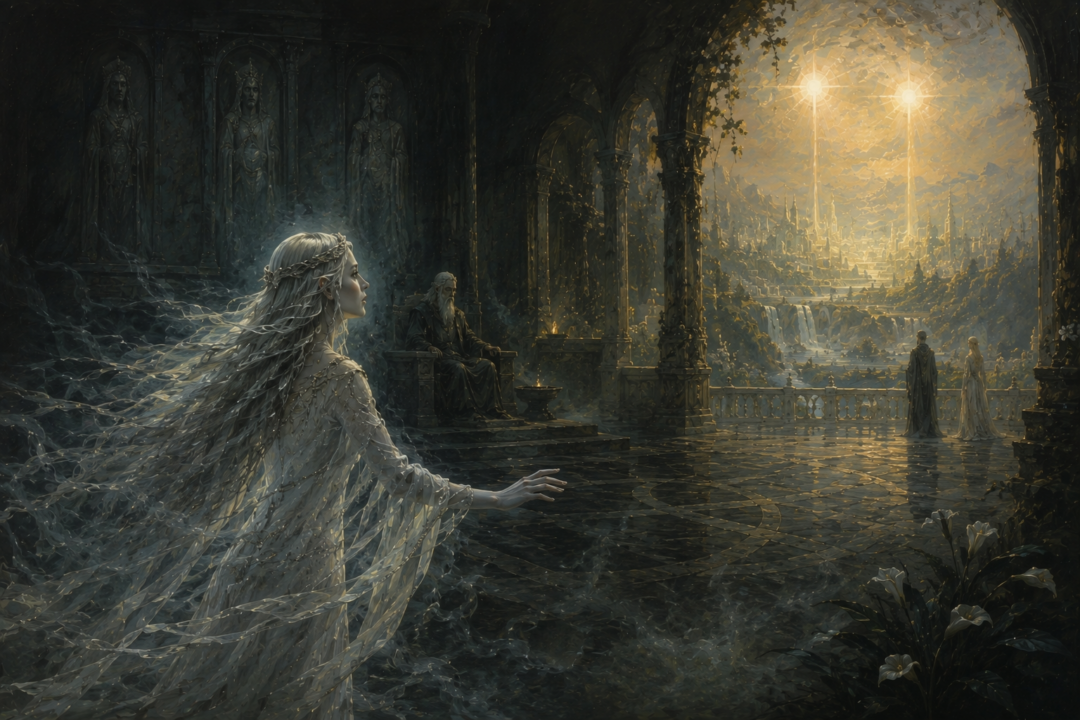
This is why Míriel’s later change of mind could not simply undo Finwë’s marriage to Indis.
The obstacle was not stubborn bureaucracy in Valinor.
It arose from the peculiar nature of Elvish existence.
For beings whose spirits survive bodily death and may return to embodied life, death cannot always settle relationships permanently. The possibility of restoration creates problems mortals ordinarily never face.
Finwë’s household became the exceptional case in which that problem had to be answered.
The answer was severe because every alternative threatened another fundamental good: freedom, fidelity, permanence, or justice to an innocent spouse.
And the final resolution does not come from pretending the earlier choice never happened.
It comes through sacrifice.
Míriel changes her mind, but Indis is not erased.
Finwë loves Míriel, but he cannot simply restore the world as it existed before Fëanor’s birth.
The past remains real.
Only when Finwë accepts the loss of his own return can Míriel take up bodily life again without creating the contradiction the Statute was intended to prevent.
That may be the most haunting element of the entire episode.
In a land imagined as the Blessed Realm, healing is possible — but healing does not always mean reversal.
Sources & Notes
- The Encyclopedia of Arda, “Míriel” — https://www.encyclopedia-of-arda.com/m/miriel.html
- The Encyclopedia of Arda, “Finwë” — https://www.encyclopedia-of-arda.com/f/finwe.html
- The Encyclopedia of Arda, “Mandos” — https://www.encyclopedia-of-arda.com/m/mandos.html
Reference entries document the characters, places, events, and textual details discussed in this article.