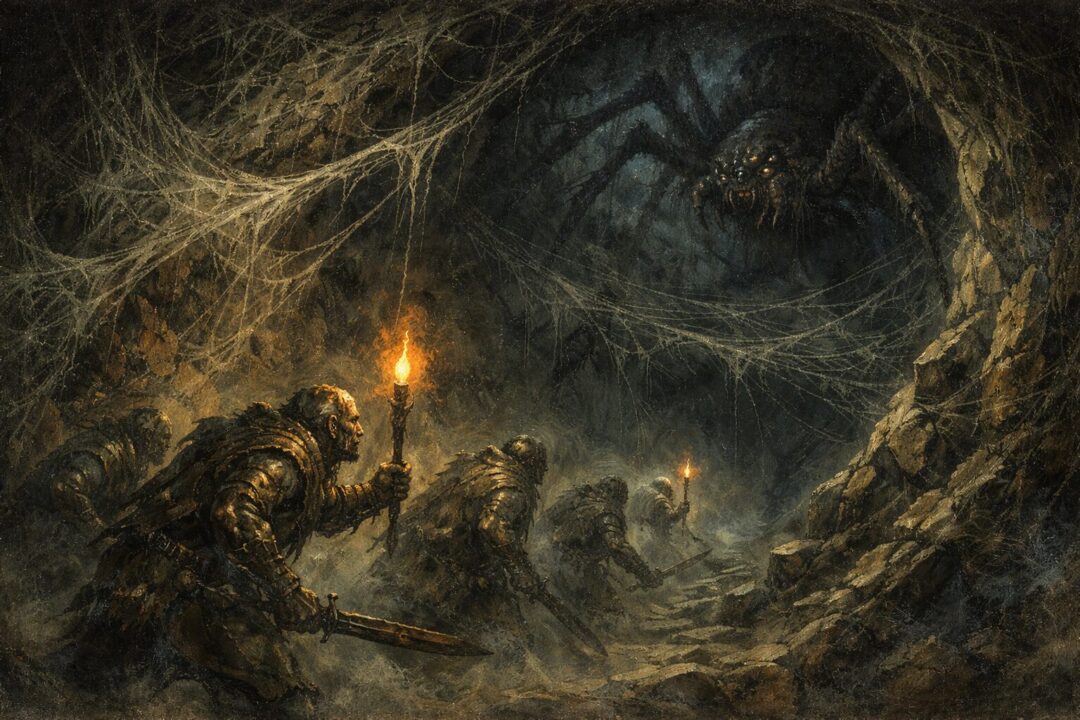
Shelob is often remembered as a single terrifying obstacle in Frodo’s journey—a monstrous spider driven back by courage, light, and a desperate Hobbit standing alone in the dark.
But that moment in The Two Towers only hints at something much larger.
By the time Frodo and Sam encounter Shelob, she has already survived for untold centuries in one of the most dangerous regions of Middle-earth. Kingdoms have risen and fallen. Dragons have been hunted to extinction. Balrogs—once terrors of the ancient world—have been destroyed or driven into hiding.
Shelob remains.
That survival was not an accident, and it was not simply a matter of brute strength.
It was the result of what Shelob was, where she chose to live, and how she understood the changing nature of power in Middle-earth better than most beings who considered themselves lords of it.
Shelob Was Not Just a Spider
Shelob’s true significance lies in her origin.
She is explicitly described as the last living offspring of Ungoliant, the ancient being of darkness who once allied with Morgoth and devoured the light of the Two Trees of Valinor. Ungoliant was not merely a creature in the usual sense. She was closer to a living void—an embodiment of endless hunger, darkness, and consumption.
That lineage matters.
Shelob inherited only a fragment of Ungoliant’s terrible power, but even that fragment placed her outside the normal order of life in Middle-earth. She was not a beast that followed natural cycles. She did not depend on sunlight. She did not age as animals do. Her hunger was not seasonal or practical—it was fundamental.
Shelob existed to feed.
And that single purpose made her far more durable than many beings who possessed armies, titles, or crowns.
A Creature From Before the World Was Ordered
Ungoliant came from outside the ordered structure of Arda. She was not bound to the hierarchies of Valar and Maiar in the same way other beings were. Shelob, as her offspring, inherited a lesser but still unsettling independence.
Shelob owed nothing to Morgoth.
She owed nothing to Sauron.
She owed nothing to the world as it was becoming.
That freedom meant she could survive the collapse of one dark power and the rise of another without needing to adapt her allegiance.
When Morgoth fell, Shelob did not fall with him.
When Sauron rose, Shelob did not swear herself to his cause.
She simply endured.
Why Shelob Chose Cirith Ungol
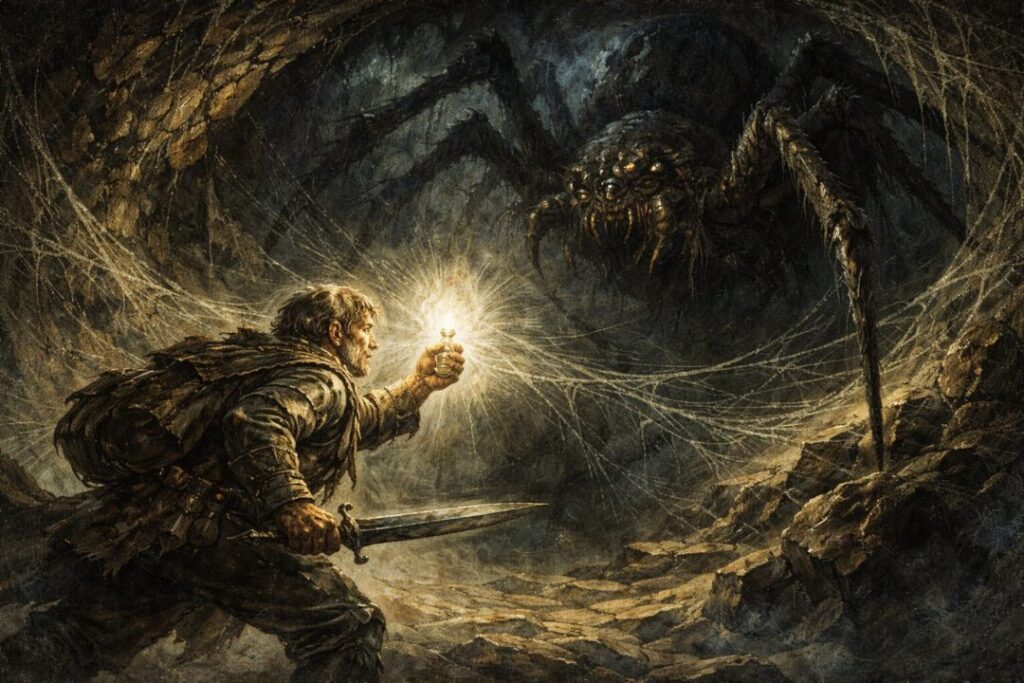
Shelob did not settle above Cirith Ungol by chance.
Cirith Ungol was one of the most strategically awkward places in Middle-earth. It was a narrow, winding pass—too confined for armies, too treacherous for cavalry, and too exposed to be easily fortified in a traditional sense. Anyone attempting to enter Mordor from the west would eventually be forced through it.
Shelob made her lair where strength, numbers, and banners meant very little.
She turned geography itself into her ally.
Her tunnels could not be besieged.
Her darkness could not be mapped.
Her webs did not care whether the victim was Orc, Man, or Elf.
Shelob did not need to hunt the world.
The world came to her.
Shelob and the Orcs: Fear Without Rebellion
Orcs feared Shelob deeply, but they tolerated her presence.
That fact alone reveals something crucial about how Shelob survived.
She did not openly dominate the Orcs.
She did not command them.
She did not seek worship or obedience.
Instead, she became an accepted terror—an environmental hazard rather than a rival authority. Orcs avoided her tunnels when they could. When they could not, some were taken. Others survived.
That balance mattered.
If Shelob had devoured too many Orcs, she would have drawn attention.
If she had challenged authority, she would have been destroyed.
Instead, she remained useful.
Why Sauron Allowed Her to Remain
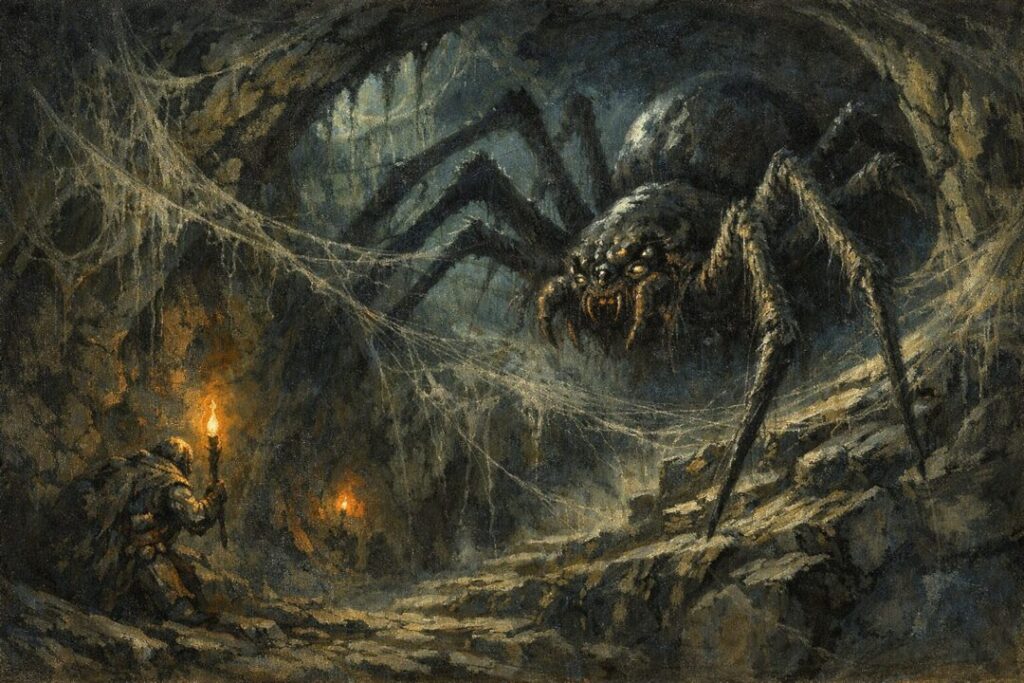
Shelob’s relationship with Sauron is often misunderstood.
Shelob did not serve Sauron.
She did not obey him.
She was not guarding Mordor on his behalf.
But she was predictable.
Shelob killed intruders.
Shelob created terror.
Shelob thinned out enemies without command, wages, or loyalty.
In Tolkien’s world, evil frequently consumes itself. Shelob embodied that principle perfectly—devouring servants of darkness as readily as enemies of it. Sauron tolerated her because she did not disrupt his larger designs. She was a hazard, not a contender.
And predictable evils are often allowed to endure far longer than ambitious ones.
Shelob’s True Survival Strategy: Restraint
Shelob’s longevity came from restraint.
She did not expand her territory.
She did not roam openly across Mordor.
She did not challenge beings of greater power.
Instead, she fed slowly over centuries—on Orcs, stray Men, captured Elves, and anything else unfortunate enough to wander into her domain. Tolkien makes clear that she grew bloated and sluggish not because she was weak, but because she was ancient and patient.
Where dragons demanded tribute and kingdoms, Shelob required only silence and darkness.
That made her nearly invisible in a world obsessed with wars, thrones, and open conquest.
The Misunderstood “Defeat” of Shelob
Many readers believe Shelob dies in Cirith Ungol.
The text does not support this.
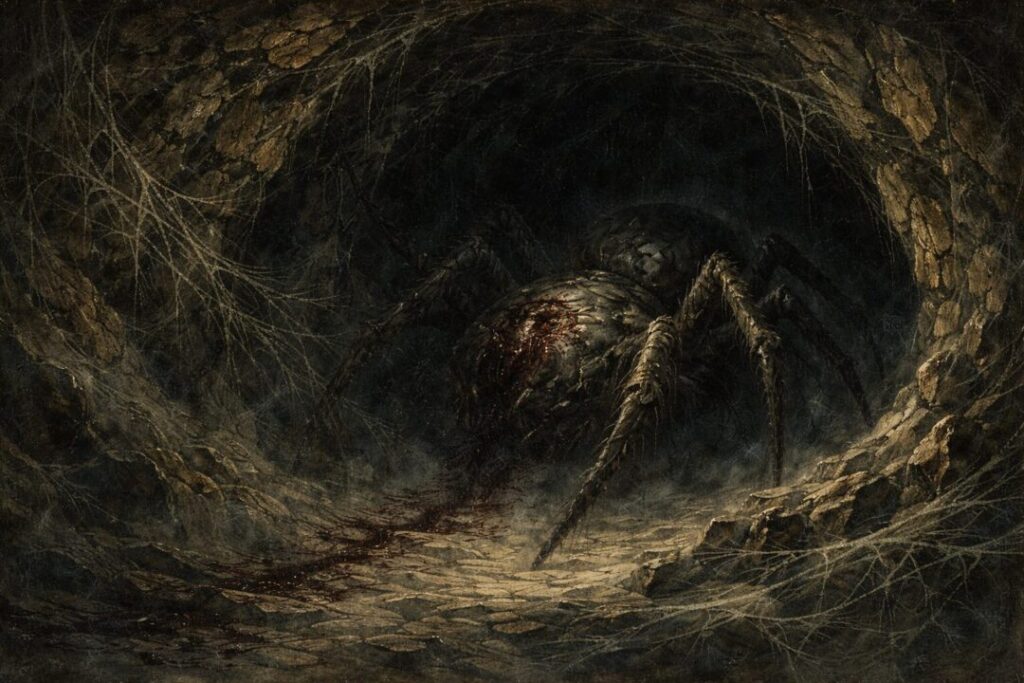
When Samwise Gamgee confronts her, he wounds her grievously with Sting and the light of Galadriel. But Tolkien is careful in his wording. Shelob does not collapse and perish. She retreats.
She flees into her tunnels—screaming, wounded, and driven back by pain she has not known for centuries.
Tolkien explicitly leaves her fate unresolved.
He describes her withdrawal into darkness to heal—or to die alone.
But nowhere does he state that she was slain.
Given her resilience, her ancient nature, and Tolkien’s deliberate ambiguity, it is entirely consistent that Shelob survived—maimed, diminished, but alive.
Which is perhaps the most unsettling outcome of all.
Why Tolkien Leaves Shelob’s Fate Uncertain
This ambiguity is not an oversight.
Shelob is not meant to receive a heroic death or a definitive end. She is not part of the moral arc of redemption or fall. She represents something older—something that does not resolve neatly when a Dark Lord is defeated.
Shelob’s story does not climax.
It simply recedes.
That is how many ancient evils end in Tolkien’s world—not destroyed, but diminished, driven back, waiting in the dark places that civilization no longer touches.
A Relic of a Dying World
Shelob represents something older than the War of the Ring.
She is a remnant of the Elder Days—a time when darkness was not centralized under a single will, but sprawled, hungry, and chaotic. Back then, evil did not always march under banners. Sometimes it simply lurked, fed, and endured.
As Middle-earth moves toward the Age of Men, creatures like Shelob fade—not because they are defeated, but because the world no longer has room for them.
They retreat into cracks.
Into tunnels.
Into forgotten places.
They stop shaping history and start haunting its margins.
Why Shelob’s Survival Still Matters
Shelob survived so long not because she conquered.
She survived because she understood something many powerful beings did not: that the world was changing, and that survival no longer belonged to those who sought domination.
It belonged to those who could wait.
In Tolkien’s world, patience can be more dangerous than strength, hunger more enduring than ambition, and silence more powerful than armies.
Shelob was never a ruler.
Never a general.
Never a Dark Lord.
She was something far older.
And that is why she lasted as long as she did.