Petty-dwarves are one of those Middle-earth details that feel like they shouldn’t matter—until you look twice.
They do not arrive with an army. They do not found a famous kingdom. They do not leave behind a line of kings whose names echo through appendices.
They appear—and vanish.
And yet, in the few passages where they are actually described, the texts quietly give you something rare: a glimpse of a people whose history is shaped less by battles than by misrecognition.
A name can hide that.
“Petty-dwarves” sounds like a tidy category, as if the world contains a normal kind of Dwarf and a smaller, lesser kind beside it. But the primary descriptions don’t present them as a separate created race at all. They are described as Dwarves who had been pushed out—masterless, few, and driven west from “the great Dwarf-cities of the east.”
That’s where the origin begins: not in a myth of making, but in an exile.
In The Silmarillion’s Túrin material, the explanation is blunt. Mîm’s people, we are told, were banished in ancient days, wandered westward into Beleriand, and—cut off from the resources and stability of their kin—became diminished “in stature and in smith-craft,” taking to lives of stealth.
This matters, because it tells you what “petty” is really doing.
It is not a biological label in the way readers sometimes assume. It is a history stamped into flesh: fewer weapons, less ore, less safety, less right to live openly in the light.
In the later “Quendi and Eldar” note preserved in The War of the Jewels, that same story is sharpened into a kind of ethnographic footnote: by their own account, they were fugitives, driven into the wilderness by their own kin further east.
So the Petty-dwarves begin as the unwanted.
Then they meet the other great power in the West: the Elves.
And this is where the most unsettling detail sits.
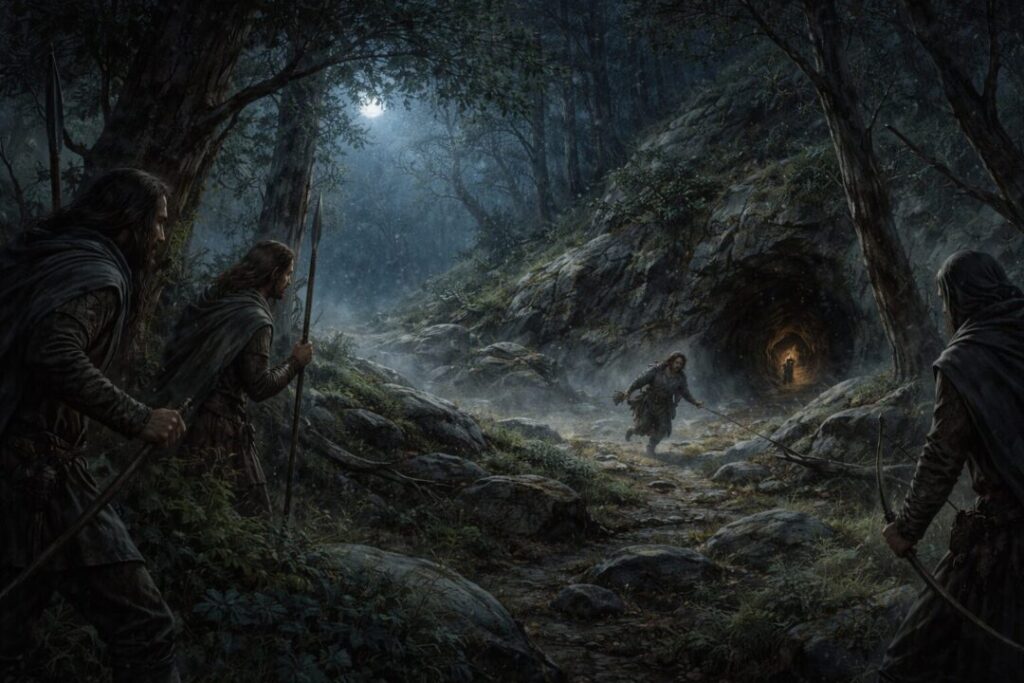
The Eldar did not at first recognise these beings as Incarnates. In that later note, we’re told the Elves became aware of them chiefly when they attacked by stealth at night; therefore the Eldar concluded they were “a kind of cunning two-legged animals” living in caves, and they hunted them, calling them Levain tad-dail—“two-legged animals.”
In other words: the first “relationship” between the Petty-dwarves and the Elves is not trade, or craft, or alliance.
It is a violence produced by darkness and fear: unseen attackers; frightened defenders; a name that turns a people into quarry.
Only after the Eldar made the acquaintance of the Naugrim—after they met the great Dwarves of Nogrod and Belegost—were the Tad-dail recognised as a variety of Dwarves and “left alone.” The note adds a crucial sting: by then there were few surviving.
This is the point where many readers start building extra scaffolding—imagining a large lost community, or a hidden civilisation, or a secret record of long wars.
But the texts don’t require that.
They give you something smaller and sadder: dwindling.
And then, suddenly, stone.
The Petty-dwarves are remembered because one of them steps into the Túrin story—because a band of desperate men stumbles over the last flicker of a nearly extinguished people.
In Unfinished Tales, the meeting comes in a way that underlines how little is left.
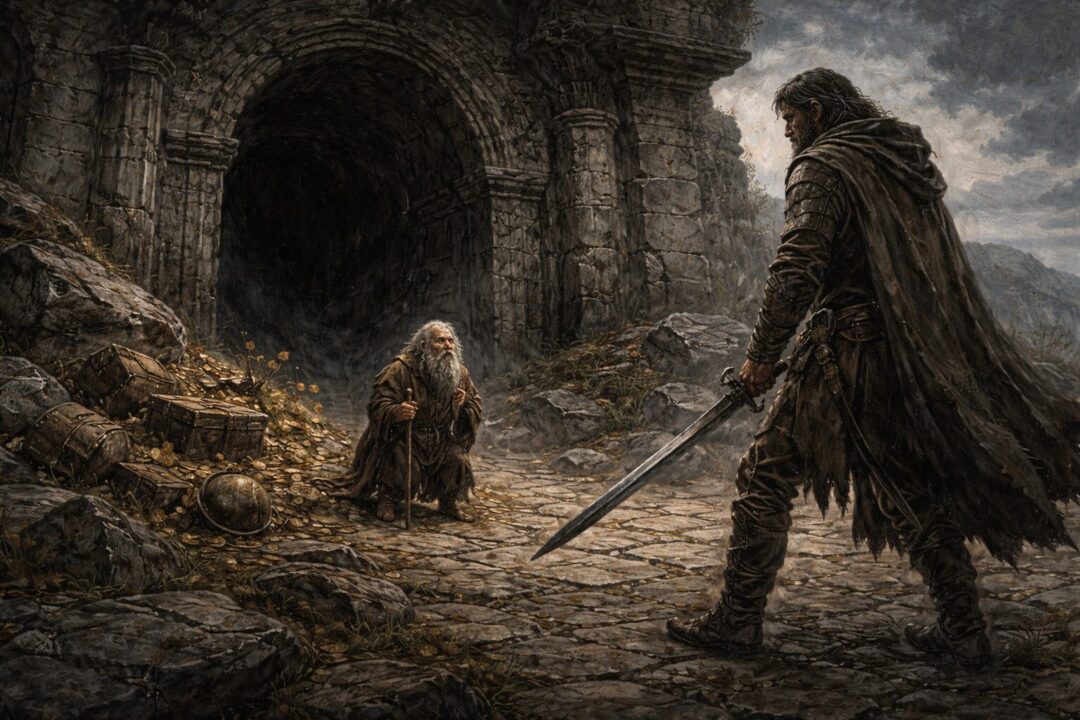
Mîm is old. He begs for his life. He says he cannot give his dwelling as ransom, and then adds a line that almost reads like an epitaph: “There is more room in it than once there was: so many have gone for ever.”
The text lets you feel, in a single sentence, how empty their world has become.
Then Mîm points westward and names the hill.
“Sharbhund we called it, before the Elves changed all the names,” he says—identifying the place the outlaws know as Amon Rûdh.
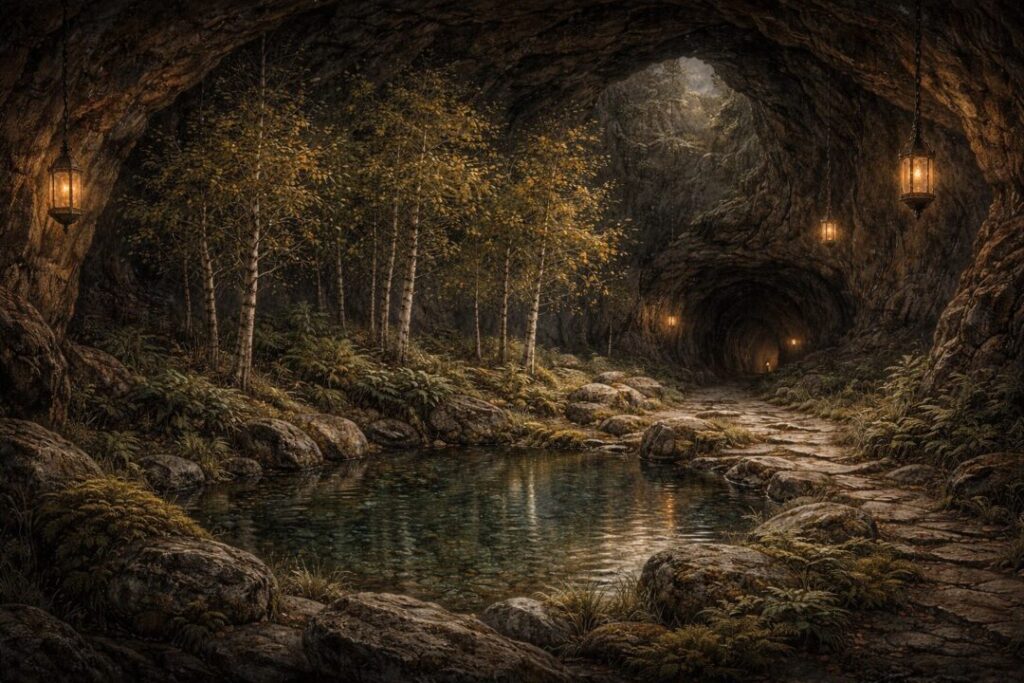
He leads them by secret paths and clefts into his house, Bar-en-Nibin-noeg, a dwelling “only ancient tales in Doriath and Nargothrond remembered.” And then the writing lingers—not on gold, but on geography: a hidden shelf, a pool, a cave-mouth that seems small until you realise what lies within.
Because the cave is not new.
It has been “deepened and bored far under the hill by the slow hands of the Petty-dwarves, in the long years that they had dwelt there.”
That phrase—slow hands, long years—is easy to miss. But it tells you the Petty-dwarves were not a passing curiosity. They were a people who had time to carve stone into shelter and make halls large enough to outlast them.
And yet, even here, the story is not allowed to become comfortable.
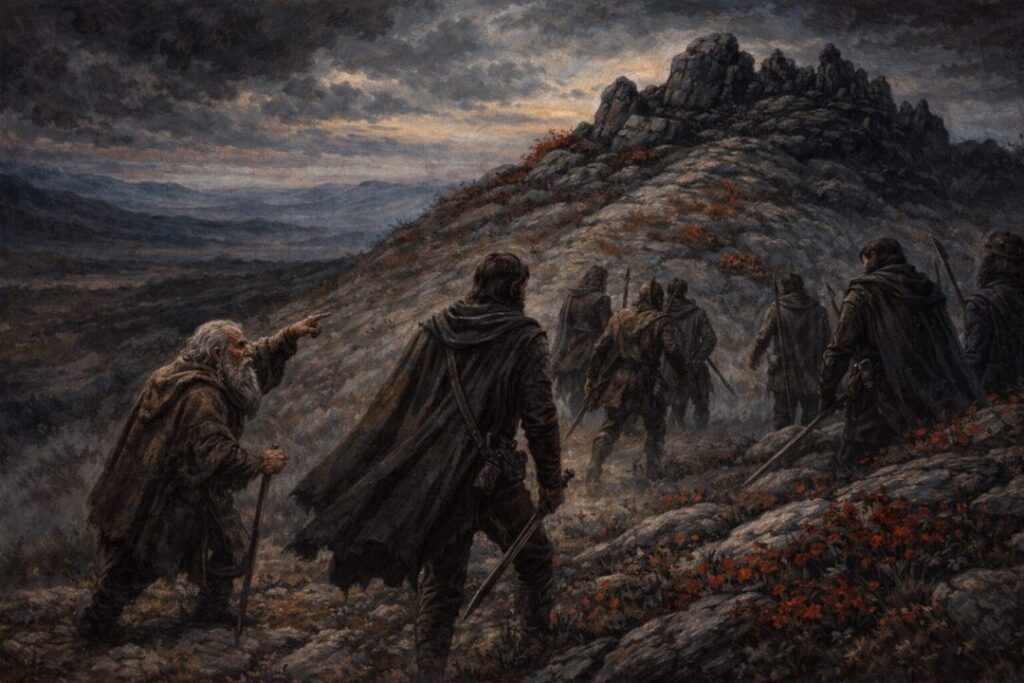
Túrin renames the refuge Bar-en-Danwedh, the House of Ransom.
A new name laid over an old one—exactly the movement Mîm complained of when the Elves changed “all the names.” It is not presented as malicious. It is simply what stronger peoples do: they arrive, they use, they rename.
If you want the most haunting proof that the Petty-dwarves understood themselves this way, you find it later—after Túrin’s story has run into ruin, after Nargothrond has fallen, after the great events of Beleriand have trampled the small.
Mîm returns to the devastated halls of Nargothrond and claims the place as his inheritance. When confronted, he says—plainly—that he is “the last of my people.”
And then Húrin kills him at the doors.
That is the ending the narratives preserve: not a battle, not a final stand, but an execution in a ruined doorway—one of the last Petty-dwarves dead in a place whose stone remembers older hands.
So what were the Petty-dwarves?
As far as the texts allow us to say with confidence, they were Dwarves—exiles and descendants of exiles—driven out from their own kind, reduced by hardship, and then further reduced by the catastrophic first misunderstandings of the western lands.
They are not “mystery Dwarves” inserted as a secret eighth House. They are a reminder that the West had margins, and that the margins had lives.
And they are a rare case where a label—“petty”—doesn’t just describe size.
It describes what history does to those who are too small, too scattered, or too early to secure their own telling.
If you only remember them as a footnote to Túrin, you miss what the texts are quietly showing.
They are not just an obscure dwarf line.
They are the cost of being misnamed first—and understood second.